An SDVOSB is a Service-Disabled Veteran-Owned Small Business that's at least 51% owned and controlled by one or more veterans rated as service-disabled by the Department of Veterans Affairs. If your company is veteran-owned, does that automatically mean you can bid on work reserved for SDVOSBs?
For many firms, the honest answer is not yet. You might look eligible in a public profile and still miss a certification, a size standard, or a control requirement that a specific solicitation demands. That's the gap this guide closes, one check at a time, so you can judge your own status before you spend money on a proposal.
What an SDVOSB Is and Why the Label Matters
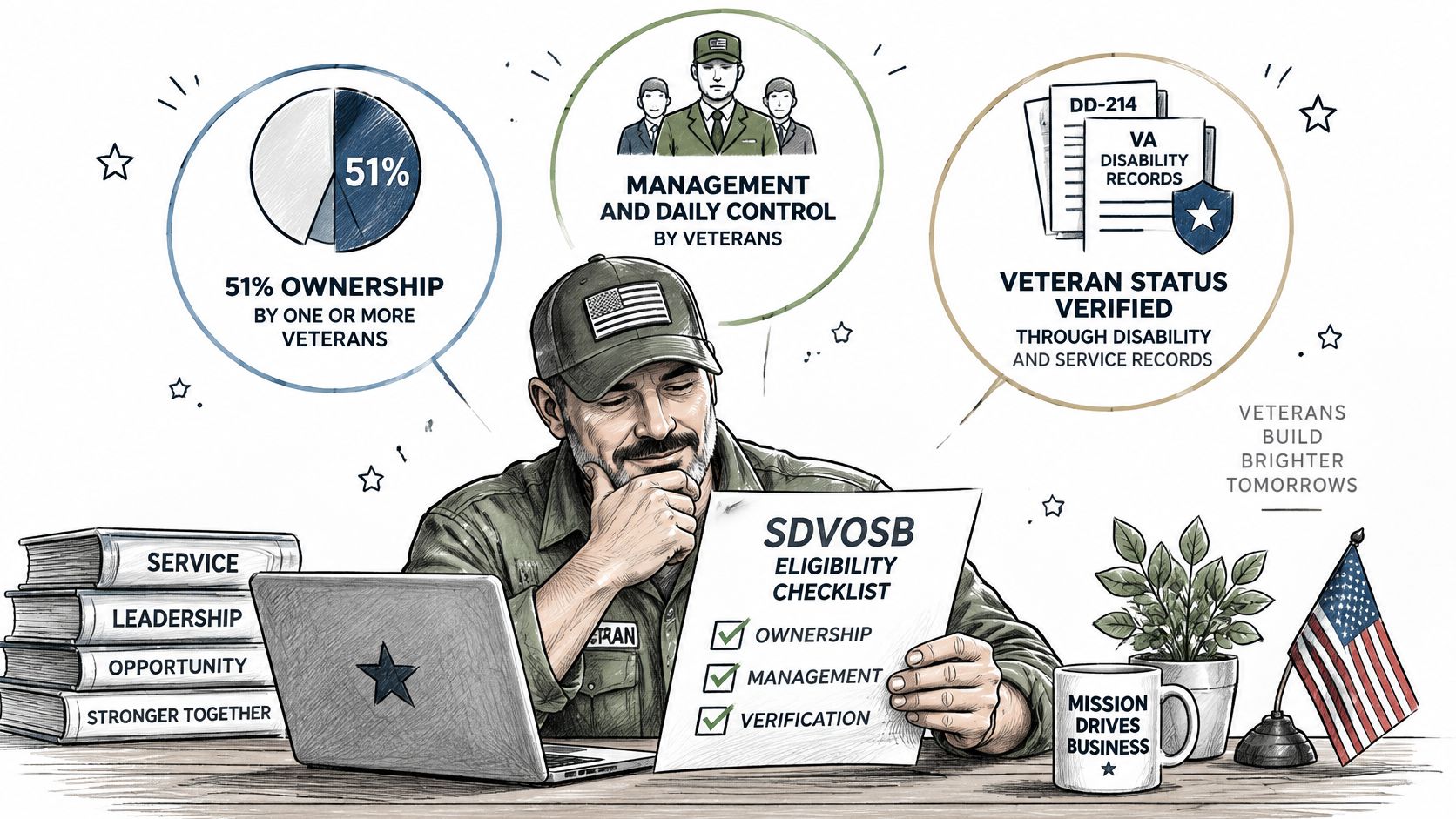
Start with the full name, because each word in it is a test. Service-Disabled Veteran-Owned Small Business means the company is small, it's owned by veterans, and those veterans carry a service-connected disability rating. Miss any one of those three parts and the label doesn't hold, no matter how strong the other two look.
The first test is ownership and control. According to the SBA guidance for contracting officials on the SDVOSB program, an SDVOSB is a small business at least 51% owned and controlled by one or more veterans whom the Department of Veterans Affairs has rated as service-disabled, and the firm's size is judged against a NAICS code in its SAM profile. The federal goal tied to that definition is at least 5% of total federal contracting dollars annually for SDVOSBs.
The second test is the disability rating itself. Serving in uniform and leaving with an injury isn't enough on its own. The VA must have formally rated the veteran as service-disabled, and that rating is what separates an SDVOSB from a plain veteran-owned small business. Two companies can both be majority veteran-owned, and only one of them clears this bar.
A Worked Example of the Three Tests
Say two Army veterans start an IT services firm and split ownership evenly. One holds a VA service-disability rating, the other doesn't. Together they own 100% of the company, but the qualifying veteran owns only 50%, so the 51% test fails. Now adjust the split so the rated veteran owns 60% and directs long-term decisions. Ownership, control, and rating line up. The firm still has one test left.
That last test is size. The company must qualify as small under the size standard attached to a North American Industry Classification System code in its System for Award Management profile. Size standards vary by industry, so a firm can be small for one kind of work and not small for another. Understanding how procurement in government contracts works helps here, because the NAICS code on each solicitation decides which standard applies to you.
Think of certification as a key cut for specific doors. It opens set-aside competitions only when the key fits the lock on that particular requirement. Agencies care about the label because they can reserve eligible work for certified firms and count those awards toward their goals. Our worked example shows the practical rule clearly.
A firm qualifies only if the ownership, the disability rating, and the size standard all hold at the same time.
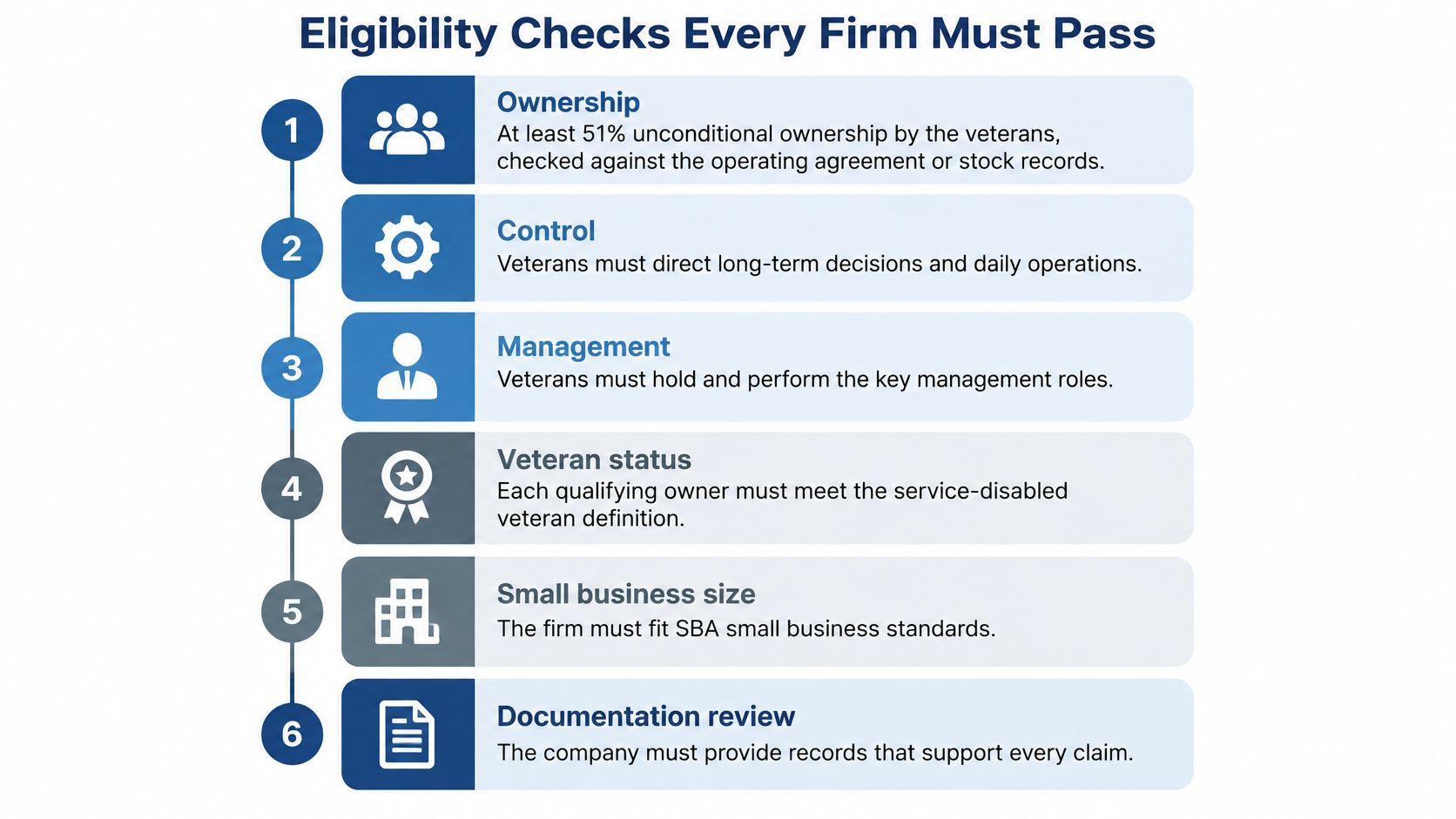
Eligibility Checks Every Firm Must Pass
Reviewers don't check your eligibility in random order, and you shouldn't either. The table below lists the six requirements in the sequence a reviewer typically works through them, with the record that proves each one. Run your own company down this list before you trust any label on a website or capability statement.
| Requirement | What It Means | How to Verify |
|---|---|---|
| Ownership | At least 51% unconditionally owned by one or more veterans | Operating agreement, stock ledger, capitalization records |
| Control | Qualifying veteran holds authority over management and long-term decisions | Governing documents, officer roles, voting records |
| Service-disability rating | Veteran rated as service-disabled by the VA | VA disability rating decision letter |
| Small size standard | Company is small under a NAICS code listed in its SAM profile | SAM NAICS list compared with the solicitation's size standard |
| SAM registration | Active System for Award Management registration | SAM.gov record status and expiry date |
| SBA certification | Active Veteran Small Business Certification (VetCert) | SBA certified database listing and expiration date |
Ownership comes first because it's the easiest to document and the hardest to fix late. The SBA page for veteran-owned businesses states that a firm must be at least 51% unconditionally owned and controlled by one or more veterans rated as service-disabled by the VA, must qualify as small under the applicable NAICS size standard, and must maintain an active SAM.gov registration. Unconditional matters. If an investor agreement or a side letter can override the veteran's share, the percentage on paper won't save you.
The Two Checks Readers Most Often Misjudge
Control is where well-meaning firms stumble. It's operational, not merely financial. The qualifying veteran must hold real authority to direct management and long-term decisions, and reviewers look for that authority in governing documents and officer roles. A veteran who owns most of the company but can't hire, sign, or set strategy without a non-veteran partner's approval doesn't control it in the SBA's eyes.
Your operating agreement is usually where that authority is written down, which is why it deserves a careful read before you apply. If you're an LLC, it helps to understand why that document functions as a custom rulebook for LLC owners, spelling out voting rights and who decides what. When your agreement, your stock ledger, and your SAM record tell three different stories, a reviewer can't confirm control, and your application stalls on paperwork rather than merit.
Size is the second trap, because it's judged per solicitation, not once for the whole company. Say your ownership is fully compliant, but your average revenue has grown past the size standard for the NAICS code printed on a new opportunity. You're not small for that buy, even though you're still small under another code in your SAM profile. Headcount-based standards work the same way.
So check these six items before you treat any opportunity as SDVOSB-eligible. Pull the VA rating decision letter, confirm the SAM expiry date, and compare your size against the code on the actual solicitation, not the code you usually bid under. Fifteen minutes of verification now beats a rejected offer later.
How SBA Certification Replaced Self-Certification
Consider the most expensive misconception first. A firm spots an SDVOSB set-aside, checks its old profile, sees itself listed as veteran-owned, and builds a full proposal. At the offer stage, the contracting officer looks for current SBA certification, doesn't find it, and the firm is out. The work was wasted not because the veteran didn't qualify, but because an old self-declaration no longer counted.
That scenario exists because the system changed on specific dates. The SBA announcement marking one year of the Veteran Small Business Certification program explains that SBA assumed veteran-business certification from the Department of Veterans Affairs on January 1, 2023, under the National Defense Authorization Act for Fiscal Year 2021, and began accepting applications on January 9, 2023. In its first year, SBA approved more than 10,400 VOSB and SDVOSB applications, and its certified database held more than 25,000 firms.
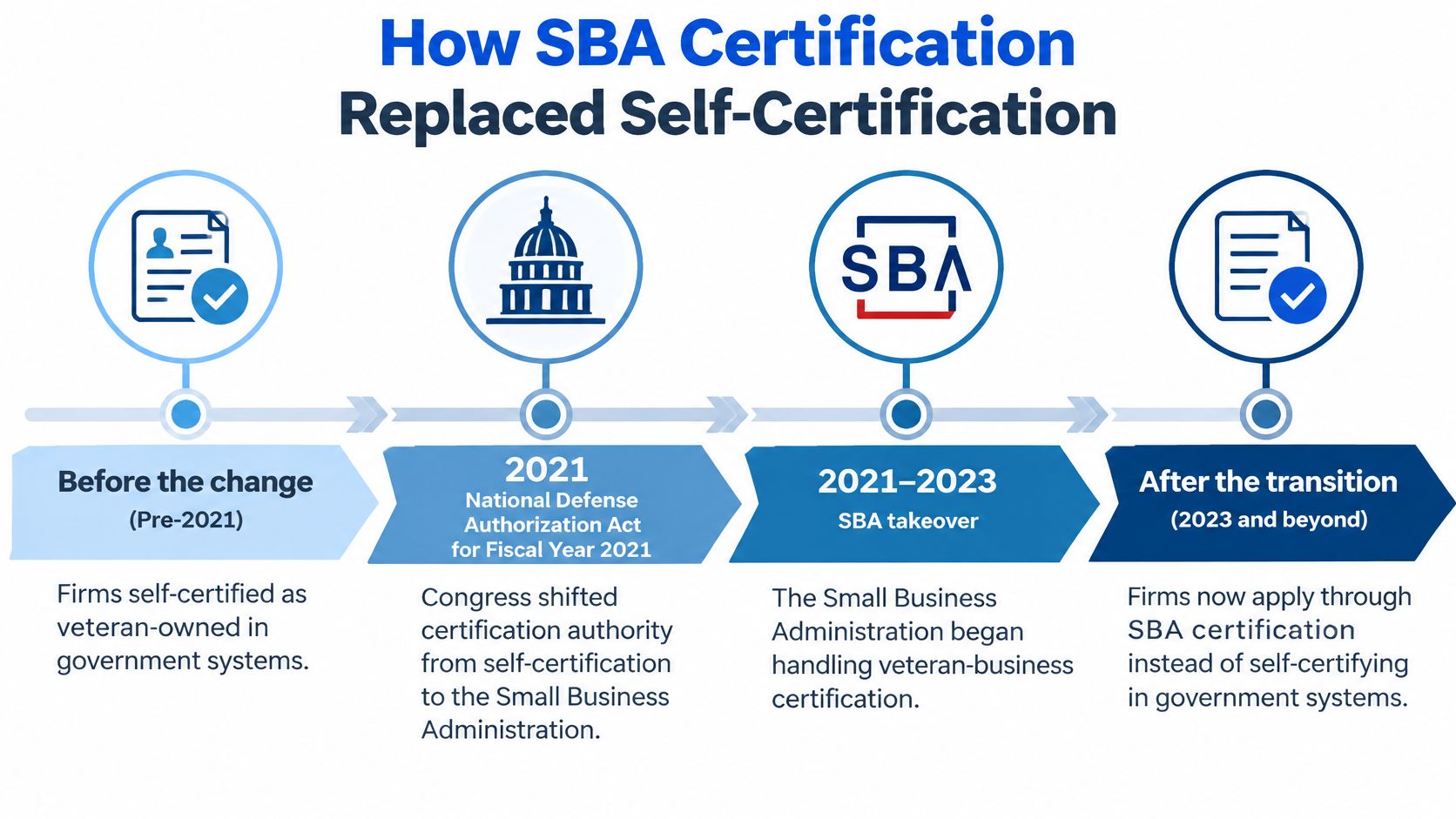
Before this change, many firms self-certified their status in government systems. Congress gave those firms a one-year grace period that ended January 1, 2024. After that date, a firm generally needs SBA certification, or at least a pending application, to compete for federal SDVOSB set-asides. In plain terms, the program moved from an honor system to a checkpoint. You now show your paperwork at the gate instead of claiming entry and walking through.
The short video below walks through how that checkpoint works in practice for applicants.
Five Misconceptions Worth Correcting
- A veteran-owned business is automatically an SDVOSB: It isn't. You also need a VA service-disability rating, a size match for the solicitation, and SBA certification for set-aside work.
- Any disabled veteran qualifies the company: Only a VA rating of service-disabled counts. A private medical opinion or a state determination doesn't substitute for it.
- SDVOSB status only matters at the VA: Certified firms compete for set-asides and sole-source awards across federal agencies, not just at the Department of Veterans Affairs.
- An old self-declared profile still counts: Since January 1, 2024, it generally doesn't. Verify current SBA certification instead of trusting legacy self-identification in a database.
- Certification removes the size test: It doesn't. The size standard still applies to each solicitation's NAICS code, so a certified firm can still be too large for a particular buy.
How to Apply for VetCert Certification
Applying through SBA's Veteran Small Business Certification program, known as VetCert, is a document exercise before it's anything else. The file has to answer every question on its own, the way a well-prepared audit folder does. The steps below follow the order that causes the fewest delays, and each step produces something concrete you can file and reuse later.
Step 1 Gather Your Documents First
Collect the VA service-disability rating decision letter for each qualifying veteran. Add your ownership records, meaning the operating agreement for an LLC or the stock ledger and bylaws for a corporation. Then pull the governing documents that show the veteran's management authority, such as officer appointments and voting provisions. Finally, confirm your SAM.gov registration is active and that the NAICS codes in it match the work you sell. This step produces a single, consistent evidence file.
Step 2 Submit the VetCert Application
File the application with SBA using the documents you just assembled. The names, addresses, ownership percentages, and NAICS codes should read identically across your application, your state filings, and your SAM record. Small mismatches, like a dropped middle initial or an old address, are the most common reason a review pauses. This step produces a pending application that a reviewer can verify line by line.
Step 3 Expect Review and Answer Quickly
SBA reviews whether ownership is unconditional, whether the veteran controls daily operations and long-term decisions, and whether your firm is small under a listed NAICS code. How long a review takes depends on the file itself, because a complete and consistent application moves through far faster than one that raises questions. If a reviewer asks for clarification, respond fast and completely, since your clock effectively waits on your answer.
Step 4 Calendar Your Renewal on Day One
Certification comes with a fixed validity period, after which it lapses unless you renew. Put the expiry date on a shared calendar the week you're approved, with a reminder scheduled well ahead of it rather than during the final month. A pending application can satisfy the post-January 2024 rule in some situations, yet an active listing is what a solicitation checks for when it requires certification at the time of offer.
Assign every document an owner: One person maintains the VA rating letter, one owns the operating agreement and stock records, one watches SAM, and one tracks the VetCert expiry date.
That small checklist prevents the usual failure mode, where everyone assumes someone else is watching the dates. Eligibility is a condition you maintain continuously, and the firms that treat it that way rarely get surprised at offer time.
How Set-Aside and Sole-Source Buying Works
Certification matters because it changes who can bid, not just who carries a label. The table below compares the five buying routes you'll meet, and the paragraphs after it explain each route in the same order.
| Buying Route | How It Works | Who Can Compete |
|---|---|---|
| Full SDVOSB set-aside | Agency reserves the acquisition for SDVOSBs | Certified SDVOSBs only |
| SDVOSB sole-source award | Agency may award without full competition when statutory conditions are met | One certified SDVOSB chosen by the agency |
| Small business set-aside | Acquisition reserved for small businesses | All small businesses, including certified SDVOSBs |
| Unrestricted competition | No set-aside applied | Any responsible offeror |
| Subcontracting goal | Prime contractor plans to subcontract work to SDVOSBs | Certified SDVOSBs as subcontractors |
A full SDVOSB set-aside is the most direct benefit of certification. The agency reserves the acquisition for certified SDVOSBs, so your competition shrinks to firms that cleared the same checks you did. You're still competing, and usually on price, capability, and past performance. Certification gets you into the room. It doesn't win the argument once you're there.
An SDVOSB sole-source award works differently. When statutory conditions are met, an agency may award directly to one certified firm without running a full competition. In practice, agencies tend to choose firms they already know can perform, which is why relationships with small business specialists matter long before a requirement appears. Don't build your pipeline assuming sole-source awards will arrive uninvited.
Routes Where You Compete More Broadly
A small business set-aside reserves work for small businesses generally, and certified SDVOSBs can enter those competitions too. The field is wider, so your veteran status doesn't narrow the pool, but the opportunity count is larger. Reading up on small business set-aside rules and thresholds helps you tell these notices apart from SDVOSB-specific ones at a glance.
Unrestricted competition applies no set-aside at all. Any responsible offeror, large or small, can bid. Certified firms still win unrestricted work, but they do it on capability and price alone, with no eligibility advantage. Many growing SDVOSBs deliberately mix set-aside and unrestricted pursuits so one slow category doesn't stall the whole pipeline.
The subcontracting route is quieter but real. Large prime contractors write subcontracting plans that include goals for SDVOSB participation, and they report against those goals. That creates steady demand for certified subcontractors who can perform a defined slice of work reliably.
Agency goals show how much this demand varies. The VA VetBiz resources page states that for fiscal year 2024, the Department of Veterans Affairs set an SDVOSB prime-contracting goal of 15% and a subcontracting goal of 5%. One agency can aim well above the government-wide target, so always read the set-aside language in the solicitation itself. That language, not your assumption, decides which route you're in.
Confirm Status and Decide Whether to Bid
You can complete a solid status check this week, without outside help. Work through these five steps in order, because each one depends on the answer before it.
- Check your SBA VetCert listing: Look up your company in SBA's certified database, confirm the SDVOSB designation appears, and write down the expiration date where your whole team can see it.
- Confirm your SAM registration: Verify the registration is active, note its expiry date, and read the NAICS codes in your profile to be sure they still match the services or products you sell today.
- Read the solicitation closely: Find the set-aside language and the NAICS code, then compare that code's size standard against your current headcount or average revenue before anyone starts writing.
- Study the buying history: Identify which office buys this requirement, who the incumbent is, and how the work was competed last time, so you're judging a real market instead of a hopeful one.
- Set alerts and deadlines: Create saved searches for new notices in your codes, and put your SAM and VetCert renewal dates on the same calendar as your proposal deadlines.
Those steps tell you whether you're eligible. They don't yet tell you whether you should bid. Four considerations separate a qualified firm from a smart pursuit, and it's worth weighing each one carefully.
Four Considerations Before You Commit
Timing: Certification must hold at the time of offer and, where relevant, through award. If your VetCert period or SAM registration expires mid-pursuit, renew early rather than hoping nobody checks. Contracting officers verify status as part of their own process, so assume they will check, and assume they'll check at the worst possible moment for you.
Documentation: Keep ownership records current and consistent with SAM at all times, not just during application season. If you bring on an investor, change officers, or amend your operating agreement, review whether control still sits with the qualifying veteran. A change that's routine for your business can undermine the unconditional ownership your certification rests on.
Size fit: Test each target NAICS code, not only your primary one. A firm often qualifies easily under its main code and fails under a secondary code attached to an attractive opportunity. Run the numbers for the specific code on every solicitation you're serious about, and keep a short internal list of codes where you're comfortably small versus codes where you're near the line.
Demand: Certification expands eligibility, but it does not create demand. Picture a qualified firm that finds a set-aside in its exact specialty, then learns the incumbent has performed the work for years and the agency forecast shows no new requirement behind it. Declining that bid isn't a failure. It's the certification doing its real job, letting you choose pursuits instead of chasing every notice out of scarcity.
Pursue only when your company is eligible, current, and has a credible path to win. Two out of three isn't enough.
Our tooling at FederalPipeline fits the workflow you've just built, and it's the one place we'll describe it. FederalPipeline reads every solicitation and provides capture briefs covering what's being bought, the set-aside and certifications required, the incumbent, the ceiling, and every deadline. Its Opportunities search spans SAM.gov solicitations, agency forecasts, grants, and innovation programs, scored against your registration, past awards, and website. Match scores, eligibility checks, and email alerts then flag new SDVOSB opportunities as they appear, which supports the same discipline as systematically finding a federal business opportunity instead of searching by hand each morning.
So, what is SDVOSB status worth to your company? It's a verified key, checked against ownership, control, a VA rating, size, SAM, and SBA certification, that opens specific doors when a solicitation's lock matches. Verify each condition before you bid, keep the records current after you win, and you'll never lose an opportunity to a technicality you could've caught in fifteen minutes.
If you're ready to put these checks into practice, visit FederalPipeline to search SDVOSB set-asides and sole-source opportunities matched to your company's registration, NAICS codes, and past awards. You'll get capture briefs that surface set-aside language, certification requirements, incumbents, and deadlines before you commit proposal resources, plus email alerts when new matching opportunities post. Set up your free account today and start building a pursuit list based on verified eligibility, not guesswork.