A capture manager opens a newly posted notice and the first reaction is relief. The work looks close to what the company already does, the deadline is still weeks away, and the set-aside label looks favorable. Then the harder question shows up. Who owns the program, who holds the current contract, and will this buy stay with the agency or move onto a government-wide vehicle?
That is the moment a federal biz opportunity stops being a listing and becomes a judgment call. The notice is only the visible surface. Budgets, forecasts, prior awards, vehicles, and parts-request records show whether the requirement is strategic, whether the company can qualify, and whether one win leads anywhere.
Why Federal Opportunity Research Extends Beyond Solicitations
The notice lands on a Monday. It names a familiar NAICS code, a civilian agency the team has chased before, and a response window that looks manageable. Nobody on the capture call can say who the program office is, what the last award looked like, or whether the requirement has options left. Finding the posting took minutes. Deciding whether it deserves a proposal team takes the rest of the week.
Treat that posting as one record inside a larger requirement, not as the requirement itself. A useful federal biz opportunity can be traced through planned funding, an agency forecast, the contracting office that will run the buy, the vehicle that may carry it, and the suppliers who have already delivered similar work. Early research answers three practical questions before anyone builds a compliance matrix: is this strategic, can we qualify, and is there a path past a single transaction?
Practical rule: If you can't name the buyer, the incumbent path, and the likely contract vehicle, you don't have a pursuit yet. You have a document.
The federal market behaves like a connected system, not a stack of isolated listings. A budget line can surface demand before SAM.gov does. An award history can show whether that demand recurs. A vehicle listing can show you can't touch the work as a prime even when the forecast looks open. Parts-request files can show a narrow quotation that never becomes a commercial contract.
What early research changes
Teams that stop at the solicitation usually bid what they can see. Teams that keep going usually drop work they can't support.
- Strategic fit: Match the requirement to capabilities you can prove, not to keywords you happen to rank for.
- Qualification risk: Set-asides, clearances, approved sources, and vehicle access can kill a bid that looks perfect on the cover page.
- Follow-on path: A one-time buy with no option years and no related program is a transaction. A recompete tied to a funded line can become an account.
The rest of this process moves in that order: map the records, pick sources for the question you're asking, connect budgets and awards, qualify before you spend proposal hours, then keep only the pursuits that still look real after the next update.
Understand the Federal Opportunity Record Types
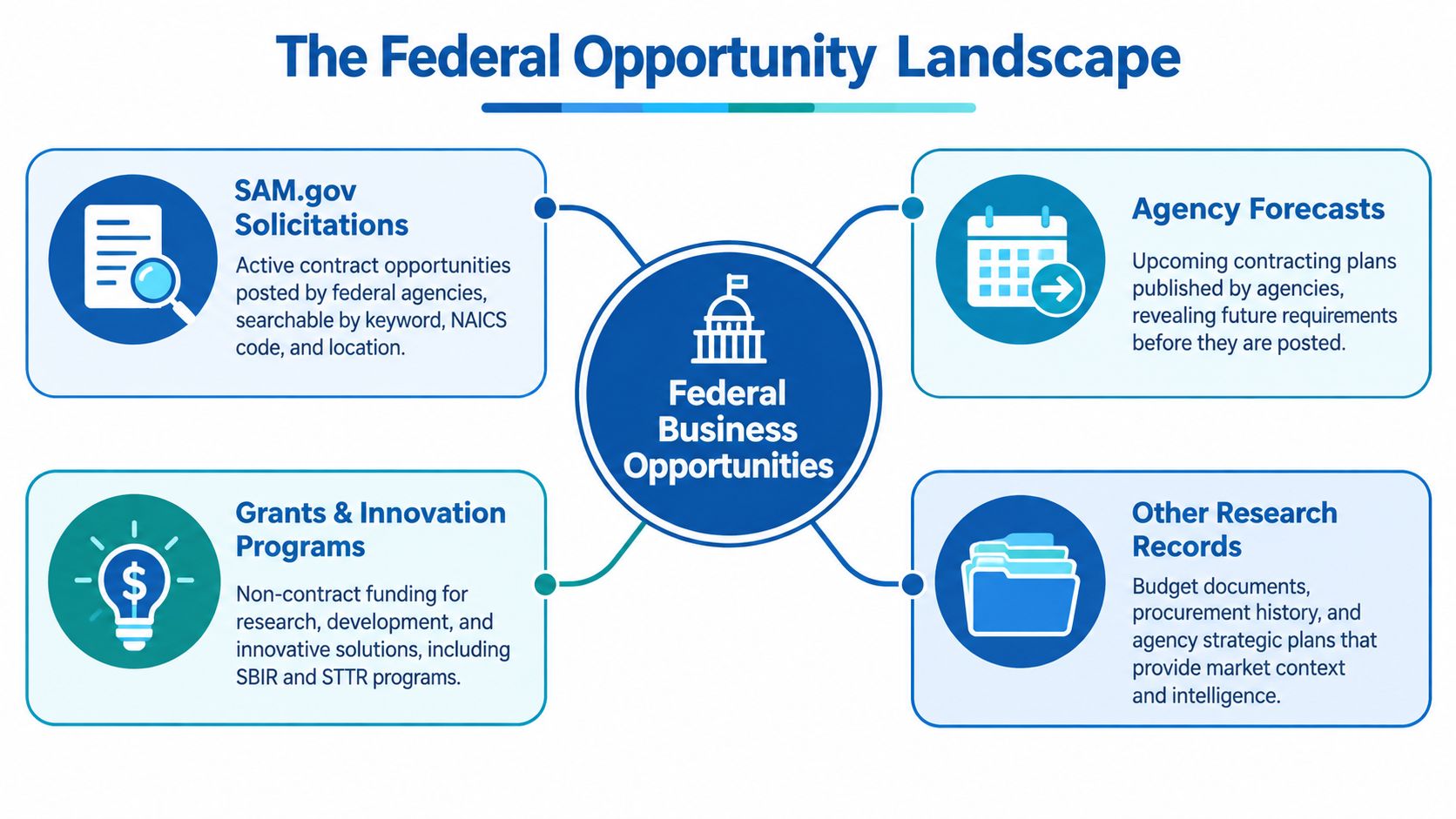
Federal demand is split across record types that answer different questions, and mixing them up is how teams chase the wrong document.
The market has several layers: what is being bought now, what agencies expect to buy, what they have already bought, and how they are allowed to buy it. In fiscal year 2024, federal agencies committed about $755 billion to contracts, roughly $22.5 billion less than fiscal year 2023 after inflation, across defense systems, information technology, professional services, construction, transportation, medical supplies, and logistics, according to the Government Accountability Office's FY2024 contracting snapshot. The same analysis found more than $495 billion spent on commonly purchased products and services, led by facilities and construction at $132.2 billion, professional services at $125.4 billion, information technology at $82.1 billion, medical products and services at $78.3 billion, and transportation and logistics at $39.1 billion.
Records and what each one signals
SAM.gov solicitations are active buying events. They carry deadlines, set-asides, and attachments. They rarely explain the program pressure behind the buy.
Agency forecasts point at anticipated demand. Dates slip, and a forecast line can later move to another office or a government-wide vehicle. Treat the forecast as a planning signal, then verify whether the requirement survives contact with budget and acquisition staff.
Grants and innovation programs, including SBIR, STTR, and some other transaction agreements, fund research or prototypes. A prototype win can prove technical credibility while still leaving the production buy unpriced, unfunded, or routed through a contract you cannot access.
Award data shows historical purchasing: who bought, who won, contract type, and sometimes the vehicle. Budget materials show planned funding and program ownership before a notice exists. Contract vehicles such as IDIQs, BPAs, and GWACs show the route to market. DLA DIBBS and Navy NECO requests are quotations for parts and supplies, often with quantities and approved-source limits that a general solicitation never mentions.
A notice only makes sense next to the program office, the contracting office, prior awards, the set-aside or certification, and the deadline. Eligibility on paper still fails if the vehicle is closed or the approved-source list does not include you.
Match the record to the decision. A live solicitation answers timing. Budgets and forecasts answer whether demand may recur. Awards and vehicles answer whether you can reach the work at all.
Choose the Right Federal Opportunity Sources
No single feed is the right feed for every stage of capture. Sources get useful when you read them against each other, and they waste time when you treat one feed as the whole market.
SAM.gov is essential once a solicitation or forecast is public. Use it for the official notice, amendments, and the response clock. It is a weak place to learn five-year buying habits, because the notice rarely carries the award history you need for a bid decision.
Award and spending records, including FPDS and USAspending, answer who bought similar work and which suppliers keep winning it. They lag the requirement. A recent award can still be in its base period while a forecast already talks about the follow-on.
Budget justification books and Congress.gov show planned funding, program names, and legislative context earlier than either of those. They don't tell you the contract type, the set-aside, or whether a parts buy will be competed at all.
Vehicle lists and parts-request files expose routes that a forecast hides. An IDIQ you don't hold can matter more than an open-looking agency plan. A DIBBS or NECO request can be a real quotation with a quantity and an approved-source constraint, not a door into a broader commercial contract.
| Source or record | Best research question | Timing value | Key limitation |
|---|---|---|---|
| SAM.gov notice or forecast | Is something published, and when is it due? | Active or near-term | Thin on incumbents and vehicles |
| FPDS and USAspending | Who has bought this, and who won? | Historical | Lags the live requirement |
| Budget books and legislation | Is the program funded, and who owns it? | Earliest signal | Not a solicitation |
| IDIQ, BPA, or GWAC records | Can we reach this buy at all? | Current access | Access beats the set-aside label |
| DLA DIBBS and Navy NECO | Is this a parts RFQ we can quote? | Immediate quotes | Approved sources and quantities rule |
An industry-day notice such as the Navy industry day N6523627R0001 is a good test. The event itself isn't a bid. It tells you which office is shaping the requirement and whether you should be in the room before the solicitation exists. Pair that kind of notice with awards and the budget line, or you will treat a meeting as if it were a contract.
A source is only as good as the question you bring to it. Ranking tools against each other misses the point.
Connect Budgets, Awards, and Agency Buying Patterns
A solicitation is the part of the river you can see from the bank. Budgets and prior awards are upstream, and they tell you whether the water is a seasonal trickle or a channel the agency refills every year.
Start with the budget record when you want demand before the notice. Defense justification books tie a line item to a program, sometimes to a program executive office, and often to the systems that office already fields. That link is how you separate a one-off service call from a funded program that will need contractors again. Contracting-office history then tells you who runs the procurement, which is not always the office named in a forecast.
Read the buying pattern, not the headline
Award history is where agencies, categories, and suppliers become concrete. Sort similar awards by NAICS, then look at contract type, ceiling, and whether the work sat on a vehicle. A high ceiling with options still unexercised is a different pursuit from a small award that already ended. Set-aside structure matters here as a research signal, not as proof you are eligible. A pattern of 8(a) or SDVOSB awards in one office doesn't mean the next buy will carry the same designation.
Incumbent names and corporate families show who already has past performance with that buyer. If the same supplier has held the work across two cycles, your capture plan needs a displacement story or a teaming path. If awards bounce between several firms, the office may be more open, and also more crowded.
The sources sought notice FA8051 for cathodic protection shows the sequence in miniature. The notice tells you an office is testing industry interest. Budget and program context tell you whether corrosion control sits on a sustained installation account. Prior awards tell you which firms already do that work for the same buyer. None of those records, alone, is a bid decision.
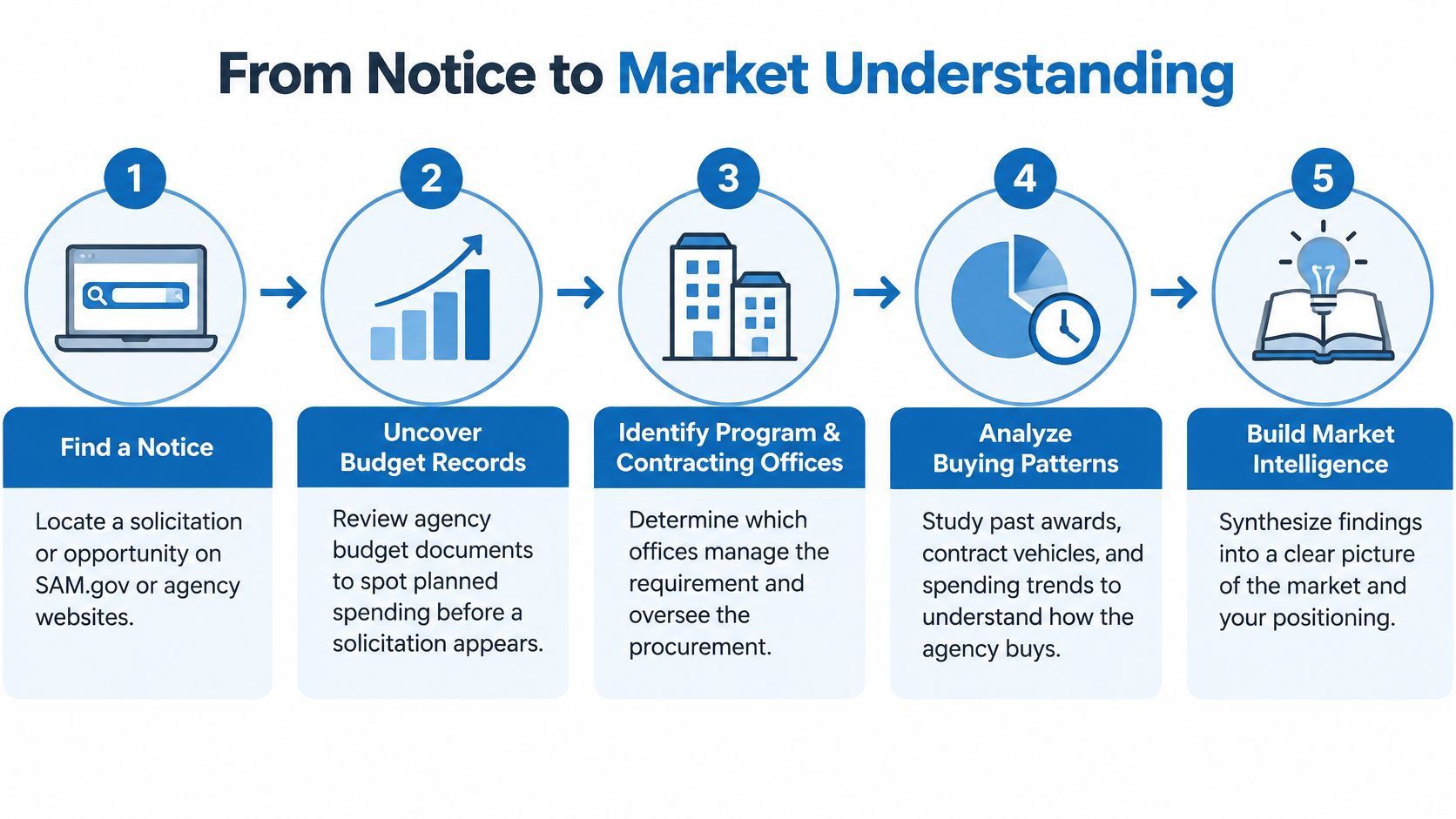
Use five checks, in order, and stop when one of them fails:
- Find the notice and record the office, NAICS, set-aside, and due date.
- Uncover the budget line so you know whether funding is a request, an enacted program, or a guess.
- Name the program office and the contracting office, because they don't always sit in the same place.
- Analyze awards, vehicles, and ceilings for incumbents and for how the agency prefers to buy.
- Write the market picture in a few sentences: durable account, or isolated task.
What you want at the end is a yes or no on a larger market. An isolated requirement with no related line, no vehicle, and no repeat buyer is usually not worth a full pursuit, even when the notice reads cleanly.
Qualify Federal Biz Opportunities Before Pursuit
A promising notice isn't a pursuit. A qualified federal biz opportunity is one you can win and then perform, with a structure your team can staff.
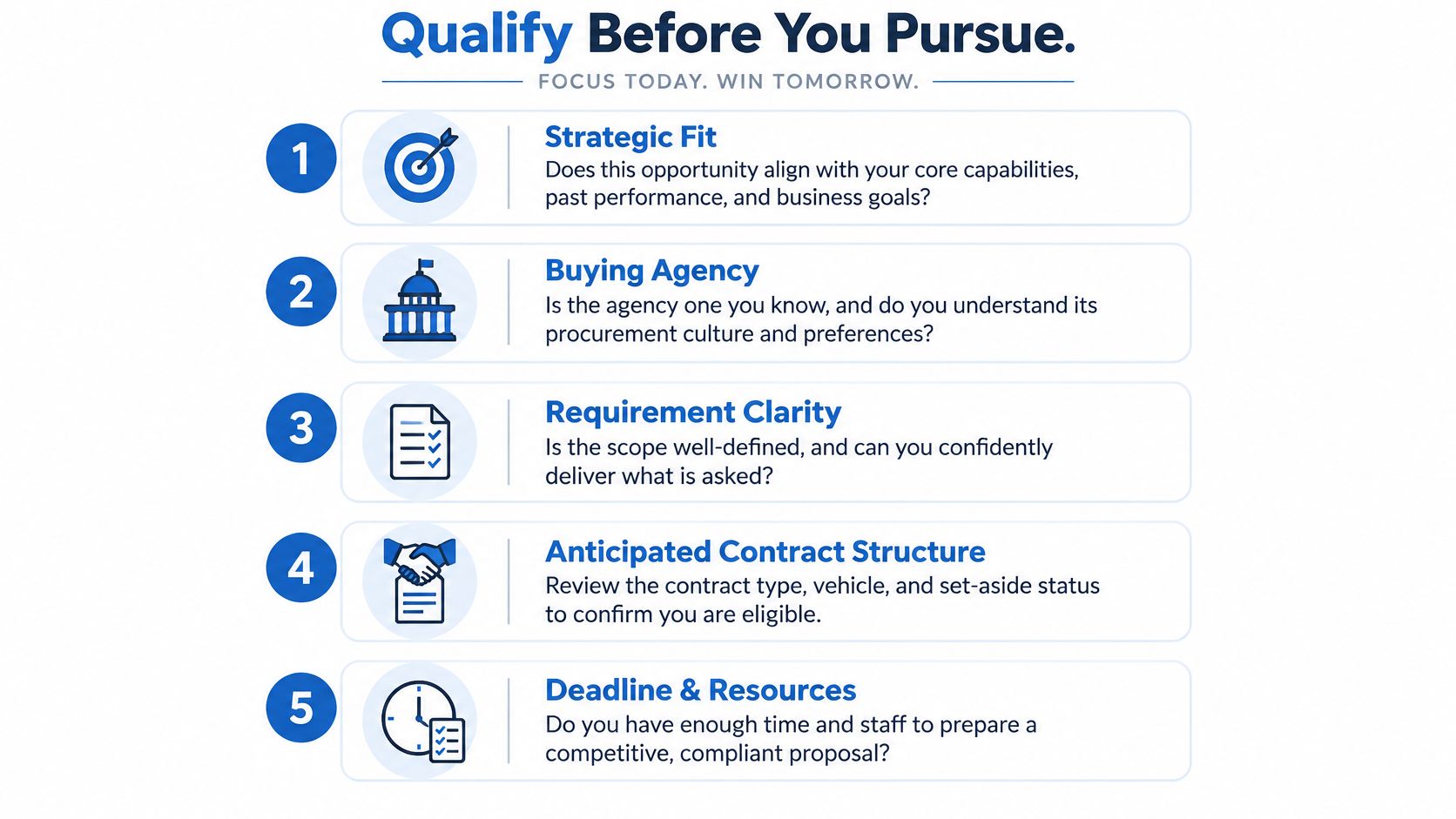
Start with strategic fit before you open the attachments. If the work sits outside core capabilities or past performance, the rest of the review is a distraction. Then name the buying agency and whether anyone on the team has worked with that office. Unfamiliar buyers aren't automatic no-bids, but they raise the cost of every assumption you make about how proposals get read.
Walk the notice before you walk the market
Read the solicitation brief for contract type, vehicle, set-aside or certification, security requirements, and the deadline. Then go into the attachments for bid blockers: mandatory capabilities, place of performance, approved sources, teaming limits, and a ceiling that doesn't support the staff you would need. A short deadline plus a thick attachment set is a resource decision, not a character test. If you can't staff a compliant draft, the opportunity isn't qualified.
The GSA opportunity 19AQMM26F1521 is the kind of record that rewards this pass. Confirm the buying office, the set-aside, and whether the work sits on a vehicle you can access before anyone drafts a technical volume.
After the paper review, run a market check that the notice won't do for you:
- Prior awards: Do incumbents have a performance story you can't match in this cycle?
- Vehicle access: If the buy is likely to ride an IDIQ, BPA, or GWAC, are you on it, or only able to subcontract?
- Teaming: Is there a prime who needs your capability, or are you hoping a team appears after the Q&A closes?
- Follow-on: Do option periods, a funded program, or a recompete window give this win a second chapter?
A company can be eligible and still be a poor bidder. Eligibility means you may submit. Qualification means you can submit a credible offer and support the work if you win.
That walkthrough is a useful companion to the checklist, especially for teams that still treat the cover page as the decision.
Before proposal hours get committed, the capture lead should be able to check every line:
- Fit: Capabilities and past performance match the scope.
- Buyer: The agency and office are known, or the learning cost is accepted.
- Paper: Scope, ceiling, set-aside, and clearances are confirmed in the attachments.
- Competition: Incumbent, vehicle, and teaming path are named.
- Time: Staff can produce a compliant proposal before the deadline.
If one line fails, the honest outcome is a no-bid or a subcontract role, not a thinner proposal.
Apply the Research Process to Different Business Goals
The same records produce different decisions once you change who is asking. A single checklist copied across every pursuit type is how primes, analysts, and parts suppliers all waste the same afternoon.
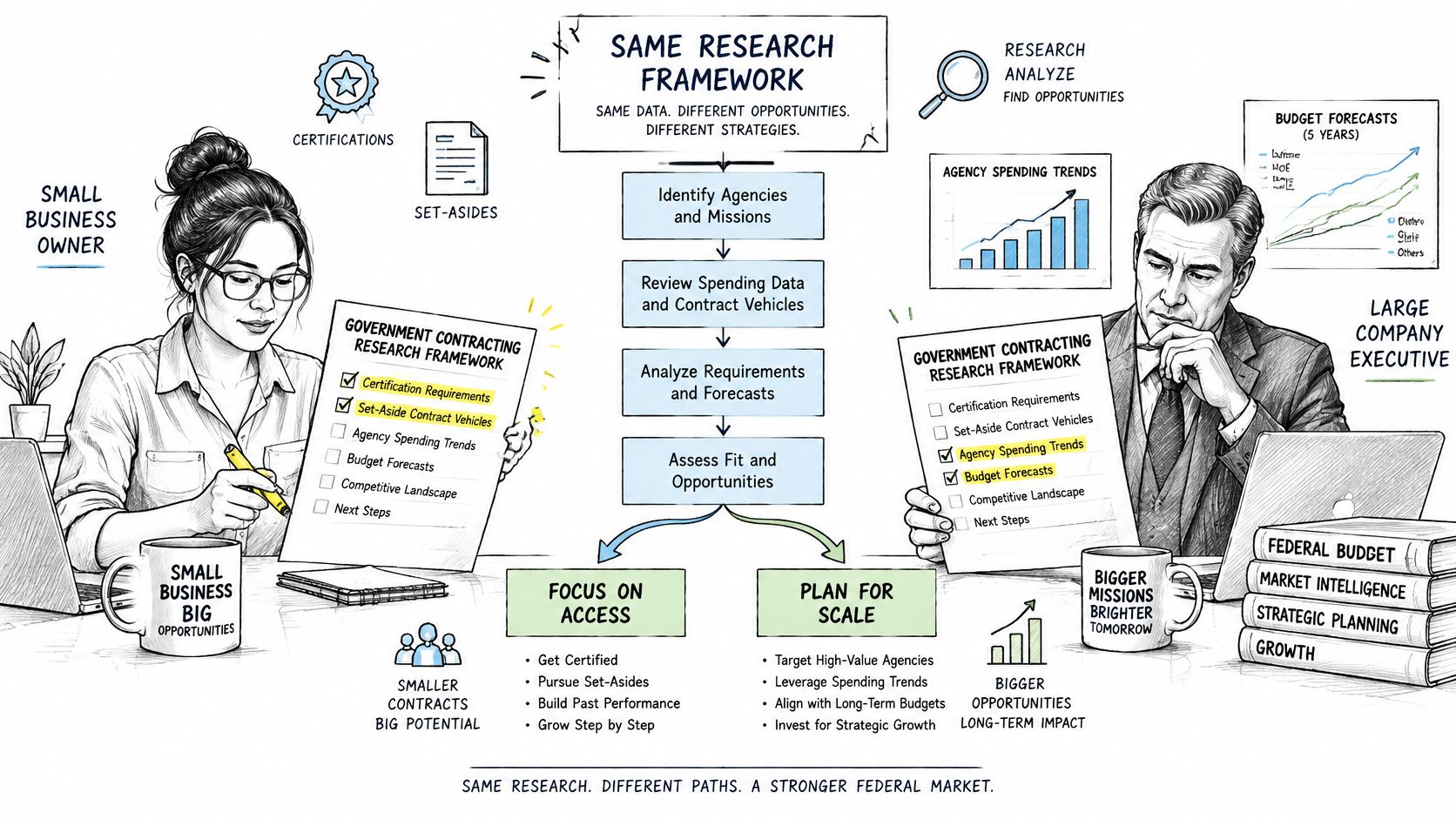
Small-business prime
You aren't asking whether small businesses win federal work in general. You're asking whether this set-aside, this agency, and this vehicle fit your certification. In FY2024, small businesses received about $183.27 billion in prime awards, 28.78% of eligible dollars, above the 23% goal and ahead of $178.62 billion (28.35%) in FY2023, $162.88 billion (26.50%) in FY2022, and $154.24 billion (27.23%) in FY2021, the SBA's FY2024 contracting update reported. Small disadvantaged businesses received $78.10 billion, or 12.26%, compared with $76.24 billion and 12.10% the year before. The SBA also certified more than 17,000 small businesses that year, nearly 40% more than in FY2023.
Those totals don't qualify your bid. Compare the certification on the notice with the one you hold, confirm you can reach the vehicle, and decide whether a subcontract is the entry if the prime path is closed.
Competitive intelligence analyst
Your job is structure, not a go or no-go. Group award recipients by corporate family, map which agencies they sell to, and separate set-aside awards from full-and-open work in the same NAICS. Concentration matters: one office buying from two incumbents is a different market from ten offices sharing a GWAC. Spending growth without a vehicle story usually means you still don't know the route.
Parts supplier
DIBBS and NECO files aren't mini versions of a professional-services RFP. Read quantity, delivery, buying history, and the approved-source list first. A request for quotation with a closed source list isn't a commercial expansion opportunity, no matter how often the national stock number appears. If history shows repeat buys and you are an approved source, quote. If you aren't on the list, the research question shifts to approval, not price.
Avoid Common Federal Contract Research Mistakes
The shortcuts that feel efficient are the ones that mis-rank pursuits. A set-aside win, a big agency spending total, and a full alert inbox can all describe activity without describing a position you can grow.
Set-aside awards don't build a durable supplier by themselves. GAO's review of fiscal years 2008 through 2017 found that only 104 of 5,339 small businesses receiving set-aside contracts in fiscal year 2008 had become mid-sized by fiscal year 2013. Only 23 were still mid-sized in 2017, with 75 contracts, and three had become large and won six contracts. About 2.5% of that original group both grew to mid-size and kept winning federal work, as reported in GAO's analysis of small-business set-asides. An isolated set-aside with no follow-on, no vehicle, and no second buyer is a transaction. Track the share of pursuits with a real recompete path, and the share of target accounts where you have neither incumbency nor vehicle access.
National small-business percentages don't mean your certification is improving. For FY2025, the SBA scorecard shows small businesses received nearly 28% of prime-contract dollars, about $179 billion, still above the 23% goal. In that same year, 8(a) firms received 3.7%, down $1.5 billion from the prior year, and small disadvantaged businesses received 11.6%, down from 12.27% in FY2024. If your direct-prime lane is shrinking, teaming and budget-stage positioning beat waiting on the next set-aside notice.
A wide forecast can also be the weaker lead. GAO's review of common contracting notes that 2025 OMB guidance pushed more purchases onto GSA-managed contracts, while warning that centralization has to balance savings with small-business goals, weak data, and unclear requirements. A forecasted set-aside you can't reach may be less actionable than a broader requirement on an IDIQ, BPA, or GWAC you already hold, or a subcontract under a prime who does. Check option periods, customer concentration, program ownership, and approved-source limits before you let an alert set your priority list.
Build a Repeatable Federal Opportunity Tracking System
A Monday inbox with 40 alerts is a queue. The system that holds up is information architecture: which records you monitor, which ones you review, which ones you share, and which ones you reopen when an amendment, option exercise, or budget line changes the odds.
Set the record types as a connected file: notice, forecast, budget line, prior award, program office, vehicle access, and for parts work, DLA or Navy demand signals. A capture brief should carry requirement, clearance, set-aside, ceiling, incumbent, buyer, and deadline so qualification starts from evidence. The pipeline entry needs four fields or it is admin debris: stage, next action, the research that supports the stage, and the bid or no-bid call.
FederalPipeline is one way to keep that architecture in one place, pulling SAM.gov notices, FPDS and USAspending award history, Department of Defense budget justification books, Congress.gov status, and DLA DIBBS or Navy NECO parts demand into saved searches, alerts, and pursuit records. Public sites still work if each source has an owner and a review rhythm. What fails is hoping everyone remembers which spreadsheet is current.
Operating checklist
- Monitor a short list of buyers, NAICS codes, vehicles, and stock numbers.
- Review alerts against fit, access, and follow-on before they enter the pipeline.
- Share the brief, so proposal staff see blockers before raw notice text.
- Revisit incumbents, amendments, and recompete timing on a fixed cadence for prime pursuits and parts quotes.
Drop anything that fails qualification twice. A healthy pipeline gets shorter as the research gets better.
If your week starts with five tabs and a stale spreadsheet, run one buyer, one NAICS code, and one vehicle through this rhythm for a month. Keep only pursuits whose next action is tied to a record you can reopen, and the federal biz opportunity you chase will show owner, access path, and follow-on before proposal hours get spent.