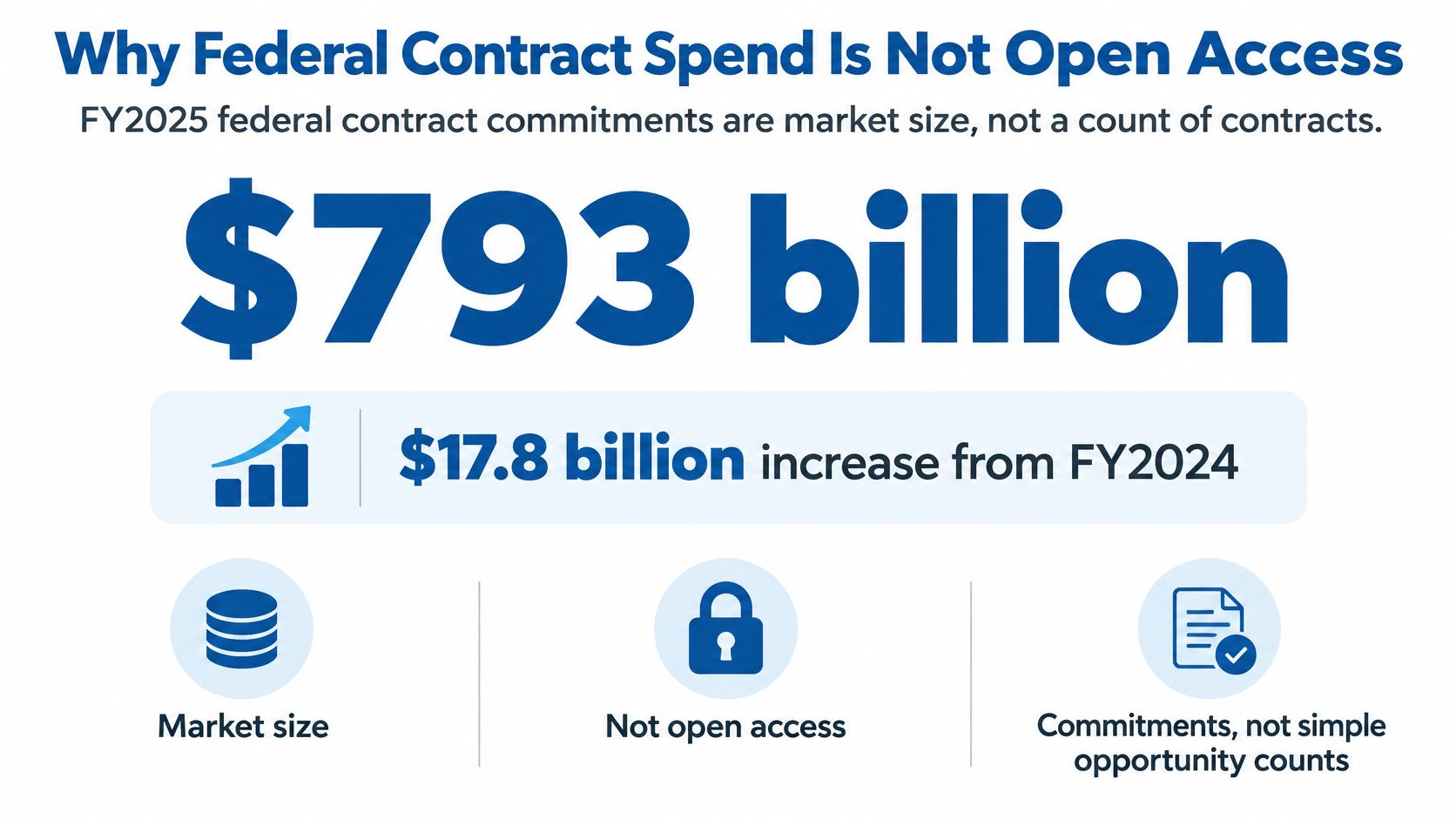
Federal contract commitments reached about $793 billion in fiscal year 2025, an inflation-adjusted increase of $17.8 billion from FY2024, according to the U.S. Government Accountability Office's snapshot of federal contracting. That figure shows the market's scale, not how many contracts a new supplier can realistically win.
Think of a public solicitation as a storefront: the agency has displayed something for sale, but much of the buying choice may already have been made in the stockroom. Procurement of government contracts is the regulated path an agency follows to turn a funded need into an award. Pursuit research is the contractor's work to identify the buyer, the contract vehicle, the incumbent, eligibility requirements, and the cost of competing.
Two common traps are starting research at the SAM.gov notice and assuming a larger federal budget means an easier path to entry. A better approach follows the buy from its early planning through award and performance, then asks whether a supplier can compete and afford to deliver.
Why Federal Contract Spend Is Not Open Access
Suppose a parts supplier sees a new federal request that matches its catalog. The notice is real, and the government has committed substantial money to contracting, but neither fact reveals whether the supplier can meet the technical requirements, enter through the right contract vehicle, or earn enough to justify its effort. The opportunity may be narrow, already tied to an incumbent's solution, or available only through a vehicle the supplier doesn't hold.
That's why market size and access need separate answers. The $793 billion in FY2025 federal contract commitments reflects the overall scale of government buying, not a count of open competitions available to any one company. Spending can rise even as certain requirements remain difficult to contest.
The procurement path gives each opportunity a place and a timing. A need may first appear in a budget document, then move through acquisition planning and market research before the agency publishes a solicitation. By the time a notice reaches the storefront, the agency may already have defined the scope, identified a suitable buying route, and learned which suppliers can perform.
The number of notices matters less than whether a particular buy has a realistic path to competition.
A contractor's first job is to find the stage its target has reached. Then it can decide whether to pursue as a prime, join a team, seek to shape the requirement before it's published, or walk away. That stage-based decision keeps a visible notice from being mistaken for a viable business opportunity.
The Path from Agency Need to Award
| Stage | What the agency does | Public signal | Contractor question |
|---|---|---|---|
| Agency need | Ties a capability gap to a funded budget line | Budget justification or agency forecast | Is a named office funded to buy this? |
| Acquisition planning | Chooses contract type, set-aside, and vehicle | Sources sought, RFI, or forecast | Can the requirement still be influenced? |
| Market research | Tests prices and capable sources | Industry day, RFI, prior award history | Who won similar work and at what lifecycle cost? |
| Solicitation | Publishes the request and evaluation factors | SAM.gov notice and amendments | Are set-aside, clearance, and certifications met? |
| Evaluation and award | Scores offers and names a winner | Award notice and debrief | Was the loss price, past performance, or a defect? |
| Performance and recompete | Exercises options and plans the follow-on | Modifications and option dates | When does the incumbent's hold expire? |
Follow the signals in order
Agency need comes first. A program office connects a capability gap to a budget line, often before a public notice exists. Look for agency forecasts and budget justifications, then ask whether a named office has funding for the need rather than relying on a broad agency priority.
During acquisition planning, the agency chooses how to buy: contract type, set-aside, and whether to use an existing vehicle. A sources-sought notice or RFI can signal that the agency is still gathering input. This is the point to ask whether your company can credibly shape the requirement, not merely whether it can answer a final solicitation.
In market research, the agency tests likely prices and identifies capable suppliers. Prior awards can help a contractor estimate costs, but only when the comparison is fair. The OECD's public procurement framework recommends using consistent, current, reliable procurement information, especially awarded prices and lifecycle costs, to inform requirements, budgets, and procurement strategies.
Compare each past award by scope, quantity, period of performance, contract type, price basis, options, modifications, and supplier. Then compare like-for-like total costs, not just headline award values. A lower apparent price might reflect a narrower scope, fewer options, or a different cost basis. A higher incumbent price might be justified by technical differences, or it might reflect repeated purchasing.
Read the public stage, then choose the next move
The solicitation publishes the request and evaluation factors. Read amendments as carefully as the original notice, because they can change the submission requirements or deadlines. At evaluation and award, the agency scores offers and names a winner; a debrief can help a losing bidder distinguish a price problem from a past-performance or compliance issue.
During performance and recompete, options and modifications shape when the next buying decision may occur. An IDIQ, GWAC, or BPA can let an agency meet a need through an existing vehicle rather than a new open competition. Learn how those routes differ in this guide to federal contract vehicles.
Before applying any later qualification test, record your target's current stage. The stage tells you whether the next sensible move is early engagement, market research, proposal preparation, or waiting for a future buying cycle.
Where Opportunities Appear and How to Register
A public notice is only one signal. Agencies may disclose emerging needs through forecasts, budget documents, and sources-sought notices, so early research can start before a solicitation appears. To submit a federal offer, however, a company needs an active registration in SAM.gov and a clear understanding of the work it's eligible to perform.
Start by checking the firm's NAICS codes and the size standard associated with each. Those codes help describe the company's work and can affect eligibility for small-business opportunities. Set alerts for relevant codes and target agencies, so sources sought, RFIs, and solicitations come into one manageable feed rather than requiring constant manual searches.
Then identify the solicitation type. An invitation for bids generally awards to the lowest responsive, responsible bidder. A request for proposals evaluates offers against stated factors, which may include technical approach and past performance. The competition path matters too: the agency may run a full-and-open competition, reserve work for a set-aside, justify a sole-source award, or place an order against an existing vehicle.
Check agency forecasts and public award records such as FPDS and USAspending to understand buying patterns and identify prior awards. For example, a supplier exploring public-sector facilities work might also review relevant municipal maintenance supplies to understand the kinds of products that government buyers procure.
Keep one tracker for the solicitation number, closing date, contracting officer, and deadline for questions. For a practical starting point when scanning notices and related signals, use this guide to finding federal business opportunities.
When the Incumbent Already Shaped the Buy
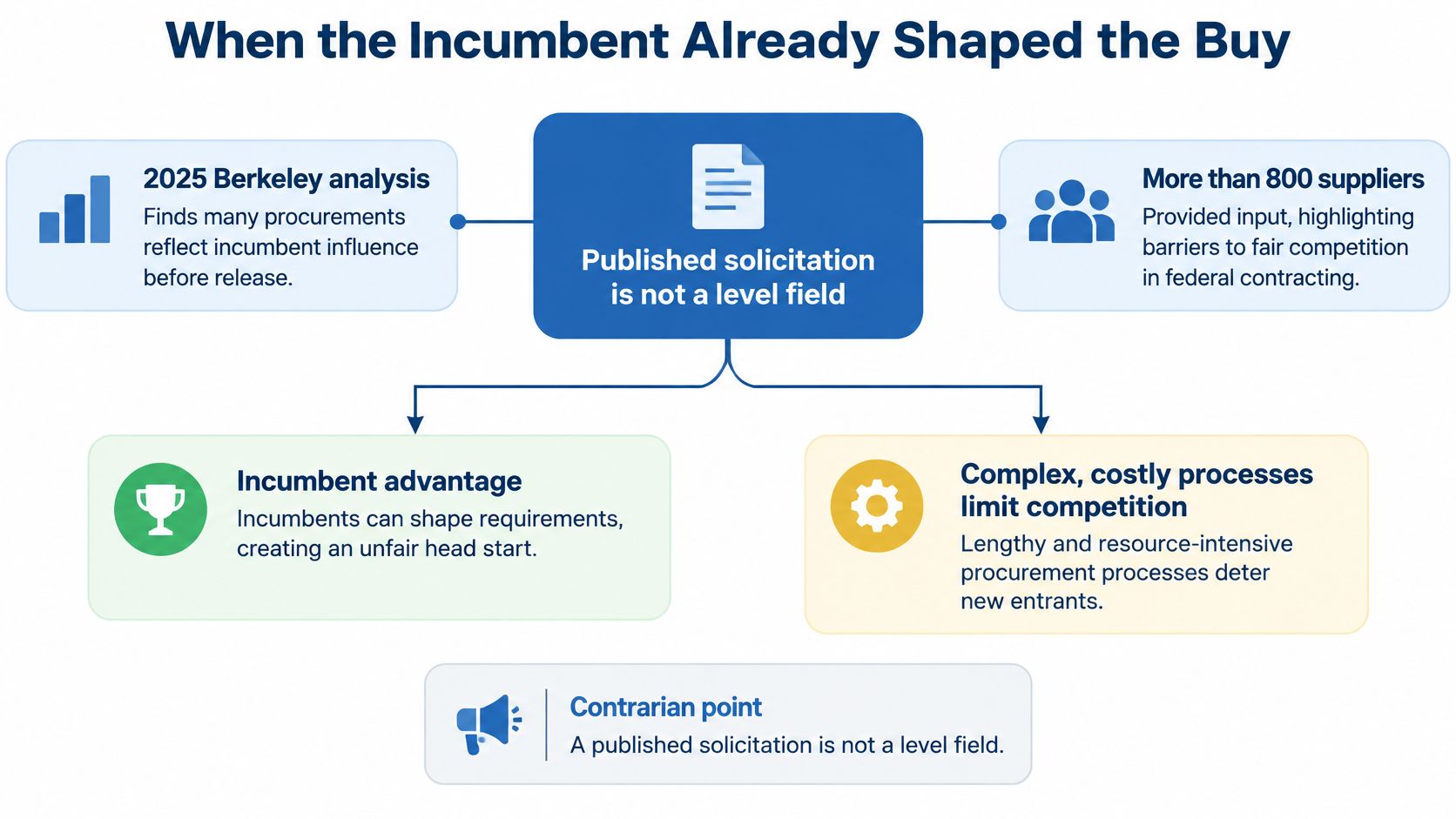
A published solicitation isn't necessarily a level field. A 2025 Berkeley analysis based on a survey of more than 800 suppliers identified incumbent advantage and complex, costly processes as the two most prominent categories of barriers; each of five identified barriers was rated significant or major by at least half of respondents, according to the Berkeley analysis of why suppliers struggle to do business with government. The notice can be open while the practical route to competing remains narrow.
The issue may begin before the notice. A buyer's past experience with a familiar vendor, a requirement bundled into a package that smaller firms can't handle alone, or technical dependencies built around an incumbent can affect which suppliers are realistically positioned to respond. The task isn't to count more notices. It's to find out whether a particular buy is contestable.
Investigate the incumbent's position
Look for the existing contract vehicle, the agency's buying history, options that may be nearing expiration, known subcontractors, and technical dependencies that would make switching difficult. Ask what story the agency may tell itself about the recompete: continuity, risk reduction, improved capability, or a need to open the field to new suppliers.
A congressional document citing Small Business Majority research also notes that familiar vendors may receive preference, bundled contracts can exclude small businesses, and cybersecurity requirements can cost more than the resulting contract benefit. Those conditions don't automatically make a solicitation unwinnable. They do mean a contractor should identify what makes the incumbent hard to replace and what evidence would make an alternative credible.
An open notice is evidence that the agency is buying. It isn't proof that every supplier has equal access.
Choose a realistic route
There are several practical outcomes. Prime when your firm can meet the requirement and the competition is open. Team with a vehicle holder when access depends on a contract vehicle your company doesn't hold. Pursue a set-aside only when the eligible supplier pool is real and your company meets the requirements. If the agency is still shaping its approach, influence the requirement early with relevant market information. If none of these paths is credible, no-bid.
The menu analogy is useful: once the agency has printed the menu, the levers left to a new supplier may be limited to price and past performance. Judge access by the number of contestable buys your team can pursue in practice, not by the number of notices it can find.
A Bid Screen for Cash and Compliance
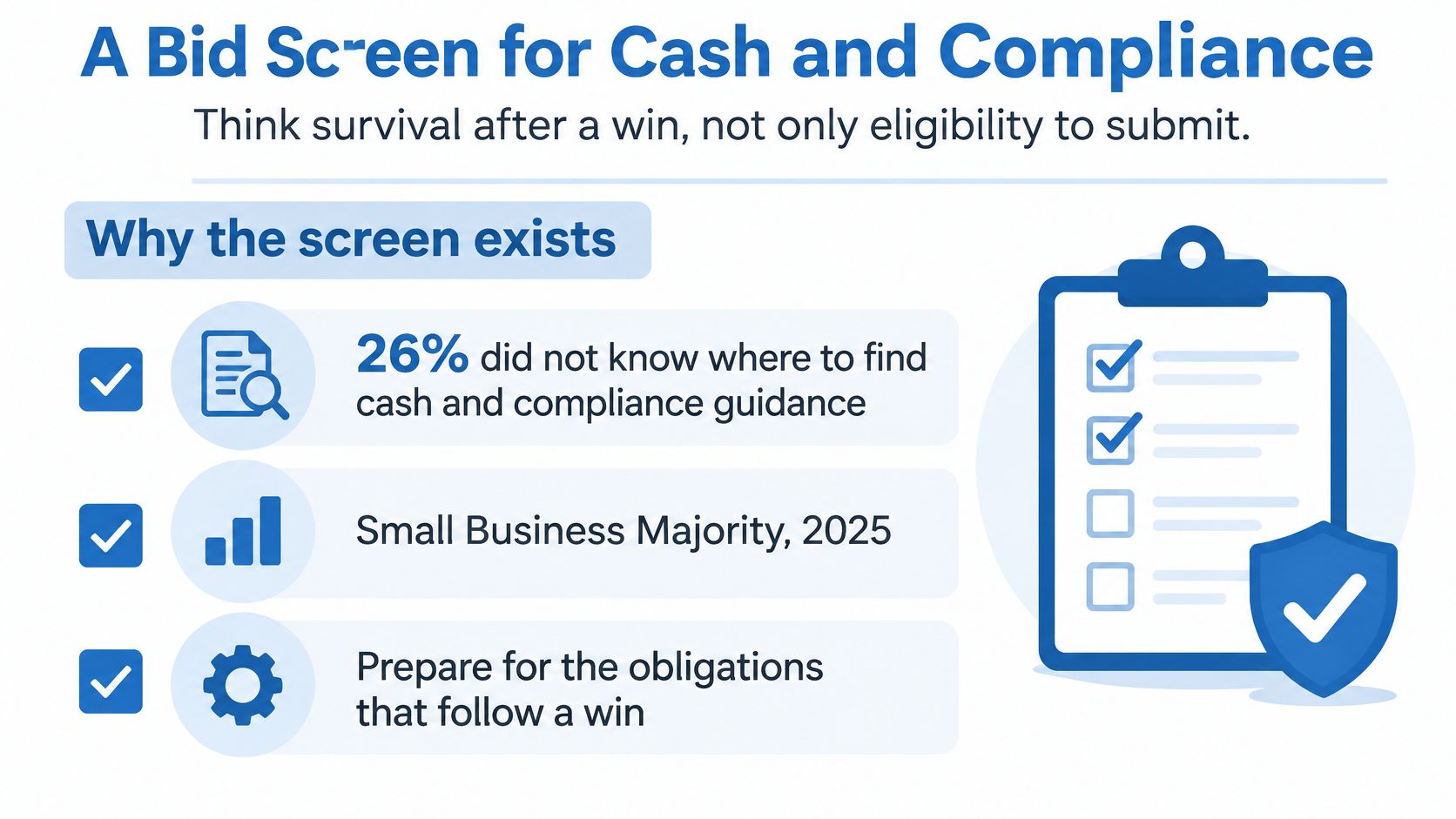
A bid can be legal to submit and still be a poor business decision. The right question isn't only whether your company qualifies. It's whether the firm can pay the pursuit and performance costs, then keep operating while it waits for its first contract payment.
A 2025 Small Business Majority survey cited in a congressional document found that 26% of small businesses didn't know where to find opportunities, 22% believed they wouldn't qualify, and 12% cited pursuit costs as a barrier. It also found that 29% couldn't cover expenses before receiving their first contract payment, while 34% were unsure they could. Those findings make a pre-bid viability screen essential, not optional.
| Check | What to verify | Walk-away signal |
|---|---|---|
| Set-aside and size | NAICS, size standard, and socioeconomic status | Wrong size or a missing required certification |
| Clearance and cyber | Facility clearance and cybersecurity obligations, including any CMMC-level cost | Compliance cost exceeds likely revenue |
| Bonding | Whether performance or payment bonds are required | Bond capacity or premium is unavailable |
| Cash timing | Payment terms and cost to perform before the first invoice | Cannot fund pursuit plus performance float |
| Ceiling versus funds | Contract ceiling against realistic first-year obligation | A large ceiling hides thin funded work |
| Teaming cost | Subcontract or prime-partner share and who holds the vehicle | No credible prime or team path before the due date |
| Pursuit cost | Proposal labor and bid expense versus expected fee | Pursuit cost consumes the likely profit |
Work down the screen before writing
Begin with eligibility: verify the NAICS code, size standard, and any required socioeconomic status. Then price the work needed to meet clearance and cybersecurity requirements. For firms evaluating federal restrictions on covered telecommunications equipment, this Section 889 information for additive manufacturers can help frame a compliance review. If the work requires bonding, confirm that the firm has the capacity and can afford the premium before treating the opportunity as viable.
Next, estimate the cash needed to mobilize, perform the work, and reach the first invoice. Compare the contract ceiling with the likely funded work rather than assuming the maximum value will be spent. Add the cost of a prime partner or subcontractor if that's the only credible way to participate. Finally, compare proposal labor and other bid expenses with the fee the firm can reasonably expect to earn.
A fixed-price award can make cost discipline especially important. Review the obligations and risk allocation with a clear understanding of fixed-price federal contracting, rather than judging the deal by its top-line value alone.
The smallest award isn't automatically the safest. Fragmented, low-value work can still require substantial administration and quality control, while a larger prime contract may be reachable through a team. In defense, cybersecurity, manufacturing, or parts supply, a ceiling that looks attractive on paper can become uneconomic once the required compliance work is priced.
Go or no-go: if a walk-away signal is true and a credible teaming arrangement can't solve it, stop before proposal writing.
What Protest Numbers Mean for Pursuit Risk
A protester receiving some form of relief isn't the same as GAO finding that the agency violated procurement law. Relief can include corrective action, while a sustain is a formal finding that an agency violated procurement law or regulation. That distinction matters when interpreting the Government Accountability Office's bid-protest statistics.
GAO aims to resolve protests to the maximum extent practicable within 100 calendar days and routinely handles more than 1,000 protests annually. Protesters receive some form of relief in approximately 50% of filed cases, while filings declined by about 32% over the preceding decade. In FY2025, GAO received 1,688 cases, including 1,617 protests, and closed 1,737 cases. Among 380 merit decisions, GAO sustained 53 protests.
Those figures don't mean half of federal procurements are defective. They describe protest cases and outcomes, including corrective actions, not the share of all government buying found unlawful. For capture teams, the practical lesson is to assess procedural and evaluation risk as part of qualifying a pursuit, not to treat protest statistics as a forecast of winning or a reason to plan a challenge.
Watch for signs of evaluation risk
Track solicitation amendments, evaluation-factor weights, possible unequal access to information, restrictive specifications, past-performance requirements, organizational conflicts, and whether the agency takes corrective action. An amendment that changes a key requirement can affect the proposal response. A restrictive specification may make it important to ask a clear question before the stated deadline.
Raise the pursuit-risk assessment when the requirement is ambiguous, the evaluation record looks thin, or the task-order structure limits review options. That doesn't automatically mean no-bid. It means the team should decide whether it can clarify the issue, document its interpretation, and compete without accepting an unmanageable uncertainty.
Use protest data to sharpen your questions and preserve proposal records, not to plan a protest.
A lower filing trend doesn't remove the need to check for ambiguity. The useful output is a better-informed pursuit decision: know the evaluation risks, ask questions while the agency can still respond, and keep a clear record of what your team submitted.
Two Pursuits from Notice to a Decision
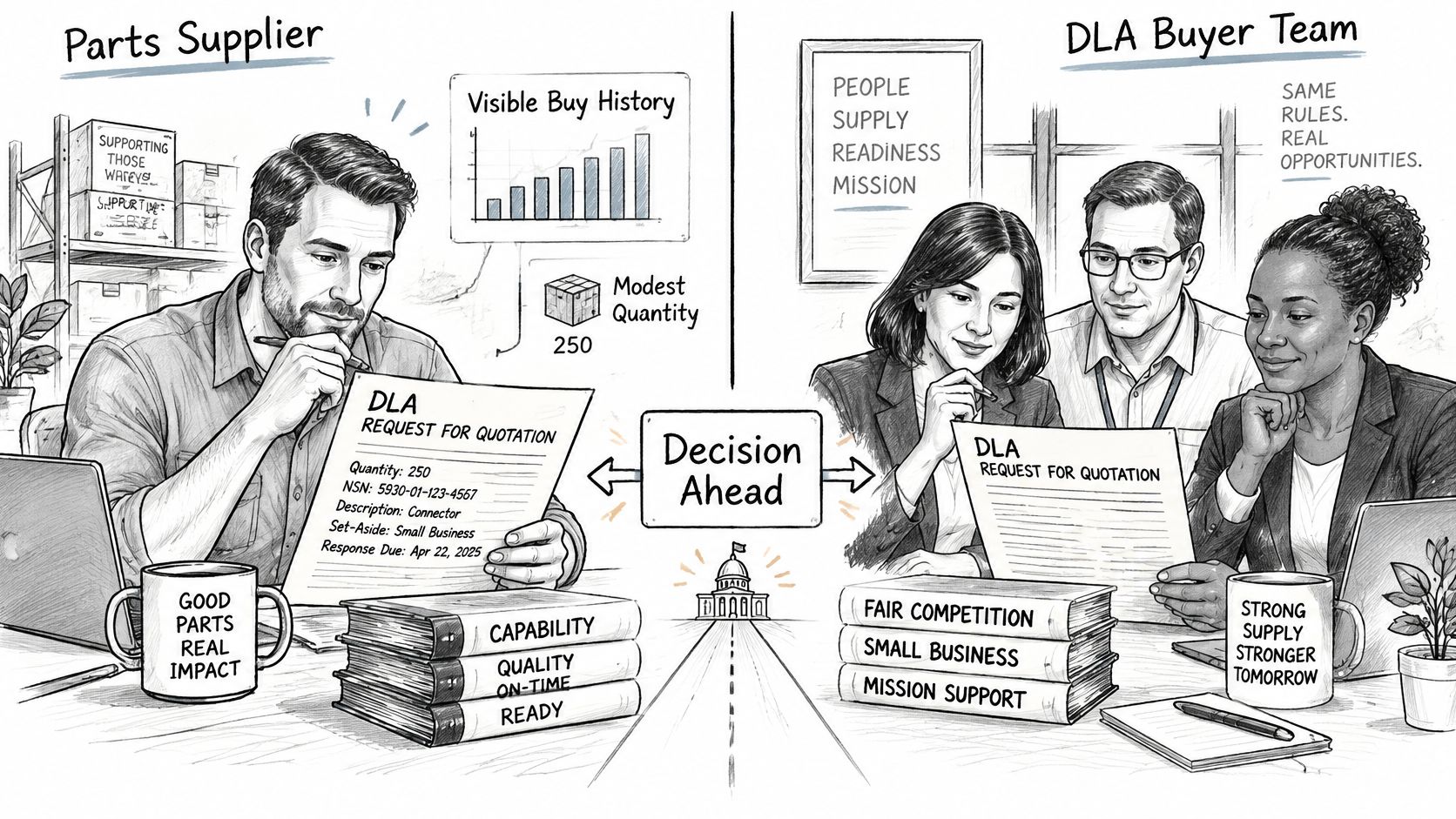
A parts supplier finds a request for a modest quantity of a component. The solicitation is easy to locate, and public buying history gives the supplier a way to compare prior purchases. But the request includes an approved-source limit, and the incumbent or approved source may already have the technical path the agency needs.
The supplier checks its own cost to meet the quality requirements against the margin available on the line. If that cost wipes out the likely return, the supplier doesn't write a full proposal just because the notice looks accessible. It submits a narrow quote only if it already qualifies as an approved source; otherwise, it declines.
The decisive failed test is economic viability: the expected margin can't support the required quality cost.
Now consider a small cybersecurity firm that finds a set-aside associated with work under an expiring GWAC. The notice may be the first signal the firm sees, but the funded need and the vehicle existed earlier. The company's technical fit is strong, yet it doesn't hold the vehicle and the first-year funding won't carry the cost of compliance.
A vehicle holder offers a credible way to team and share the work. The firm accepts only if the arrangement gives it enough work and revenue to cover its delivery obligations. If the holder won't commit to a viable share, the company waits for a recompete or walks away instead of assuming it can access the work through the notice alone.
The decisive failed test is cash survival unless a partner's share makes the performance costs supportable.
These examples lead to one practical sequence for any target: mark its stage, assess whether there's a contestable path to prime or team, then check whether your firm can fund the pursuit and wait for payment. A target that fails either of the last two checks doesn't become viable just because the solicitation is public.
Qualify the Buy Before You Spend Proposal Time
Proceed only when three conditions hold:
- A named office has funding for the need.
- You have a contestable route to prime or team with a vehicle holder.
- Your firm can cover pursuit costs and perform while waiting for its first payment.
If one of these conditions fails, don't default to writing a proposal. Team if a credible partner can resolve the gap; otherwise, no-bid and preserve the time for a better-qualified target.
For each opportunity, record its stage, the next action, the date, and the evidence behind your decision. That simple research trail keeps the team from rediscovering the same buy and helps everyone work from the same view of the opportunity. FederalPipeline brings together opportunities, budgets, buyers, and awards so capture teams can research what's coming, whether they can bid, and who they're up against.
Pick one live target today. Mark its stage, test whether the path is contestable, and stop if your company can't survive the cash requirements.
FederalPipeline connects federal opportunities with budgets, buyers, and award history to help teams assess a contract before committing proposal time. Use FederalPipeline to research your next target, check whether you can compete, and decide whether to prime, team, or walk away.