If your team can explain how it will answer an RFP but can't explain why it should pursue the contract, what has it planned? That gap is where proposal work starts consuming resources before anyone has tested whether the opportunity is winnable.
What a Capture Plan Is, When It Starts, and What It Is Not
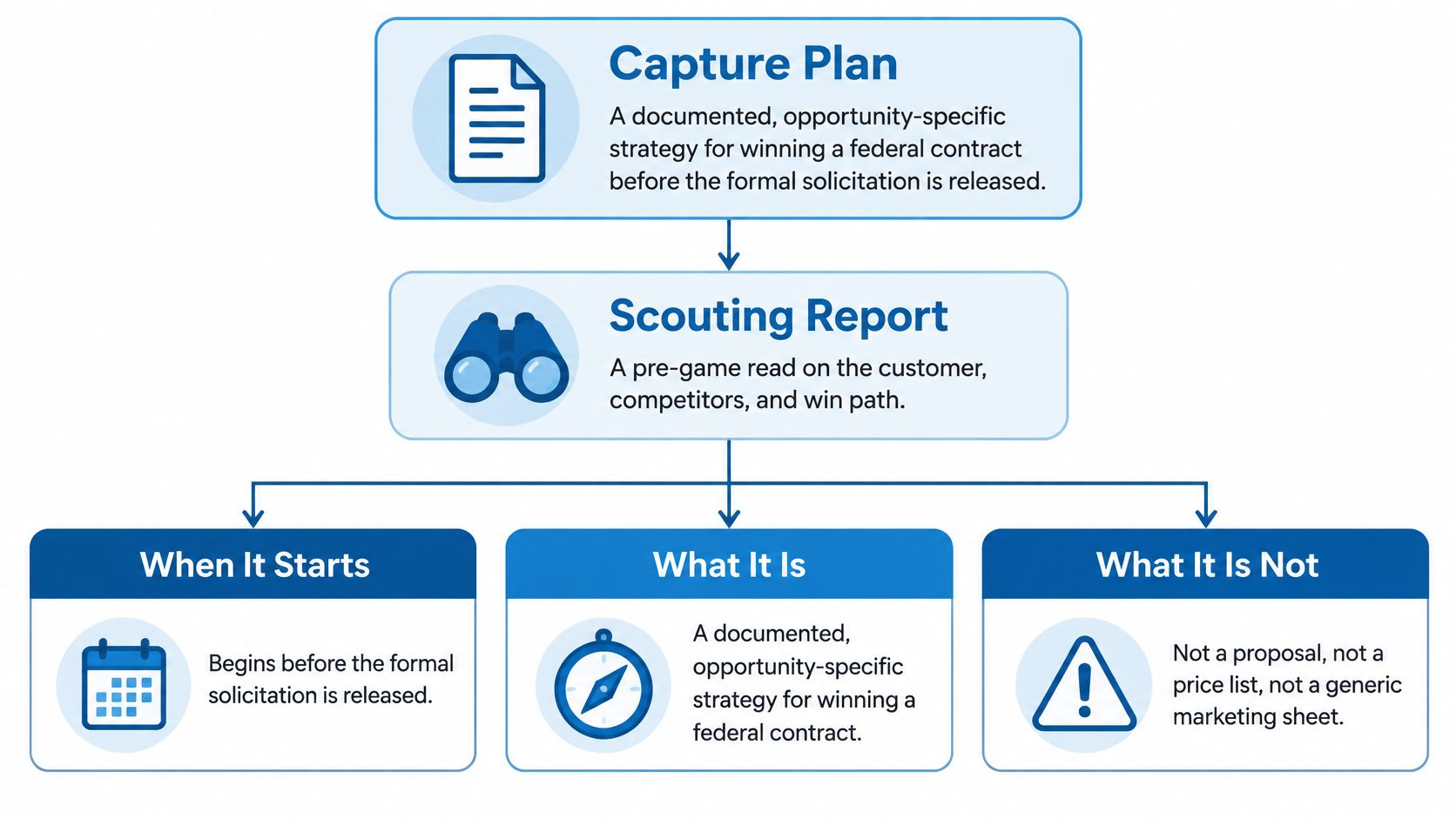
A capture plan is a documented, opportunity-specific strategy for winning a federal contract before the formal solicitation is released. It connects what your team knows about a requirement to the actions it must take, the uncertainties it must resolve, and the decision to pursue or pass.
Think of it as a scouting report a coach builds before a game, not the playbook players read during it. The coach studies the opponent, checks the team's strengths, identifies weaknesses, and decides where to concentrate effort. A capture team does the same with the customer's mission, likely requirements, incumbent, competitors, partners, and pricing.
The analogy has an important limit. Your customer isn't the opponent. You're trying to understand the agency's problem well enough to offer a credible solution while competing against other suppliers.
Start with the need, not the notice
Government planning starts upstream of the RFP. The Government Accountability Office's acquisition-planning review describes written acquisition plans as road maps with decision milestones and recommends beginning planning when the need is identified, preferably well before the fiscal year in which an award is needed.
For a contractor, that means the first useful signal might be a budget request, an agency forecast, or an approaching contract expiration. None proves that an award will happen exactly as expected. Each provides a reason to investigate.
Say your company supplies replacement components. A forecast mentions recurring purchases, but it doesn't identify the approved-source requirements. Your capture plan shouldn't say the opportunity matches your products. It should identify who will verify source approval, what evidence they'll seek, and what finding would stop the pursuit.
Connect the opportunity to its budget line, program office, contracting office, incumbent, contract vehicle, and eligibility constraints. Those connections help distinguish an attractive description from an accessible procurement.
Qualification and positioning are different jobs
A capture plan has two jobs: decide whether the company should pursue, and improve its position before competition formally opens. Qualification protects resources. Positioning develops the solution, team, customer understanding, and defensible advantages needed for a credible bid.
A bid-response outline serves a different purpose. It organizes answers to a posted solicitation, including instructions, evaluation factors, required volumes, and submission requirements. A capture plan helps explain why those answers should persuade the customer.
For example, a proposal outline might reserve space for a delivery approach. The capture plan should already establish whether delivery reliability matters to the buyer, what your company can demonstrate, and how competing suppliers might respond.
A useful capture plan doesn't just describe an opportunity. It tells someone what to validate or do next.
Common misconceptions blur these distinctions:
- It's a sales pitch. It's an evidence-based qualification and execution plan. Unsupported enthusiasm belongs in neither the decision nor the strategy.
- It starts when the RFP posts. Start when you identify a credible need that fits your business, while there's still time to investigate.
- It's a one-time document. Keep versions and reopen affected decisions when customer information or procurement assumptions change.
- Longer means better. An unowned assumption or missing exit gate weakens a plan regardless of its length.
A capture plan can't guarantee a win. It also doesn't authorize privileged access, restricted information, or attempts to bypass procurement rules. Keep market engagement within the applicable rules, and record each contact's date, participants, subject, and relevant follow-up.
Start a capture plan when you identify a credible agency need, so you can decide whether to pursue and take evidence-backed action before the solicitation arrives.
Core Components Every Capture Plan Needs
Use this component checklist to connect each strategic question to evidence your team can inspect, rather than filling headings with general observations.
| Component | Question It Answers | Evidence to Record |
|---|---|---|
| Customer mission and need | What problem is the agency funding? | Budget line, program office, mission statement |
| Requirements and assumptions | What will the solicitation likely require? | Draft requirements, forecast entries, confidence rating |
| Customer access | Who makes the decision, and can we reach them? | Named stakeholders, contact status, engagement dates |
| Incumbent and competitors | Who holds the work, and how strong are they? | Award history, recompete timing, competitor strengths and gaps |
| Teaming | Which partners close our capability gaps? | Teaming status, capability overlap, agreement status |
| Discriminators and win themes | Why would the customer choose us? | Differentiators tied to stated customer needs |
| Price-to-win | What price is likely to win? | Historical pricing, competitor estimates, confidence range |
| Eligibility and compliance | Can we legally bid? | Set-aside status, clearances, certifications, vehicle access |
| Risks and milestones | What could stop us, and when must we act? | Probability and impact score, owner, due date |
Mission evidence explains the purpose of the purchase. Requirements evidence translates that purpose into likely work, while customer-access records distinguish a named office from an actual engagement path. Don't treat finding a contact's name as proof that the team understands the buyer.
Competitive analysis should separate known awards from inferred strengths. Teaming records should show which gap a partner closes, not merely list firms you've contacted. A discriminator needs a customer-relevant proof point, while a price-to-win estimate needs assumptions that your pricing lead can challenge.
The government-side foundation is similar: FAR acquisition-planning policy calls for acquisition planning and market research, with personnel responsible for significant acquisition functions integrated into the process.
Make every assumption inspectable
Attach a source, confidence rating, validation date, owner, and due date to material assumptions. Use plain confidence labels, such as confirmed, supported but unverified, and speculative. These labels describe the evidence, not how strongly someone feels about the pursuit.
Consider a hypothetical entry:
Assumption: The forecasted recompete date is reliable. Evidence: Current agency forecast. Confidence: Supported but unverified. Owner: Capture lead. Validation action: Check the incumbent's remaining options and request a schedule update through an appropriate channel.
The forecast supports an anticipated date, not certainty. The validation action makes that distinction operational.
Keep version history so reviewers can see what changed and why. For risks, record both the likelihood of a problem and its effect on eligibility, cost, schedule, or delivery.
This checklist is a working control, not a form to complete once. If staffing is limited, start with customer access, eligibility, and incumbent position. They expose whether you have a credible route into the competition before you invest in detailed positioning.
How the Plan Guides Pursue or Pass Decisions
An unresolved gate pauses the affected commitment. A missing certification may block bidding altogether; an uncertain schedule may allow continued research but not a full proposal kickoff. Treat these differently instead of averaging every weakness into an encouraging score.
The acquisition-planning guidance in SOFARS treats market research as a continuing responsibility whose results inform risk analysis and acquisition strategy. Apply that discipline on the contractor side by making each gate an evidence test.
| Criterion | Pursue Signal | Pass Signal |
|---|---|---|
| Customer access | Named decision makers are reachable | No credible path to decision makers |
| Eligibility | Set-aside, clearance, and certifications are met | A blocking requirement the company cannot meet |
| Incumbent position | Incumbent is beatable or the recompete is open | Incumbent is entrenched with strong performance |
| Teaming readiness | Partners signed for each capability gap | No partner for a critical capability gap |
| Requirements coverage | Most requirements match company capabilities | Core scope lies outside company capabilities |
| Price-to-win confidence | Credible price range supports target margin | Winning price falls below cost |
| Funding and timing | Funding confirmed and award date fixed | Funding unconfirmed or award date unclear |
These signals support judgment, not automatic rejection. Strong incumbent performance is a warning, not proof that a challenger can't win. Likewise, funding confirmation and a fixed award date are desirable evidence, but forecasts can remain useful even when schedules aren't firm.
Separate a blocker from an unknown
Use pursue, pursue with conditions, pause, or pass as decision states. A conditional pursuit needs a bounded task, such as validating vehicle access before authorizing solution-development work. A pass should identify the reason clearly enough that someone won't reopen the opportunity without new evidence.
For help structuring weighted criteria, the CapyScout guide to scoring prospects offers a related account-prioritization framework. Adapt the method, but keep federal eligibility blockers outside any weighted average. Strong customer fit can't cancel a mandatory requirement.
When several answers remain unknown, choose the next cheapest validation step. Review a forecast, attend an industry day, respond to a request for information, or arrange an appropriate capability conversation with the contracting office. Match the action to the uncertainty instead of commissioning broad research.
Decision rule: Don't authorize expensive work merely because nobody has disproved the opportunity.
Set exit gates before enthusiasm builds. Record the decision date, approver, evidence, open conditions, and permitted spending or effort.
For a practical internal policy, pause a pursuit missing multiple gates rather than forcing it forward. A legal or eligibility blocker can justify stopping on its own.
Tracking Customer Intelligence as Forecasts Change
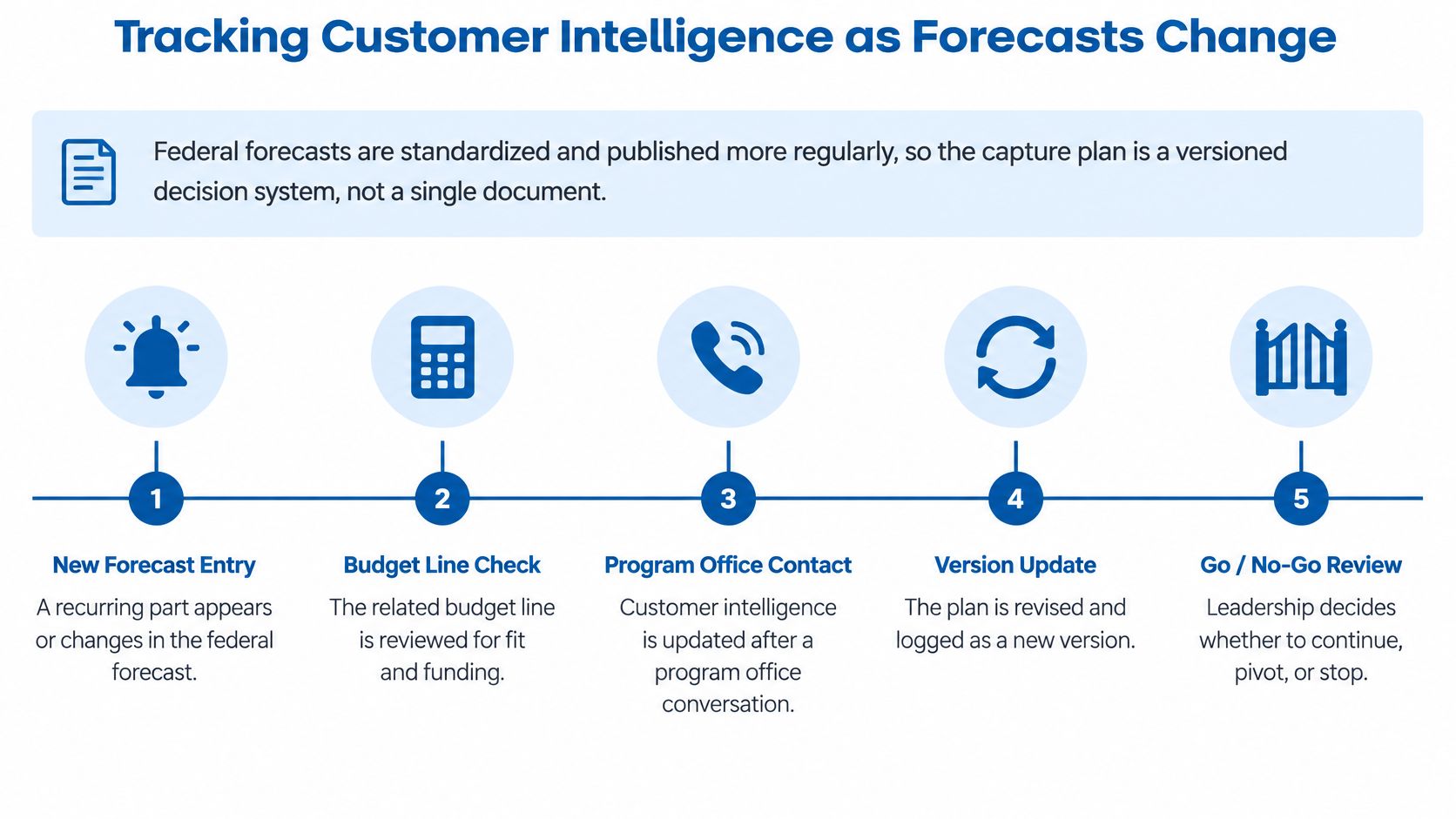
A forecast is a planning signal, not a promise. The OMB memorandum on strengthening federal procurement forecasts directs agencies to improve forecast content, publish more regularly, and report forecasts quarterly, with a centralized capability being phased in over 18 months.
That direction makes disciplined change handling more useful than a polished, static document. Your team needs to know which assumption changed, who must investigate, and whether the change affects the pursuit decision.
Reopen the decision when the evidence changes
Use these events as review triggers:
- A revised forecast or draft solicitation appears. Re-score requirements coverage and timing. Have the capture lead compare the new wording with the prior baseline.
- A new incumbent award is posted. Reassess competitive position and schedule. Assign the market analyst to check whether it's a bridge, replacement, or separate requirement.
- The NAICS code changes. Recheck the associated eligibility assumptions with the compliance owner.
- A vehicle restriction appears. Have the teaming lead confirm access before committing additional proposal resources.
- Competition shifts to a set-aside. Reassess the proposed bidding entity's qualification, then log the revised decision.
For every trigger, re-score the affected criterion, confirm its owner, and record the version date. Don't overwrite the old conclusion.
Saved searches and alerts help detect changes; the change log shows when your team acted. A federal business opportunity research workflow can help organize the notices and related records worth monitoring.
Cross-check before changing course
Procurement records are fragmented, so an isolated entry can mislead. As a working practice, cross-check material changes against another relevant record, such as comparing a forecast revision with a draft solicitation or incumbent award.
For policy-sensitive questions, distinguish an official rule from someone's interpretation. Teams comparing research tools for small law firms through LegesGPT face a related source-traceability issue: a useful summary still needs an inspectable underlying authority. In capture work, retain that authority alongside the interpretation.
Adopt a monthly review for active pursuits, with immediate reviews for blocking changes. Clear obsolete assumptions, confirm pending actions, and decide whether the current evidence still supports the authorized effort. Responsiveness matters more than pretending the original forecast predicted everything correctly.
Qualifying Small Business Set-Asides Early
The Rule of Two makes early market assessment important: agencies must expect at least two responsible small-business offers at competitive prices, quality, and delivery, and small-business set-asides represented more than $113 billion, nearly two-thirds of small-business federal contract awards, in FY2023, according to the Congressional Research Service's set-aside overview.
A set-aside label therefore isn't enough to qualify a pursuit. Your company must be able to satisfy the requirement, and the expected competitive field must support the acquisition approach.
Check disqualifiers before polishing the solution
Begin by separating facts from assumptions. A published designation is evidence of the announced acquisition approach. A belief that the agency will change that designation is an assumption requiring validation.
Assign confidence to customer and competitor intelligence. An award record establishes that a company held work; it doesn't establish that the company will bid again, qualify under the anticipated restriction, or offer the same solution.
Check status, size, clearances, certifications, vehicle access, approved sources, and relevant performance requirements before developing elaborate win themes. The small-business set-aside guide provides context for evaluating the designation alongside the rest of the procurement.
Then select a focused validation action. An RFI response can explain your capabilities to the agency. An industry-day question can clarify a draft requirement, while a forecast review may resolve whether you're examining the right purchase at all.
Use a compact validation sheet
Keep the following on a working page:
- Opportunity and designation. Record the announced set-aside and the official record supporting it.
- Bidding entity. Identify which company would submit and what supports its eligibility.
- Blocking requirements. Mark each as satisfied, unresolved, or not achievable.
- Competitive field. Separate known qualified suppliers from speculative bidders.
- Capability gaps. Name the missing capability and a feasible remedy.
- Next action. Assign the cheapest useful validation step to an owner.
- Decision condition. State what evidence permits continued investment.
If the likely qualified field looks thin, don't assume an easy win or a guaranteed set-aside. Investigate whether teaming can close your own delivery gaps, or pass if the requirement remains unsuitable. A partner's credentials don't automatically transfer eligibility to your company.
A Worked Example From Forecast to Go or No-Go
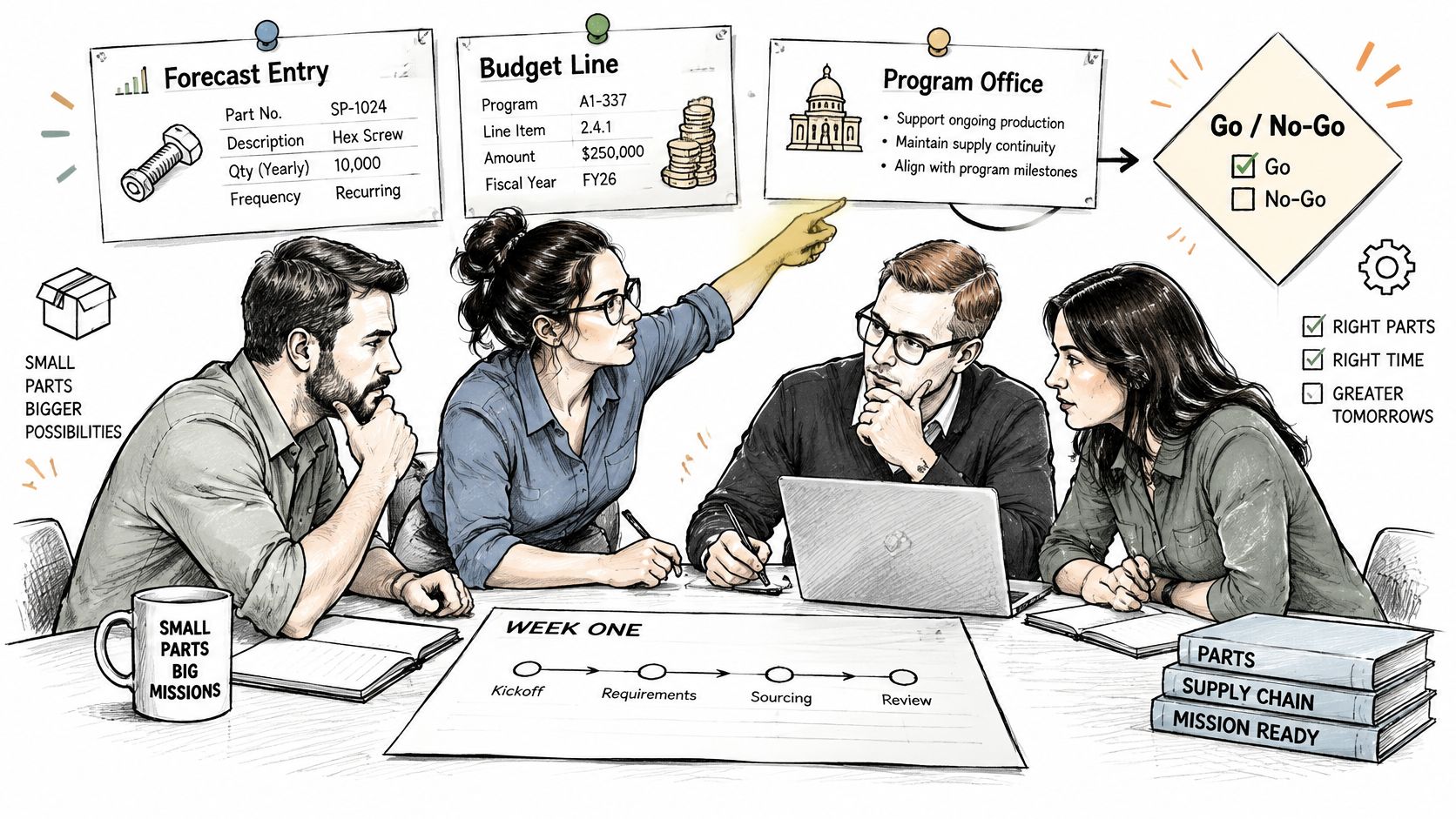
Illustrative scenario: A small parts supplier finds an agency forecast for a recurring replacement component. The description matches its product family, but the supplier hasn't established source approval, final quantities, or the intended competition approach.
The capture lead checks the related budget line and identifies the program office. The budget supports investigating the mission need, but the team doesn't treat it as proof that money is available for this particular purchase.
The initial record separates signals from conclusions
During the opening week, the lead saves the forecast and its publication date. The entry identifies the anticipated item, program office, and schedule, with a supported-but-unverified confidence rating. The assigned action is to clarify the procurement path through the designated market-engagement channel.
Later, an updated official notice confirms the planned set-aside, and the analyst finds an established incumbent in the award history. The team records high confidence in the announced designation, while leaving the final solicitation terms open. It records the incumbent's identity as confirmed but makes no unsupported claim about customer satisfaction.
The sales lead now has a specific task: develop a defensible reason the buyer might consider an alternative. Merely selling the same component isn't enough.
A draft requirement changes the decision
When the draft solicitation appears, the quantity has changed and a new certification is required. The company doesn't hold it, so the compliance owner changes eligibility from unresolved to blocked pending a valid remedy.
A potential teaming partner holds the certification. Before treating that as a solution, the compliance owner checks whether the requirement permits that partner to perform the relevant work and whether the proposed bidder must independently hold the credential.
| Decision Entry | Illustrative Record |
|---|---|
| Current position | Pursue with conditions |
| Required evidence | Certification applicability confirmed and partner agreement signed |
| Accountable owner | Capture lead, supported by compliance and teaming leads |
| Exit gate | Agreement completed by the internal cutoff before proposal kickoff |
| Stop condition | Required credential must belong to the bidder, with no feasible compliant arrangement |
| Decision record | Dated approval with draft requirement and partner evidence attached |
The partner's certificate supports a capability claim. The requirement's wording determines whether that capability solves the bidding problem.
The team permits limited partner-development work, not unrestricted proposal spending. If the condition fails, the pursuit stops.
Because each entry carries a date, owner, and supporting record, the team can later explain why it continued, what changed, and what evidence would have required a different decision.
Decide to Pursue or Pass Before Proposal Spend
Apply the process to a live opportunity before scheduling a proposal kickoff. You don't need an elaborate presentation; you need a decision someone can defend.
- Name an open or forecast opportunity. Identify the purchase, buyer, and official record. Avoid broad targets such as winning more agency work.
- Write the key assumptions. Give each a source, confidence rating, and owner. Mark unsupported beliefs plainly instead of allowing them to become background facts.
- Score the pursue-or-pass criteria. Evaluate access, eligibility, incumbent position, partners, scope, pricing, funding, and timing. Keep blocking requirements visible.
- Set a dated exit gate. Record the decision, supporting evidence, permitted next action, and condition that will stop further investment.
If the team struggles to distinguish conditional paths, Fluidwave's decision tree templates for teams offer a practical way to map them. Put eligibility questions before preferences, and give each branch an action rather than an ambiguous score.
Keep research attached to the decision
Our capture briefs read every solicitation and show what's being bought, required clearances, set-asides and certifications, the incumbent, ceiling, and every deadline, with bid blockers flagged up front. Our Pipeline tool tracks pursuits by stage, with the next action and research attached; each pursuit also has a name and target date.
These tools support the evidence-gathering work, but they don't make the business decision for you. Verify consequential requirements against the underlying documents and assess whether your company can deliver profitably.
Before preparing a proposal to the government, make sure the authorized pursuit decision is current. A prior approval shouldn't carry a team past newly discovered blockers.
At the next revised forecast, draft solicitation, or other material trigger, review the affected gate and log the new version date. The useful output isn't a finished document. It's a current, accountable decision about where to invest effort.
FederalPipeline connects opportunity research with budgets, buyers, incumbents, and pursuit tracking so your team can build a capture plan around inspectable evidence. Visit FederalPipeline, choose an opportunity you're considering, and attach its next validation action to a pursuit record before committing proposal resources.