SBIR Phase III Is Not a Third Round of SBIR Grant Money. It is the commercialization and follow-on stage. Work that derives from, extends, or completes an earlier SBIR effort gets funded here with money from outside the SBIR program, either private capital or non-SBIR federal awards.
Think of it like a product lifecycle. Phase I is the proof-of-concept sketch. Phase II is the working prototype.
Phase III is the moment a real buyer pays to deploy, produce, test, or sustain it.
What SBIR Phase III Actually Means
The statutory anchor is 15 U.S.C. § 638. It defines Phase III as work that traces back to an effort funded through an earlier SBIR agreement, but paid for with funds outside the SBIR program.
That money flows in two directions:
- Non-federal capital for commercial products
- Follow-on federal awards that are not SBIR awards for government use
The Department of Defense frames that work broadly. It covers products, test and evaluation, production, services, research, development, or combinations of those activities. You can read the full statutory language in 15 U.S.C. § 638 on the U.S. Code site.
The defining rule: Phase III work must trace back to prior SBIR effort, while the funding must come from outside the SBIR program itself.
That one sentence sets Phase III apart from every other federal contract. It is the lineage of the work, not the label on the notice, that makes it Phase III.
SBIR Phase III at a Glance
Here is the fast version if you only need the core mechanics:
| Attribute | What It Means in Phase III |
|---|---|
| What it is | The commercialization and follow-on stage of earlier SBIR work |
| Where the money comes from | Non-SBIR sources, private capital or non-SBIR federal awards |
| What work it covers | Products, test and evaluation, production, services, R&D, or combinations |
| Who can receive it | Companies with prior Phase I or Phase II SBIR/STTR awards |
| Whether limits apply | No stated limits on number, duration, type, or dollar value of awards |
No cap, no set format. If the lineage connects and the funding is non-SBIR, it can qualify.

Who This Guide Serves
This guide is written for three readers. Capture teams qualifying federal opportunities. Small business owners weighing their SBIR transition options. And business development planners tracking programs and budgets.
Here is the path ahead:
- How Phase III differs structurally from Phase I and Phase II
- Eligibility and sole-source rules, including what agencies can and cannot skip
- The four transition pathways that deliver Phase III work to companies
- A repeatable research workflow for finding these opportunities
The core concept is simple once it clicks. A finished SBIR project does not end when the research contract ends. It opens a continuing procurement pathway.
The transition matters because the rules for early research don't automatically apply to what comes next.
Phase I, Phase II, and Phase III Compared
Think of the first two phases as a measured runway. Phase I tests whether an idea is even feasible, while Phase II keeps developing it toward something usable, as described in the SBIR statute.
SBIR Phase III is the open road — if the work qualifies. It can cover deployment, production, services, testing, or continued research without those same program limits, according to Defense Department contracting guidance.
Here is how the three phases line up side by side:
| Dimension | Phase I | Phase II | Phase III |
|---|---|---|---|
| Purpose | Establish feasibility | Continue research and development | Transition qualifying work |
| Funding | SBIR funds | SBIR funds | Non-SBIR funds |
| Award limits | Program boundaries apply | Program boundaries apply | No stated phase-specific limits |
| Business size | Small-business limits apply | Small-business limits apply | Earlier size limits don’t apply |
| Buying signal | Feasibility question | Development need | Follow-on customer requirement |
That shift from SBIR money to outside funding is the real dividing line. It changes what can be bought and how.
Read the Comparison as a Progression
The purpose row tells a story in three questions. Can this approach work? What development is still needed? And now, what does the customer actually need to buy, test, or deploy?
The funding row marks a structural break. Phase III draws on money outside SBIR, including qualifying federal funding or private capital, not another draw from program funds, as Congress specifies.
- Award limits open up considerably. Phase III has no stated limit on the number, duration, type, or dollar value a company may receive under Defense Department guidance.
- Buying signals become much more customer-driven. A robotics startup, for example, might prove navigation works, build a prototype, then move into paid testing services.
The business-size row catches a lot of teams by surprise. Growth doesn't shut this door.
The Phase I and Phase II small-business size limits do not apply to Phase III awards, according to the contracting guidance.
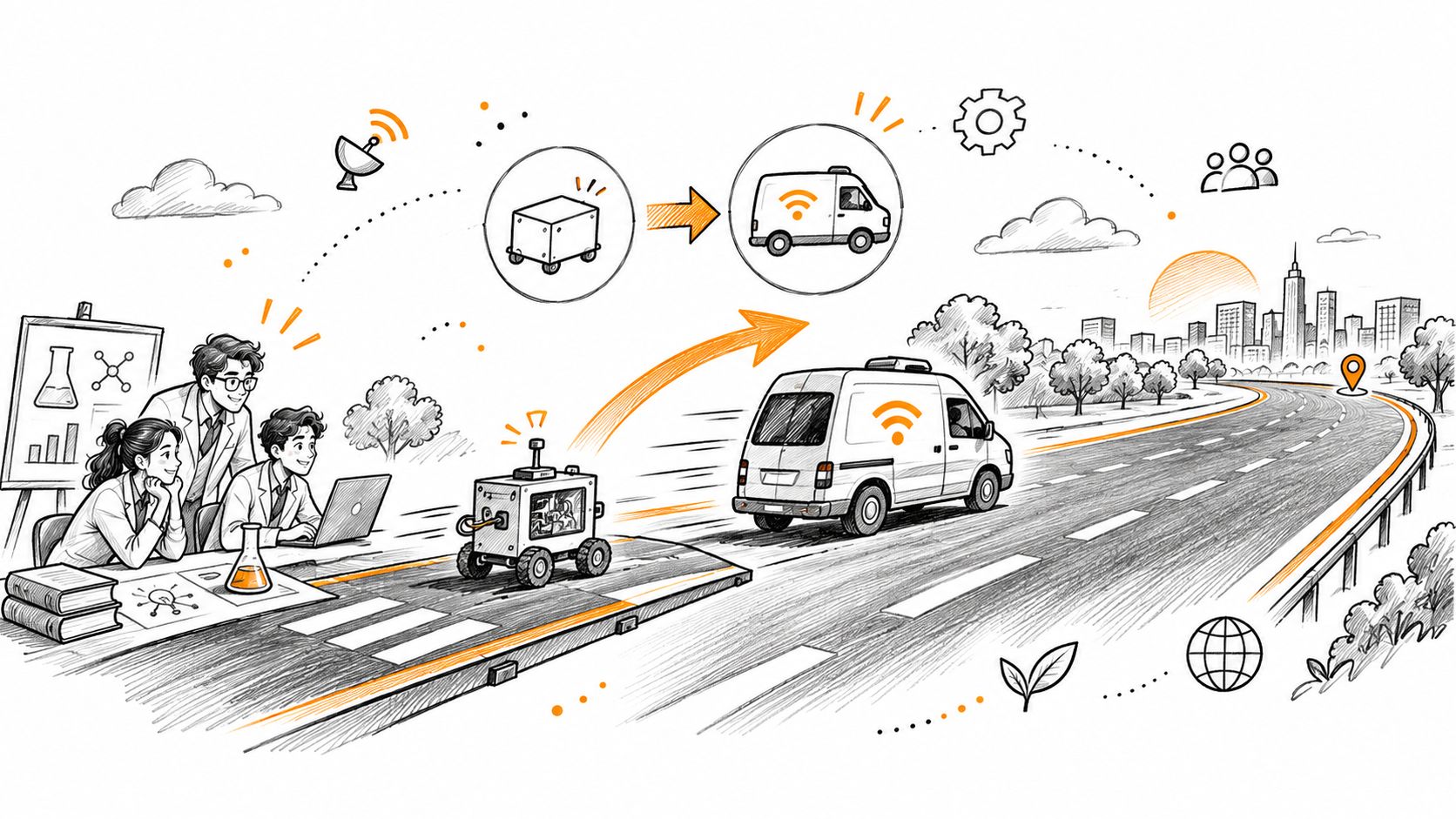
Turn the Differences Into Capture Actions
Timing is more flexible than most people expect. An agency can enter a Phase III agreement with a Phase I or Phase II awardee at any time, so finishing Phase II isn't always required under Defense Department guidance.
For capture teams, that points to a clear sequence:
- Identify the earlier award and what capability it proved.
- Connect that capability to a current follow-on need.
- Document how the new scope derives from, extends, or completes that earlier work.
Don't treat an expired research contract as a dead end. Pull one completed SBIR project, find a likely government buyer, and sketch the qualifying follow-on. The research award can open a continuing procurement pathway, not just a one-time purchase.
An Agency Can Award Qualifying SBIR Phase III Work Without a New Competition, but That Authority Isn't an Award Promise. For capture teams, the real question is simpler: can you show a clear, documented link back to the earlier SBIR work?
Eligibility and Sole-Source Rules Explained
SBA policy says an agency funding an SBIR/STTR Phase III follow-on to earlier awards does not have to run another competition to meet the relevant statutory requirements. The Department of Defense allows that work to be awarded competitively through a broad agency announcement or request for proposals, or noncompetitively to a prime or subcontractor at any tier. In both cases, Phase III status and SBIR data-rights protections carry forward. Read the Defense Department’s Phase III contracting guidance.
Permission to skip another competition doesn't remove the need to prove eligibility or follow the procurement rules.
Establish the Technology's Lineage
Think family tree, not look-alike contest. A new requirement has to descend from the earlier effort — not just resemble technology built under an SBIR award.
Deploying the navigation capability developed under a prior robotics award, for example, is a connection worth documenting. Offering unrelated scheduling software to that same customer is not, by itself.
- Trace the technical connection. Pinpoint which earlier results support the proposed work.
- Explain the scope relationship. Show how the requirement derives from, extends, or completes that effort.
Compare Competitive and Noncompetitive Routes
The award route and the technical lineage answer two different questions. One is how the buyer buys. The other is why the work qualifies.
| Capture Question | Evidence to Prepare |
|---|---|
| Why Does This Qualify? | Technical lineage and scope comparison |
| Which Route Is Proposed? | Buyer's acquisition approach |
| What Remains Unresolved? | Applicable procurement requirements |
For broader context, see this guide to sole-source contracting. And never frame the lack of mandatory recompetition as a reason the buyer has to choose your solution.
Document Subcontracting and Data Rights
Chasing the work as a subcontractor? Make the technical relationship obvious to both the prime and the government buyer. Ask early how the scope and the associated data-rights protections will be handled in the contract language.
If delivery also needs outside specialists, keep that staffing decision separate from the technology's eligibility. Contractors weighing agreement structures can review TekRecruiter on augmentation rates and terms.
Before you contact a buyer, pull this evidence packet together:
- Prior award numbers, with supporting award documents.
- Technology descriptions, tied to the specific research results.
- Scope comparisons, linking the earlier requirement to the proposed work.
- Data-rights records, ready to discuss with contracting staff.
Pick one prospective requirement today and build that packet before you ask for a Phase III discussion.
Finding SBIR Phase III work is a bit like tracing a river upstream. The notice you see is downstream. The real story — the budget decision, the program owner, the earlier award — is what explains why the buyer needs the technology in the first place.
Transition Pathways From Earlier SBIR Work
Direct Follow-On. A program office can pick up where earlier SBIR work left off and turn it into a new award. Say a team built a navigation prototype. That prototype gets linked to a real deployment need, and the follow-on scope gets worked out directly with that office.
Production or Services Requirement. Sometimes demand doesn’t look like research at all. It shows up as products being purchased or services being ordered. That’s why it pays to search for the capability itself, not just the title of the original project.
Follow the requirement's ancestry, not only its label. Defense Department guidance recognizes production, services, testing, and subcontracting routes.
Test and Evaluation. A buyer might fund testing that builds on the earlier effort. For example, putting an SBIR-developed sensor through its paces in real operating conditions can be a clear transition signal, without going back to square one on feasibility.
Subcontract at Any Tier. The original awardee can also do qualifying work under another prime, even several tiers down. In that case you need to look at both sides — the prime’s requirement and supplier network, plus the government’s buying approach — using the Department's subcontracting guidance.
Read the Signals Behind Each Pathway
Here’s the signal problem: the opportunity often won’t be labeled as a new SBIR solicitation. The money or buying relationship could run through a program office, a contracting activity, a prime contractor, or a completely non-SBIR federal account.
This infographic lays out the four routes, along with the search anchors and early-planning connections that make them easier to spot.
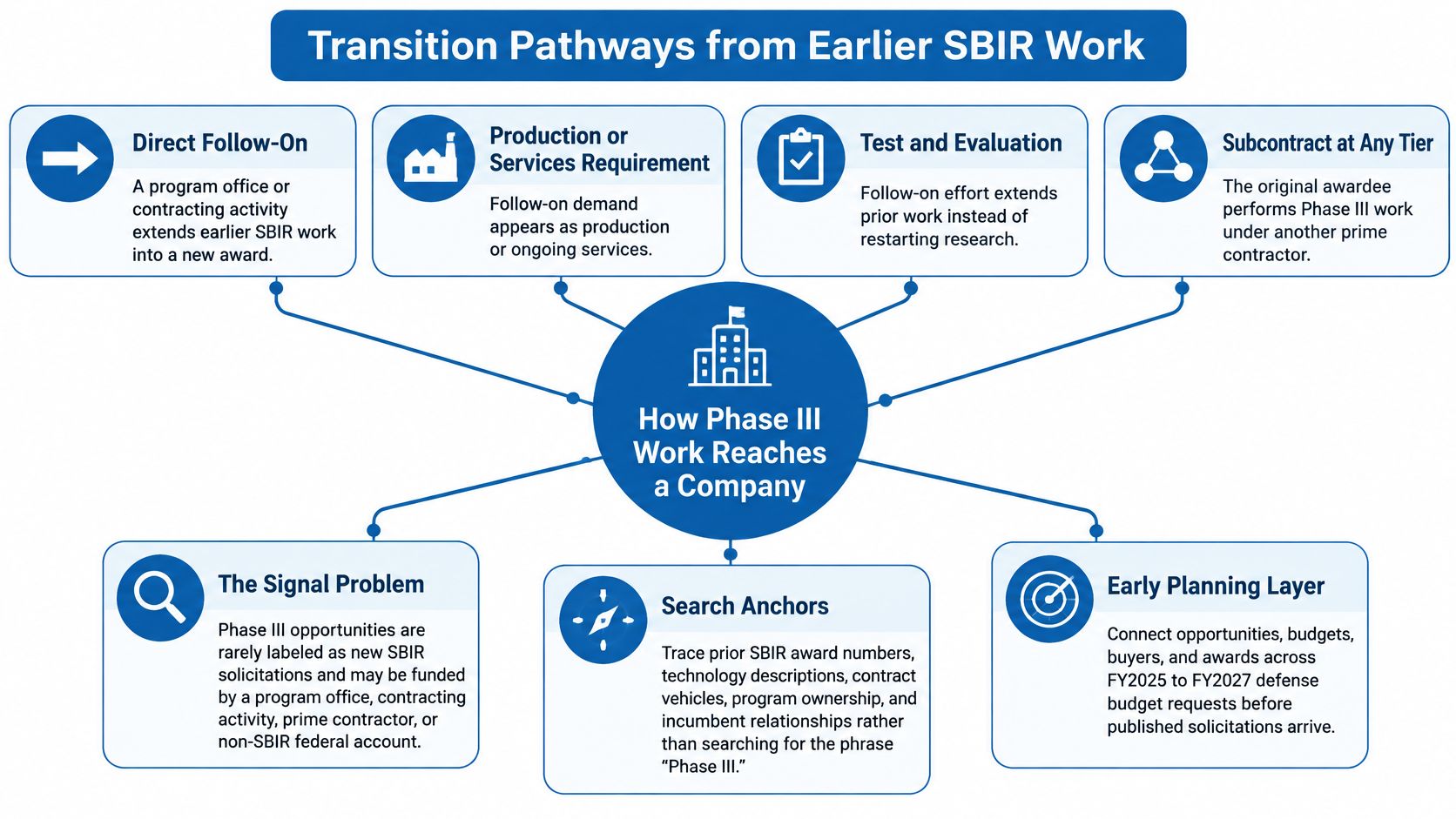
What ties it all together is connected evidence. Every route is simpler to research once you link the buyer’s need back to that earlier work.
- Prior award numbers and technology descriptions show what capability already exists.
- Contract vehicles and program ownership point to likely buying paths and who’s in charge.
- Incumbent relationships highlight current suppliers and where a teaming conversation might fit.
Together, those anchors tell you far more than searching for “Phase III” by itself. They help you separate a real transition from a notice that just happens to use similar technical words.
Connect Budgets Before Notices Appear
Use FY2025 to FY2027 defense budget requests as an early-planning layer, and match budget lines to program offices. A request signals intent, not a guaranteed award. By the time a solicitation posts, it’s often too late to shape anything.
FederalPipeline connects opportunities, budgets, buyers, and awards so teams can see what's coming, whether they can bid, and who they're up against. Explore FederalPipeline's capture intelligence.
Pick one prior award today, find its program owner, and trace the next funded requirement from there.
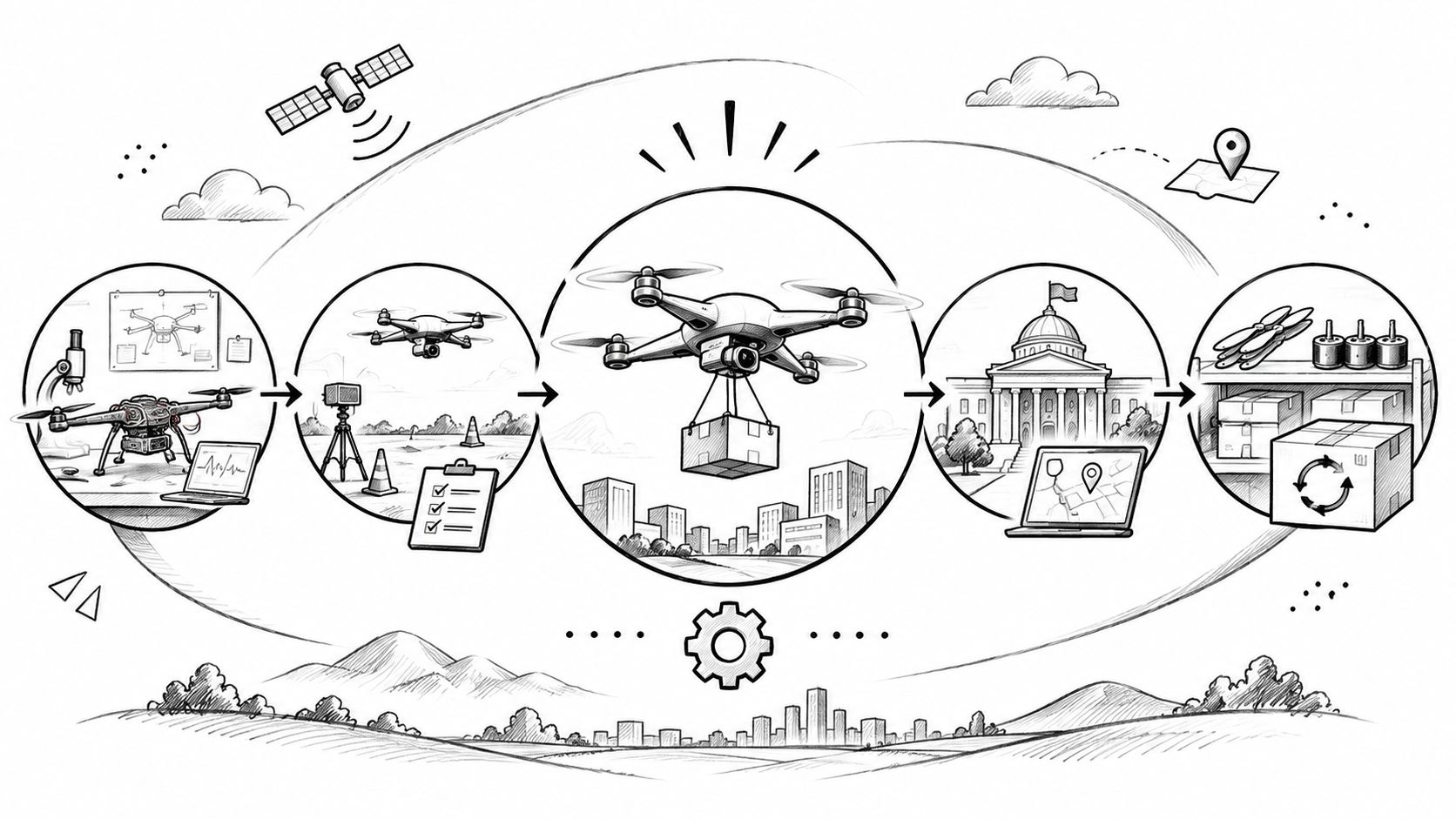
These hypothetical patterns show how SBIR Phase III can turn earlier research into paid work, without assuming that any particular purchase automatically qualifies.
Examples of Phase III Work in Practice
When Commercial Buyers Enter the Picture
Commercialization
- Buying signal: Commercial customers want a product incorporating technology developed under an earlier SBIR agreement.
- Funding source: Non-federal capital supports bringing that product to market.
- Lineage evidence: Prior award documents and product specifications connect the commercial capability to the funded research.
When Agencies Need Production and Services
Government Production or Services
- Buying signal: A program office needs production units or operating services based on the earlier technology.
- Funding source: Federal money outside the SBIR program pays for delivery.
- Lineage evidence: The proposed scope identifies which earlier SBIR results support the requirement.
These patterns reflect the commercial and government funding directions in the SBIR statute. Think of them as different customers buying from the same technology family tree, not separate research programs that merely share a subject.
Recognize Testing and Subcontract Demand
Test and Evaluation
- Buying signal: A buyer requests operational testing that extends an existing SBIR capability rather than restarting feasibility research.
- Funding source: Non-SBIR federal funds support the evaluation.
- Lineage evidence: Test objectives reference earlier deliverables and explain the additional validation required.
Subcontract Performance
- Buying signal: Another prime contractor needs the original awardee's technology within a government requirement, potentially at any subcontract tier.
- Funding source: Government contract funding outside SBIR flows through the contracting chain.
- Lineage evidence: Subcontract tasks map directly to earlier SBIR work.
The Defense Department's contracting guidance recognizes testing and subcontract pathways. Neither changes the need to document the technical connection.
Sustainment and Parts Supply
- Buying signal: Repeat requests seek replacement items supporting the transitioned technology.
- Funding source: Non-SBIR federal procurement funds purchase qualifying follow-on items.
- Lineage evidence: Item specifications and award records connect those parts to the earlier effort.
FederalPipeline includes parts RFQs from DLA DIBBS and Navy NECO with quantities, buy history, and approved sources. Compare those records to assess recurring demand and identify listed suppliers through FederalPipeline's procurement research.
Choose one requirement, document its funding and ancestry, then use this government proposal guide to prepare your buyer discussion.
The notice's label matters less than the work's lineage. Recurring demand alone doesn't establish Phase III eligibility.
None of this matters — lineage, pathways, buying signals — unless you turn it into a habit you actually run every week. Here is a simple workflow capture and BD teams can stick with in 2026.
A Five-Step Research Workflow
- Build your capability profile. FederalPipeline starts with your work email domain to identify the company, then pulls together your registration, award history, and website into one profile.
- Search Opportunities. Coverage spans SAM.gov solicitations, agency forecasts, grants, and innovation programs, including other transaction agreements, with each match scored against your profile. FederalPipeline's Opportunities search includes SAM.gov solicitations, agency forecasts, grants, and innovation programs, with each opportunity scored for a company based on its registration, past awards, and website.
- Qualify fast with capture briefs. Each brief lays out what is being bought, clearance needs, set-aside and certification requirements, the incumbent, the ceiling, and every deadline.
- Trace program ownership and budget lines before a notice drops, and check incumbents and teaming connections.
- Save the search, set alerts, and push the pursuit into the pipeline.
Qualify Early Instead of Reading Everything
Attachment review is where most SBIR Phase III research time disappears. FederalPipeline calls out bid blockers up front, including the incumbent, the prior contract, and key requirements pulled from the attachments.
That lets you kill a bad fit in minutes, not hours. For stronger qualification habits, check out our guide on finding federal business opportunities.
The pipeline is where stage, next action, and supporting research stay attached to each pursuit, so nothing lives only in someone's inbox.
A specification RFP analyzer can complement FederalPipeline when evaluating and comparing federal research and contracting opportunities, and teams that need to analyze lab specification RFPs can layer that on top of this workflow.
Access and Pricing
Browsing without an account sits under daily limits. A free account includes 500 searches, 200 record views per day, and 10 alerts.
- Pro costs $49 monthly, with unlimited AI company and capture reads plus contracting officer and buyer contacts.
- Team costs $39 per seat monthly with a three-seat minimum.
Paid plans add CSV exports, and the platform runs daily updates across connected federal records.
Start with one saved search tied to a prior award number, turn on an alert, and let the pipeline carry it from there.
SBIR Phase III eligibility comes down to the earlier work — not just how big the company is now or whether it checked off every research phase.
Frequently Asked Questions About SBIR Phase III
Must a Company Complete Phase II First?
No. An agency can sign a Phase III agreement with a Phase I or Phase II awardee at any time, according to Defense Department contracting guidance.
Think of it less like a staircase and more like a bridge. If a Phase I project already produced something the government needs next, there is no rule forcing the company to finish Phase II first.
The catch is documentation. The proposed work still has to show a clear link back to that earlier SBIR effort, and it must be funded outside of SBIR.
Can a Company Outgrow Small-Business Size Standards?
Yes. The size limits that control Phase I and Phase II don't apply to Phase III, as the Defense Department guidance explains.
So growth by itself doesn't shut the door. A company that has scaled up can still qualify.
What helps here is preparation. Keep the prior award paperwork handy, along with a side-by-side comparison of the technical scope. That lets contracting staff focus on whether the lineage qualifies, instead of getting stuck on current headcount or revenue.
Is Phase III Always Sole-Source?
No. Phase III awards can be competitive or noncompetitive, and no new competition is required under the SBIR authority, according to federal contracting guidance.
No mandatory recompetition doesn't mean a guaranteed award.
This is where a lot of teams get tripped up. Proven lineage makes an award possible without a fresh competition — it doesn't force the agency to buy.
Before assuming anything, ask the contracting officer which acquisition approach fits the requirement.
How Should Teams Find Notices Without Phase III Labels?
Many follow-on buys never use the words “Phase III.” You have to search for clues instead of the label:
- Prior award numbers and technology lineage tie the original research to the new scope.
- Program ownership and contract vehicles point to who buys and how they buy.
- Incumbent relationships open the door to supplier and teaming talks.
Start narrow, then widen out. One solid thread is often enough to surface the real opportunity.
Pick one prior award today and trace its buyer, budget, and related requirements with FederalPipeline. Save the search and give your team a clear next research step.