Your saved search fires on a Tuesday. The notice carries a question deadline nine days out and a response date before the end of the month. Someone opens the instructions volume, sees thirty pages of rules about fonts, page limits and file naming, and says the sentence that sinks more bids than any other: "Let's start writing and sort the rest out later."
Drafting first is how capture teams burn weeks. The expensive decisions on a proposal to government all happen before the first sentence of the technical volume. Whether you're eligible to bid at all. Whether the requirement is already shaped around an incumbent. Whether every instruction in the solicitation has an owner and a home in the response. Get those three right and the writing moves fast. Get them wrong and you produce a polished document that scores low, or never gets submitted.
Proposal Parts and What Evaluators Score
A federal proposal is judged volume by volume, and each volume is scored against the evaluation factors the solicitation names. Nobody grades the document as a whole. The technical volume earns a technical rating, past performance earns a relevance and quality rating, and price gets its own analysis. Representations and certifications sit outside the scoring, but they settle an earlier question: whether you were allowed to bid.
The scale explains the scrutiny. The U.S. federal government committed approximately $793 billion in contracts during fiscal year 2025, according to the U.S. Government Accountability Office. Every requirement inside that total was competed against a written standard and read by someone scoring it line by line against that standard.
| Volume | What evaluators check | Where the rules come from |
|---|---|---|
| Technical approach | Method, staffing and deliverables tied to the statement of work | Evaluation factors and instructions |
| Past performance | Relevance and quality of comparable work | Solicitation references and reference contacts |
| Price or cost | Price realism, reasonableness and formulas that match the technical labor | Pricing schedule and price instructions |
| Management and staffing | Organization, key personnel and risk control | Management instructions and factor weights |
| Representations and certifications | Eligibility and socioeconomic status | SAM.gov registration and solicitation clauses |
Read instructions and evaluation criteria side by side
In a uniform-format solicitation, Section L holds the instructions to offerors and Section M holds the evaluation factors and their weights. Read them together, not one after the other. L tells you what to submit and in what shape; M tells you what gets scored and how heavily. Where L demands something M never scores, you've either found a drafting error worth a question or a compliance item you still have to satisfy.
Not every solicitation uses that structure. Plenty of simplified and commercial-item acquisitions run a single instruction list with a short evaluation section attached to it. Check the document before you assume a format.
Know which document you're answering
An RFP asks for a technical and price proposal scored against the evaluation factors. An RFQ usually wants a simpler quote. A sources-sought notice or an RFI asks only for capability information and awards nothing at all. Teams that treat an RFI as a live opportunity spend weeks on a document with no contract behind it, while teams that treat an RFQ as a full RFP drown a small requirement in paperwork nobody asked for.
Before drafting, write one sentence per volume naming the factor it satisfies. A proposal that can't show where each factor is covered gets marked down even when the underlying work is strong.
Engage Early Before the Solicitation Drops
By the time a notice posts, the requirement is mostly set. The scope, the contract type, the evaluation weights and often the incumbent's advantage are already written into the acquisition plan. That's why the useful window opens months before release, not on the day the notice appears.

Signals worth tracking come in plain sight. The agency's budget request shows which lines are funded, and the program office that owns a line is usually the office that will buy. Published forecasts, existing contracts nearing expiration, draft requirements and sources-sought notices all leak intent early. A sources-sought notice in particular tells you the agency is building a requirement, what it believes the scope is, and which vehicle it intends to use, months before a solicitation exists.
Map the buyer before you introduce yourself
Identify three things: the contracting office that will run the buy, the contract vehicle it's likely to use, and who holds the work now. FederalPipeline lets users follow defense budget lines to the program offices that own them and the contracting offices they buy through, years before the requirement reaches SAM.gov. That's the map you want in hand before an industry day, not after.
Then make one contribution. Ask a question at an industry day that shows you understand the operational problem, not your own capabilities. Submit market research that describes what you can do and where the gaps usually sit, without revealing how you do it. Generic enthusiasm doesn't register with a buyer who has read forty vendor slides that month.
Engagement rule: one specific input that solves a named problem beats ten emails of enthusiasm.
The sequence that works is short. Watch the budget and forecast signals. Map the buyer, the vehicle and the incumbent. Submit one useful piece of market research. Then build the capability statement and the eligibility file so you're ready when the notice lands.
When a forecasted requirement lines up with your past performance, start the eligibility work now. The calendar after posting is short, and the companies that win are usually the ones that were ready on day one.
Confirm Eligibility and Set-Asides Before You Write
A solicitation lands with a small-business set-aside, and the capture team has already sketched a technical approach. Three weeks later, the size standard check kills it. That is the expensive way to learn that eligibility comes first. The cheap way is to run the check before anyone drafts.
Small-business policy shapes the whole market. The Business Opportunity Development Reform Act of 1988 set a government-wide minimum requiring small businesses to receive at least 20% of the total value of prime contract awards each fiscal year, and that benchmark later rose to 23%, according to the Congressional Research Service. Set-asides are a permanent slice of federal spend, and they are closed to firms that do not qualify. Screening for them early is more valuable than competing indiscriminately across the entire federal market.
The checks, in the order a bid manager runs them
Start with the set-aside language in the solicitation. A small-business or socioeconomic set-aside limits the bidder pool, and better writing does not fix a category mismatch. Then confirm the NAICS code and its size standard, because the same firm can be small under one code and other-than-small under another. Run the affiliate test, since ownership and affiliate revenue or headcount feed directly into the size calculation. Verify your SAM.gov representations and the certification for the category you claim.
Separate prime eligibility from teaming. A firm can be a strong subcontractor on a set-aside it could never bid as prime, and that is a legitimate strategy rather than a consolation prize. Teaming does not make an ineligible prime eligible. Finally, pull the incumbent, the prior contract and the attachment requirements. Clearances, certifications and an entrenched incumbent usually end a pursuit faster than any evaluation factor.
FederalPipeline reads every solicitation and provides capture briefs that state what's being bought, the clearance, set-aside and certifications required, the incumbent, the ceiling and every deadline. It also flags bid blockers up front, including the incumbent, the prior contract and requirements pulled from the attachments.
| Criterion | Pass condition | Evidence source |
|---|---|---|
| Size status | Small under the NAICS size standard, with affiliates counted | SAM.gov representations and size calculation |
| Set-aside category | Your certification matches the set-aside category in the solicitation | Solicitation set-aside clause and certifications |
| Teaming role | Prime eligibility confirmed, or a subcontract role is the fallback | Solicitation teaming rules |
| Past performance | Relevant comparable contracts with reference contacts | Capability library and reference records |
| Staffing and clearances | Key personnel and clearances available by the award date | Statement of work and attachments |
| Incumbent position | Incumbent and its prior contract assessed | Prior award and agency records |
| Price realism | Labor rates support a competitive price at the expected ceiling | Pricing schedule and market rates |
| Win probability | A discriminating factor identified against likely competitors | Competitive analysis and capture brief |
Eligibility files live or die on documentation, and they get reviewed in odd places: a parking lot after a site visit, an airport gate. Teams that dictate findings instead of typing them keep better records. For documentation captured after a site visit, hands-free note taking for aging users can record findings without a keyboard.
Close the check with a written bid/no-bid note listing eligibility, past performance, staffing, security and price. A recorded decision beats a remembered one, especially when the same requirement resurfaces next year. If the set-aside picture is unclear, the small business set-aside rules are worth reading before you commit production hours.
How to Build a Compliance Matrix Step by Step
Every later decision depends on this artifact, so build it before anyone drafts a word. A defensible matrix maps every solicitation instruction, evaluation factor, submission limit and performance requirement to a proposal section, an owner, an evidence source and an internal review date. The GAO's protest data for FY2024 shows why this matters: the leading bases for sustained protests included unreasonable technical evaluation, flawed selection decisions, and unreasonable cost or price evaluation, which is why a matrix that ties every requirement to evidence matters.
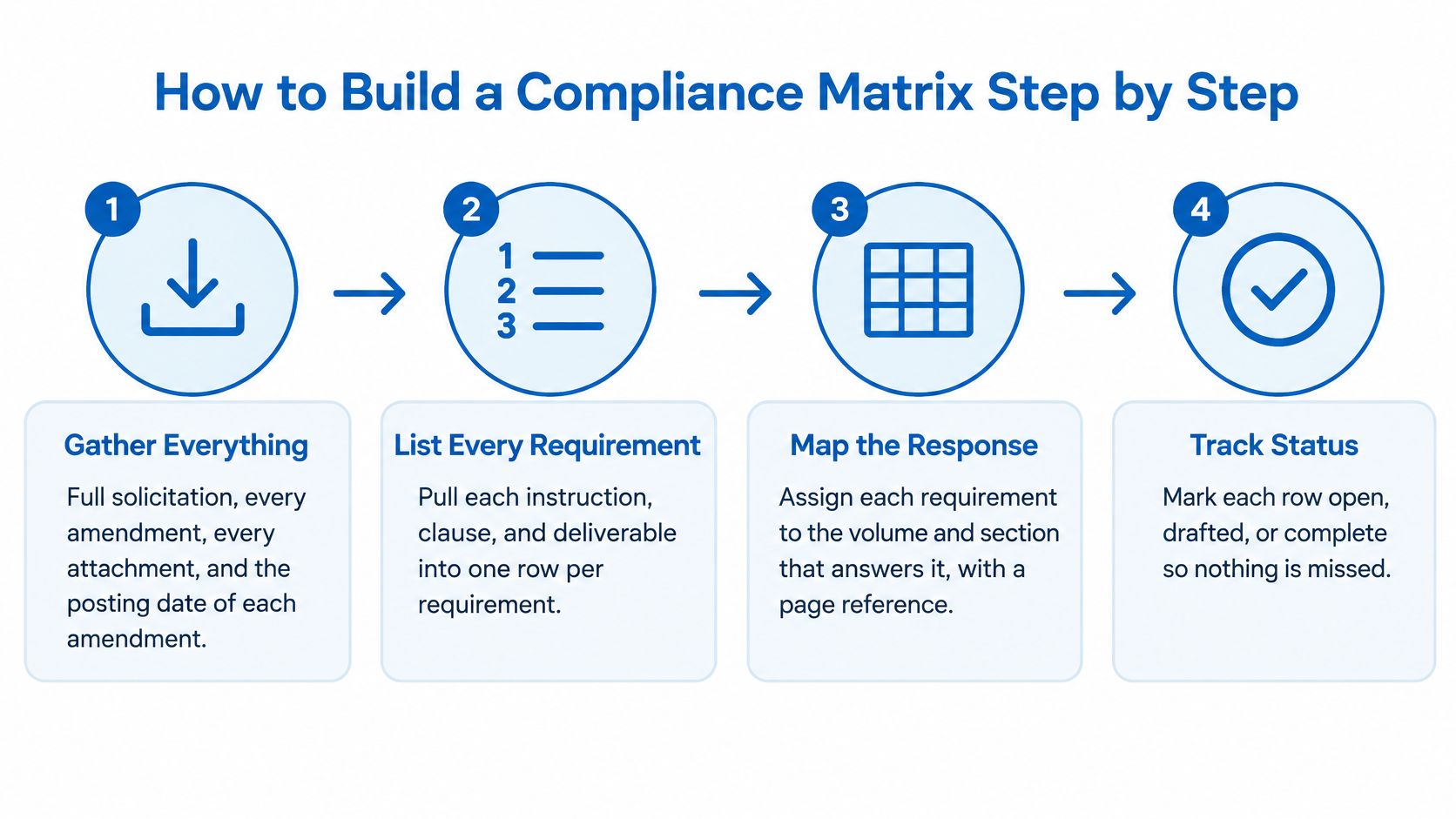
Gather everything. Download the full solicitation, every amendment and every attachment, and note the posting date of each amendment. Late amendments routinely change page limits, due dates and required forms, and a matrix built on the original document goes stale.
List every requirement. One row per item, with the source section and page number. Capture instructions, evaluation factors, submission limits, deliverable schedules and contract performance requirements. Reading only the statement of work is the common slip; page limits and format rules are often buried in the attachments.
Map each row to a response. Use the solicitation's own factor order and terminology, so an evaluator can find the answer without hunting. If a factor has no home, you have found a hole before it costs you a rating.
Assign an owner and an evidence source. A name and a document: a résumé, a past-performance reference, a pricing workbook, a certification letter. A row with an owner but no evidence is a promise waiting to become an unsupported claim.
Set a review date for every row. Work backward from the due date and leave protected time for an independent red-team read. Rows without dates are the ones that get answered at 2 a.m. on submission night.
Flag the conflicts. A staffing assumption in the statement of work that disagrees with the price schedule is a defect, not a detail. Resolve it through the question process while the solicitation still allows questions.
Here's how the process looks when a capture team walks it end to end.
Scoring conventions matter when you build the matrix. Many teams grade each row against a simple scale, and clear guidance on yes, no and partial compliance scoring from Procright helps keep reviewers consistent across volumes. The scale matters less than applying it the same way to every row, because inconsistency is what turns a matrix into a set of opinions.
The completeness test is mechanical. Every row has an owner, an evidence source and a review date, and no row is blank. A blank row means either you do not understand the requirement or you have decided not to answer it. Both need a decision today rather than a surprise during production.
Draft Each Section Against the Evaluation Criteria
Drafting gets easy once the structure is locked, because the matrix has already told you what each section must prove. The job now is placement and evidence. Evaluators read quickly, against a checklist, and they reward proposals that make their checklist easy to complete.
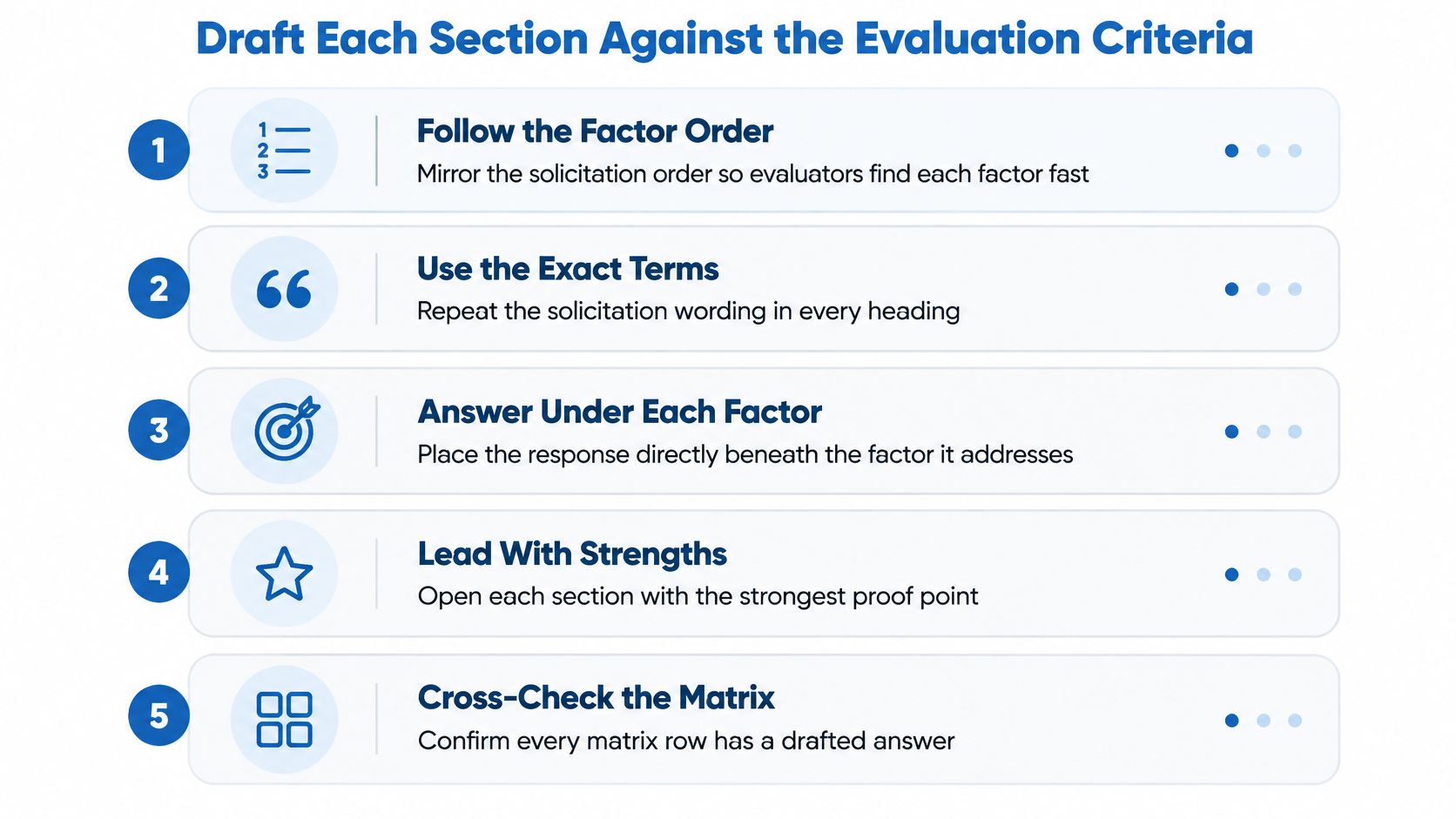
Start by mirroring the solicitation's factor order in your headings, using its exact terms. If the solicitation says "quality control approach," your heading says quality control approach, not "our commitment to excellence." Under each heading, restate the requirement in one sentence, give the approach, then supply the evidence. That pattern is boring, and boring is what an evaluator hunting for a specific criterion wants.
Trace every technical promise to something measurable. Not "we deliver on time," but monthly reports issued within five business days of month end, with the contract where that standard held named in the same paragraph. A promise with a metric and a precedent is a strength. A promise with an adjective is a risk.
Drafting rule: if a sentence can't survive the question "where is that proven," cut it or replace it with one that can.
Write with the actual response format in mind, because the price volume changes shape with the vehicle. The difference between how RFPs and RFQs structure pricing affects what you draft: a firm-fixed-price RFP wants a cost build-up you can defend line by line, while a parts RFQ often wants a unit price and a delivery date. Reconcile the two volumes before either is final. Staffing hours described in the technical approach must match the labor categories and quantities in the price schedule, down to the hour count.
Remove superlatives you can't support and claims the statement of work never asked for. Unsupported claims don't just fail to help, they invite doubt about the claims that are supported. Keep a claims register linking each asserted strength to the specific solicitation criterion it answers, so the red team can audit the mapping instead of re-reading prose.
Write the management and risk sections last. They expose the gaps the earlier sections left open, and it's easier to staff a risk register once the technical approach is settled than to invent a technical approach around a staffing chart.
Any finished section should be readable on its own and still make clear which factor it answers.
Red-Team Review and Pre-Submission Audit
Most proposal losses come from errors someone on your own team could have caught. Not superior competitors. Not pricing strategy. Missed instructions, unreconciled labor hours, a technical claim with nothing behind it, a file uploaded in the wrong format. Review is a risk-control function, and treating it as a final proofread is how those errors reach an evaluator.
The protest record shows how often procurement errors surface after award. The GAO's FY2025 protest data shows that only 14% of protests resolved on the merits were sustained, but protesters obtained some form of agency relief in 52% of all cases, with a five-year effectiveness rate of approximately 48%. Those numbers aren't your odds of winning a contract. They're a measure of how often agencies end up correcting or reworking an award, and the recurring causes are familiar: inconsistent application of stated factors, unsupported technical ratings, unreasonable price or cost analysis, unequal treatment, and rejection of a proposal after a material misreading of its contents.
Pass one, read like an evaluator
The red team gets the evaluation factors and the proposal, and nothing else. No verbal explanation, no context from the capture lead. Ask three questions of every section. Does each claimed strength map to an explicit criterion? Does any assumption contradict the statement of work or an attachment? Can the rating an evaluator would give be supported by evidence inside the document?
Pass two, audit the mechanics
Then run the checklist that catches what sinks otherwise strong bids.
| Audit item | What to verify |
|---|---|
| Page counts | Each volume is within the stated limit, with the required fonts and margins |
| File naming | Every file name matches the portal and solicitation instructions |
| Signatures | Each required signature and certification is present and dated |
| Representations | SAM.gov registration and representations are current and match the claims |
| Pricing formulas | Totals, escalation and labor rates reconcile with the technical volume |
| Attachments | Every required form and attachment is included and current |
| Portal timestamp | Upload is complete before the deadline and the confirmation is saved |
Freeze the compliance baseline before final production. Once the matrix is locked, late edits can't break a page limit or orphan a requirement. Then track the leading indicators that predict quality: compliance defects per proposal, unresolved assumptions, review findings sorted by severity, and the share of claimed strengths backed by past-performance evidence. Any of those tells you more about your next bid than a win rate does.
Hard rule: no edits after the final audit unless a second reviewer signs off on the change.
An avoidable error doesn't just cost you the award. It starts a clock, creates rework, and pulls your team into a dispute when they should be writing the next pursuit.
Submit on Time and Decide Your Next Bid
Upload the complete set of volumes at least one business day before closing, through the official portal, and save the confirmation with its timestamp. If the portal fails, follow the solicitation's stated fallback procedure immediately, contact the contracting officer only as the instructions permit, and log every step with the time it happened. Deadline-day heroics are how good proposals die in a queue.

Within a week, hold a short lessons review. Note which factors were hardest to evidence, which assumptions changed during the red-team pass, how many days each review consumed, and which matrix rows needed the most rework. If you lose, request a debrief inside the window the solicitation allows and use the answers to update both the matrix and the past-performance library.
Keep one pipeline record per pursuit with its stage, next action and eligibility file, so the next bid starts from documents rather than memory. Setting up a FederalPipeline account takes two minutes: you sign up with a work email through a magic link, confirm the company, and get matched to opportunities scored for fit with email alerts on your schedule. The Pro plan at $49 per month adds unlimited searches, buyer contacts and CSV export when the pipeline outgrows a spreadsheet.
The decision to make this week is narrow. Confirm you meet every line of the bid/no-bid table. If a line fails, pass on the opportunity and move the effort to the next forecasted requirement that matches your past performance.
FederalPipeline connects the pieces this process depends on: solicitations and forecasts scored for fit, capture briefs that surface set-asides, clearances, incumbents and ceilings before you open a single attachment, and budget lines traced to the program offices that own them. If your team is qualifying opportunities by hand and still missing blockers, FederalPipeline is built to shorten that work. Sign up with a work email and see which open requirements match your past performance.