You've found a federal notice that looks made for your company. The work fits, the quantity is manageable, and the words small business set aside sit right at the top. Then doubt sets in. Does that label mean only firms like yours can bid, does it improve your odds, and could hidden requirements still make the buy unwinnable?
Those are three different questions. A set-aside answers the first one. It doesn't answer the other two by itself. Work through the value rules first, then your eligibility, then whether you can realistically compete.
Set-Aside Rules by Contract Value at a Glance
Start with the estimated dollar value, because value drives the treatment an acquisition receives. Use this lookup before you read anything else in a notice.
| Contract value or situation | Set-aside treatment | What the contracting officer must confirm |
|---|---|---|
| Below micro-purchase threshold (about $15,000) | Set-aside generally not required, simplified purchase methods apply | Price is reasonable and a simplified purchase method is used |
| Above micro-purchase threshold up to $350,000 | Total small business set aside generally required | Reasonable expectation of at least two responsible small-business offers at fair market price |
| $350,000 and above | Socioeconomic programs considered first, then general set-aside if the two-offer test is met | Same two-offer and fair-price test, plus program eligibility |
| Any value, partial requirement | Part of the requirement reserved for small business | Acquisition strategy supports dividing the work |
| Any value, no acceptable offer received | Solicitation withdrawn and resolicited without the set-aside | Market re-evaluated before the new solicitation |
| Any value, one acceptable small-business offer | Award generally made to that firm | Offer is responsible and priced fairly |
Reading the Rows in Order
Below the micro-purchase threshold, buyers generally use simplified methods and don't have to reserve the purchase. That doesn't exclude you. It means the buy is small enough that the formal reservation process usually isn't required.
From above that threshold up to $350,000, a total set-aside is the default. The word total matters because the whole requirement is reserved, not just a slice of it. The exception is important too. If the contracting officer has no reasonable expectation of two responsible small-business offers at fair prices, the mandatory treatment falls away.
At $350,000 and above, the officer doesn't jump straight to a general small business set aside. Socioeconomic programs come first, and a general set-aside follows only if that review doesn't produce a program-specific reservation and the two-offer test is met.
Two Details Readers Often Miss
A partial set-aside can apply at any value. The agency reserves part of a larger requirement, so a small firm may compete for a defined portion even when it couldn't perform the whole job.
Practical rule: Find the estimated total value, including options, before you judge which row applies.
Don't rely on one line item or the first-year amount. Options can push a buy into a higher row. Find the solicitation's stated estimate, match it to the table, and only then assess your eligibility.
What a Set Aside Reserves and Who Qualifies
A small business set aside reserves an acquisition, in whole or in part, for eligible small businesses. Only qualifying firms may compete for the reserved work. Think of a reserved lane on a road. The lane decides who may enter, not who arrives first.
That reservation happens before competition. It's not a scoring bonus added after large and small firms have bid against each other. This distinction is central to the system described in the GAO summary of the government-wide small business goal, which notes that Congress established a goal that at least 23% of the total dollar value of federal prime-contract awards should go to small businesses in each fiscal year, as cited in that summary.
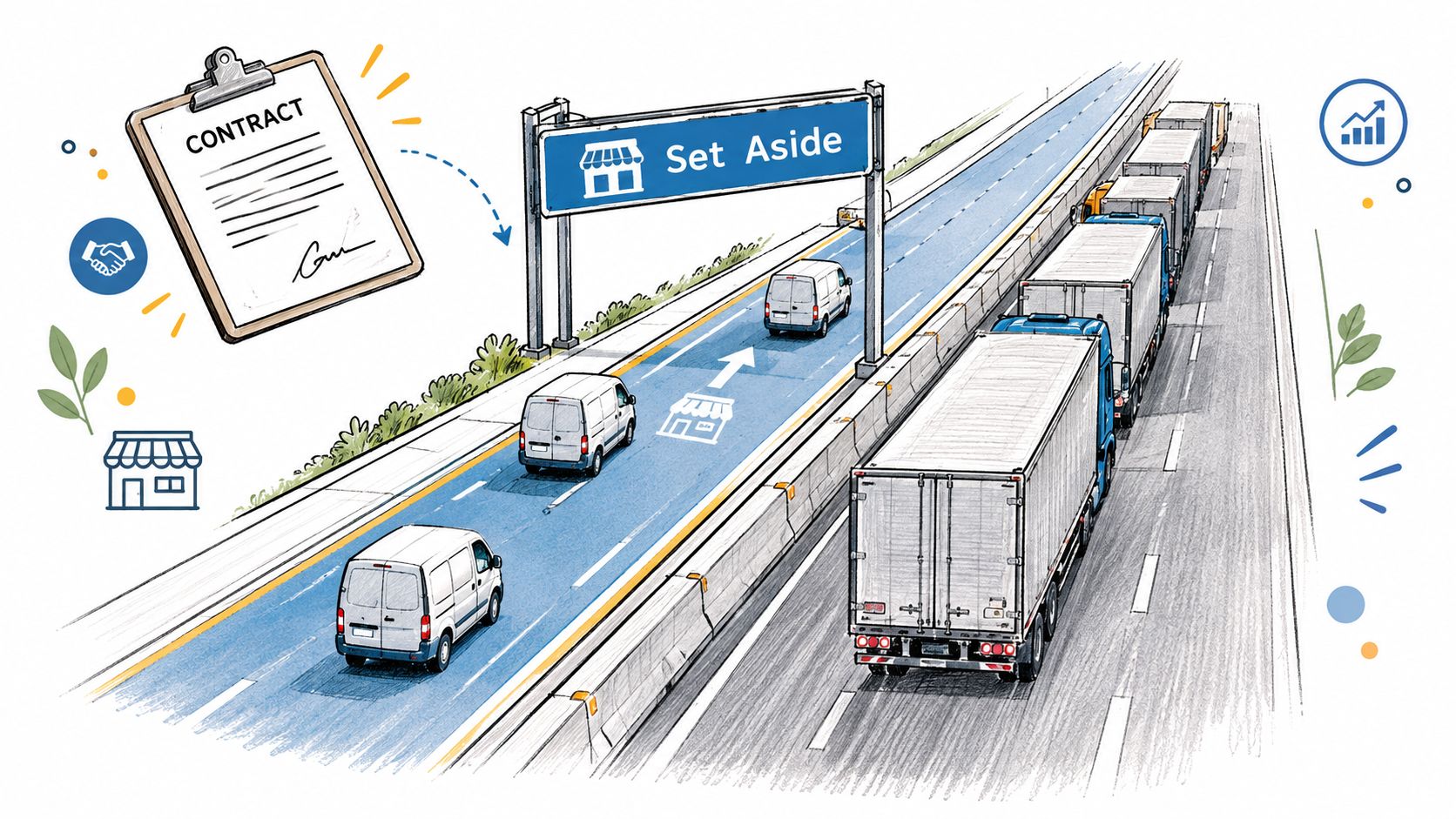
Don't read that 23% figure as a promise about any single purchase. It's a government-wide target across federal prime contracting. A particular solicitation can still be unrestricted, partially reserved, or reserved under a socioeconomic program you don't hold.
Run Your Own Eligibility Check
Work from the solicitation outward, not from what you usually call your company.
- Find the NAICS code: Open the solicitation and locate the assigned North American Industry Classification System code, then find its size standard in the SBA size standards table.
- Compare your size: Check your average annual receipts or employee count, whichever that standard uses, against the threshold for that code.
- Confirm program status: If the notice requires 8(a), HUBZone, SDVOSB, or WOSB status, verify that your current certification matches that exact program.
- Check SAM.gov consistency: Confirm your registration lists the same NAICS codes and current representations, so your search profile and offer don't tell different stories.
Where Confusion Usually Starts
A firm can be small under one NAICS code and not small under another, because the size standard follows the code assigned to the procurement. Don't assume yesterday's result carries into today's notice. Recheck it every time.
Socioeconomic status is separate from size. Meeting the size standard lets you enter a general small-business competition, but it doesn't make you eligible for a program-specific one. Both checks have to pass.
A set-aside tells you who may bid. It doesn't tell you who will win.
Your size and status establish legal eligibility. Whether the reservation remains in place depends on the contracting officer's market test and the existence of enough responsible firms that can perform at a fair price.
How the Rule of Two Decides Whether a Set Aside Applies
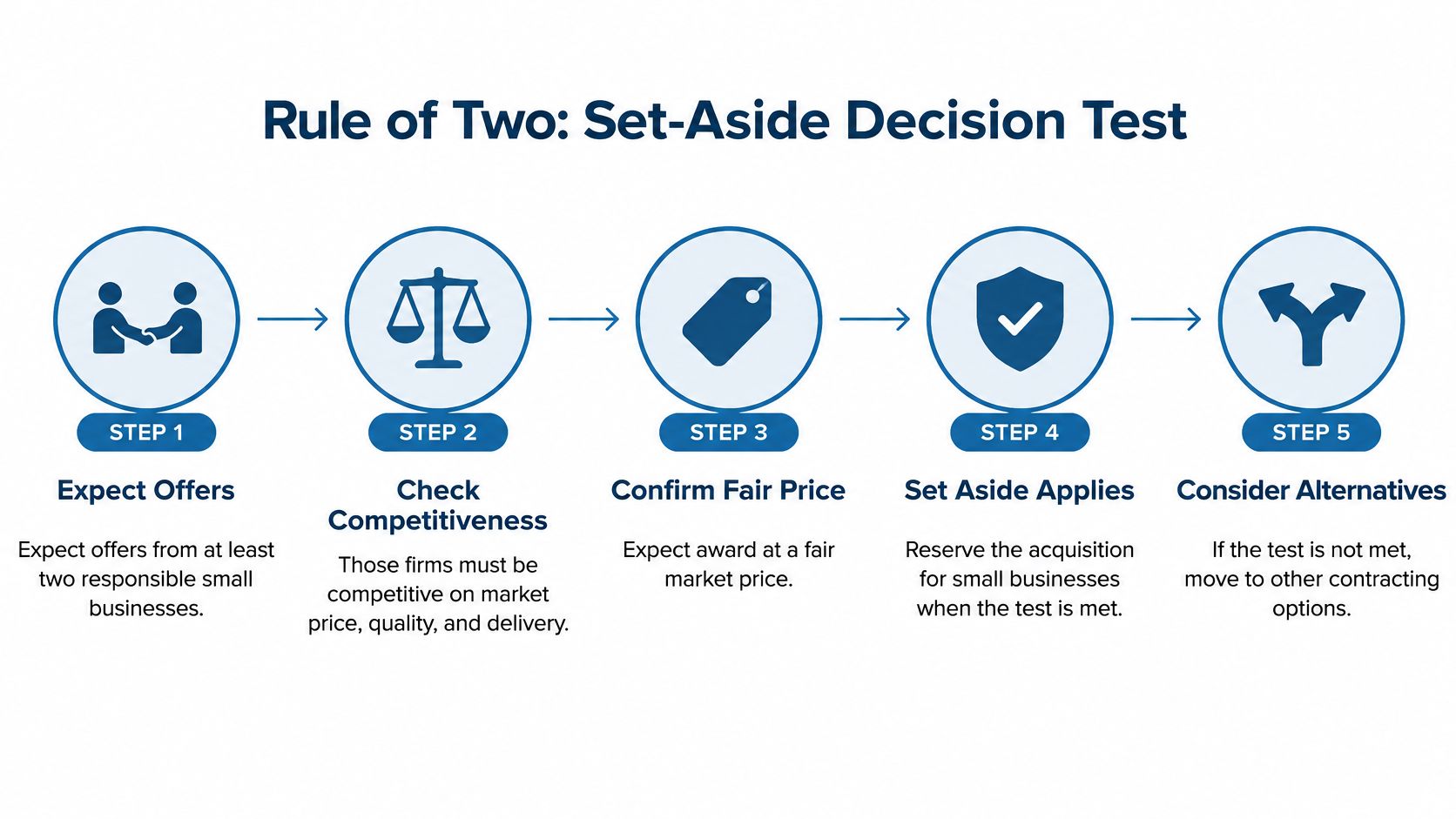
The rule of two is the engine behind the set-aside decision. Under FAR 19.502-2 on setting aside acquisitions, the contracting officer must reasonably expect offers from at least two responsible small businesses and expect award at a fair market price. Both parts matter.
Two names in a database aren't enough. The officer needs a reasonable basis to believe those firms can actually do the work, meet responsibility requirements, and price it fairly. That's why market research, not the label alone, determines whether a reservation holds.
Follow the Decision in Order
- Check the value: Match the estimated total, including options, to the thresholds in the opening table. The value tells the officer which set-aside treatment should be considered.
- Name plausible offerors: Use market research to identify specific small businesses that appear capable of meeting the requirement. A vague belief that someone might bid is weaker than named firms with relevant capability.
- Test capability and price: Confirm each candidate can perform the technical, delivery, quality, and responsibility requirements at a fair price. Registration under the NAICS code doesn't prove it can supply this item or service.
- Apply the result: If two firms pass, the set-aside stands. If the expectation isn't there, the officer follows the applicable alternative instead of reserving the buy on hope.
What Happens After Offers Arrive
If a set-aside receives no acceptable offer, it must be withdrawn and resolicited without the restriction. That outcome protects the agency from being trapped in a competition that produced no workable bid.
If only one acceptable responsible small-business offer arrives, the contracting officer should generally award to that firm. Don't confuse that award outcome with the initial decision test. Two expected offers support setting the buy aside, but one acceptable offer can still receive the award.
A Worked Example With Machined Brackets
For example, an agency plans to buy 400 machined brackets with a hypothetical estimated value of $280,000. Three small firms appear under the NAICS code. On paper, that looks like more than enough competition.
Closer research changes the picture. Only one firm has supplied the part before and holds the drawing approval needed to make it. The other two are registered, but neither shows evidence it can meet the technical requirement.
In that example, a reasonable expectation of two qualified offers may be absent, so the set-aside generally wouldn't be required. The number that matters isn't how many firms exist. It's how many responsible firms can credibly offer at a fair market price.
For your own qualification work, mirror that logic. Identify at least two plausible eligible competitors, validate their capabilities and status, and compare incumbent or market pricing. A set-aside label alone doesn't establish that the opportunity is awardable or worth pursuing.
Socioeconomic Programs That Come Before General Set Asides
Above the simplified acquisition threshold, order matters. Contracting officers must first consider the socioeconomic programs before turning to a general small business set aside. SBA guidance for contracting officials explains that acquisitions from $15,000 to $350,000 are automatically and exclusively set aside for small businesses, while acquisitions of $350,000 or more require the two-or-more-small-business determination, with solicitation-level verification still required.
That sequence explains a common frustration. You may qualify as small, yet still be shut out because the notice is reserved for a program you don't hold. Size gets you into the general category. Program certification controls the narrower one.
| Program | Eligibility test | Priority above simplified acquisition threshold | Nonmanufacturer rule applies |
|---|---|---|---|
| 8(a) Business Development | Owned and controlled by socially and economically disadvantaged individuals in SBA's 8(a) program | Considered first | Yes |
| HUBZone | Principal office and employee residency tied to a historically underutilized business zone | Considered first | Yes |
| Service-disabled veteran-owned small business (SDVOSB) | Owned and controlled by service-disabled veterans | Considered first | Yes |
| Women-owned small business (WOSB) | Owned and controlled by women; EDWOSB adds an economic disadvantage test | Considered first | Yes |
| General small business | Within the NAICS size standard listed in the solicitation | Used only after programs are considered | Generally no at or below simplified acquisition threshold |
Understand the Nonmanufacturer Rule Before You Quote
The nonmanufacturer rule affects firms that resell products instead of manufacturing them. In plain terms, under the socioeconomic programs in the table, a nonmanufacturer generally must supply a product made in the United States by a small business.
That can change your sourcing plan completely. You might have distributor access, competitive pricing, and fast delivery, yet still fail the program requirement because the manufacturer behind the product doesn't fit. Check the source before you promise the item.
The general category works differently at the lower end. The nonmanufacturer rule generally does not apply to small-business set-asides at or below the simplified acquisition threshold. That exception is narrow, so don't carry it into an 8(a), HUBZone, SDVOSB, or WOSB buy where the rule applies.
Build a Screening Workflow You Can Repeat
Before you estimate eligibility or discuss teaming, extract four items from the notice and attachments. Capture the NAICS size standard, the program restriction, whether you're acting as manufacturer or reseller, and every certification requirement. Those four fields prevent most early mistakes.
If your firm holds several certifications, don't lead with the longest list. Use the one the solicitation specifically invokes. Extra credentials may help your capability story, but they don't substitute for the specific status named in the reservation.
How to Find Set Aside Opportunities Early
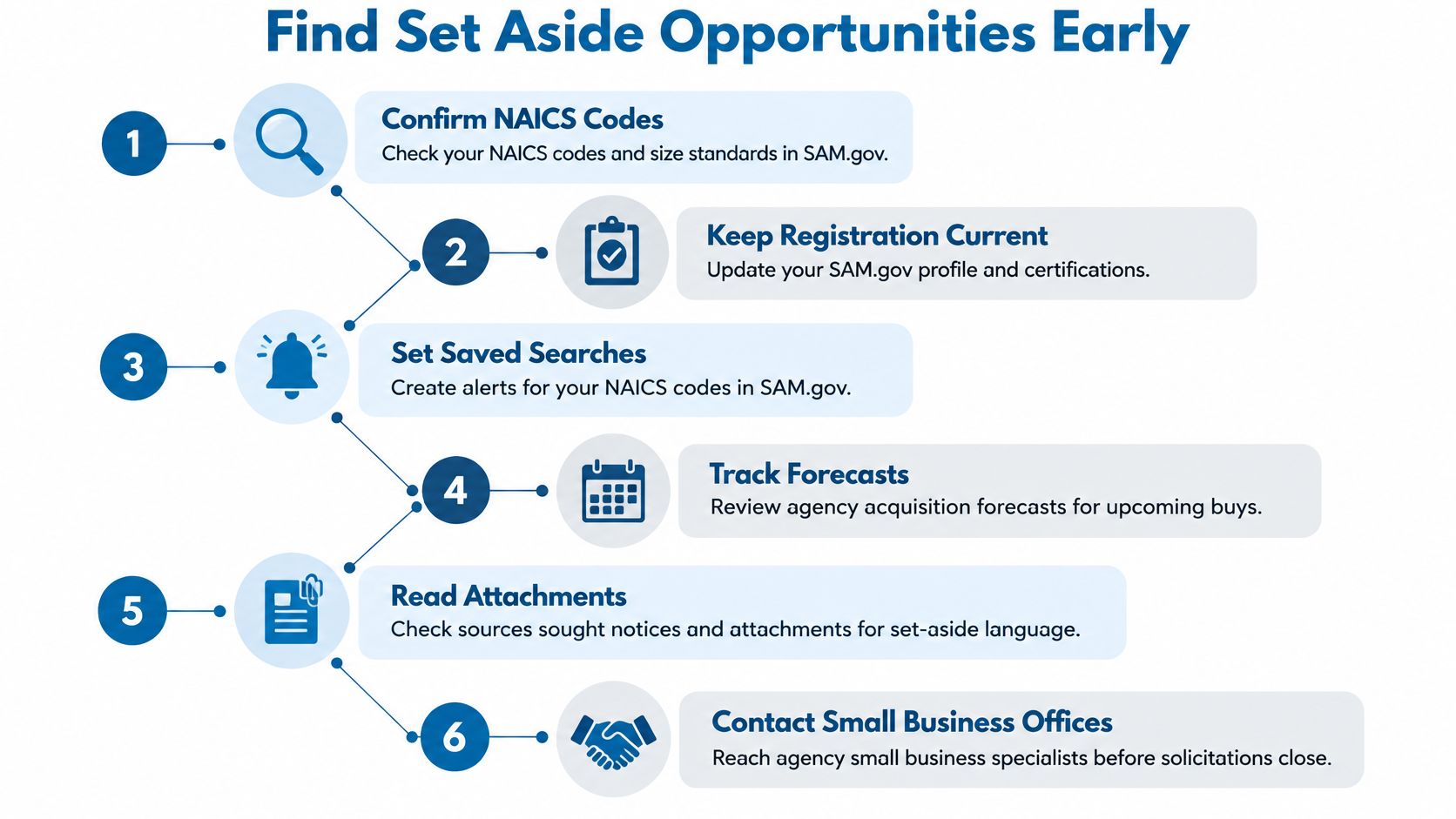
Most missed opportunities aren't lost on price. They're found too late, buried under a broad keyword search, or hidden in attachments nobody opened until the deadline was close. A repeatable search routine fixes that problem before proposal writing begins.
Set Up Searches That Match How Agencies Buy
- Confirm your NAICS codes and size standards: Make sure your registration reflects the work you can perform. Search categories built on the wrong code will surface the wrong buys and hide relevant ones.
- Filter SAM.gov by set-aside type: Don't rely only on keywords. Save searches by set-aside designation and NAICS code so new notices reach you in the category where you're eligible.
- Read agency forecasts and budget requests: Program offices often signal future requirements well before a solicitation appears. Forecasts give you time to research incumbents, certifications, and capacity.
- Pull award history from FPDS and USAspending: Look at who won similar work, which contracting office placed it, and whether a set-aside was used. Past buying patterns help you judge whether a future reservation is plausible.
- Monitor parts channels by NSN: If you supply parts, watch DLA DIBBS and Navy NECO requests for quotations by National Stock Number. Keyword searches alone can miss item-specific buys.
Open the Attachments and Track the Pursuit
- Read every attachment early: Look for the set-aside designation, clearance and certification clauses, drawings, approved-source language, and period of performance. The detail that disqualifies you rarely sits in the headline.
- Log each candidate with a next action: Record the deadline, open questions, competitor checks, and who owns the next step. A pipeline entry without a date is just a bookmark.
You can run every step with free government tools. It takes discipline, especially when forecasts, awards, and solicitations sit in different systems. A consolidated research tool can reduce that switching, but it doesn't replace reading the requirement.
When an opportunity sits under an existing ordering arrangement, also learn how a federal contract vehicle works before assuming you can bid directly. The set-aside may be real, while access depends on holding a place on that vehicle.
Search rhythm: Save the filters you'd want on your busiest week, not the ones you have time to rebuild today.
Early discovery buys you options. You can seek source approval, approach a teaming partner, question an unrealistic delivery window, or walk away before bid costs grow. Late discovery usually leaves only one option, which is rushing.
Legal Eligibility Versus Real Bidability
Here's the assumption worth challenging. A small business set aside doesn't mean the competition is open in any practical sense. It means eligible small firms are the only ones allowed in. One of them may still hold nearly every advantage that decides the award.
Keep two questions separate. Legal eligibility asks whether you may bid based on size, status, and certifications. Bidability asks whether you can realistically win against the requirement, the incumbent, the price history, and the delivery terms. Under FAR subpart 19.5 on small business total set-asides, the contracting officer must reasonably expect at least two responsible small businesses that can meet the requirement at a fair market price, and an award cannot be made if the small-business price is not fair and reasonable.

Signals That a Nominal Set Aside Is Narrower Than It Looks
- Incumbent concentration: One contractor keeps winning the same requirement, suggesting relationships, data, tooling, or pricing that newcomers can't match quickly.
- Approved-source or drawing control: The solicitation requires source approval or proprietary technical data, and only one eligible firm already has it.
- Clearance, facility, or location limits: Security, site, or geographic requirements shrink the eligible pool after the set-aside label creates a wider first impression.
- Delivery quantity and window: The required volume or schedule exceeds your current production, inventory, staffing, or supplier lead time.
- Price history: Prior awards show the going rate clearly, and your cost structure can't reach a fair and reasonable price without losing money.
Price deserves special attention on any fixed-price buy. Reviewing how fixed price contracting allocates cost risk can help you test whether matching the incumbent's historic price leaves any margin for performance problems.
A Valve Example With a Hard Verdict
For example, a parts supplier finds a hypothetical set-aside for 2,000 valves. The firm meets the size standard, and two registered competitors appear in early research. Legally, it can bid.
Then the details narrow the field. Price history in this example shows the incumbent has delivered the same part at a lower unit cost for three years. Only one competitor holds source approval, and the supplier would need approval before it could deliver an acceptable part.
The verdict is clear. The set-aside is legally real but commercially narrow. The supplier should team with the approved source if that route is allowed and economical, or pass and preserve bid resources.
Before you write, answer three questions. Who won the last three buys? Which firms can supply without new source approval? Can we meet the delivery window?
If you can't answer those questions with evidence, you don't yet have a bid decision. You have a label.
Decide to Bid, Team or Pass on a Set Aside
Make the decision in the same order the government does. First confirm your size, certifications, and program status against the solicitation. Then test whether at least two named, capable competitors support the set-aside logic. Finally check bidability, including source approval, incumbent strength, delivery capacity, and price history.
Skipping to enthusiasm is expensive. A notice can pass your keyword filter, carry the right set-aside label, and still leave you with no practical route to award. Slow the first hour down so you don't waste the next several weeks.
Apply a Simple Decision Rule
- Bid: Bid when you're eligible, at least two capable small firms make the competition credible, and you can perform at a fair price without heroic assumptions.
- Team or subcontract: Team when you qualify on size or status but lack source approval, past performance, capacity, or a technical element another firm already has.
- Pass: Pass when the set-aside is nominal, the incumbent position is closed, or price history leaves no responsible path to profit.
Treat the label as the start of qualification, not the answer. The same discipline applies when you're scanning the wider market for a federal business opportunity that fits your capabilities, because fit is always narrower than the headline category.
Turn the Checks Into a Repeatable Routine
Save the searches, record the blockers, and assign the next action while the evidence is fresh. FederalPipeline's Opportunities search includes SAM.gov solicitations, agency forecasts, grants, and innovation programs, with each opportunity scored for a company based on its registration, past awards, and website. Its Free plan at $0 includes 500 searches a day, 200 record views a day, 5 AI company reads a day, 10 alerts on saved searches and notices, and saved research on every device.
Setting up a FederalPipeline account takes two minutes. You sign up with a work email via a magic link with no password, confirm the company, and get matched to opportunities scored for fit with email alerts on your schedule. Use that kind of tool if it helps you maintain the routine. The decision to bid, team, or pass still stays with you.
Put the bidability test to work on your next small business set aside before you invest in a proposal. FederalPipeline connects solicitations, award history, incumbents, and your company profile so you can see eligibility, likely competitors, and bid blockers in one place. Start with the free account, save your set-aside searches, and let scored alerts bring the next qualified opportunity to you.