Costpoint is Deltek's enterprise resource planning software for government contractors, while “cost point” in general business usage can mean break-even, such as the 10,000 units needed to cover $100,000 in fixed costs when each sale contributes $10.
But does knowing when revenue covers expenses tell you which costs the government will reimburse? That's the gap between a basic break-even calculation and government contract accounting. If you're asking “what is cost point,” the spelling matters: cost point describes a financial threshold, while Costpoint names a system for connecting work performed, contract costs, billing rules, and supporting records.
What a Cost Point Is in Units and Dollars
In ordinary business writing, a cost point commonly means the break-even point, where total revenue equals total cost and profit is zero. The U.S. Small Business Administration's break-even guide gives the unit formula as fixed costs divided by selling price minus variable cost per unit.
Break-even units = Fixed costs ÷ (Selling price per unit − Variable cost per unit)
The amount left after subtracting variable cost from the selling price is the contribution margin. It covers fixed costs first, then contributes to profit.
Two worked cost-point calculations
In the SBA-style example, annual fixed costs of $100,000, a $12 selling price, and $2 variable cost produce a $10 contribution margin and a break-even requirement of 10,000 units. Below that volume, contribution margin doesn't cover fixed costs; above it, additional sales contribute to operating profit, assuming price and costs remain unchanged.
The University of Missouri Extension's product-pricing example uses $12,682 in annual fixed costs, $8.44 variable cost per bottle, and a $16 price, producing a $7.56 margin and break-even of 1,678 bottles after rounding. At projected sales of 2,000 bottles, its break-even price is $14.78, leaving a $1.22 cushion below the selling price.
| Example | Fixed costs | Price | Variable cost | Contribution margin | Cost point |
|---|---|---|---|---|---|
| SBA-style annual units | $100,000 | $12 | $2 | $10 | 10,000 units |
| Missouri bottles per year | $12,682 | $16 | $8.44 | $7.56 | 1,678 bottles |
| Missouri price at 2,000 units | $12,682 | $16 shelf price | $8.44 | $7.56 at shelf price | $14.78 break-even price |
To express break-even in sales dollars, divide fixed costs by the contribution-margin ratio, which is contribution margin divided by selling price. To find a break-even price, add variable cost per unit to fixed costs divided by expected unit sales.
There's no universal cost-point percentage. Your threshold changes when you change prices, expected volume, or the cost structure.
Costpoint at a Glance and What It Covers
Deltek Costpoint is an ERP system built around the needs of government contractors. It connects project accounting, timekeeping, billing, procurement, and financial records so employees can work from consistent contract and accounting information.
The two-word business term concerns break-even; the software name concerns how a contractor records and manages its operations. That distinction matters when you're searching for a formula but encounter instructions about timesheets, charge codes, or financial close.
Core modules and their main users
| Module | What it handles | Main users |
|---|---|---|
| Project accounting | Costs, budgets, and burn rate by contract, task, and project | Program managers and controllers |
| Timekeeping | Hours recorded against charge codes and labor categories | Employees and timekeepers |
| Billing | Invoices built from eligible costs and contract terms | Billing and contracts teams |
| Accounts payable and receivable | Vendor bills, customer payments, and collections | Finance staff |
| General ledger | Financial records and the period close | Controllers and CFOs |
| Procurement | Purchase orders and subcontract costs | Procurement teams |
| Compliance reporting | Indirect rate support, cost accounting records, and audit trails | Contracts and audit staff |
Costpoint can operate in cloud-hosted or on-premises environments. Its integrated accounting structure lets authorized teams use shared project, employee, vendor, and financial records instead of maintaining disconnected versions in spreadsheets.
For example, an employee's approved time can become project labor cost and support billing without someone manually retyping the same hours. That doesn't make every recorded hour billable. Contract terms, funding, labor qualifications, and accounting configuration still determine how the transaction is treated.
Practical rule: Think of Costpoint as the connection between an employee's work, the contract receiving that work, the applicable accounting treatment, and the evidence supporting the transaction.
The implementation matters as much as the product name. A contractor must establish project structures, approval responsibilities, rate configurations, and access permissions that match its actual operations.
If your team uses the term while discussing cost-reimbursement billing, time-and-materials invoices, or supporting records for auditors, it almost certainly means the software rather than a break-even calculation.
Why Government Contractors Need a Cost Accounting System
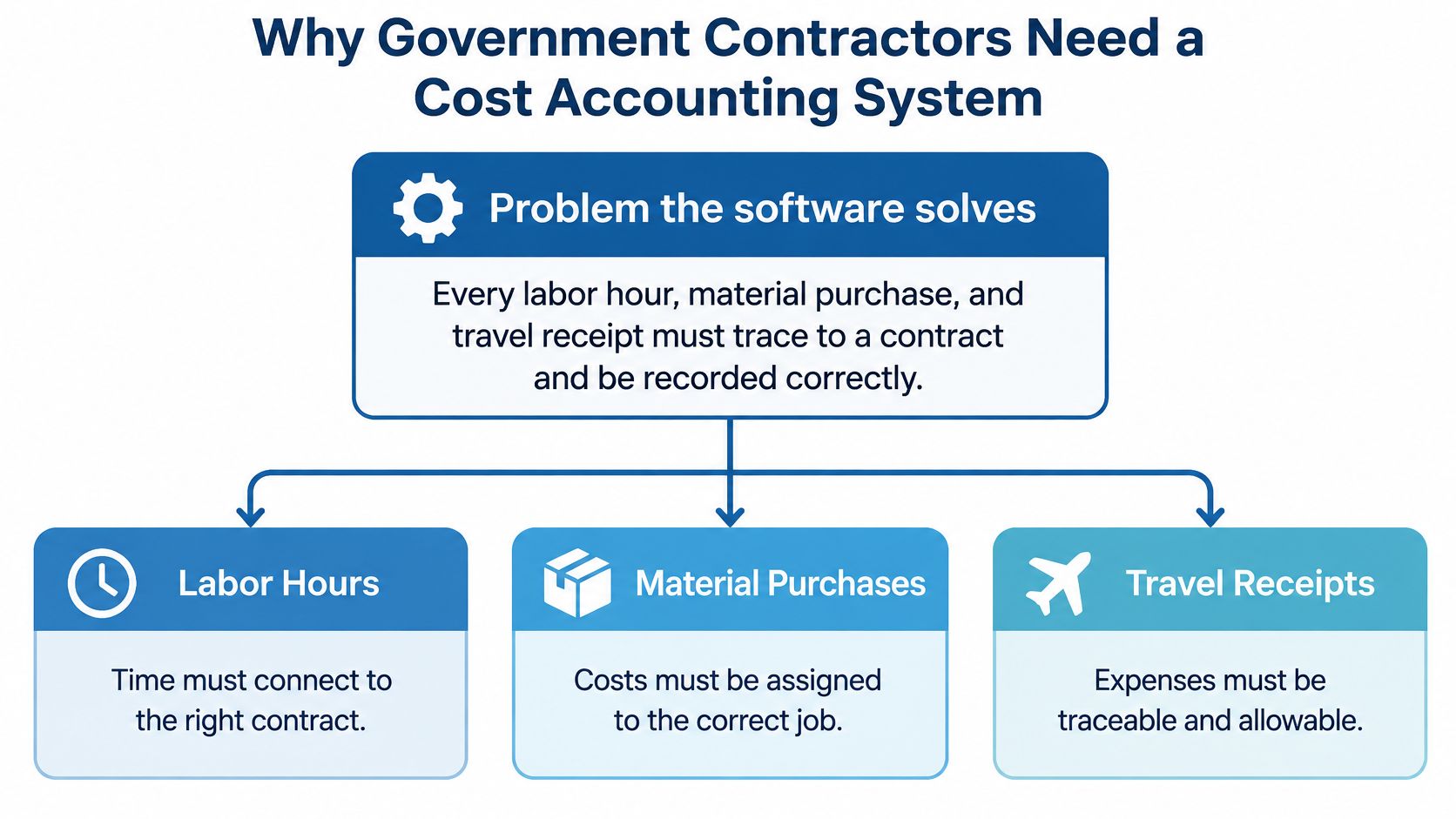
A general ledger tells you what the company spent. A government contract cost accounting system must also explain which work benefited, how costs were assigned, and whether those costs belong in a government bill.
That's a different problem from categorizing payroll, travel, and supplies. A payroll total can be correct at the company level while the allocation among contracts is wrong.
The accounting problem begins with the underlying transactions.
Recording an expense isn't permission to bill it
For cost-reimbursement work, contractors need to distinguish related but separate questions:
- Allowable: Is the cost permitted under the applicable cost principles and contract terms?
- Allocable: Does the cost benefit this contract, or should it be distributed among other activities?
- Reasonable: Would a prudent business incur this expense under comparable circumstances?
An expense can be real and properly documented without being reimbursable. It can also be an otherwise acceptable expense assigned to the wrong contract.
Cost Accounting Standards, when applicable, add requirements for consistent cost measurement, assignment, and allocation. Applicability depends on the acquisition and contractor's circumstances, not on whether the company calls itself a government contractor.
Why the labor split matters
Say an engineer works on customer deliverables and also helps prepare a proposal. The customer work belongs to the benefiting projects; proposal preparation needs its appropriate separate treatment.
If the engineer charges everything to the most familiar customer code, payroll may still balance. But the project manager sees distorted performance, the proposal account understates its activity, and billing staff may include labor that doesn't belong on that customer's invoice.
Fixed-price contractors also need reliable cost records to estimate future work and understand margins. Cost-reimbursement work adds a more immediate connection between recorded costs and amounts requested from the customer.
A balanced ledger proves that debits and credits agree. It doesn't prove that the right contract received the charge.
To assess your needs, ask whether you bill incurred costs, whether government reviewers examine your indirect rates, and whether you distribute shared expenses across multiple contracts. Several affirmative answers indicate a need for project-centered accounting controls, whether you implement Costpoint or evaluate another suitable system.
Price Reasonableness Cost Realism and a Credible Range
A federal contracting “cost point” isn't necessarily a target price. Before using the term in a capture meeting, identify whether you mean an acceptable offer price, your estimated performance cost, or the government's evaluated probable cost.
FAR Subpart 15.4 distinguishes price analysis, cost analysis, and cost realism analysis. They answer different questions:
- Price reasonableness: Is the offered price fair and reasonable, considering the appropriate price-analysis evidence?
- Cost analysis: Do the individual cost elements and proposed profit or fee support a fair and reasonable outcome?
- Cost realism: Are proposed costs realistic for the work, consistent with the solicitation, and aligned with the proposed technical approach?
A low offer may be competitive in fixed-price contracting while still depending on an implausible staffing plan. In a cost-reimbursement evaluation, realism analysis can lead the government to evaluate probable cost differently from the offeror's proposed cost.
Build a range you can defend
The Government Accountability Office's review of 252 fixed-price construction subcontracts completed in fiscal year 2023 found that 161, or 64%, finished above contractors' initial cost estimates, with total overruns of $37.5 million. Those findings concern that reviewed group, not a universal overrun rate.
GAO's estimating approach calls for a point estimate, comparison with an independent estimate, and analysis of risk and uncertainty. For a capture team, that means normalizing historical comparisons for scope, labor mix, schedule, and quantity before treating prior awards as benchmarks.
Document what would move your estimate. A credible range identifies its assumptions and confidence level rather than attaching unsupported precision to a single amount.
Name the risk that would push performance toward the high end, such as delayed hiring, uncertain material quantities, or a subcontractor's unresolved scope.
Indirect Rates That Set the Billable Price
Direct costs are identifiable with particular work. Indirect costs support more than one activity and must be allocated through an appropriate cost pool and allocation base.
Fringe benefits, overhead, and general and administrative expense are familiar indirect categories. The important question isn't just the percentage assigned to each category. It's what costs belong in the pool and what base receives the allocation.
An illustrative labor-hour build-up
Consider a purely hypothetical pricing worksheet with direct labor of $100, fringe of 30%, overhead of 40%, and G&A of 10%. These are teaching assumptions, not industry benchmarks, published company rates, or recommended billing rates.
In this scenario, overhead applies to direct labor plus fringe. G&A applies to the accumulated cost before G&A.
| Cost element | Allocation base | Illustrative rate | Resulting amount |
|---|---|---|---|
| Direct labor | One hour charged to the contract | Given amount | $100 |
| Fringe benefits | Direct labor of $100 | 30% | $30 |
| Overhead | Direct labor plus fringe of $130 | 40% | $52 |
| General and administrative | Total cost input before G&A of $182 | 10% | $18.20 |
| Total cost before fee | Sum of the rows above | n/a | $200.20 |
The sequence explains the result. Fringe increases the amount subject to overhead, then the accumulated cost becomes the assumed G&A base.
The percentages aren't added together and applied to direct labor. Changing the fringe assumption changes overhead, G&A, and the final total in this particular structure.
Use the company's actual allocation structure
Not every contractor uses these bases. Some overhead structures use a different labor base, and different G&A allocation methods can produce different results.
The accounting configuration must reflect the contractor's established practices and applicable agreements. Real rates come from the company's cost pools and allocation bases, with government review or agreement where required.
For cost-reimbursement billing, provisional billing rates support interim invoices and are subject to adjustment as applicable final indirect rates are established. Finance should distinguish estimated pricing rates, interim billing rates, and final rates rather than treating them as interchangeable.
Contract type also matters. For time-and-materials contracts, negotiated labor rates govern labor billing; the contractor shouldn't assume that an internal cost build-up becomes the invoice rate.
Configuration check: For every indirect pool, identify the included expenses, the allocation base, the applicable period, and who approved the setup.
That documentation makes a rate review useful. A percentage without its base tells a reviewer very little about whether the resulting allocation is correct.
How a Timesheet Becomes a Government Invoice
A government invoice begins with operational records, not with the billing screen. Employees, supervisors, accounts payable staff, project managers, and finance each handle a different part of the supporting evidence.
The simplified flow shows the relationship between recorded time and billing.
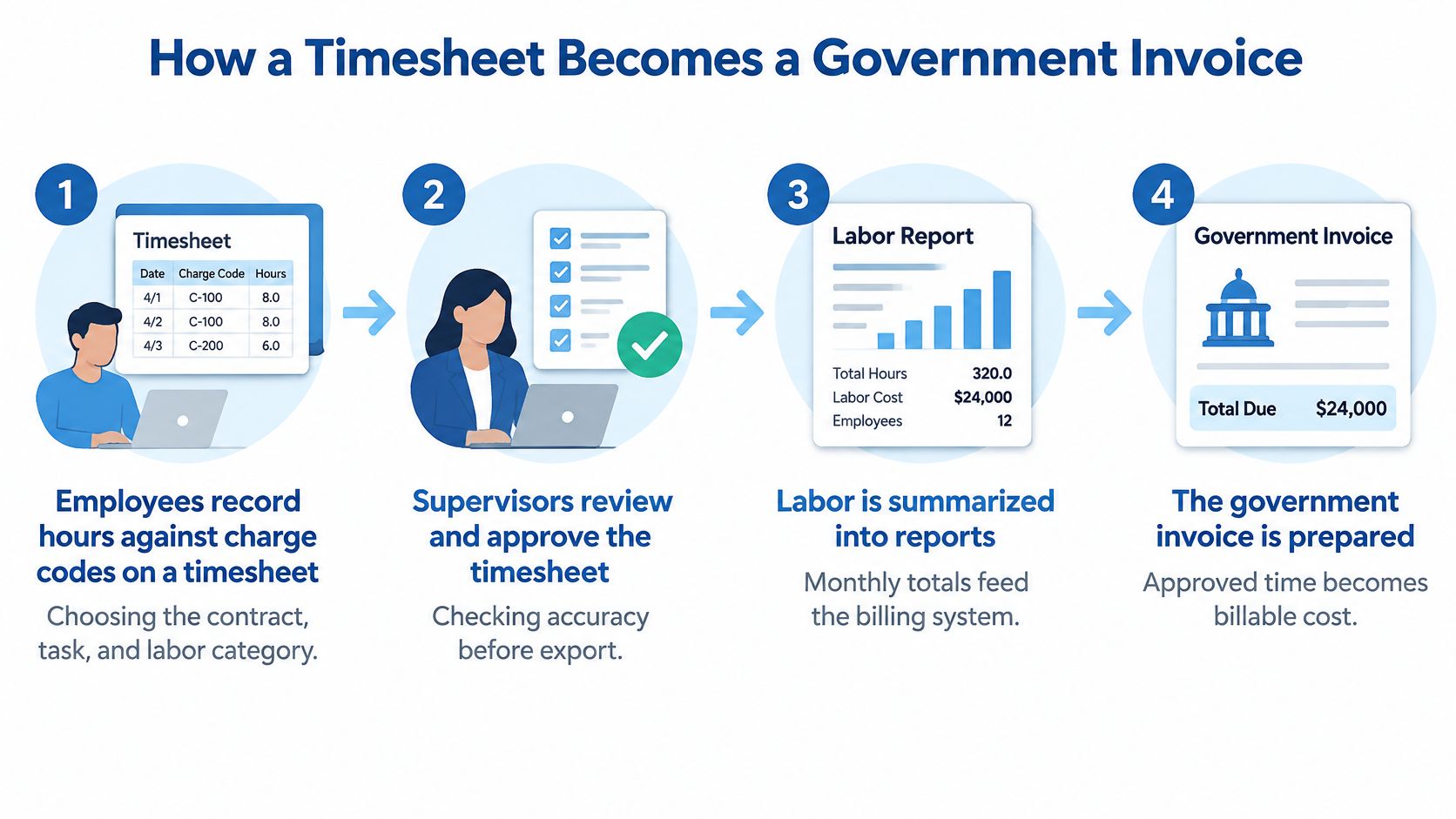
Follow the transaction through the accounting cycle
Employees record time. They select authorized contract, task, and labor information so the work reaches the correct project; copying a familiar default code is a common avoidable mistake.
Supervisors review and approve. Review confirms that recorded activity matches the work performed, while approval and correction controls prevent informal changes from bypassing oversight.
Finance posts labor. The posting process converts approved time into project labor cost using the configured payroll and accounting treatment; incorrect effective dates can send otherwise valid activity to the wrong period.
Accounts payable records other costs. Subcontract invoices, materials, and travel need the appropriate project and account coding, since a missing or incorrect task can leave the cost unassigned or misallocated.
Indirect costs are allocated. Finance applies the configured pools, bases, and applicable rates, checking that excluded costs haven't entered a base or billable pool improperly.
Project managers review performance. They compare actual costs, commitments, remaining work, and estimates at completion, distinguishing a genuine performance problem from a posting error.
Billing prepares the invoice. Billing staff apply the contract's reimbursement rules, fee treatment, funding restrictions, and required presentation rather than billing every ledger entry automatically.
Finance reconciles and closes. Staff reconcile project accounting, billing, and the general ledger, preserve supporting records, and control subsequent changes to the period.
Match accounting detail to the contract
A project code isn't necessarily a government contract line item. Your accounting structure must support the reporting and invoicing detail required by the agreement, including the relevant contract line item number, or CLIN, where applicable.
For example, a contractor may need internal tasks for management while also reporting invoices by a separate contractual line structure. Establish that mapping before employees start charging time, not during the first invoice deadline.
The process also needs an exception path. If a supervisor rejects time or accounts payable discovers a coding mistake, the team should know who corrects it, who approves the change, and whether billing must pause.
A clean close means no unexplained unassigned costs, approved time records, and invoice amounts that reconcile to supporting accounting records. It doesn't mean suppressing exceptions to meet a deadline.
A Month-End Close in a Mid-Size Contractor
Consider a hypothetical mid-size contractor nearing its monthly billing deadline. A project manager opens the budget report and sees an unexpected increase in subcontract cost on a customer task that had been tracking close to plan.
The manager doesn't immediately revise the estimate at completion. Instead, she opens the transaction detail and finds a subcontractor invoice whose description doesn't match the task receiving the charge.
Find the error without erasing its history
Accounts payable checks the purchase order, confirms the benefiting task, and prepares a reclassification. The clerk records why the coding changed and obtains the required approval rather than editing the transaction without explanation.
The project manager reruns the report and separates the corrected posting from genuine changes in labor usage. That distinction matters: a coding correction shouldn't hide a real staffing overrun elsewhere.
Meanwhile, the controller discovers that an indirect-rate configuration change affected a period the team believed was closed. Billing holds the affected invoices while finance identifies the postings, obtains approval for the necessary correction, and reconciles the revised balances.
Keep the original transaction, the correction, and the reason connected. A clean-looking report isn't a substitute for a traceable correction.
Coordinate the close across teams
The billing lead needs confirmation from accounts payable and the controller before releasing invoices. The project manager needs a refreshed cost report before approving the customer explanation.
For a practical way to organize those handoffs, Loopfour's guidance on how to manage cross-team close dependencies can help teams define owners, prerequisites, and unresolved blockers. The useful habit is to make each dependency explicit instead of assuming another department has finished.
After the close, the contractor changes its workflow. Accounts payable checks task coding against the purchase order before posting, administrators restrict changes affecting closed periods, and project managers review emerging variances before billing begins.
The software didn't prevent every mistake. Transaction detail, controlled corrections, and period permissions gave the team a way to identify the problem and fix it without losing the evidence.
Compliance Controls Auditors Check First
Timekeeping deserves early attention because labor charges connect employee activity to project costs and potentially to government reimbursement. Buying accounting software doesn't establish that employees selected the correct codes or that supervisors performed a meaningful review.
Use the visual as a starting point for examining your own approval process.
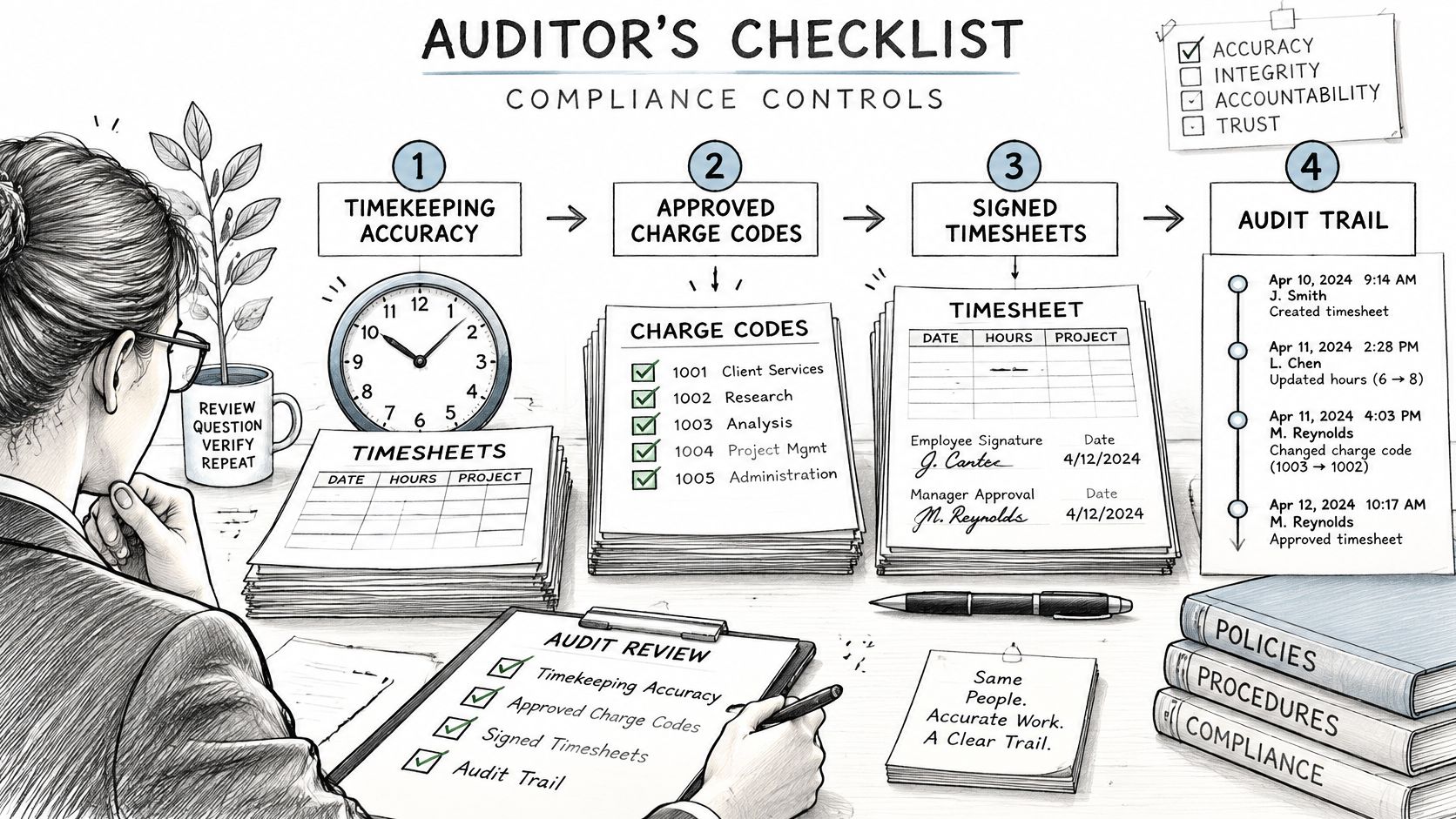
Questions your records should answer
- Timekeeping accuracy: Can you show authorized charge codes, employee certification, supervisory approval, and a history of corrections?
- Allowability screening: Do staff identify potentially unallowable expenses and keep them out of reimbursement requests and inappropriate indirect pools?
- Accounting consistency: Do actual postings follow written accounting practices, with applicable changes reviewed and documented?
- Indirect-rate support: Can a reviewer trace pool expenses and allocation bases to the ledger and reproduce the calculation?
- Record retrieval: Can staff retrieve invoices, receipts, time records, approvals, and supporting explanations for the applicable retention period?
- Period security: Would reopening a closed period require authorization, and would the system preserve evidence of what changed?
A “yes” should mean you can produce evidence, not merely describe a policy. Test the controls by selecting a billed transaction and tracing it back to its originating record.
Separate system capability from compliance
The Defense Contract Audit Agency, when involved, examines accounting and cost support and may question costs. A questioned cost isn't itself the final contracting determination, but it requires a supported response rather than an assurance that the software calculated it.
Potentially unallowable entertainment, lobbying, or alcohol expenses need careful screening under the applicable rules. Serious false billing can also create legal exposure, so suspected mischarging calls for prompt review by the appropriate accounting, contracts, and legal personnel.
The accompanying video provides another format for reviewing the topic.
Before relying on automated controls, compare user permissions with actual job responsibilities. Check whether administrators can bypass approvals, whether corrections retain explanations, and whether billing staff can identify excluded transactions.
Costpoint supports a controlled accounting process; it doesn't replace one. Written policy, system configuration, and daily behavior must agree.
FederalPipeline connects federal opportunities, budgets, buyers, and awards so you can assess a pursuit before committing estimating and accounting resources. Visit FederalPipeline to investigate the buyer and incumbent, check solicitation requirements, and keep your pursuit stage, next action, and supporting research together.