Federal contractors classified under NAICS 517 reported roughly $563.0 billion in sales or receipts in 2012, while employing about 12.4% fewer people than the same sector had in 2007, according to the Census Bureau's advance report on the 2012 Economic Census. Revenue climbed, headcount fell, inside a single code. That gap is the reason to treat a NAICS code as a filter you tune rather than a label you inherit.
Most NAICS code telecommunications research stops at a definition and a list. The definition is the least useful part. The code does three jobs at once: it tells an agency which vendors to expect, it fixes the size standard that decides whether you can bid as a small business, and it gives you a handle for pulling award history, incumbents and expiration dates. Pick it badly and you're invisible to buyers you could serve. Pick it well and the code becomes a clock as much as a category.
Telecommunications NAICS Codes at a Glance
Telecommunications isn't one market with one code. It splits into carriers, resellers, agents, satellite operators and specialty providers, and the six-digit code you register under decides which of those pools a buyer sees you in.
| Code | Official title | Covers | Fits if your business |
|---|---|---|---|
| 517100 | Wired and Wireless Telecommunications (except Satellite), broad category | Parent category for wireline and wireless carriers | You want the broad search family, not a single operator |
| 517111 | Wired Telecommunications Carriers | Fiber, cable and DSL network operation | You own or operate wireline transport networks |
| 517112 | Wireless Telecommunications Carriers (except Satellite) | Cellular, mobile and fixed wireless networks | You own or operate wireless networks |
| 517121 | Telecommunications Resellers | Buying network capacity and reselling under your own brand | You sell service but do not own the network |
| 517122 | Agents for Wireless Telecommunications Services | Selling wireless service on behalf of carriers | You sell wireless service as a dealer or agent |
| 517410 | Satellite Telecommunications | Communications delivered by satellite | You operate or resell satellite connectivity |
| 517810 | All Other Telecommunications | Specialized telecommunications not classified elsewhere | Your services do not fit the carrier, reseller or agent categories |
Two things to notice before you move on. NAICS 517 is a family of related procurement and industry codes, not one uniform business segment, so a search on the parent returns competitors selling something different from you. And the split follows business model rather than technology, which is why a company that resells capacity and a company that owns the fiber carry different codes even when both describe their offer as broadband.
Do this now: find the row where the service earning the largest share of your revenue sits, write that six-digit code down verbatim, and keep it beside you for the matching and search steps below.
That single number is about to do more work than your capability statement.
How NAICS 517 Breaks Into Smaller Codes
Think of a mailing address. Country, state, city, street. Each level narrows where you are without contradicting the level above, and nobody ships a package to "the United States" and expects it to arrive.
Here's that narrowing applied to industry classification.
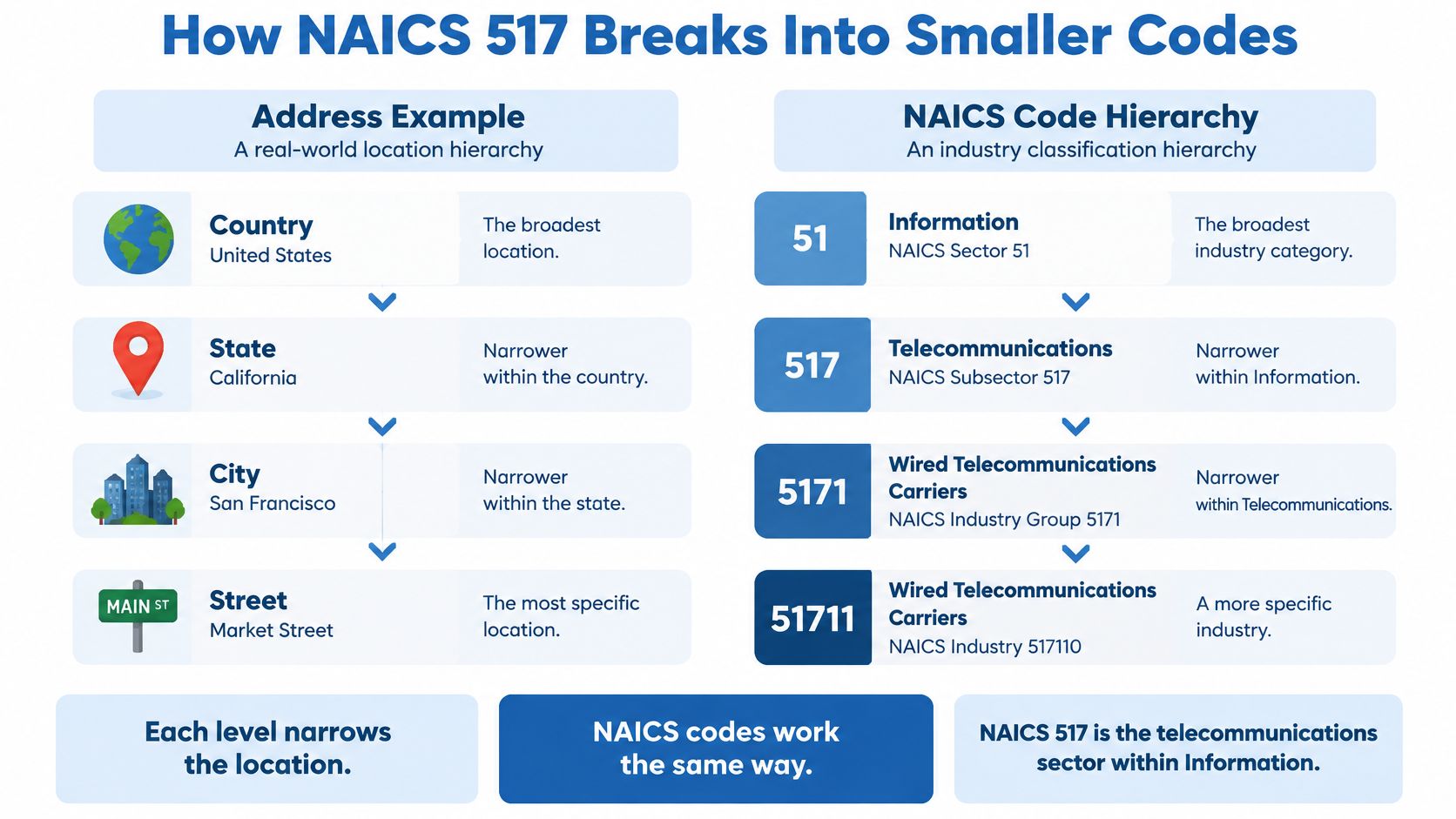
NAICS 517 is the U.S. telecommunications sector within Information, sector 51, and the Census Bureau's 2022 NAICS manual divides it into three subsectors: 5171 Wired and Wireless Telecommunications (except Satellite), 5174 Satellite Telecommunications, and 5178 All Other Telecommunications. Within 5171 are the four codes most contractors register under: wired carriers 517111, wireless carriers except satellite 517112, telecommunications resellers 517121, and agents for wireless services 517122. Satellite operations fall under 517410, and all specialized activities are categorized in 517810.
Why the sixth digit changes your competitive set
A mobile network operator, a satellite provider and a reseller all work in telecommunications. They don't share buyers, incumbents or eligibility screens, and the manual's structure deliberately separates network ownership and operation from resale, agency and satellite activity. That separation is why the six-digit code beats the three-digit sector for anything procurement-related.
Size varies enormously at the leaf level. The Census Bureau's Annual Integrated Economic Survey counted 429 employer establishments under NAICS 517410, Satellite Telecommunications, in 2024 (Census data). A code holding a few hundred establishments is a different competitive field from a carrier code holding thousands, and the same search technique returns very different answers in each.
NAICS also classifies establishments by what they do, not by what they call themselves. The manual describes the system as a way for statistical agencies to group establishments by activity so economic data can be collected, analyzed and published consistently. A company whose marketing says "communications solutions" might be a wired carrier, a reseller or a support provider depending on where the money comes from.
Address test: name your six-digit code, then name the sibling codes you most often compete against. If you can't do both, your registration is guessing.
The same narrowing logic applies on the buying side. Product and service codes record what an agency is purchasing, and pairing them with your NAICS code keeps a search from drifting into unrelated notices that merely share the word "telecom."
What the 2022 Recode Changed for Older Awards
If your saved search still runs on the code you registered under in 2019, you are searching an address that no longer exists. The 2022 revision went well past renaming a handful of industries. It reorganized how telecommunications work is described, and most published code lists never say so.
The Census Bureau's 2022 NAICS manual maps the change directly: former 517311 became 517111, and former 517300 became the broader 517100 category. The old other-telecommunications bucket was split, with reseller activity folded into the wired and wireless grouping and the remainder moved to the all-other code.
| Former code | 2022 code | What changed |
|---|---|---|
| 517311 | 517111 | Wired carrier code renamed and recoded under the wired carriers category |
| 517300 | 517100 | Replaced by the broader wired and wireless category |
| 517911, 517919 | 517121, 517810 | Resellers recoded under the wired and wireless grouping; all-other activity moved to All Other Telecommunications |
The Bureau of Labor Statistics notes that the 2022 update changed the Information sector's coding emphasis from delivery method to the product delivered (Monthly Labor Review). That shift explains why a fiber network and a copper network can land differently on paper even when a buyer reads them as the same service.
Two failure modes follow. A company searching only its historical code misses awards, forecasts and competitors that moved with the revision. A company that defaults to the broad parent code retrieves wireless, wired and non-satellite activity that has nothing to do with its capability. The first failure is quieter than it looks: an award issued in FY2020 keeps the code that existed when it was signed, so the record of that work sits under numbering your current filter never queries.
Search rule: run current and predecessor codes together across at least three fiscal years, then read the award description before you trust the code attached to it.
Filtering correctly has a cost, and the cost is recall. Awards coded under predecessor classifications often describe substantially the same service, so a strict current-code filter shrinks the performance history your past-performance narrative depends on.
How to Match a Code to Your Services
Matching is a sort, not a judgment call. Work the six steps in order and the code falls out of the evidence.
Here's the short version of the first two steps before the detail.
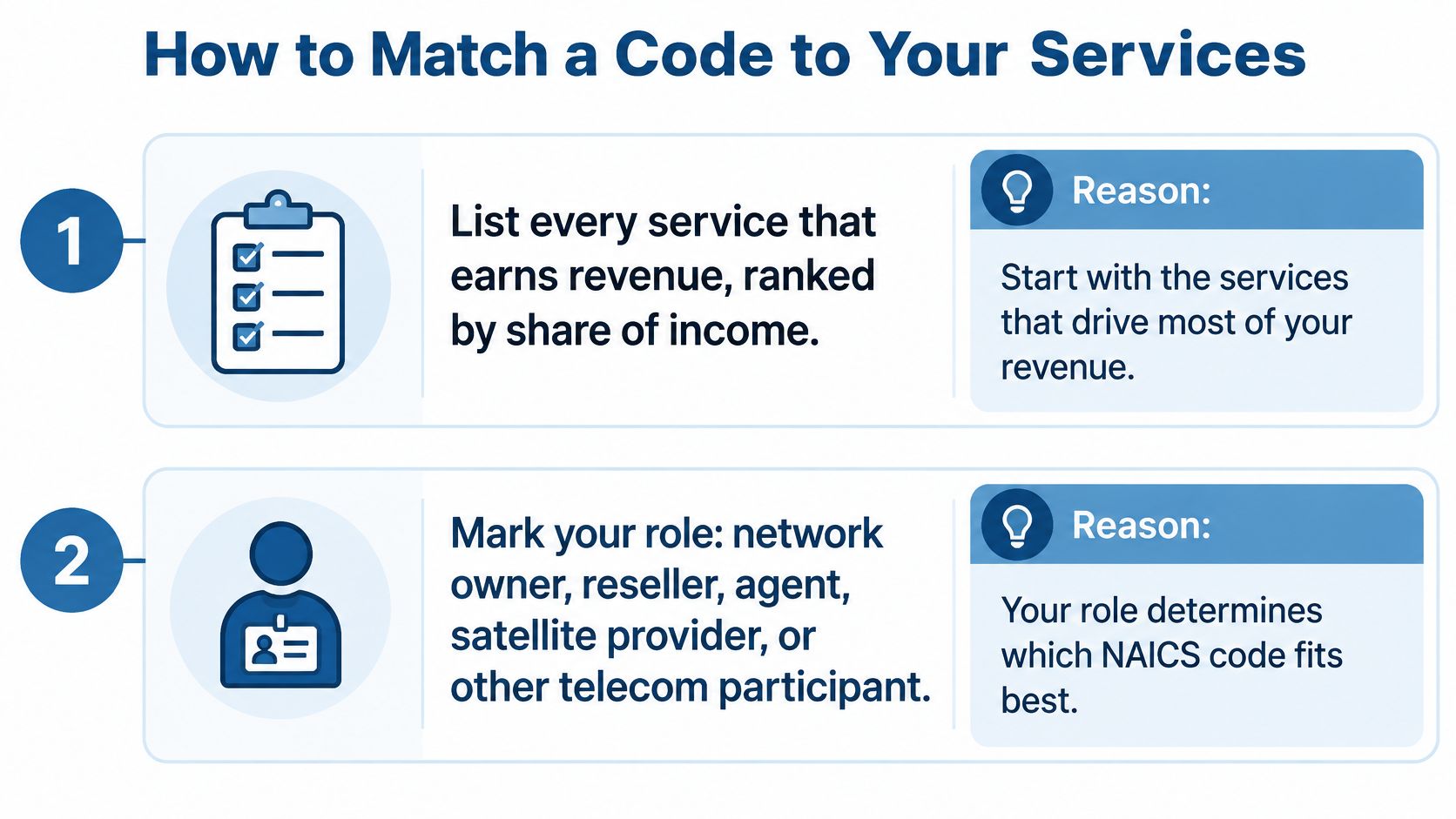
- List every service that earns revenue, ranked by share of income. The code follows your money, not your ambitions. A service that's 4% of revenue is a secondary code at best.
- Name your role. Network owner, reseller, agent, satellite operator or support provider. The classification separates network ownership and operation from resale and agency, so the role decides the branch before the technology does.
- Map each service to the narrowest six-digit code that describes the activity. A facilities-based fiber carrier belongs in wired carriers. A firm that buys capacity and resells it under its own brand belongs in resellers, even when both call the offer broadband.
- Test the solicitation's own language. Compare the stated NAICS and the technical statement of work against the activity that generates your revenue, matching on capability rather than on the words "telecom," "broadband" or "communications." Installation is where this gets slippery: the 2022 NAICS structure file keeps communication transmission-line and tower installation inside Subsector 517 when a telecommunications company performs it, while the same work classified as construction by another type of business lands elsewhere.
- Check the size standard attached to the code. Eligibility is set per code, measured in average annual receipts or employee count depending on the industry, so confirm the current threshold alongside the small business set-aside rules before you spend proposal hours.
- Register one primary code and two or three secondary codes. The primary sets your size and your default notices. The secondaries widen discovery without muddying your identity.
Match on the statement of work, not on the word broadband.
Segment size is the reason the distinctions pay off. In the first quarter of 2022, telecommunications receipts totaled about $166.4 billion, split between roughly $79.5 billion for wired carriers, $75.5 billion for wireless carriers excluding satellite, and $11.4 billion for other telecommunications, per the Census quarterly services report.
| Segment | Q1 2022 receipts | Year-over-year change |
|---|---|---|
| Wired carriers | $79.5 billion | -0.2% |
| Wireless carriers excluding satellite | $75.5 billion | +6.3% |
| Other telecommunications | $11.4 billion | -6.8% |
| Total telecommunications | $166.4 billion | +2.3%, weighted across the three segments |
Those directions diverge: wireless receipts rose 6.3% while wired slipped 0.2% and other telecommunications fell 6.8%. Aggregate growth in 517 can therefore conceal exactly the movement your segment is living through, and a mobile, satellite or specialized communications firm faces different agency demand, incumbents and subcontracting openings than a fixed fiber transport provider.
If you want the registration logic walked through end to end, this covers it.
The check at the end is simple. The solicitations you pursue should describe the services you deliver, and your records should carry the six-digit code next to the capability attributes it represents, not instead of them.
Using Code Timing to Spot Federal Opportunities Early
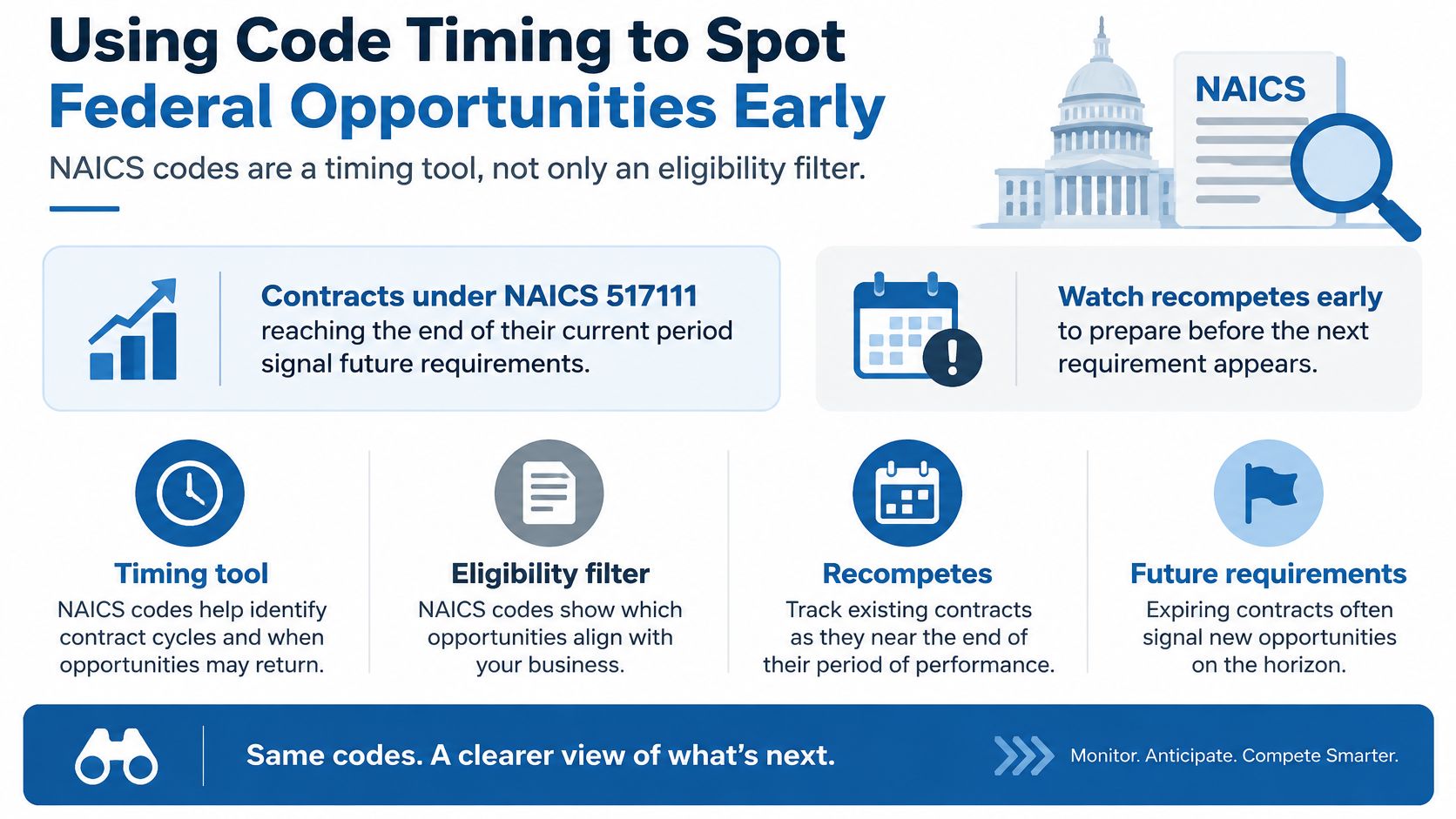
A code is also a clock. Contracts approaching the end of their current period are the clearest public signal of future requirements short of a market research conversation, and they surface months before a solicitation posts.
Recent USAspending-derived data tracked 541 prime contracts under NAICS 517111 ending within 365 days, including 25 within 30 days and 93 within 90 days, spread across 214 vendors and 26 agencies (FindingBase NAICS 517111 profile). Each of those contracts will be re-solicited, extended or replaced, and each one has a buyer already accustomed to buying the work.
Read the agency trend, not the market total
The assumption that telecommunications spending expands uniformly doesn't survive contact with agency-level data. Obligations under this code move in opposite directions across departments: defense-side demand has been falling while at least one major civilian buyer's obligations have climbed sharply. In both markets, a small group of contractors holds most of the obligations, which matters more for your entry strategy than the direction of the total.
| Signal | Value | What it tells you |
|---|---|---|
| Prime contracts ending within 30 days | 25 | Near-term recompete window |
| Prime contracts ending within 90 days | 93 | Requirements likely to be re-solicited soon |
| Prime contracts ending within 365 days | 541 | Pipeline of future recompetes |
| Vendors on those contracts | 214 | Size of the incumbent field |
| Agencies on those contracts | 26 | Breadth of federal buyers |
| Defense obligations trend | Falling year over year | Declining defense demand |
| Civilian obligations trend | Rising sharply | Growing civilian demand |
| Share of obligations held by top contractors | Concentrated in a small group in both markets | Incumbent concentration favors teaming |
Run the sequence in this order: pull expiring contracts for your codes and their 2022 predecessors, note how many vendors and agencies sit on them, check option status on the largest awards, track which agencies are adding obligations, and open teaming talks with incumbents well before the notice posts. A cold bid against a contractor holding most of an agency's spend rarely ends well. A subcontracting conversation six months earlier often does.
A market can be shrinking overall and still be entering territory. Where contracts expire, where one agency's demand is climbing, and where a handful of incumbents hold most obligations, the practical route in is teaming. Tools that consolidate award, vehicle and incumbent records speed that read up: FederalPipeline flags the incumbent and prior contract on each opportunity and scores it against your registration and past awards. Track those federal business opportunities by expiration date first and by keyword second.
Avoid These Code Errors and Start Searching
Three mistakes account for most wasted effort in this market, and each one is cheap to fix once you see it.
- Keyword search replaces the code. Searching "telecom," "broadband" or "communications" returns whatever wording a contracting officer happened to use. The cost is invisible: you lose solicitations that describe the identical work as network transport or satellite bandwidth. Pair your code and its predecessors with keywords used only to widen a set you already trust.
- One size standard fits every code. Size standards attach to codes, not companies, and a wrong primary code can place you on the wrong side of an eligibility line you never knew you crossed. Confirm the current threshold for each code you bid under.
- The registration code never gets rechecked. A registration still listing the code you chose when you sold a different mix routes notices you can't perform and hides the ones you can. Review it whenever your revenue mix shifts, and after any acquisition or new service line.
Then put the next five actions on this week's list.
- Confirm your primary code and two or three secondary codes, each with the service it covers written beside it.
- Check buyers, spend trends and winning companies for each code. Market data by NAICS for every year, including spend, growth, buyers, set-aside and sole-source amounts, shows which codes carry money and who takes it.
- Review the contract vehicles that carry your codes, including every IDIQ, GWAC and BPA, to see who holds them and which agencies order through them. Vehicles are where subcontracting entry points hide.
- Set saved searches for your codes and their predecessors, so awards coded under the old structure and brand-new solicitations both reach you. FederalPipeline connects these records in one workflow, with market data by NAICS, vehicle data showing holders and buyers, and an opportunity search covering SAM.gov solicitations, agency forecasts, grants and innovation programs scored against your registration, past awards and website.
- Move promising opportunities into a pipeline with a stage and a next action, so timing signals become pursuits instead of bookmarks.
Confirm the code, then start the search.
The code you register under decides which buyers can find you, which size standard applies, and which expiring contracts you'll see before your competitors do. FederalPipeline gives you market data for every NAICS market by year, including spend, growth, buyers, set-asides and the companies that win, plus saved searches and a pipeline that keep the whole pursuit in one place. Visit FederalPipeline and run your telecommunications codes before the next recompete cycle closes.