
CPARS is the federal government's official electronic system for recording contractor past-performance evaluations, which agencies use when judging future bids. If you delivered good work, why would that work help or hurt you later if nobody preserved the evidence behind the rating? Understanding what CPARS is means looking past the adjective to the records, deadlines, and narratives that follow your company into the next competition.
What CPARS Is and Why Agencies Rely on It
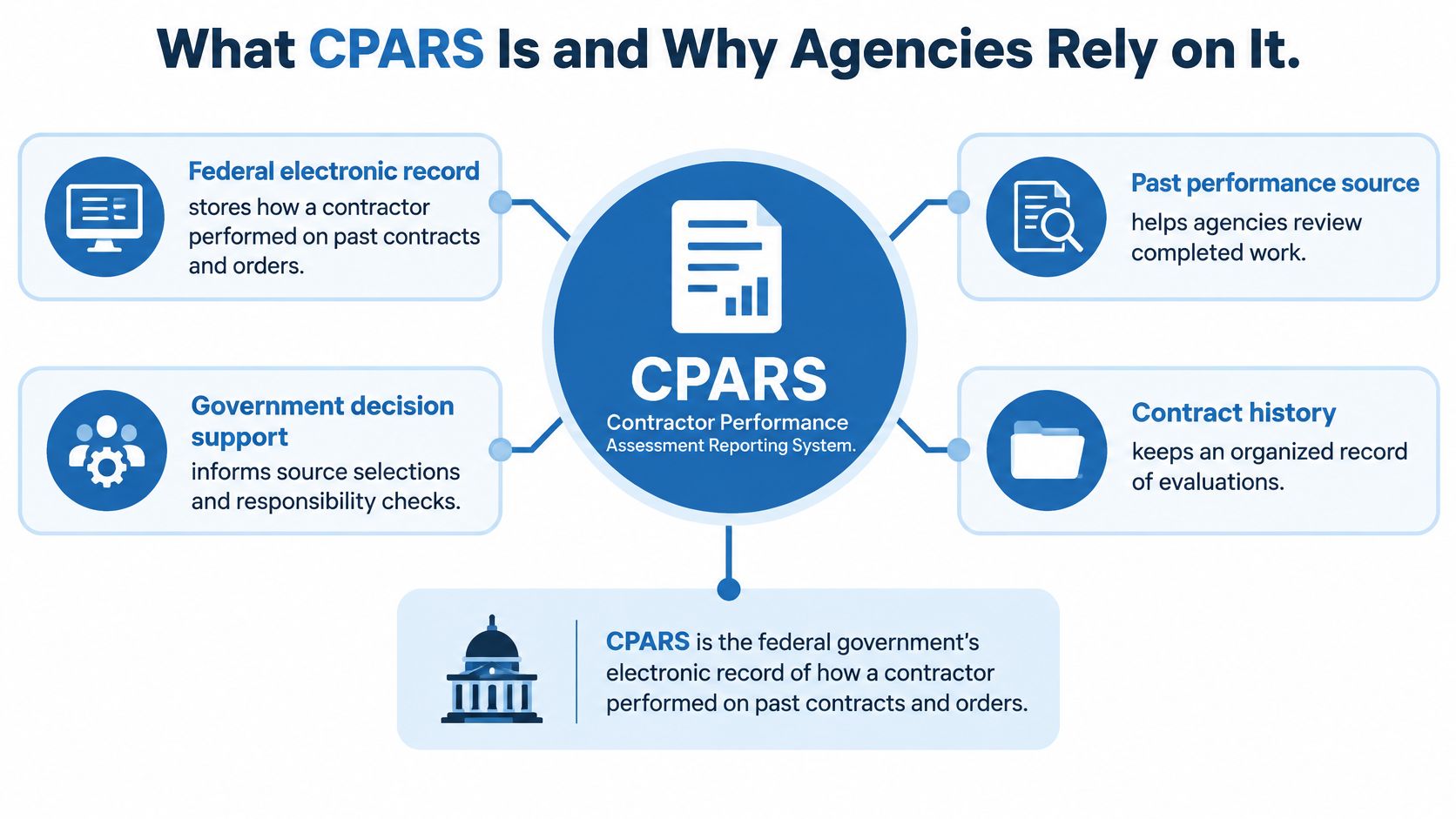
CPARS, the Contractor Performance Assessment Reporting System, is the federal government's electronic record of how a contractor performed on past contracts and orders. Think of it as a supplier's work reference file. It travels with the company from one federal contract to the next, and it gives buyers a documented history instead of forcing them to rely on memory or proposal claims alone.
The visual below maps how that reference file fits into federal buying.
The Rule Behind the Record
Under FAR Subpart 42.15, agencies must prepare performance evaluations at least annually and when the work under a contract or order is completed, generally for contracts and orders exceeding the simplified acquisition threshold, with additional rules for certain construction contracts and terminations. That requirement turns reporting into an administrative duty, not a courtesy. Agencies also monitor reporting timeliness and completeness through CPARS metrics.
Say your firm finishes a services order and submits a strong final deliverable. The evaluation doesn't stop at saying the work ended. It records how your team handled quality, schedule, cost control, management, and other contract-specific factors during execution. A later contracting team can then compare that record with the promises in your next proposal.
Who Reads It and What It Isn't
Source-selection officials are the key readers. When they're assessing proposals for a future procurement, a contractor's prior delivery record helps them judge whether that supplier has demonstrated reliable execution. That's why an incumbent's history matters during a recompete and why a new bidder's earlier federal work can shape its credibility.
Practical test: If a company is rated on its last contract, that rating can shape how officials assess its next bid.
CPARS isn't a bid board, an opportunity listing, or an award database. It won't tell you what open solicitation to pursue or what price a rival charged. It's a performance-record system. The distinction matters because counting past awards tells you who won work, while CPARS helps explain how the winner performed after award and whether that record supports another award.
How Ratings, Factors and Misreadings Work
Start with the five labels, but don't stop there. A rating is useful only when you connect it to the factor being rated and the narrative explaining it.
| Rating | Meaning in practice | Signal to a source-selection team |
|---|---|---|
| Exceptional | Performance clearly exceeds requirements with significant benefit to the government | Strongest support for a future award |
| Very Good | Performance exceeds many requirements with benefit to the government | Positive evidence; the narrative shows the specifics |
| Satisfactory | Performance meets requirements, with issues that were handled | Baseline compliance; the narrative shows what was delivered |
| Marginal | Performance has significant weaknesses that are not yet corrected | Risk signal; the narrative shows whether corrective action was taken |
| Unsatisfactory | Performance has significant deficiencies that are not corrected | Major risk signal; prepare evidence for any dispute |
The Factors Behind Each Rating
Under FAR 42.1502, each evaluation must address at minimum technical performance or product/service quality, schedule or timeliness, management or business relations, and, when applicable, cost control. Firm-fixed-price contracts and fixed-price contracts with economic price adjustment are excluded from the cost-control factor. For each applicable factor and subfactor, the contracting activity provides a supporting narrative and assigns one of the five ratings.
That structure prevents a single impression from swallowing the whole record. Say a contractor delivers technically strong software but repeatedly misses milestones and responds slowly to government direction. Its technical rating may look solid while schedule and management ratings create concern. In a best-value competition, those distinctions help officials decide whether the risk is limited to planning or points to broader execution problems.
The volume is also substantial. As of October 1, 2024, CPARS recorded 1,559,607 completed evaluations, according to the official CPARS program. Source-selection teams therefore expect this record to exist for experienced federal contractors.
Four Common Misreadings
- It's one reputation score: It isn't. CPARS assesses performance factor by factor, and the narratives explain the evidence behind each rating.
- A below-satisfactory rating ends the competition: It doesn't decide the outcome by itself. Officials weigh it with relevance, recency, corrective action, and other proposal evidence.
- Satisfactory means weak: It means requirements were met. Agencies also may not assign a rating below satisfactory solely because a contractor didn't exceed contractual requirements.
- Scores compare cleanly across rivals: They don't. Different contracts, scopes, and narratives make a single adjective comparison misleading.
Read the narrative before you judge the adjective. The narrative tells you what happened, how serious it was, and whether the contractor fixed it.
When you review an evaluation, pull three items every time. Capture the rating for each factor, copy the narrative lines supporting it, and record the contract or order number. That small habit keeps your capture analysis tied to a specific performance history instead of a vague impression of the company.
How an Evaluation Moves From Contract to Record
An evaluation becomes useful because it follows a defined path from contract execution to a retained record. The flow below shows the basic movement before the detailed steps.
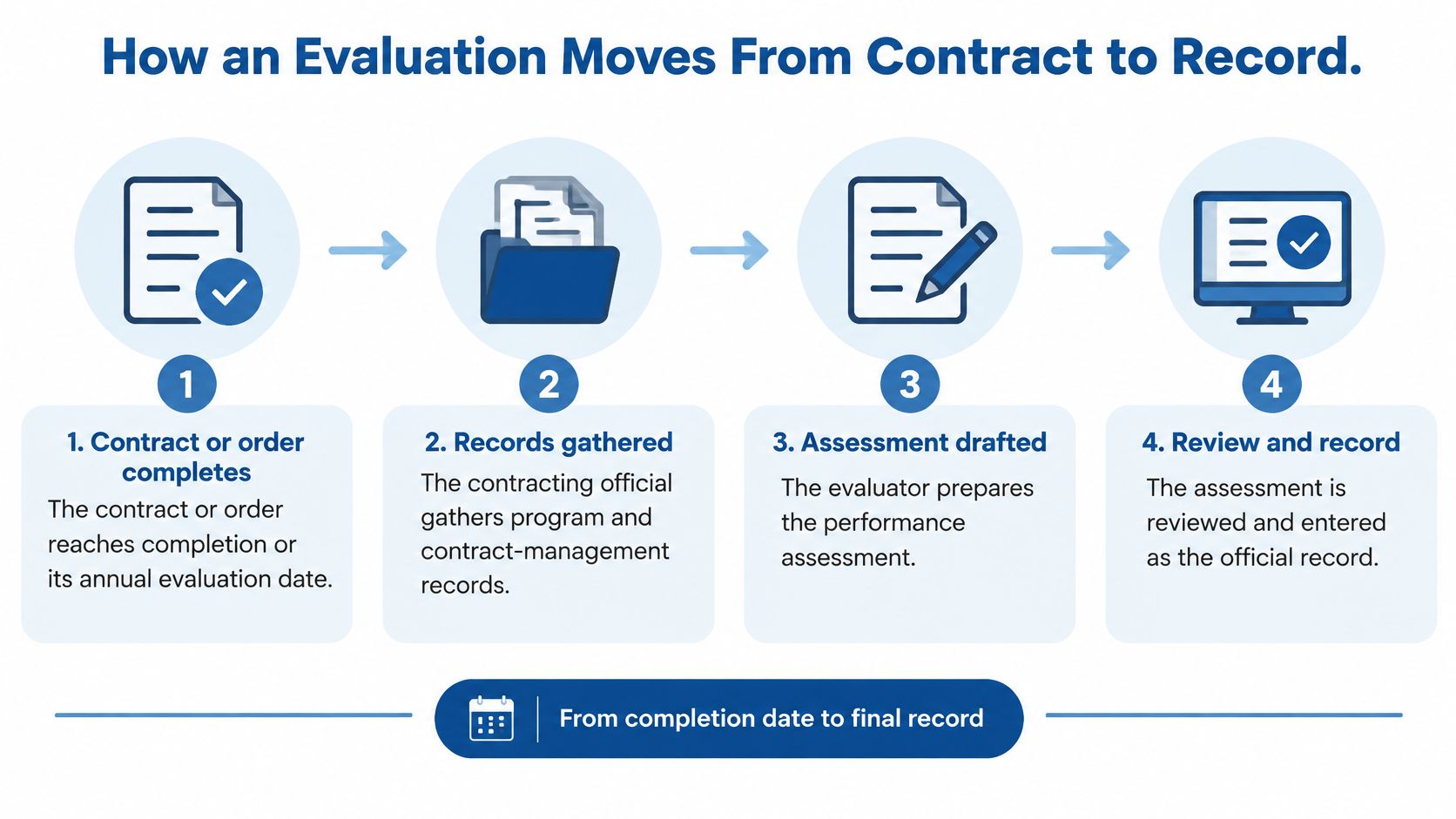
- The trigger arrives: The contract or order reaches completion or its annual evaluation date, so the agency knows an assessment is due.
- Records are gathered: The contracting official collects program and contract-management records, including progress reviews, cost and schedule measures, and acceptance data.
- Ratings and narratives are drafted: The official rates each applicable factor and writes narrative support that separates ordinary compliance from performance exceeding requirements or showing significant deficiencies.
- The evaluation enters CPARS: The agency submits it electronically, and the contractor is notified that it's available for review.
- The contractor responds: The contractor may comment, concur, or refute the assessment during the response period.
- Discrepancies are reviewed: The reviewing official considers the comments and reconciles significant disagreements.
- The record becomes available for later use: Once final, it's retained as structured past-performance evidence for later source selections.
The short video below adds a visual walkthrough of how that record moves through the system.
This lifecycle is why CPARS matters beyond contract administration. As explained in the compiled FAR Subpart 42.15 text, agencies submit evaluations electronically in CPARS and use CPARS metrics to monitor the quality and timeliness of reporting. The same source notes an important edge case for the Department of State: all terminations for default and terminations for cause must be entered regardless of contract purpose or dollar value.
That edge case changes how you should read the record. A termination event isn't the same thing as a completed routine evaluation, so identify the specific contract, map the rating to its factor, and read the narrative before drawing conclusions. Teams researching the broader procurement process for government contracts should use that discipline when assessing incumbents, recompete risk, and their own bid readiness.
Response Deadlines and Monitoring Windows
Timing mistakes are avoidable, yet they're common because two different clocks run at once. The table below separates the full evaluation process from the contractor's narrower response duty.
| Stage | Timing | Who Acts |
|---|---|---|
| Performance period ends | Contract or order completion, or annual evaluation | Contracting official begins the evaluation |
| Evaluation process complete | Within 120 days after the performance period ends, including the 60-day contractor comment period | Agency and contractor |
| Contractor response | 14 calendar days after notification that the evaluation is available | Contractor submits comments, rebuttal or additional information |
| Award end date field | Contract completion date, effective July 7, 2025 | Agency records; legacy contracts may keep the older field |
| Source selection use | Future competitions after the evaluation is final | Source-selection officials |
According to official CPARS guidance, the complete evaluation process should finish within 120 days after the performance period ends, including the contractor's 60-day comment period, while FAR guidance provides up to 14 calendar days after notification to submit comments, rebutting statements, or additional information. The guidance also states that, effective July 7, 2025, CPARS began using the contract completion date rather than the estimated ultimate completion date or last date to order for determining award end dates and when evaluations are no longer required, though legacy contracts may continue using the older field unless FPDS is modified.
The Clock Starts With Notification
The practical deadline begins when the system notifies you, not when someone mentions the evaluation in a hallway conversation. Say a notice lands in a shared inbox on a Friday and nobody owns that inbox. Your team might discover it the following week with much of the window already gone.
Assign a named owner and a backup before an evaluation arrives. A missed notification can become a missed chance to correct the record.
Set up notification controls, delegated access, and an internal escalation path while the contract is still active. Name who checks the account, who alerts program leadership, who gathers records, and who approves comments. That preparation matters even more because CPARS evaluations are source-selection-sensitive and aren't generally releasable unless directed by the submitting agency.
How to Respond to an Assessment With Evidence
Don't draft a response until you've classified the problem. Different disputes need different proof, and arguing every sentence the same way weakens your credibility.
| Issue Type | Example | How to Respond |
|---|---|---|
| Factual error | Wrong delivery date or dollar amount in the narrative | Submit the contract record that corrects the figure |
| Unsupported conclusion | Rating cites a missed schedule with no milestone data | Attach the baseline, approved revisions and acceptance dates |
| Scope disagreement | Narrative faults work outside the contract line items | Cite the contract scope and any modifications that define the work |
| Legitimate shortcoming | Late corrective action on a documented defect | Concur, describe the corrective action taken, and avoid arguing the record |
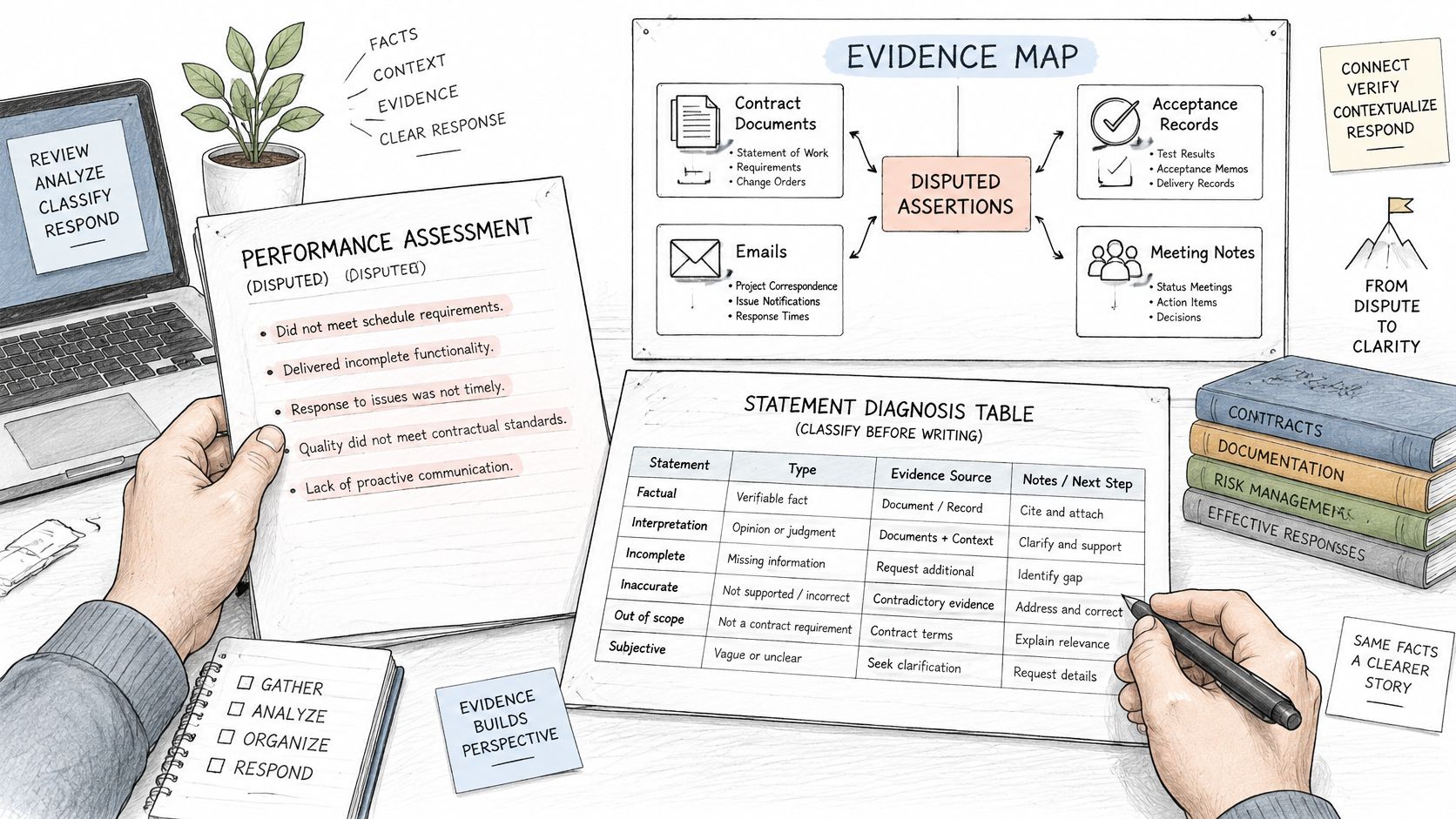
The workspace image below reflects the practical task here, sorting claims against documents instead of relying on general disagreement.
Build an Evidence Map
Official information at CPARS.gov supports treating evaluations as an evidence process grounded in objective data, or measurable subjective data when objective data are unavailable, supported by program and contract-management records. Build a simple map with one row per disputed assertion. Link each row to deliverables, acceptance records, correspondence, schedule baselines, invoices, corrective-action logs, or customer meeting minutes.
Say the narrative claims your team missed a milestone by six weeks in a hypothetical dispute. Attach the approved baseline, the government-approved revision, and the acceptance record showing the final date. That sequence lets the reviewing official test the claim quickly. It's stronger than saying your team worked diligently, and it connects naturally to price and schedule questions such as what a cost point means when both records affect bid decisions.
A response doesn't automatically erase a negative assessment. You may comment, concur, or refute, and the reviewing official considers and reconciles significant discrepancies. Keep the tone factual, especially when the record supports part of the criticism. For a legitimate shortcoming, concur and document the corrective action, the date it closed, and the result.
Small businesses often face a records problem rather than a performance problem. Gather acceptance records, baselines, modifications, invoices, corrective-action logs, meeting minutes, and key correspondence before any evaluation arrives.
Check Your CPARS Record Before Your Next Bid
Your decision isn't whether an opportunity looks attractive. It's whether your own record, or an incumbent's record, could change how officials judge the pursuit.
- List your contracts: Note every active and recently completed contract and order number.
- Confirm access: Verify who can enter CPARS and who receives system notices.
- Calendar the response window: Count from the notification date, not from informal discovery.
- Pull supporting files: For any weak factor, gather the records that explain corrective action and final outcomes.
- Review the competitive context: Study incumbent history before you commit capture resources to the pursuit.
Assign one account owner and a named backup this week. When you're reviewing a federal business opportunity, treat CPARS as one input alongside eligibility, customer needs, price, and competitor research. We connect opportunities, budgets, buyers, and awards so your team can see what's coming, whether you can bid, and who you're up against, but your documented performance record still needs active management.
Before your next proposal is due, visit FederalPipeline to research the opportunity, buyer, incumbent, ceiling, set-aside, certifications, clearance, and deadlines in one capture brief. Use our match scores, eligibility checks, and email alerts to spot fitting work earlier, then pair that research with a clean, well-documented CPARS record.