A time-and-materials contract pays fixed hourly labor rates plus allowable materials, under a ceiling the contractor exceeds at its own risk. Popular advice tells you to obsess over winning a higher hourly rate. That's the wrong priority for most federal pursuits.
A rate you can't staff, document, or fit inside the ceiling isn't an advantage. Materials, subcontracts, travel, and other direct costs often consume the ceiling faster than labor does, especially when purchase orders land before you've billed enough hours to see the burn. If you don't forecast those nonlabor costs forward, you'll learn the contract is nearly spent after the money is already committed.
Read time and materials contracts from the payment clause outward. Find who may bill, at what category, what products count as materials, and where spending must stop.
How Time and Materials Contracts Get Paid
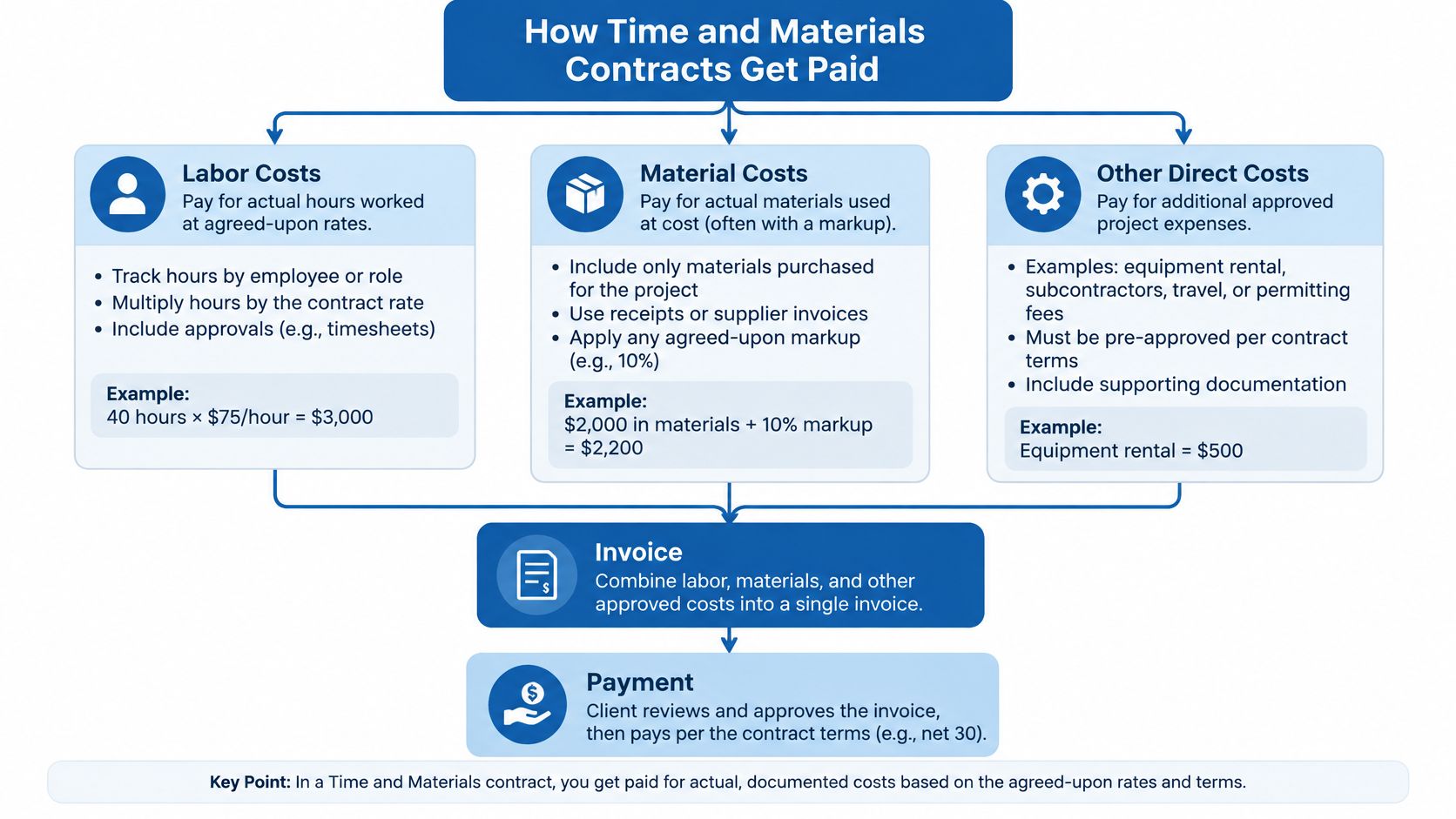
The payment rule is simple. The government pays for direct labor hours at the fixed rates in the contract and reimburses allowable materials and other direct costs under the contract's direct-cost provisions. FAR 16.601 provides no positive profit incentive for contractor cost control or labor efficiency.
Think of hiring a specialist by the hour and reimbursing parts, rather than buying a finished repair for one price. You can start work before anyone knows how many hours or parts the job needs, but you don't get a guaranteed finished result for a set amount. That trade explains both the usefulness and the risk.
The Four Payment Elements
Direct labor comes first. For each approved hour, the contractor multiplies the hour by the rate for the matching labor category. That rate already bundles wages, fringe benefits, overhead, general and administrative expense, and profit, so you don't add profit to labor a second time.
Materials work differently. The government generally reimburses allowable actual cost without a separate profit factor. Subcontracts and travel follow the materials or other-direct-cost treatment the contract specifies, which is why you must read those definitions instead of assuming every nonlabor charge gets handled the same way.
| Element | What is paid | Contractor exposure |
|---|---|---|
| Direct labor hours | Fixed hourly rate covering wages, fringe, overhead, G&A, and profit | Hours that push payments over the ceiling are unpaid |
| Materials and other direct costs | Allowable actual cost, generally with no profit factor | Purchases and commitments still consume the ceiling |
| Subcontracts and travel | Treated under the materials or other-direct-cost rules in the contract | Early commitments can burn the ceiling faster than billed labor |
| Ceiling price | Not-to-exceed amount required by FAR 16.601 | Costs above the ceiling are at the contractor's risk |
Why More Hours Do Not Mean Better Performance
Revenue rises when hours rise. A team that takes longer can bill more, while a team that finishes efficiently bills less, even if the efficient team produced the better result. FAR 16.601 therefore requires surveillance sufficient to give reasonable assurance that the contractor uses efficient methods and effective cost controls.
Don't treat that surveillance as paperwork. Before you compare opportunities, locate the labor categories, the rate basis, the materials clause, and the ceiling in the solicitation. Map each one to the relevant contract line, and learn how a CLIN structures what the government buys and pays for if you're unsure how those lines control billing.
Practical rule: Price the hours you can defend, not the hours the rate schedule lets you imagine.
Say a solicitation lists three analyst categories but doesn't estimate trouble tickets. Your price isn't one number yet. It's a set of possible totals created by different mixes of junior and senior hours, plus software, travel, or replacement hardware. The ceiling tells you which of those totals the government will pay before you're working at your own risk.
When Agencies Choose This Contract Type
Start with the choice the contracting officer has to defend. Each contract type fits a different level of knowledge about the work.
| Contract type | When it fits | Who bears cost risk | Profit incentive |
|---|---|---|---|
| Firm-fixed-price | Result and effort are knowable before award | Contractor | Strong incentive to control cost |
| Cost-reimbursement | Cost risk is high and fee and allowable-cost rules govern | Government, within allowable-cost rules | Fee structure, with cost-control rules |
| Time-and-materials | Labor categories and rates can be defined but total hours cannot | Government pays hours; contractor bears overrun above the ceiling | None positive for efficiency under FAR 16.601 |
A contracting officer may choose this type when the extent, duration, or cost can't be estimated accurately at award. The 2007 Government Accountability Office review emphasized that T&M contracts should be limited to circumstances where reliable cost estimation is not feasible. The file must document why no other contract type is suitable.
The Repair Shop Test
Say a vehicle arrives with an unknown electrical fault. The shop can quote a diagnostic labor rate and the cost of parts, but it can't quote the completed repair until someone opens the harness. An hourly rate plus parts fits that uncertainty.
That honesty needs guardrails. The buyer needs a spending cap and someone watching the clock, the parts ordered, and the progress made. Without those controls, uncertainty about the fault becomes uncertainty about the entire bill.
Compare that situation with fixed-price contracting for a defined deliverable, where the contractor prices the result and carries the cost of taking longer. If the result and effort are already knowable, paying by the hour gives up price discipline for no good reason.
Treat a missing justification or an open-ended services scope as a bid-risk signal. It may mean the requirement, ceiling, or oversight plan isn't settled. A federal time and materials contract isn't just a commercial hourly engagement with a government logo. Every award needs a ceiling and surveillance procedures that monitor labor, materials, and cumulative spending.
What Sits Inside a Labor Rate
A labor rate looks like one number on a pricing sheet. Inside it, several cost layers have to fit before there's any profit left. Working through one hypothetical rate makes the bundle easier to see.
Say a senior analyst bills at $120 per hour. The rate might reflect about $55 for direct pay and fringe, $30 for overhead, $18 for general and administrative expense, and $17 for profit. That split is only an example. Your actual split follows your accounting system, indirect pools, and the solicitation's rate instructions.
The Government Buys a Category
The government doesn't buy a named person by the hour. It buys labor that meets a category definition. Education, years of experience, certifications, clearance, and duties can all act as gates.
If the person charging time doesn't meet the stated gate, the hour can be rejected even when the person did useful work. A talented junior analyst billed as a senior analyst isn't a harmless staffing shortcut. It's a category mismatch, and useful output doesn't cure it.
Map every proposed person to a category before you price the pursuit. Check the resume against each required element, not against the job title alone. Then confirm who must approve a substitution, because replacing a qualified person with someone who meets a different category can change the rate and the hour's billability.
A lower rate from an under-qualified person isn't a saving if the contracting officer won't accept the labor.
Where Rate Builders Get Confused
Profit belongs inside the burdened labor rate. Don't build a rate with wages, fringe, overhead, G&A, and profit, then add another profit factor to the same hour. Materials follow a separate treatment, so keep the labor build and the materials support apart in your pricing file.
Watch three edge cases closely:
- Overtime premiums: Charge a premium only when the contract allows it and the work meets its conditions.
- Uncompensated overtime: Model salaried staff who work more hours than the rate build assumes, because those extra hours can change your real cost per billable hour.
- Teaming crosswalks: Translate each subcontractor's roles into the prime contract's categories, qualifications, and rates before you combine the price.
Don't let a subcontractor's commercial title decide the category. A partner may call someone a consultant while the solicitation separates junior, mid-level, and senior analysts by degree and experience. Crosswalk duties and credentials first, then apply the rate.
Test the Mix Against the Ceiling
Solicitations often describe outcomes in the statement of work while pricing effort in hours. That mismatch hides the main question. How many hours, from which categories, will the outcome consume?
Build a low case, an expected case, and a high case for every category. Add the materials each case would trigger, then compare all three totals with the ceiling. If only the low case fits, your proposal depends on everything going right. If the expected case fits with room for normal variation, you've got a pricing story you can defend.
Ask one final question before you lock the rate. Can you hire, retain, and replace people who meet the category at the pay hidden inside it? A rate that wins evaluation but can't hold qualified staff creates vacancies, substitution disputes, and hours you'll never bill.
How the Ceiling and the 85 Percent Notice Work
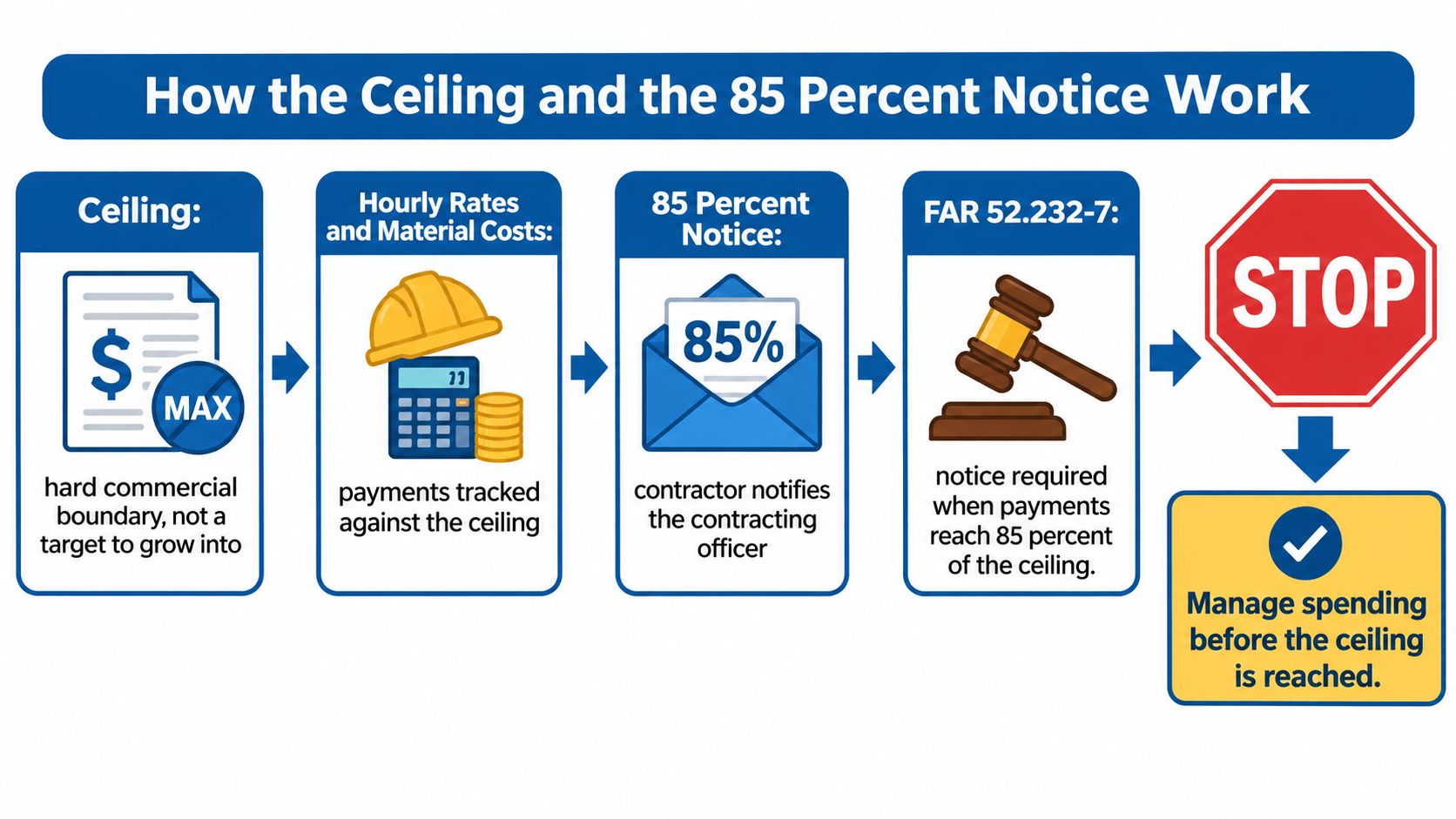
The ceiling isn't a target to grow into. It's a hard commercial boundary. The largest threat often isn't the hourly rate, it's weak forward visibility into materials, subcontracts, and other commitments that consume the ceiling between invoices.
Labor usually burns in a visible rhythm through timesheets. Nonlabor costs can jump. A parts order, software purchase, subcontract deposit, or urgent trip can commit a large share of the remaining ceiling in one day, weeks before the invoice makes the damage obvious.
The Notice Trigger
FAR 52.232-7 requires notice when projected hourly-rate payments and material costs for the next 30 days, combined with prior payments and costs, will exceed 85% of the ceiling. The notice must include a revised estimate and supporting documentation.
Read that trigger carefully. You don't wait until cumulative billing crosses 85 percent. You forecast the next 30 days, add that forecast to what you've already incurred, and notify the contracting officer when the combined amount will cross the line.
The notice is not a modification. It doesn't raise the ceiling, promise more funding, or authorize work beyond the existing amount. It's a documented warning that lets the contracting officer decide whether to modify the contract, redirect the work, or let performance stop at the boundary.
Build a Rolling Forecast
Give contracts ownership of the forecast, with finance supplying cost data and the program manager supplying upcoming work. Update it on a fixed cycle and whenever a major commitment appears. A useful forecast has six parts:
- Hours by labor category: Show approved hours, hours worked but not yet billed, and hours planned for the next 30 days.
- Material commitments: List purchase orders and planned purchases, including items ordered but not yet invoiced.
- Subcontracts: Show authorized amounts, amounts incurred, and work expected during the forecast period.
- Travel: Include approved trips and trips awaiting approval separately, so decision-makers can see what's already committed.
- Other direct costs: Capture allowable charges that don't fit neatly into labor, materials, subcontracts, or travel.
- Ceiling comparison: Total the forecast against both 85 percent and 100 percent of the ceiling, mapped to the contract lines.
Support the forecast with approved timesheets, purchase orders, subcontract records, and a dated burn chart. Vague statements that work is moving faster than expected won't help the contracting officer evaluate a revised estimate. Show which requirement drove the hours or purchase and which line will absorb the cost.
What Happens Near the Top
Use best efforts to perform within the ceiling. Treat work beyond it as your financial risk unless the contracting officer raises the ceiling in a modification before that work continues. A program official's encouragement to keep going doesn't replace that written contract action.
Separate a legitimate ceiling notice from an unauthorized plea for funding. The notice states the forecast, explains the supporting evidence, and identifies the decision the government needs to make. It doesn't assume the government will pay for an overrun or pressure the contracting officer by creating one first.
Small businesses face a sharper version of this problem. A company without an earned-value system may track labor weekly but miss deposits and parts moving through purchasing. Cash goes out, ceiling room disappears, and billed labor hasn't caught up. A simple commitment log reviewed with the burn chart closes that gap better than a larger report nobody updates.
Where Federal Time and Materials Spending Shows Up
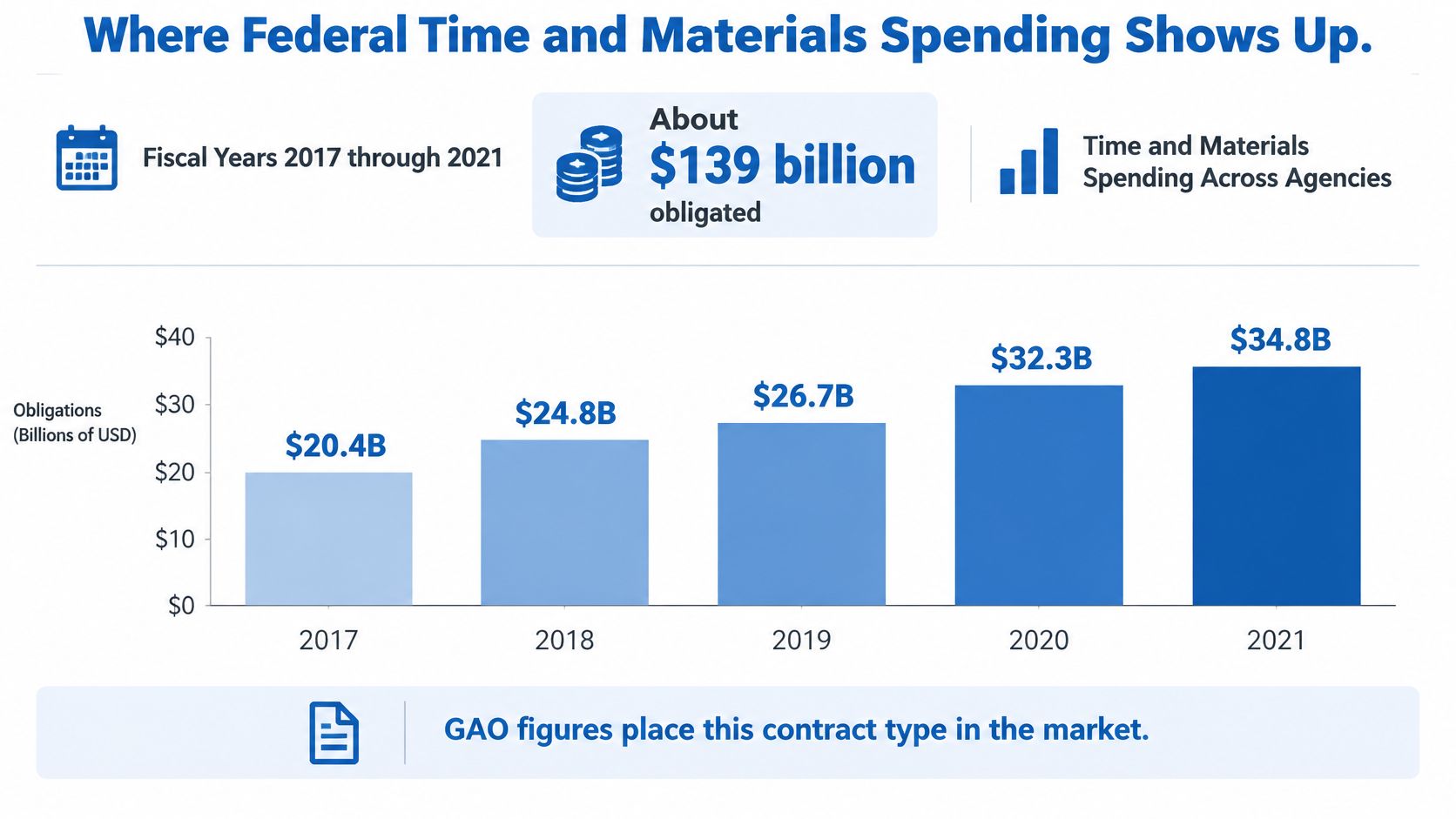
Federal T&M spending is significant, but its share varies by agency. A government-wide total can show that the contract type matters while hiding where a services contractor is most likely to encounter it.
| Scope | Figure | What it tells a bidder |
|---|---|---|
| All federal agencies, FY2017 to FY2021 | About $139 billion obligated | T&M is financially significant, not a niche clause |
| Civilian agencies | About 11 percent of contract obligations | T&M has greater relevance in service-heavy civilian work |
| Department of Defense, all obligations | Roughly 1 percent | T&M is a smaller share of Defense contract dollars overall |
| Department of Defense service contracts | Used more heavily than its all-obligations share suggests | The overall figure can understate its relevance to services captures |
The Government Accountability Office analysis of federal contracts from FY2017 through FY2021 found that agencies obligated about $139 billion through T&M contracts over that five-year period. Civilian agencies devoted about 11% of contract obligations to T&M, compared with roughly 1% for the Department of Defense.
Read the Defense Number Carefully
The Defense figure covers all contract obligations, including major purchases that have little in common with hourly services. For a services contractor, that broad denominator can obscure T&M's greater use in Defense services buying.
That pattern does not mean every Defense services pursuit uses T&M. Check the buying office, service category, parent vehicle, and prior ordering pattern to see how a specific opportunity is likely to be structured.
Three Familiar Pictures
An IT help-desk task order may face ticket volumes that shift with system releases and outages. The agency can define technician categories before it can predict monthly demand. Hourly payment accommodates that uncertainty, while ticket records can show whether the work resolved issues.
A professional-support order may involve studies whose questions take shape during performance. The agency knows it needs analysts and subject specialists, but cannot define every task before award. An expanding queue of requests can consume the ceiling before the work is complete.
An equipment-repair order may reveal its parts needs only after teardown. Labor categories may be predictable while failed components are not, making material commitments an important part of tracking total costs.
Use agency share and task-order history as pursuit signals. A government-wide total shows the contract type's scale. A specific office's repeat orders offer a clearer view of its buying pattern.
Contractor Controls That Keep Billing Defensible
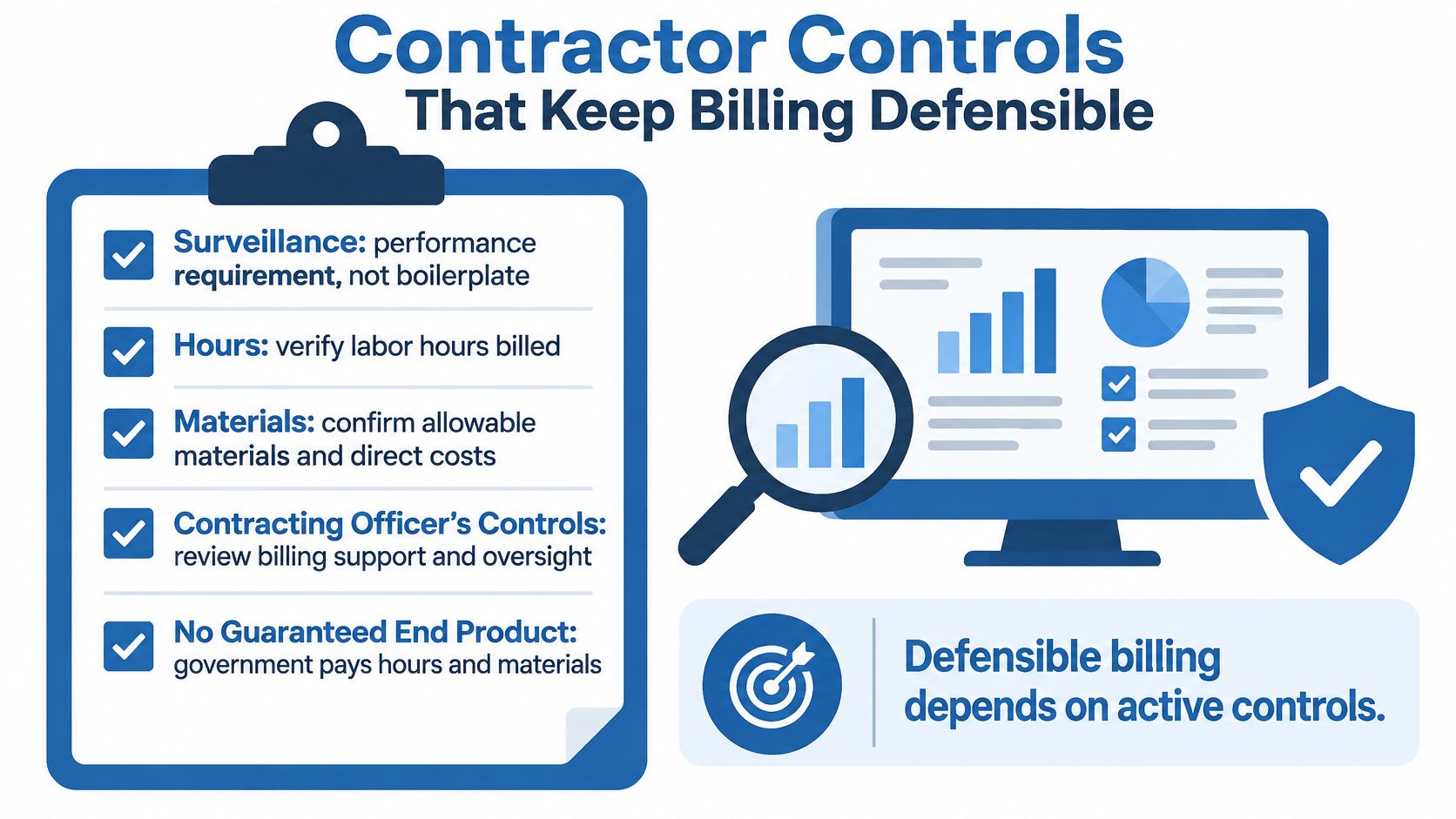
The most common rejected hour isn't always an hour nobody worked. It's an hour worked by the wrong category, charged to the wrong line, approved by the wrong person, or supported after the fact from memory. The work may be real. The billing still fails.
Surveillance exists because the government pays for hours and materials without receiving a guaranteed end product at a fixed price. Treat the contracting officer's representative's monitoring plan as a performance requirement. Your team should know how hours get approved, how work gets directed, and how deliverables get accepted before the first timesheet closes.
Control the Labor Record
Match each person to the labor-category definition in the contract. Keep the qualification evidence with the billing file, and get written approval before a substitution changes who is performing. If the replacement belongs in a lower category, bill the lower category.
Record time daily and tie it to the correct contract line and authorized task. Weekly reconstruction invites errors about dates, tasks, and who approved the effort. Supervisors should review category, task, and cumulative hours together, not just confirm that an employee was present.
Keep technical direction separate from unauthorized scope growth. Government staff may clarify how to perform authorized work, but a new task that changes scope or consumes ceiling needs proper contract authority. Train team leads to pause and route those requests through contracts instead of treating every urgent request as an approved change.
Control Materials and the Invoice Packet
Authorize purchases before they hit the ceiling. Keep the requirement, approval, supplier invoice, receipt, and line-item mapping together. Confirm the cost is allowable under the contract, and don't add duplicate profit to an amount already covered by a burdened labor rate or another indirect pool.
A clean invoice packet should let a reviewer trace the charge without asking your team to rebuild it:
- Approved timesheet: Shows the employee, date, hours, task, and contract line.
- Category crosswalk: Connects the employee's qualifications to the billed labor category.
- Material receipt: Supports the allowable cost and shows the government received the item or service.
- Cumulative spend line: Places the invoice against prior billing and the remaining ceiling.
Three failures deserve escalation, not a promise to fix the spreadsheet later. Charging a junior employee at a senior rate misstates the category. Continuing after verbal direction that never became a modification creates unauthorized work. Letting indirect pools double-count items already inside the hourly rate inflates the charge.
Apply a blunt pre-award test. If your company can't name who approves hours, who authorizes purchases, and who stops work near the ceiling, the opportunity is a compliance problem, not just a pricing problem. Fix those roles before award, while you can still design the workflow instead of defending invoices under pressure.
Qualify the Opportunity Before You Spend Proposal Time
The hourly rate is only part of the risk. If materials and other nonlabor costs are hard to forecast, they can use up the ceiling before the team expects it. Before bidding, check whether the contract's ceiling, terms, and available purchasing information give you enough visibility to plan the work.
Proceed when the labor categories match people you can staff, the expected hours and materials fit under the ceiling, and the file explains why another contract type will not work. Identify who will own the rolling forecast. Check how the contract applies the 85 percent notice under FAR 52.232-7, and make sure your team can act on it before spending reaches the ceiling.
Pause if the ceiling is unclear, materials look open-ended, or the surveillance rules conflict with how your company records hours. Those conditions can make otherwise valid work difficult to bill. Walk away or team if you cannot meet the qualifications, clearance, or set-aside requirements. A partner may address a staffing or eligibility gap, but its people still need to fit the required labor categories.
Before deciding, review the labor-rate schedule, ceiling, payment clause, and recent task-order awards on the same vehicle. Read the notice and attachments from the official federal opportunity source. Then run your own staffing mix and 85 percent trigger against the ceiling in your pricing file. FederalPipeline capture briefs summarize what is being bought, required clearances, set-asides and certifications, the incumbent, ceiling, and deadlines. The platform also flags bid blockers drawn from solicitation attachments. Use those findings to focus your document review, then confirm the requirements against the source documents and your federal business opportunity qualification process.
Before proposal hours begin, use FederalPipeline to connect the solicitation with the incumbent, prior contract, buyers, and award history. Check the listed requirements and bid blockers, then assess the opportunity against your own staffing and ceiling controls. That qualification work can help you decide whether the pursuit deserves proposal time.