Fixed-price contracts averaged 63% of annual federal contract obligations during fiscal years 2011 through 2015, compared with approximately 37% for cost-reimbursement and time-and-materials or labor-hour arrangements combined, according to GAO's analysis of federal contracting data. That makes fixed price contracting a mainstream capture decision, not a specialist pricing issue.
But the government's preference isn't your investment thesis. Before committing proposal resources, answer a harder question: Can your company carry the uncertainty inside the proposed price? A promising ceiling, familiar customer, or attractive set-aside doesn't answer it.
Why Fixed Price Contracting Dominates Federal Awards
The obligation shares above remained broadly stable across the period GAO examined. The practical message is that capture teams need a repeatable fixed-price qualification process, not an exception review reserved for unusually risky pursuits.
Read the denominator correctly. Obligations aren't contract counts. Large awards can influence the share, so the finding doesn't establish that the same proportion of individual opportunities used fixed pricing. Nor should a historical government-wide result substitute for research into the agency buying your services today.
Agency differences matter. In the same GAO analysis cited above, the Department of Homeland Security used fixed-price arrangements more heavily than civilian agencies on average. That's a reason to investigate the customer's buying practices, not assume that every agency allocates delivery risk identically.
Read the bargain from the supplier's side
Consider a hypothetical federal equipment delivery. The buyer specifies the equipment, quantities, delivery requirements, and acceptance conditions, then agrees to a price. Your team earns its return by purchasing and delivering within the cost base supporting that price.
That bargain can be attractive when your suppliers are dependable and the requirement matches work you know how to execute. It becomes less attractive when the buyer has settled the price structure but hasn't settled what successful delivery requires.
Capture rule: A fixed government expenditure isn't the same thing as a predictable contractor cost.
Start qualification with the relationship between the requirement and your delivery model. Don't let the advertised value become the first and last reason to pursue.
- Identify the actual subtype. A broad fixed-price label doesn't tell you how price adjustments or incentive provisions operate.
- Inspect the statement of work. Look for a defined obligation, not merely an appealing mission.
- Test technical maturity. Separate repeatable execution from development your engineers still need to resolve.
- Name the overrun owner. Write down which party carries each material exposure.
The recommendation is straightforward: qualify the economics before celebrating the opportunity size. A smaller, well-defined requirement can deserve proposal resources that a larger, poorly bounded pursuit doesn't.
How Fixed Price Subtypes Move Cost and Profit
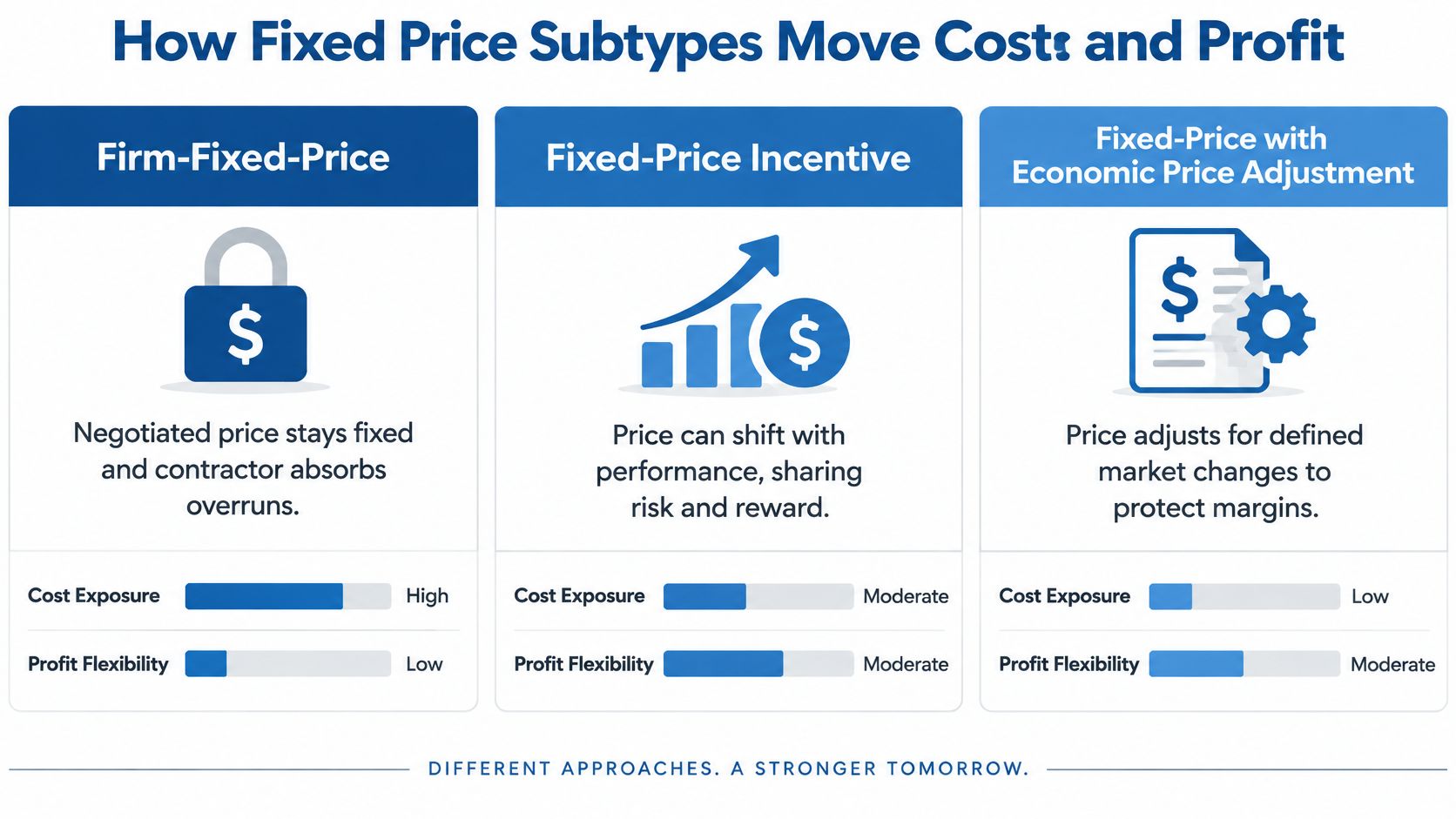
Firm-fixed-price, or FFP, makes your estimate consequential. The negotiated price doesn't change merely because actual costs differ from your estimate. Better execution can preserve more profit; higher costs can consume that profit and produce a loss.
The FAR's fixed-price contracting guidance connects FFP suitability to sufficiently definite requirements, reasonably predictable market or labor conditions, and the ability to establish a reasonable price at award. Those conditions should become capture gates, not background reading.
Test what your team must deliver
For a hypothetical maintenance requirement, ask whether the solicitation defines measurable outputs, acceptance criteria, quantities, the performance period, and government-furnished information. If your estimate assumes access to technical records, verify that the requirement provides for that access.
A missing input isn't automatically a contingency you can price. Your team needs to understand its effect before assigning a cost allowance.
Fixed-price incentive arrangements change the relationship between cost, price, and profit. They can share savings and risk and connect profit to performance. But sharing doesn't mean eliminating exposure: the team still needs to model the negotiated arrangement rather than treating an incentive label as downside protection.
Economic price adjustment, or EPA, addresses separately identified labor or market contingencies. It doesn't turn the contract into reimbursement for every cost increase.
Who Bears the Overrun
| Subtype | Cost overrun | Best fit |
|---|---|---|
| Firm-fixed-price | Contractor generally absorbs differences between estimated and actual costs | Definite requirements with reasonably predictable execution conditions |
| Fixed-price incentive | Government and contractor share specified cost effects under the negotiated arrangement | Work suited to explicit cost and performance incentives |
| Fixed-price with economic price adjustment | Defined changes may qualify for adjustment; other exposure remains | Work with identifiable labor or market instability |
Suppose a supplier raises its quote after your estimate is complete. Under FFP, don't assume that increase changes what the government pays. Under an incentive arrangement, inspect how it affects the agreed sharing mechanics. Under EPA, determine whether the specific input and change qualify.
Lower administration is a recognized FFP benefit, but it doesn't remove acceptance, modification, or claims risk. Simple payment mechanics don't excuse weak estimating or scope control.
When Fixed Pricing Outran the Technology
The historical warning isn't that fixed pricing fails. It's that procurement teams can ask a price mechanism to solve a technical problem it cannot resolve.
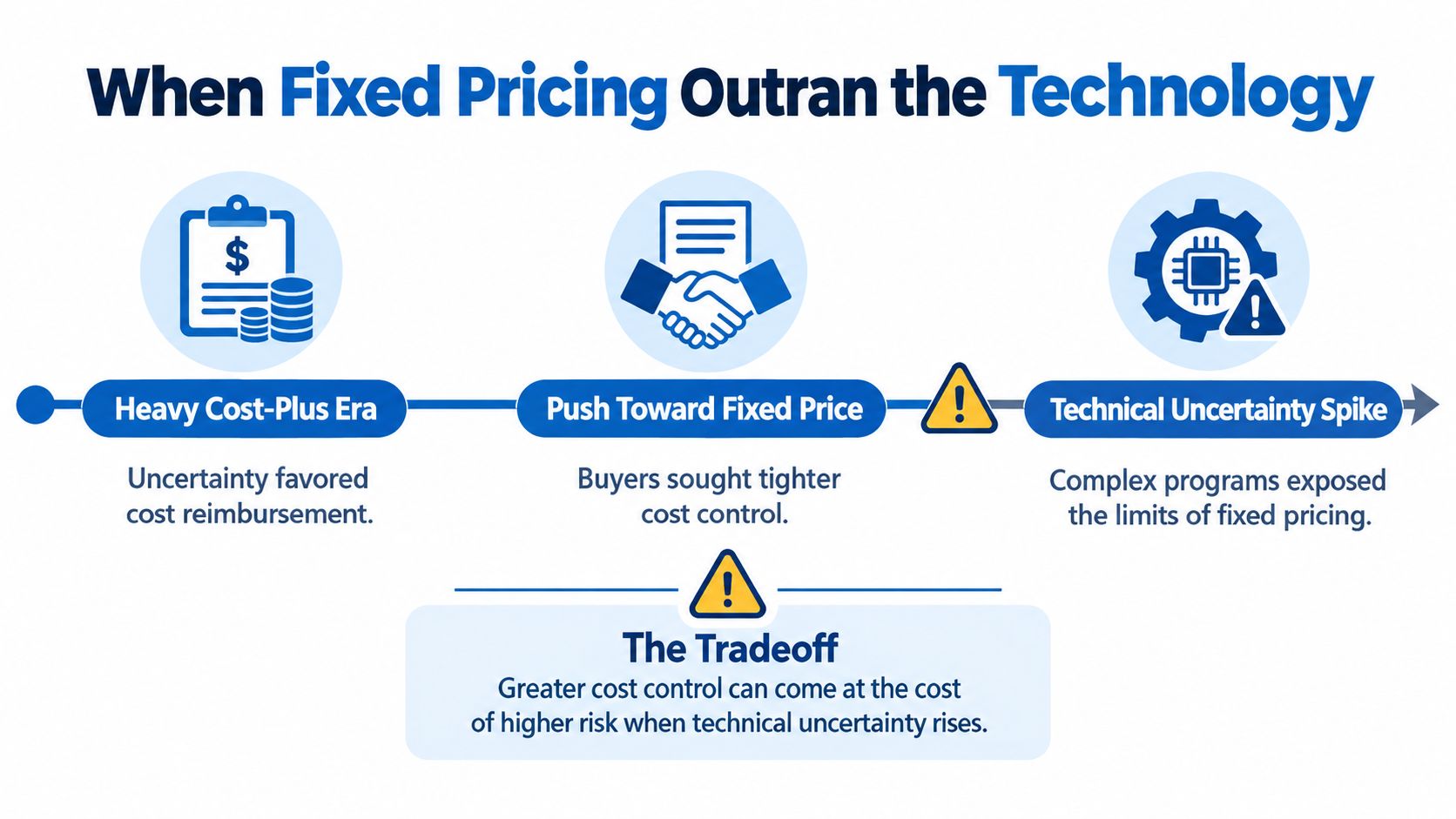
The historical account associated with GAO's review of foreign military sales contracting describes aircraft programs averaging 220% above baseline during the cost-plus-heavy 1950s, the Air Force's introduction of Total Package Procurement in 1964, and its abandonment under Defense policy in 1971. The attempted solution was ambitious: place research and development through low-rate initial production under a single fixed-price contract.
The attraction was understandable. Buyers wanted stronger cost discipline and more responsibility for performance placed on industry. Combining development and production also aimed to connect decisions made during design with the consequences of manufacturing.
A price commitment cannot mature a design
The experiment exposed the central difficulty: contractors were being asked to commit across work whose technical and production costs weren't sufficiently mature. Defense policy ultimately prohibited the approach and favored cost-based contracting for development efforts.
For a capture lead, the useful distinction is between execution uncertainty and discovery uncertainty. You can investigate supplier lead times, validate staffing assumptions, and test a production plan. You can't confidently price an unresolved engineering outcome just because the proposal spreadsheet requires an entry.
Don't price an engineering discovery as though it were a purchasing variance.
The same GAO foreign military sales review found that firm-fixed-price represented 99% of contract awards during fiscal years 2007 through 2016, while describing increased use of fixed-price incentive arrangements to share savings and risk. That finding is about awards within the reviewed market, not the government-wide obligation measure discussed earlier.
The modern lesson isn't to reject complex work. It's to separate what your team can estimate from what the program still needs to learn.
If a hypothetical acquisition combines an unproven design with a production commitment, require engineering to identify the unresolved dependencies before pricing approves the pursuit. Ask which tests establish feasibility, what evidence supports the manufacturing approach, and whether acceptance depends on performance your team hasn't demonstrated.
Bid when your estimate describes a credible delivery plan. Pause when it substitutes confidence for technical evidence. An elaborate incentive structure won't rescue an estimate built on an unknown design.
Uncertainties That Should Stop a Bid
A government-friendly risk allocation can be a supplier-unfriendly business decision. That distinction matters especially when a small business lacks reserves, negotiating power, or a deep record of comparable delivery costs.
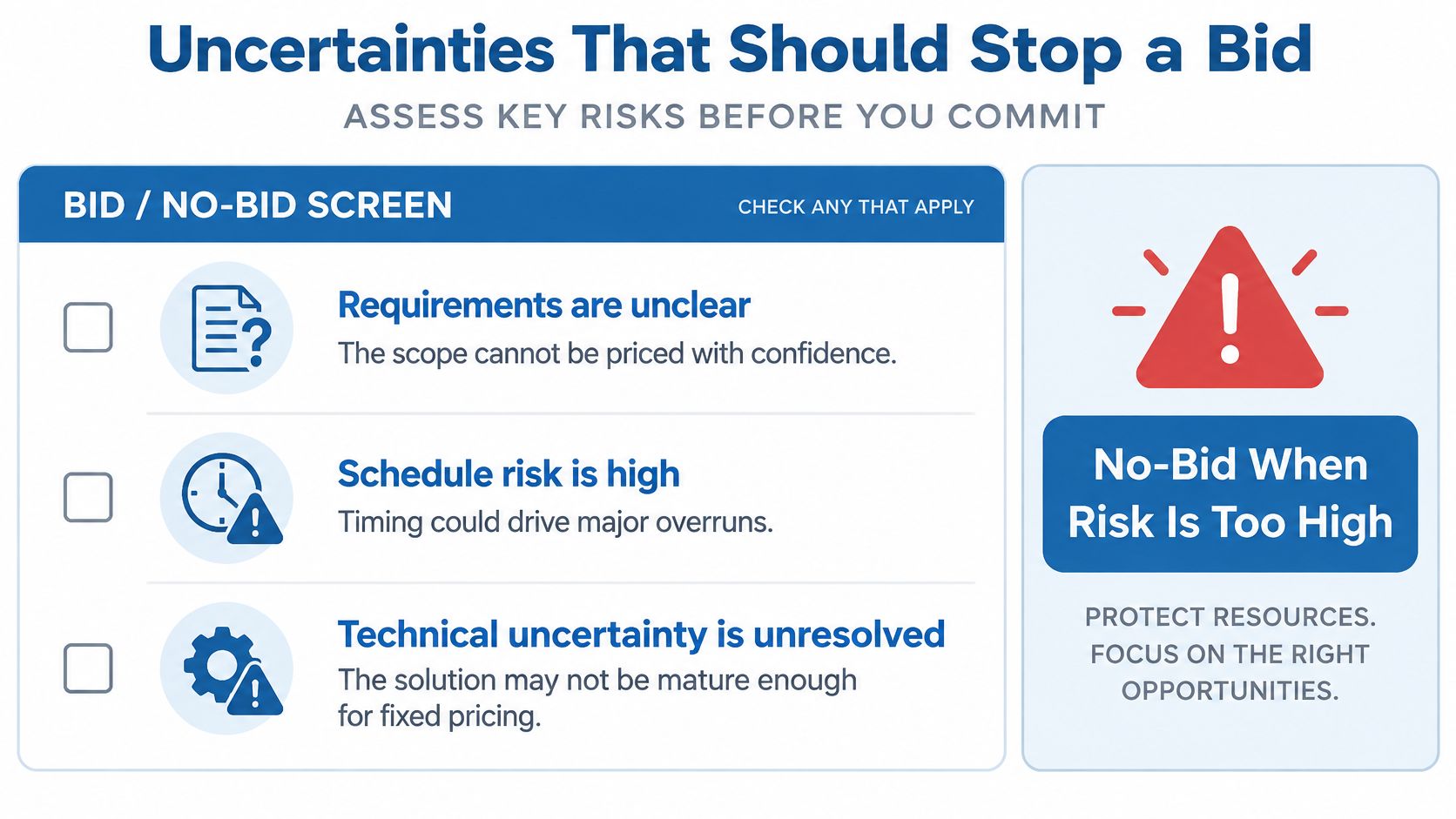
Congressional research on contract pricing identifies the problem with fixed pricing when price or performance costs cannot be determined reliably: the contractor can face escalating costs, reduced profit, or loss. Your bid review should therefore classify uncertainty, not merely acknowledge it.
Require evidence across the delivery model
- Scope. Require a stable specification and an acceptance standard your technical lead can explain. An objective such as improving readiness isn't, by itself, a bounded work package.
- Quantity. Compare the pricing quantity with available buying history. Ask whether your purchasing assumptions remain credible if the expected order pattern changes.
- Schedule. Validate the performance period against recruiting, access, approvals, and supplier lead times. A delivery date isn't a delivery plan.
- Supplier. Identify named sources and obtain quotes whose validity and conditions support your proposal.
- Wage. Document labor categories, recruiting assumptions, and the basis for rates. Don't use an incumbent's apparent staffing model without checking whether you can hire against it.
- Compliance. Confirm clearance, certification, and other stated requirements before treating eligibility as settled.
Choose price, question, or decline
Price a bounded risk. In a hypothetical parts buy, a documented supplier quote supports the material estimate, but freight remains variable. If you can investigate that variability and carry a defensible allowance, it can remain in the bid.
Question an unresolved assumption. For a services opportunity, the staffing plan may depend on when the government provides site access. Submit a clarification question that asks for the access conditions and timing. Don't convert an unsupported assumption into the baseline without challenge.
Decline an unbounded obligation. If the buyer expects a guaranteed result while leaving the essential specification or acceptance standard unsettled, recommend no-bid unless the requirement is corrected.
Ordinary adjustment procedures aren't a substitute for a stable requirement. Don't assume that every ambiguity will become a recoverable change after award.
Your threshold should be explicit: each material uncertainty needs supporting evidence, a defined contractual treatment, or resolution before commitment. If none is available and the exposure could exceed what leadership is willing to carry, stop the pursuit.
Inflation Clauses That Still Leave Gaps
Under FFP, contractors generally bear cost increases, including inflation, and unexpected inflation alone doesn't authorize contractual relief. DoD guidance on inflation and economic price adjustments explains that exposure and describes when an economic price adjustment clause may apply. Treat every EPA clause as a bounded risk transfer with stated limits.
Clauses such as FAR 52.216-4 adjust prices only through the mechanism written into the contract: specified labor or material categories, a stated measurement basis, and stated limits on recovery. Whatever the clause fails to cover stays on your cost line. Read the actual clause text in each solicitation rather than assuming a standard formula applies.
Follow an input through the clause
Take a hypothetical long-duration supply buy built around a volatile material. Your supplier's price may climb sharply during performance. Recovery depends on three things: whether the clause names that input, whether it measures the change the same way your estimate does, and whether it permits an adjustment at the time you need it.
A threshold leaves smaller qualifying changes with you. A cap leaves you carrying increases after the permitted adjustment runs out. An exclusion leaves the input outside the mechanism entirely.
Pricing instruction: Model the cost you retain after the adjustment, not just the adjustment you expect to request.
The FAR permits an EPA clause when serious doubt exists about the stability of labor or material prices during performance and the contingencies can be identified and covered separately. Your cost model has to match what the clause measures, or the protection is theoretical.
Before pricing, require answers to the following:
- Measurement basis. Which labor or material index, established price, or other specified measure controls? Does it match the input your estimate depends on?
- Baseline and dates. What starting point and measurement dates apply?
- Quantity and schedule assumptions. Does the proposed buying pattern align with the periods the adjustment covers?
- Limits and exclusions. Which thresholds, caps, and eligible line items govern recovery?
- Documentation. What evidence must your team retain and submit?
The same discipline applies to wage exposure on a services buy. An adjustment tied to a measure that poorly reflects your labor mix protects you less than the proposal team expects.
Finish the EPA analysis before proposal approval. If the clause leaves a material gap, price what you would retain, get leadership to accept that exposure explicitly, or stop the pursuit. A capped clause still leaves you holding the residual risk.
How to Test a Fixed Price Before You Propose
Reading the solicitation is necessary. Reading only the solicitation is a weak basis for deciding whether your company can execute profitably.
The better research method depends on what remains unknown. Use the notice to establish the proposed obligation, award history to investigate the buying pattern, and connected records to understand the customer and incumbent context. None of those records reveals an incumbent's private cost ledger.
Compare the research paths
| Research method | What it establishes | What still needs testing |
|---|---|---|
| Solicitation review alone | Current requirements, clauses, eligibility, and deadlines | Whether your delivery assumptions fit observable buying behavior |
| Manual award-history research | Prior awards, recipients, and available procurement context | Whether records are comparable and connected to the current requirement |
| Connected opportunity, award, and budget research | Relationships among the notice, incumbent, prior contract, program, and buyer | Your actual costs, supplier commitments, and acceptable business exposure |
Manual research can be appropriate for a familiar customer or a narrowly defined buy. Its weakness is fragmentation: someone must connect the relevant records and explain why they apply to this pursuit.
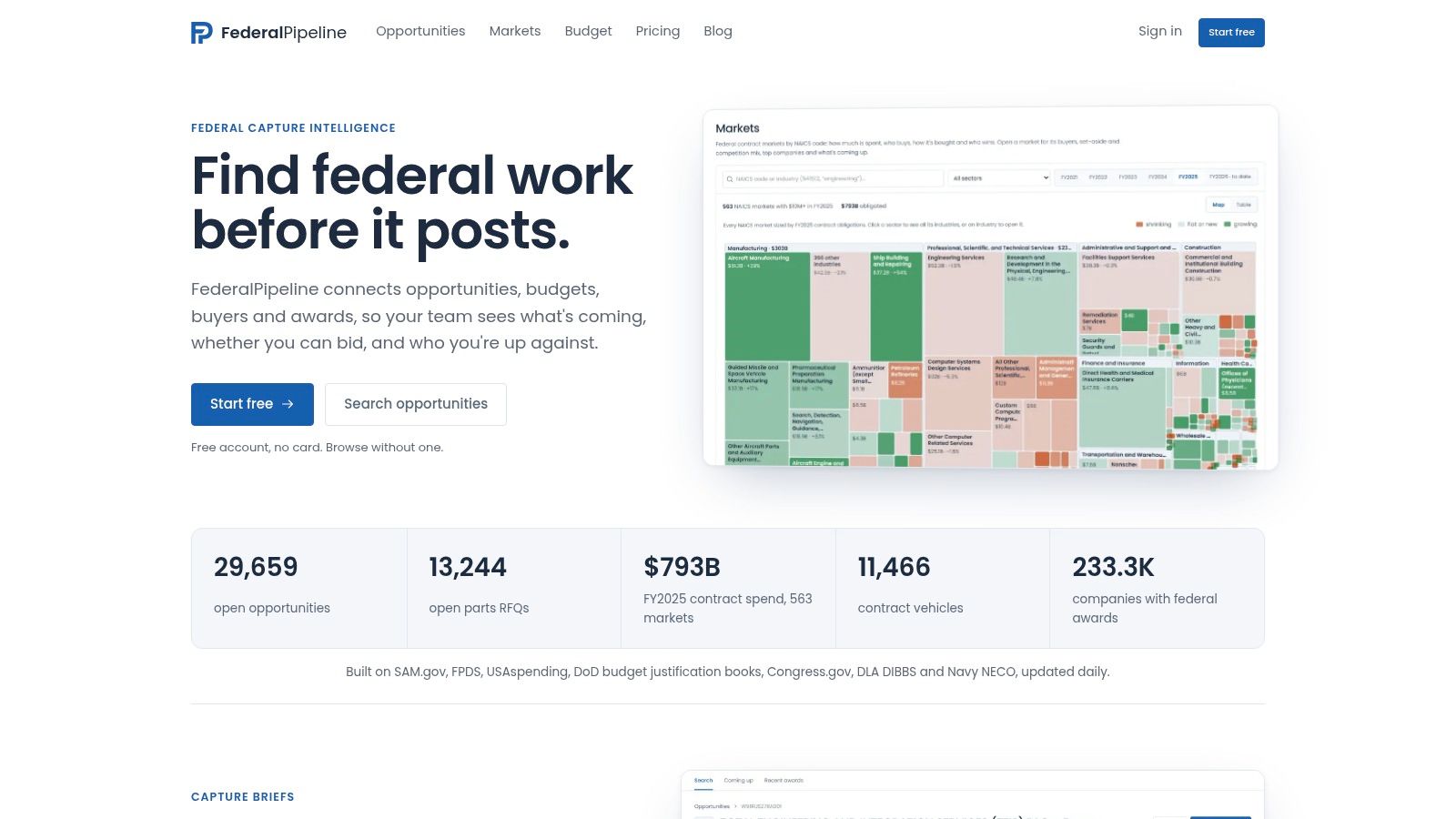
At FederalPipeline, we flag bid blockers up front, including the incumbent, prior contract, and requirements pulled from attachments. We read every solicitation and provide capture briefs covering what's being bought, required clearance, set-aside and certifications, the incumbent, ceiling, and every deadline.
Use that context to direct the document review rather than replacing it.
Investigate the assumptions behind the notice
We also let users follow defense budget lines to the program offices that own them and the contracting offices they buy through, years before a requirement reaches SAM.gov. That gives a capture team an earlier research path than waiting for a published solicitation.
For a practical federal business opportunity qualification process, connect each record to a pricing question. Does the prior contract suggest comparable duration? Do available requirements support the labor mix you're assuming? Does the agency's buying history support the quantities your supplier quote requires?
Keep the distinction between public evidence and internal economics clear. A prior award can provide context; it cannot prove that your company can reproduce the incumbent's delivery costs.
Use connected research to shorten qualification, not outsource judgment. Your pricing lead, technical lead, and company decision-maker still own the bid decision.
Make the Next Fixed-Price Decision Explicit
Choose a live pursuit this week and write the decision before authorizing more proposal work. Don't settle for “good fit” or “strategic customer.” State whether the proposed obligation is yours to carry and what evidence supports that conclusion.
Start by confirming the subtype. Then ask whether the work is definite enough for that structure and whether the material uncertainties have defensible treatment. Price what you can support; don't conceal unresolved questions inside an unexplained contingency.
Put the decision into the pursuit record
Use a short decision statement that identifies the remaining condition for approval. For example, a hypothetical services pursuit might remain on hold pending clarification of government-provided access. A supply pursuit might proceed only after a supplier confirms quote validity through the required purchasing date.
- Proceed. The team has a supported estimate, an executable delivery plan, and leadership acceptance of the remaining exposure.
- Pause. A missing index, unstable specification, or unavailable cost evidence prevents a responsible commitment.
- No-bid. A material gap remains unresolved and the company won't accept the consequences.
An incumbent cost base you can't see isn't automatically disqualifying. It is a reason to stop using the incumbent's apparent economics as your own pricing evidence.
We make the operational next step straightforward: account setup takes two minutes, using a work-email magic link without a password, followed by company confirmation and opportunities scored for fit, with email alerts on your schedule. Open the opportunity and read the capture brief for ceiling, set-aside, certifications, incumbent, and deadlines.
Assign the next action
Our Pipeline feature tracks pursuits by stage, with the next action and supporting research attached. Attach the evidence, name the decision owner, and record whether the immediate action is a clarification question, further validation, or no-bid.
Approval should reflect a business commitment, not proposal momentum. Bid when your company understands and accepts the retained exposure. Decline when winning would depend on relief you haven't established or performance you can't credibly estimate.
FederalPipeline connects opportunities with prior awards, incumbents, buyer context, and capture briefs so your team can investigate fixed-price exposure before committing proposal resources. Visit FederalPipeline, open a live pursuit, and attach the evidence supporting your next go-or-no-go decision.