A Contract Line Item Number identifies one separately identifiable supply or service on a federal contract. The contract total is the wrong unit for a pricing review: a CLIN can be priced, funded, evaluated, and ordered independently. A line can carry a price without having funds obligated against it. It can also be a zero-dollar data requirement that still calls for work and delivery.
That distinction matters when you read the schedule. CLIN 0001, CLIN 1001, and a subline such as 0004AA may appear together, yet they can represent different things: base-year work, an option the government may choose not to exercise, or a breakdown of a parent line by destination or accounting. The award ceiling alone does not explain what each line promises. Review each one on its own terms.
What a CLIN Actually Is
A Contract Line Item Number (CLIN) is the identifier for one separately identifiable supply or service on a U.S. federal contract.
Treat the contract like a grocery receipt. The cart is the award. Each scanned item is a CLIN. The store cannot fund, accept, invoice, or modify "the cart." It can only act on a line that names the item, the count, and the price. Federal acquisition rules generally require purchased items or services to be identified as separate line items unless doing so isn't feasible, because evaluation, funding, invoicing, modifications, and performance tracking all attach to the line. That link is what makes procurement data traceable. A specific requirement sits on a measurable obligation, not on a lump-sum story.
Not every line is the same kind of work
A CLIN may be a deliverable, travel, data, an option, or an administrative requirement. Its pricing type can change how bids are compared. A solicitation can list many CLINs while the evaluated price uses only some of them.
The Government Accountability Office decision on a federal solicitation is a clean example. The request for proposals contained 23 CLINs and related subline items. 21 were fixed-price, 1 covered cost-reimbursable travel, and 1 was a zero-dollar line item for contract data requirements. The agency evaluated total price by summing the 21 fixed-price CLINs. The travel line and the data line were still part of the contract. They just didn't enter the price the agency used to compare offers.
Practical rule: Before you build a price, mark which lines enter the evaluated total and which lines are only obligations.
That split is the whole point of asking what a CLIN is in government contracts during capture, not after award. A line that adds nothing to score can still add delivery, inspection, and invoice work. Read the fields on each line before you decide the opportunity is one job with one price.
What Every CLIN Has to Spell Out
Read a CLIN the way you'd read a shipping label. If a box on the label is blank, nobody can ship, accept, or pay that box alone.
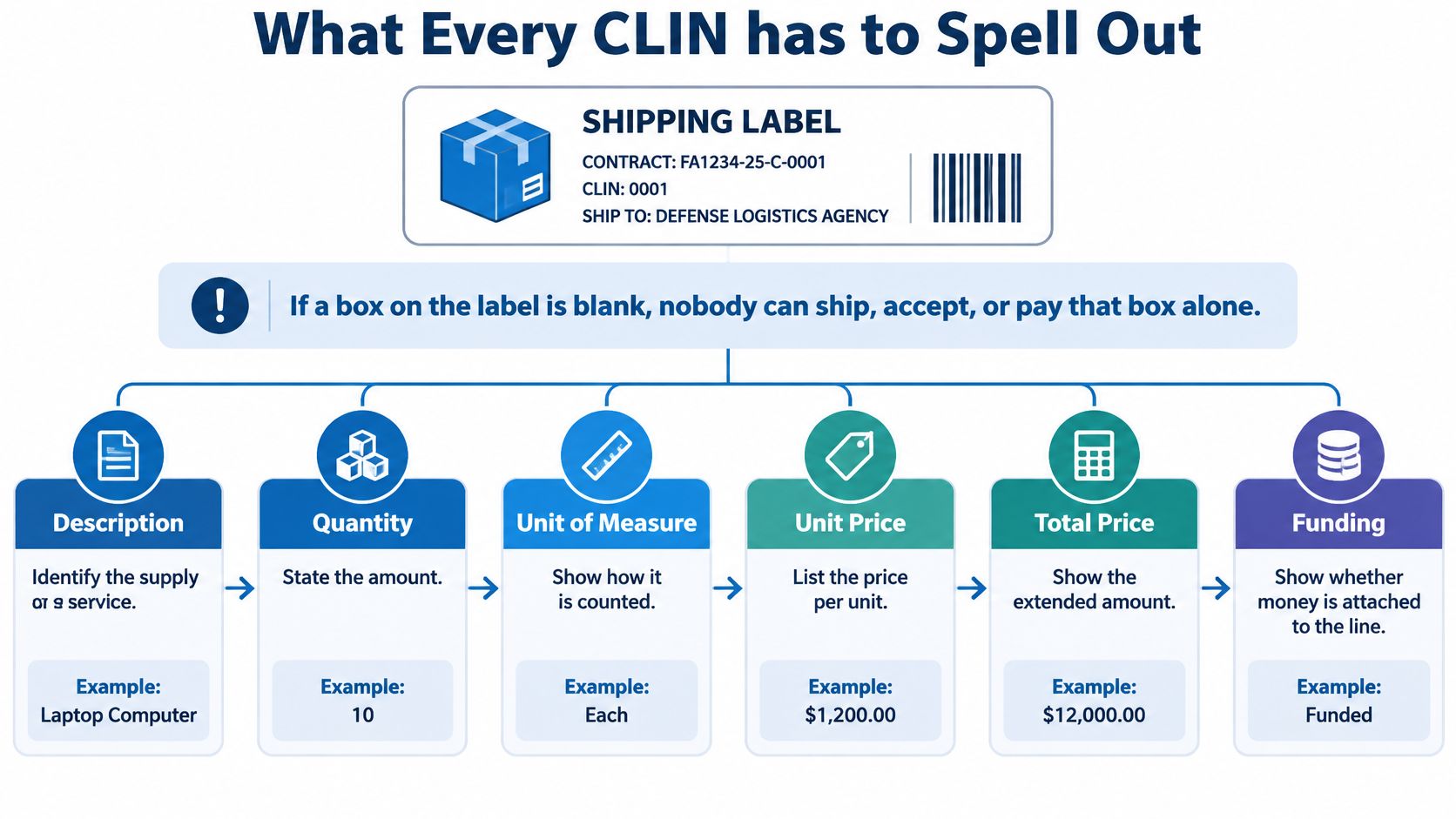
The DFARS uniform line-item rules say contracts should identify separately acquired items or services as distinct line items unless that isn't feasible. Each CLIN must also have an expressly stated delivery schedule, period of performance, or completion date.
Walk the label in order
Description comes first. It has to name the supply or service so the line can stand apart from the rest of the award. "Program support" that hides three systems is not a description you can accept or reject on its own.
Quantity and unit of measure turn that description into something countable. Each, lot, hour, and month are different businesses. A quantity of 1 lot can hide a year of labor. A quantity of 12 months tells you the invoice rhythm.
Delivery schedule, period of performance, or completion date is not optional under those DFARS rules. One of the three has to be on the line. Place of delivery matters when acceptance happens at a specific site, depot, or government office rather than "as directed."
Inspection and acceptance decide two dates that pricing teams blur. The government may reject the work only after the inspection point in the clause. You may invoice only after acceptance, or after the event the line names, such as a month of hours or delivery of a lot.
Pricing structure isn't one format. Fixed-price CLINs show unit price and total price. Cost-type CLINs use the applicable cost-contract elements rather than unit pricing. Copying a unit-price column onto a cost line, or burying cost elements inside a fixed-price unit, is how invoices get kicked back.
Funding is its own box, and it can sit below the priced amount. Note the field here. Whether money is on the line is a later question, not a reason to skip the box.
The number itself is stable. Standard CLINs use four numeric digits from 0001 through 9999, normally in sequence. The solicitation line-item number should remain the contract line-item number unless there is a valid reason to change it. If 0007 in the RFP becomes 0012 in the award with no stated reason, your crosswalk is already broken.
Subline items are splits, not a second scope. They break a parent for destination, packaging, configuration, or accounting. A lettered suffix under 0004 is still 0004's family unless the schedule gives that subline its own deliverable.
| Element | What it fixes | Capture check |
|---|---|---|
| Item or service description | The separately identifiable supply or service | Can your team perform this line without the others? |
| Quantity and unit of measure | How much and in what unit, such as each, lot, hour, or month | Is the quantity economically viable? |
| Delivery schedule, period of performance, or completion date | When performance is due; one of these is required | Can you meet that date or period? |
| Place of delivery or performance | Where acceptance and performance occur | Do you have people or stock at that place? |
| Inspection and acceptance | When the government may reject work and when you may invoice | Does your quality evidence match the clause? |
| Pricing structure | Unit and total price on fixed-price lines; cost-contract elements on cost-type lines | Are you pricing in the format the line demands? |
| Four-digit CLIN number, 0001 through 9999 | The stable identifier from solicitation into the contract | Did the number change without a stated reason? |
One CLIN that combines several independently delivered systems hides cost, schedule, acceptance, and responsibility. Compare the solicitation's CLIN structure to your scope, pricing model, delivery capability, and compliance evidence before you treat a bundled line as a single easy price.
How CLIN Numbers Separate Base Work From Options
The number is a map of time, not a serial sticker. Under Defense acquisition line-item guidance, base-period line items use numbers beginning with 000x. Option periods run in sequence: 100x for the first option period, 200x for the second, 300x for the third, and 400x for the fourth.
Each item or system is identified on its own CLIN, with its own quantity and unit of measure. That is how you separate hardware from services without reading every attachment first. A parent that only points at an exhibit is telling you the commercial shape lives one document deeper.
When the list gets long
Hardware has a practical cutoff. Contracting officers use separate CLINs when hardware requirements involve fewer than 10 line items. An exhibit may be used when hardware requirements exceed 10 line items, if the CLIN references that exhibit. Don't assume the parent states every part, quantity, and unit. Open the exhibit before you decide a parts buy is viable.
An informational subline, often an alpha suffix such as 0001AA, splits ship-to, configuration, or accounting under a parent. It isn't a second scope and it isn't a new option year. If your bill of material only changes the destination, keep the price conversation on the parent and the funding conversation on the split.
| Series or device | What it covers | What to assume | What not to assume |
|---|---|---|---|
| 000x | Base-period line items | Work structured for the initial period | That every 000x line is funded on day one |
| 100x | First option period | A separately numbered option year | That the option will be exercised |
| 200x | Second option period | The next option year in sequence | That pricing equals an order |
| 300x | Third option period | The third option year | That the ceiling is revenue |
| 400x | Fourth option period | The fourth option year | That later years match base quantity |
| Separate CLINs for hardware | Fewer than 10 hardware line items | Each item or system has its own quantity and unit | That a long parts list will look the same |
| Exhibit referenced by a CLIN | More than 10 hardware line items | The CLIN points to the list; quantities can live in the exhibit | That the parent CLIN states every part |
Sort the sheet into base-year work and options, then into hardware and services, then into lines that carry quantity and price versus lines that only point at an exhibit. That sort is enough to see whether the opportunity is a one-year services buy with priced-out years, or a hardware list hiding in an attachment. The same structure shows up on orders placed through a contract vehicle, where the vehicle ceiling and the order's CLINs are different objects.
Detailed conventions differ by agency and contract type. A civilian schedule may use four digits and never follow the Defense option-year series.
Read Section B and the schedule instructions before you decide that 2001 means option year two. A jump in the leading digit usually marks an option, a separately identified system, or a pointer to an exhibit. The number tells you structure. It doesn't tell you the government has funded the line or ordered it.
Price Funding and Obligation Are Not the Same
Four questions can all get different answers on one line. Pretty ceilings fail when you collapse them into one yes.
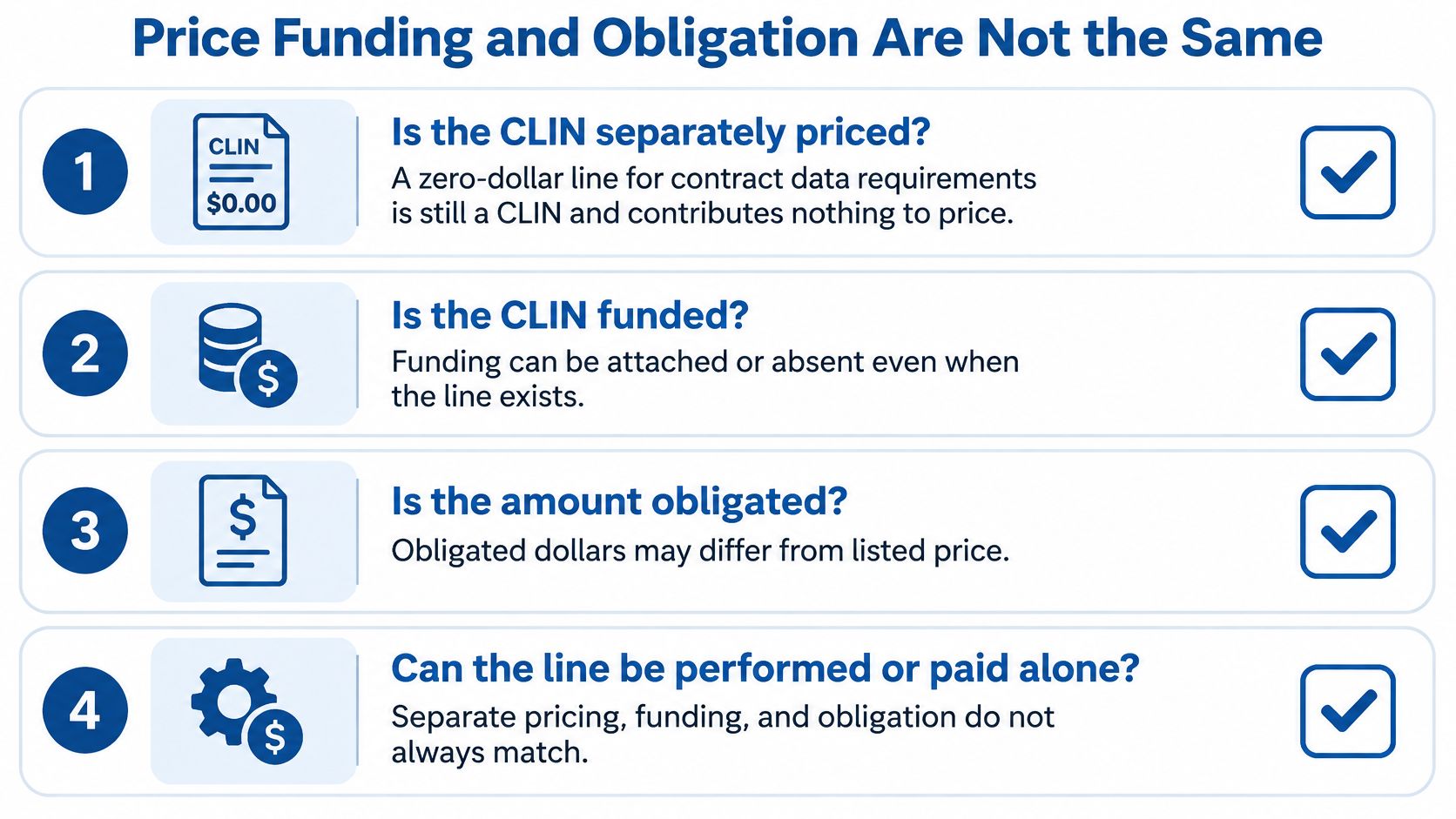
Is the CLIN separately priced? A zero-dollar line for contract data requirements is still a CLIN. It contributes nothing to price and still names work.
Is it separately funded? The funded amount can be only part of the priced amount. A large line can have a small amount you are allowed to invoice.
Is it in the evaluated price? Source-selection math may add the fixed-price lines and leave travel or data lines out of the total. Your winning number and your delivery cost are not the same sum.
Must the government order it? Options, IDIQ ordering lines, and unfunded quantities can be written and even priced without becoming committed demand.
Agency pricing guidance can require prices broken out by CLIN and by contractor fiscal year, with recurring and non-recurring costs identified separately for each CLIN or sub-CLIN. That breakout is where small businesses get hurt. An attractive total ceiling can hide setup cost loaded into the base, escalation that differs by year, and option CLINs that are priced but not guaranteed to be ordered.
Where the cash actually sits
For a parts supplier or subcontractor, quantity and unit of measure decide whether the buy is worth quoting. A subline may only split packaging, configuration, destination, or funding. Traceability isn't demand. Numbered lines support tracking, and a user shouldn't treat every number as an order.
| Question | Yes means | No means | Trap if you skip it |
|---|---|---|---|
| Is it separately priced? | The line has unit and total price, or the required cost elements | A zero-dollar or unpriced administrative line | Treating every number as revenue |
| Is it separately funded? | Money is obligated on that line and can be invoiced | The line is structured or priced but not yet funded | Booking the priced ceiling as cash |
| Is it in the evaluated price? | The agency adds this line into the bid total | Travel, data, or other lines may be excluded from scoring | Winning math that ignores how price is summed |
| Must the government order it? | The line is obligated base work | An option, IDIQ quantity, or exhibit item may never be bought | Forecasting option years as guaranteed sales |
On a fixed-price contract line, unit price and total price are what you live with after award. On a cost-type line, the risk sits in the cost elements and the funded ceiling, not in a unit you invented to make the spreadsheet balance.
Tighten price on lines that are evaluated. Isolate cost-type risk on its own row. Don't forecast revenue on lines the government has neither funded nor promised to order. A base year full of non-recurring setup, followed by option years that carry the attractive unit price, is a cash-flow problem even when the five-year ceiling looks healthy.
Real CLIN Cases and the Mistakes They Expose
How can one contract contain lines with different pricing rules, limits, and delivery obligations? Two awards show why the contract header is the wrong unit for understanding the work.
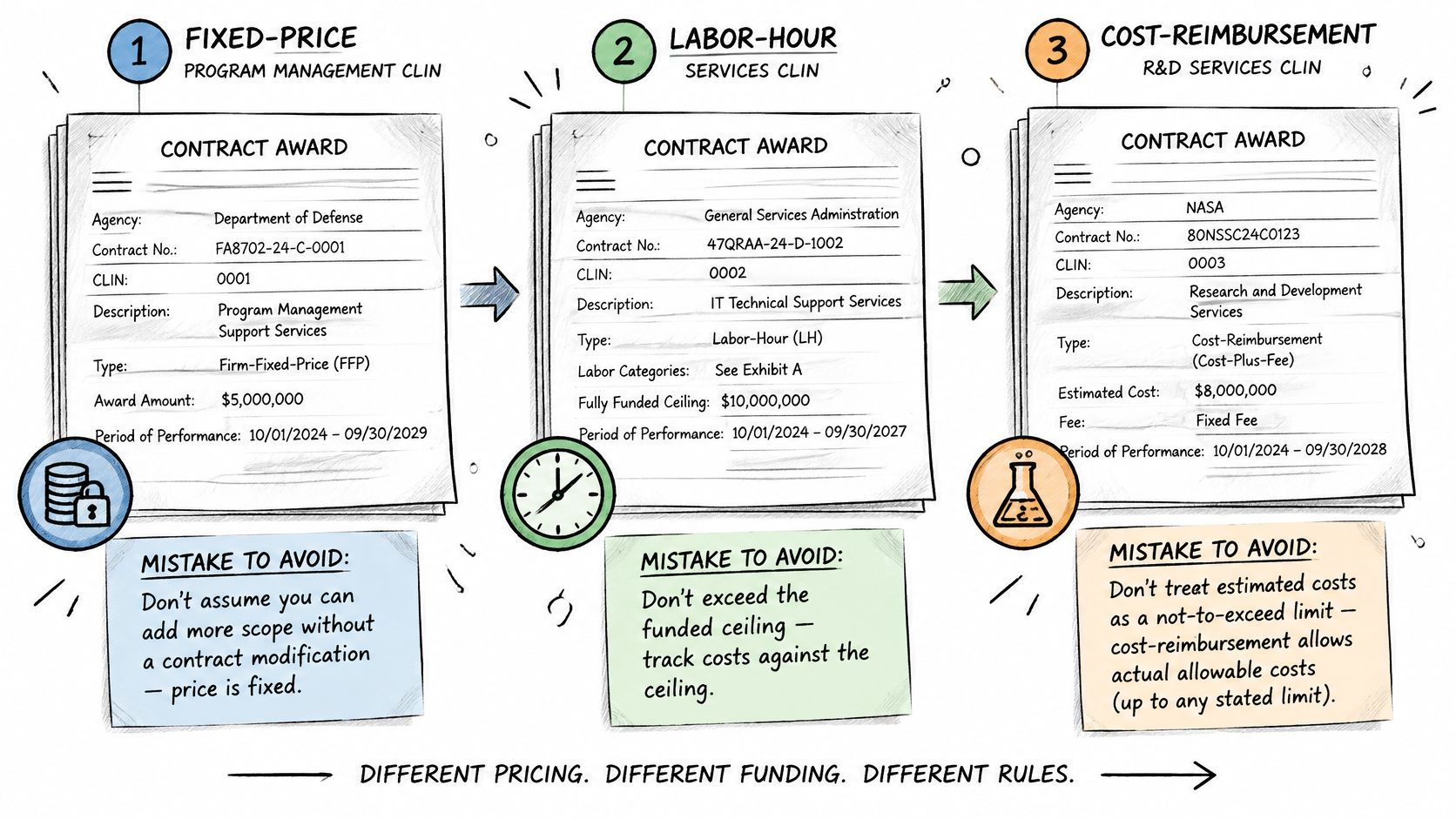
In 2023, the Government Accountability Office described a hybrid task order with three CLINs. CLIN 1 was fixed-price program management. CLIN 2 was labor-hour services with a funded ceiling of $778,049.37. CLIN 3 was cost-reimbursement travel with a $100,000 funded ceiling. The order combined three pricing arrangements and two different funding caps. Treating it as one contract total would hide what could be billed for labor and what could be spent on travel.
That same year, the Architect of the Capitol added CLIN 0004 for materials and supplies valued at $4,560,500, covering 115,000 COVID-19 tests, 100,000 KN-95 masks, 100,000 N95 masks, 100,000 boxes of gloves, and 100,000 containers of disinfecting wipes, according to a separate GAO protest decision. Here, the quantities and units define the purchasing task. A supplier able to provide gloves but not tests cannot assume it can fulfill the entire line.
Five header mistakes
The GAO's discussion of line-item traceability describes CLINs as more than pricing rows. A line can carry its own deliverables, funding, fee structure, and performance evaluation. Capture teams that qualify only at the solicitation or total-contract level can miss differences in what they must price, deliver, and manage.
- Reading only total contract value. The hybrid order's labor ceiling, travel ceiling, and program-management price represent different limits and pricing rules.
- Assuming every numbered line is committed demand. A funded ceiling sets a cap on payment; it does not promise that every hour will be ordered.
- Treating a subline as new scope. A split may distinguish packaging, destination, configuration, or funding under work the team has already priced.
- Ignoring a zero-dollar data CLIN. The line can require a delivery even though it adds nothing to the evaluated price.
- Recombining lines the government separated. Combining them can obscure distinct prices, acceptance requirements, and responsibilities. Performance evaluations may track individual lines rather than the contract as a whole.
The contract total is often the wrong unit for competitive analysis. Each CLIN may be priced, funded, and evaluated independently, and a zero-dollar line can still require delivery and create work. Read the lines before judging the award by its header.
Build a CLIN-Level Matrix Before Proposal Work
Stop copying the total value into the pipeline. Give every CLIN or sub-CLIN its own row, and fill the row before anyone is assigned to write.
Use the hybrid pattern as the test. CLIN 1 is fixed-price program management, so its invoicing basis is the event or period in the schedule, not hours. CLIN 2 is labor-hour services with its own funded ceiling, so the row needs hours, the ceiling, and the rate basis. CLIN 3 is cost-reimbursable travel, so the row needs the funded cap and the rule for what counts as allowable cost. One shared description of "the task order" can't carry three contract types, three evaluation treatments, and three ways to invoice.
A subline earns its own row only when it changes destination, configuration, or funding. If 0002AA and 0002AB are the same work shipped to two sites, you still need both rows, because acceptance and obligation can differ by site. You don't need a new technical volume for each.
A zero-dollar data CLIN still gets a row. Put the delivery reference, the attachment, and the acceptance point on it. Leave the evaluated-price column at zero so nobody later adds it into the bid total by habit.
| Matrix field | What the row records |
|---|---|
| CLIN or sub-CLIN number | Identifier from Section B and any split line |
| PWS or SOW reference | The paragraph that defines the work on this line |
| Quantity and unit | Count and unit of measure such as each, lot, hour, or month |
| Period of performance | Dates or periods during which work on the line is due |
| Place of delivery | Location where acceptance and performance occur |
| Funding | Amount obligated on the line, separate from the priced ceiling |
| Contract type | Fixed-price, labor-hour, cost-reimbursement, or other type |
| Evaluation method | Whether the line enters the evaluated price total |
| Invoicing basis | Event or measure that triggers an invoice on this line |
| Applicable attachments | Exhibits or attachments the line references |
That matrix is the working copy. Assign an owner to each row before writing starts, so the person pricing labor-hour hours isn't also owning a travel cap and a data delivery.
Read the CLIN Sheet Before You Bid
Run this check before the team spends proposal hours. It is a go or no-go on the lines, not a rewrite of the PWS.
- Pull the pricing papers. Get Section B, the pricing schedule, and any exhibit a CLIN references. If the parent only points at the exhibit, the quantities you need aren't on the parent. Solicitations laid out as RFPs and RFQs both do this. The label on the notice doesn't change the schedule.
- Sort base from options. Separate 000x base lines from 100x and later option series. Note where an exhibit holds the quantities, especially when hardware runs past the separate-CLIN cutoff.
- Answer the four money questions. For each line, record whether it is separately priced, separately funded, inside the evaluated price, and something the government must order.
- Match the line to delivery. Compare quantity, unit, place, and period with what you can ship, staff, and get accepted. A viable unit price on a place you can't cover is still a no-go.
- Build price and cash on different columns. Price only the lines that will be scored. Forecast cash only for lines that are funded or obligated. Leave unfunded options out of the revenue plan.
- Flag the structural risks. Mark any line that bundles work you would deliver separately. Mark any option year that carries the revenue while the base carries the setup cost.
Record the go or no-go against those flags. Then check the matrix rows against bid blockers such as clearance, set-aside, certifications, and deadlines pulled from the attachments. FederalPipeline reads every solicitation and provides capture briefs that tell what is being bought, the clearance, set-aside and certifications required, the incumbent, the ceiling, and every deadline, and it flags bid blockers up front, including the incumbent, the prior contract, and requirements pulled from the attachments. The ceiling in that brief is a starting fact. The CLIN sheet still decides which dollars you can invoice.
If your team is qualifying federal work, start from the line, not the award total. FederalPipeline connects opportunities, budgets, buyers, and awards so you can see what's coming, whether you can bid, and who you're up against, including the ceiling and the attachment requirements that sit behind each CLIN. Visit FederalPipeline and pull the capture brief before you price the next Section B.