A cost-reimbursable contract pays the contractor its allowable incurred costs plus any fee the contract provides, up to an estimated total cost ceiling the contractor generally cannot exceed without contracting-officer approval. It doesn't guarantee reimbursement for every expense, and it certainly doesn't guarantee profit.
The popular advice to pursue cost-type work because the government covers your costs leaves out the hardest part. You still have to fund performance, support each charge, manage indirect rates, and earn enough fee to absorb expenses the government won't reimburse. For capture teams, the question isn't whether the work fits your capabilities. It's whether your accounting and cash position can support the payment structure.
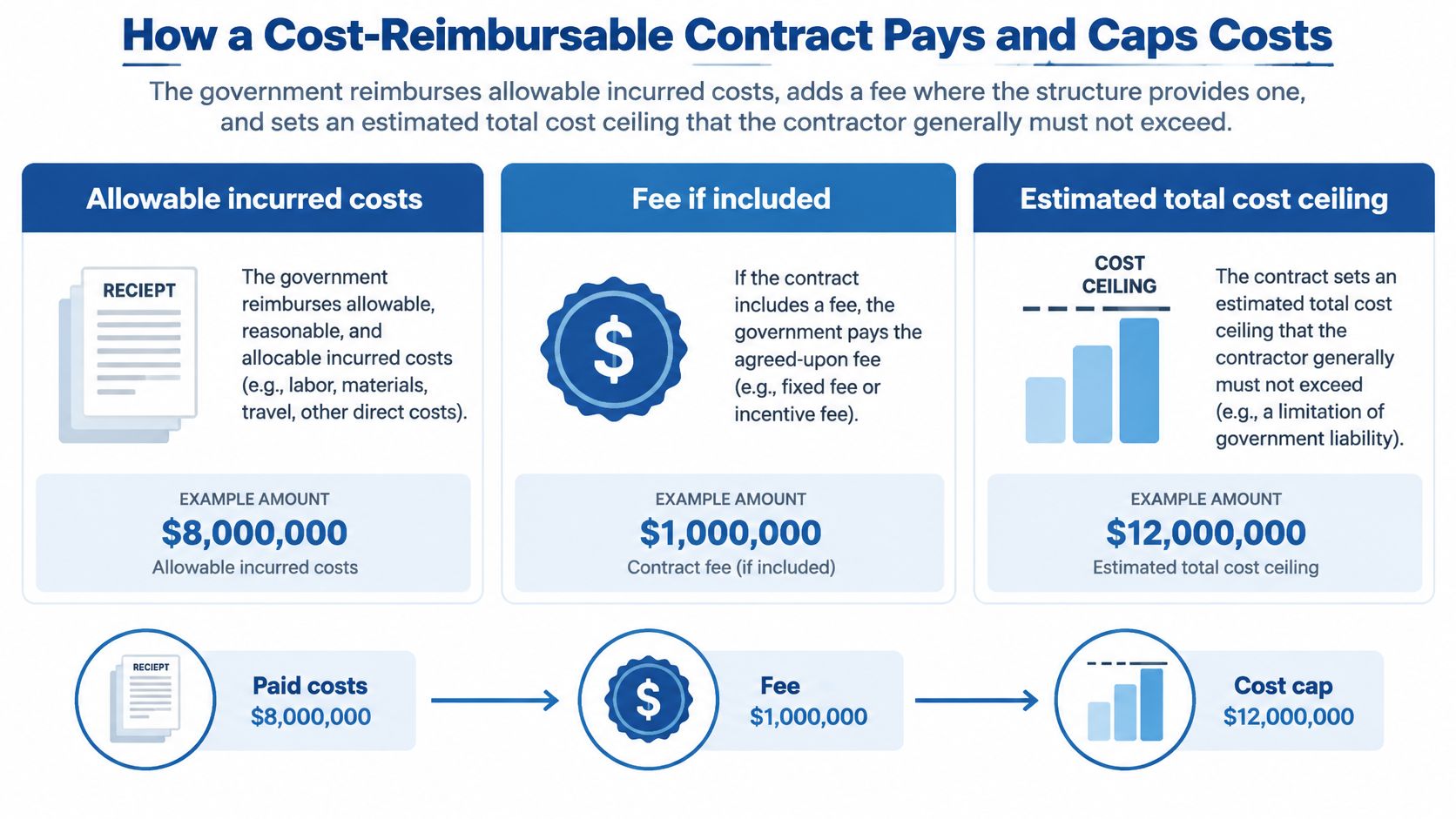
How a Cost-Reimbursable Contract Pays and Caps Costs
Think of a renovation billed as materials and labor plus a builder's fee, rather than a fixed quote for a finished kitchen. The customer accepts uncertainty about the work's eventual cost, but the builder still needs records showing what was purchased, who worked, and whether the charges belong to that project.
Federal cost reimbursement follows that broad logic, with contract-specific controls. Allowable incurred costs, fee, and the estimated total cost ceiling perform different jobs. Don't combine them into a single revenue assumption.
The payment structure is easier to evaluate when those elements stay separate.
Cost-reimbursable and related contract types compared
| Contract type | Cost overrun risk | Fee | Typical use |
|---|---|---|---|
| Cost contract | Government up to the ceiling | None | Research where costs cannot be estimated |
| Cost-plus-fixed-fee (CPFF) | Government up to the ceiling | Fixed at award, subject to contractual adjustments | Studies and development with evolving scope |
| Cost-plus-incentive-fee (CPIF) | Shared through fee adjustments within negotiated limits | Moves with actual cost against target | Work with measurable cost targets |
| Cost-plus-award-fee (CPAF) | Government up to the ceiling | Award portion determined by performance evaluation | Work emphasizing evaluated performance and quality |
| Time-and-materials (T&M) | Mostly government, subject to the ceiling | Labor-hour rates plus materials, rather than a separate cost-plus fee | Short or hard-to-define work |
| Firm-fixed-price (FFP) | Contractor | Profit built into the price | Well-defined requirements |
T&M and FFP are comparison points, not cost-reimbursement subtypes. The distinction matters because an agreed hourly rate, reimbursement of actual costs, and a fixed deliverable price create different commercial incentives.
Under fixed-price contracting, controlling delivery costs can increase the profit retained from the agreed price. Under cost reimbursement, spending less doesn't automatically increase the fee. Your contract's fee mechanism determines that outcome.
Commercial rule: Treat a ceiling as a spending boundary, not a sales forecast.
The ceiling controls government exposure. It doesn't promise that the agency will order enough work, authorize enough spending, or accept enough costs for your company to recognize that amount as revenue. Also distinguish the estimated cost, fee, currently available funding, and any broader vehicle ceiling when reviewing an opportunity.
Start with the pricing schedule and contract line-item structure, then reconcile them to the payment and funding clauses. A solicitation can combine different pricing arrangements across its line items. Labeling the whole opportunity “cost reimbursable” without checking those details can produce the wrong staffing assumptions and an unreliable margin model.
Which Costs the Government Will Reimburse
Before treating an expense as reimbursable, ask whether it is allowable, allocable, reasonable, adequately documented, and authorized by the contract terms. These are connected checks, not interchangeable labels: a real expense can still belong to another project or lack adequate support.
The FAR cost-reimbursement provisions establish the central boundary: reimbursement covers allowable incurred costs specified in the contract, not every expense a contractor chooses to incur. A receipt proves that money changed hands. It doesn't, by itself, prove that the government owes you reimbursement.
Allowability of common cost items
| Cost item | Allowable? | Condition or rule |
|---|---|---|
| Direct labor | Yes, when supported | Timesheets must match work performed on the contract |
| Indirect costs, including overhead and G&A | Yes, when allowable and properly allocated | Use applicable government-approved billing rates, with reconciliation to final rates |
| Travel | Yes, subject to restrictions | Follow applicable travel cost principles, limits, contract terms, and approval requirements |
| Subcontracts | Yes, when eligible | Support the charges and obtain government consent when required |
| Entertainment | No, generally | Segregate entertainment expenses from reimbursable charges |
| Alcoholic beverages | No | Exclude alcohol charges, including separately identifiable amounts on meal receipts |
| Lobbying | No, generally | Segregate lobbying expenses and review any claimed exception before billing |
| Fines and penalties | No, generally | Exclude them unless an applicable exception supports allowability |
Use this table as a screening tool, not a substitute for reviewing the solicitation's incorporated cost principles and clauses. For travel, for example, separate airfare, lodging, meals, and other expenses before determining eligibility. Don't approve an entire trip merely because the program manager authorized attendance.
Build the evidence before billing
Cost allocation needs a consistent method. SIX ERP's explanation of assigning expenses to business projects offers useful operational context for connecting expenses to project work, although federal reimbursement still requires a separate contract-allowability review.
Indirect costs deserve particular attention. A provisional billing rate supports interim reimbursement; it isn't a promise that the final rate will match. If final allowable indirect costs support a lower rate, earlier billings may need adjustment. If they support a higher rate, recovery still needs to fit the contract's terms and funding position.
Build an expense map before pricing:
- Identify the purpose. Connect the planned expense to a task, deliverable, or legitimate indirect activity.
- Choose the treatment. Classify it consistently as direct, indirect, or unallowable.
- Attach the evidence. Retain receipts, allocation support, and required approvals with the accounting record.
This approach catches problems before they become disputed vouchers. It also gives the pricing team a clearer view of expenses the company must absorb rather than recover.
How Fee Changes Your Payout Under Each Structure
A cost-plus-incentive-fee contract makes cost performance part of the fee calculation. The FAR incentive-fee provision describes a target cost, target fee, minimum and maximum fees, and an adjustment formula tied to allowable cost performance.
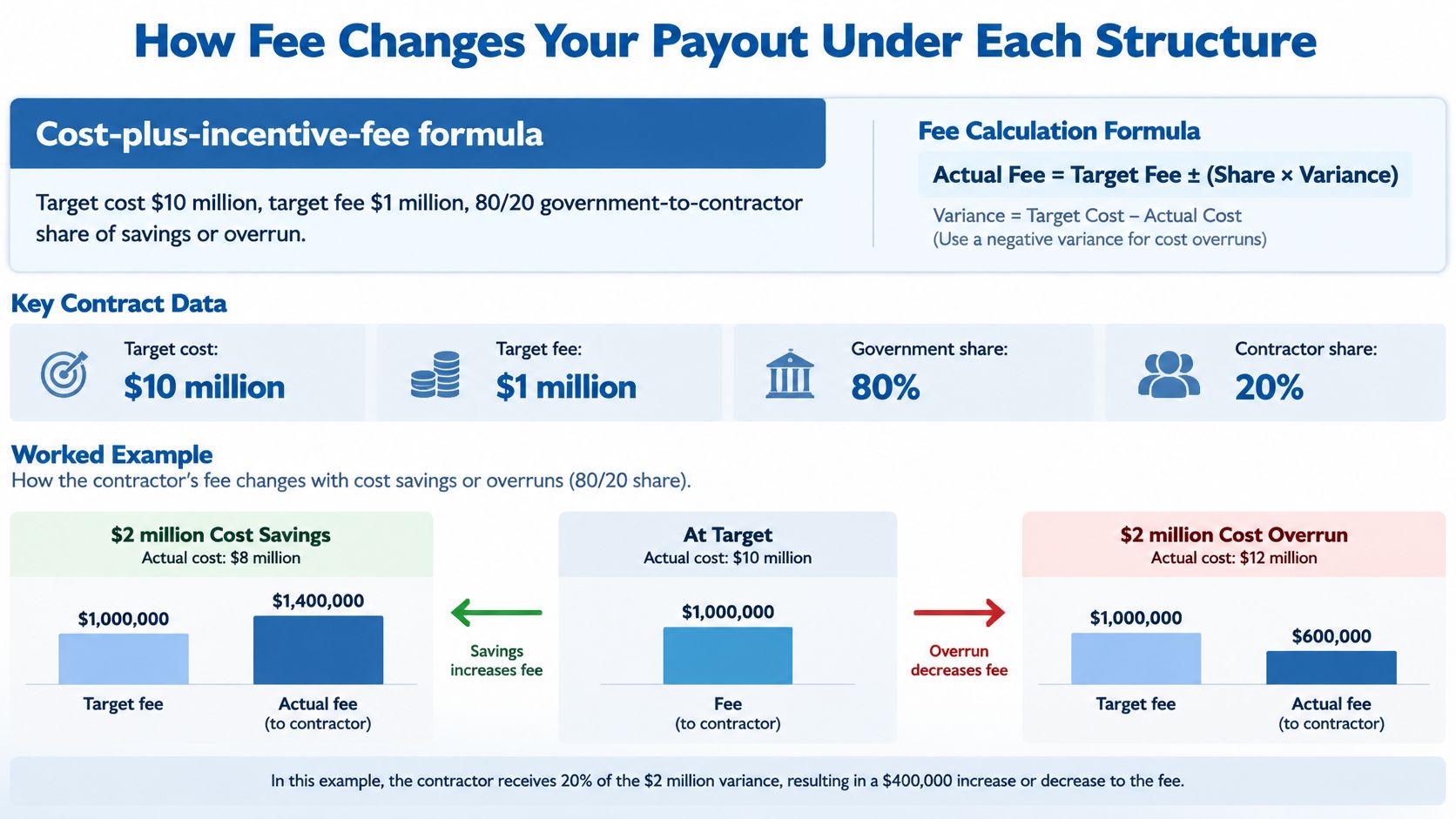
For a hypothetical example, assume a target cost of $10 million, target fee of $1 million, and an 80/20 government-to-contractor share of savings and overruns. Set a minimum fee of $300,000, maximum fee of $1.5 million, and estimated cost ceiling of $15 million. These are illustrative negotiated inputs, not standard federal terms.
The illustration shows how the contractor's share changes fee.
Apply the formula and then the limits
For this example, fee equals target fee plus the contractor's share of target cost minus actual allowable cost, bounded by the negotiated minimum and maximum. At an actual allowable cost of $9 million, the contractor receives $200,000 of additional fee, producing $1.2 million in fee and $10.2 million in total payment.
Illustrative fee and payment outcomes for a cost-plus-incentive-fee contract
| Actual cost | Against target | Fee earned | Total paid |
|---|---|---|---|
| $7.5 million | $2.5 million below | $1.5 million | $9 million |
| $9 million | $1 million below | $1.2 million | $10.2 million |
| $10 million | At target | $1 million | $11 million |
| $11 million | $1 million above | $800,000 | $11.8 million |
| $12 million | $2 million above | $600,000 | $12.6 million |
| $14 million | $4 million above | $300,000 | $14.3 million |
At the lowest-cost outcome, fee reaches the maximum. At the highest-cost outcome, the uncapped calculation produces $200,000, so the minimum applies instead. All costs in this example are assumed allowable and authorized; fee is shown separately from the estimated cost ceiling.
For another explanation of the payment mechanism, watch the accompanying video.
Don't mistake the contractor's share for an obligation to pay that share of every overrun out of pocket. Within this model, the adjustment reduces fee while allowable costs remain reimbursable under the contract's controls.
CPFF doesn't offer the same cost-linked fee upside, and time-and-materials contracts use a different billing mechanism. Extract the target, share relationship, fee limits, ceiling, fee-bearing deliverables, and reporting cadence before comparing opportunities.
Keep tax planning separate from fee modeling. Allied Tax Advisors' guide to compare local tax preparation services can help with choosing tax support, but tax preparation doesn't replace federal contract-cost expertise.
When Agencies Are Allowed to Use This Contract Type
An agency's preference for flexibility isn't enough to justify cost reimbursement. Under the FAR contract-type provisions, FAR 16.301-2 limits its use to requirements the agency cannot define sufficiently for fixed pricing or performance uncertainties that prevent sufficiently accurate cost estimates.
That makes research and development, advanced technology, and complex engineering natural candidates. The relevant question is what remains uncertain: the technical approach, required effort, operating conditions, or eventual deliverables. A capture team should identify that uncertainty rather than assume every development project requires the same pricing structure.
What the approval requirements signal
The same FAR provisions require an approved written acquisition plan, approval at least one level above the contracting officer, an adequate contractor accounting system, sufficient government management resources, and appropriate surveillance. Each safeguard has a bidder-facing implication:
- Documented justification means the agency should understand why it cannot confidently fix the price.
- Accounting adequacy makes financial controls part of qualification, not just post-award administration.
- Management resources matter because the agency must review performance and control spending.
- Surveillance means contractors should expect scrutiny of methods and cost controls, not merely acceptance of deliverables.
The final-rule notice for FAR Case 2008-030, effective April 2, 2012, strengthened planning requirements for non-firm-fixed-price work, including risk mitigation, transition toward firm-fixed-price arrangements when practicable, consideration of fixed-price portions, and designation of a properly trained contracting officer's representative.
For capture purposes, that creates an opportunity to separate mature work from uncertain work. A stable production deliverable may support a different arrangement from an experimental engineering task. Propose that distinction only where the solicitation permits it, and explain the operational basis rather than presenting it as a pricing preference.
A cost-type opportunity should trigger deeper qualification, not an automatic assumption that the agency has removed your commercial risk.
Before committing proposal resources, ask whether the scope is still evolving, whether the agency has a trained representative ready to administer performance, and whether any portion is sufficiently defined for fixed pricing. Unclear answers are reasons for clarification before bid approval.
Accounting and Oversight You Must Be Ready to Prove
Your ledger must tell the government which dollar belongs to which contract and why. A company-wide profit-and-loss statement can't do that, even when the business is profitable and its tax records are clean.
The federal cost-reimbursement regulations make an adequate accounting system capable of identifying applicable contract costs a pre-award requirement. Technical competence doesn't cure a system that mixes projects, loses labor detail, or cannot support a reliable forecast.
Test a transaction from origin to forecast
Choose a labor charge and trace it from the employee's time entry through payroll, labor distribution, the contract ledger, and the billing record. Then trace a material purchase from the invoice to receipt, project assignment, and charge. Any unexplained break deserves attention before the company submits a proposal.
Keep direct charges separate from indirect pools and unallowable expenses. Maintain labor records by employee, task, and day as an operating discipline, and retain material invoices with their project coding. A reviewer should be able to reconstruct the charge without relying on someone's memory.
For contractors moving from commercial project work, Bookkeeping and Accounting of Florida Inc.’s discussion of construction accounting methods provides useful job-costing context. Federal work adds contract-specific allowability, allocation, and reporting obligations that ordinary job profitability reports may not address.
Prove the reporting process works
Software helps only when configuration and daily practices support the required output. Teams evaluating what Costpoint does should test actual project setup, labor distribution, indirect allocations, and forecast reports rather than treating a product name as evidence of compliance.
Government oversight can examine both the charge and the controls behind it. Prepare for questions about who approved changes, how corrections were recorded, and whether managers receive forecasts early enough to act.
Use these readiness questions as an internal demonstration, not a questionnaire answered from memory:
- Can the system identify contract-level costs? Produce a ledger reconciled to supporting records.
- Are indirect rates current? Show the rate basis, applicable approvals, and internal reconciliation.
- Can labor be traced to tasks? Demonstrate the path from time entry to billed charge.
- Can cost-to-complete be reported monthly? Generate a forecast using actual spending and remaining work, with a named owner for corrective action.
Common Pitfalls and How to Avoid Them
Reimbursement is not margin. A contractor can perform useful work and still lose money through rejected charges, weak timekeeping, unfavorable rate adjustments, or spending that wasn't authorized.
The practical failure is usually earlier than the invoice. Someone assigns the wrong task code, approves an unsupported expense, or lets delivery continue without a credible estimate of remaining cost.
Cost-reimbursable pitfalls, causes and fixes
| Problem | Usual cause | Fix |
|---|---|---|
| Voucher expense rejected | Cost not linked to a contract task or lacking support | Tie each charge to a task and keep the receipt |
| Costs above the ceiling | Work continued without timely contracting-officer involvement | Track cost-to-complete monthly, notify early, and obtain required authorization |
| Indirect rate surprise | Provisional rate differs from final rate | Reserve working capital for the true-up |
| Timesheets challenged | Labor charged without a task record | Record daily time by task code and retain correction history |
| Unallowable cost billed | Entertainment or lobbying coded to the contract | Use separate unallowable accounts and screen charges before billing |
A notice alone isn't permission to keep spending. Give the contracting officer a usable forecast, explain the remaining work, and obtain the required direction or authorization before relying on additional reimbursement.
Finance the gap rather than assuming it away
Working capital pays salaries, suppliers, and subcontractors while the reimbursement process runs. A disputed voucher or rate adjustment can therefore create a cash problem even when the underlying project appears profitable.
Cash-flow check: Forecast bank cash separately from contract revenue and earned fee.
Build the cash forecast around payroll dates, supplier terms, expected billing submissions, and realistic receipt timing. Include room for charges that require correction or additional support rather than assuming every voucher converts immediately into cash.
Assign responsibility across finance, contracts, and delivery. Finance should reconcile charges, contracts should manage required communications, and the delivery lead should validate remaining effort. A cost-to-complete review works only when those people agree on what still has to be done.
Decide Whether to Bid on a Cost-Reimbursable Solicitation
Use pass, fix, or blocker for each qualification check. A pass needs evidence, a fix needs an owner and completion point, and a blocker stops pursuit until the underlying issue is resolved.
- Confirm the pricing structure. Identify the contract type by line item and determine whether the agency permits a fixed-price portion. Mark unclear terms as a fix requiring clarification.
- Demonstrate accounting readiness. Require a sample contract ledger, supported labor charges, indirect allocation, and cost-to-complete report. An inability to produce them is a blocker.
- Test the funding position. Reconcile expected performance cost with the applicable ceiling and available funding. Model contingency internally rather than treating a risk reserve as automatically billable. An unresolved funding gap is a blocker.
- Validate rates and liquidity. Confirm the indirect-rate basis and the cash needed to bridge payment timing and adjustments.
- Review subcontract requirements. Identify consent requirements, supporting cost records, and any supplier commitments that would leave your company exposed.
At FederalPipeline, we read every solicitation and provide capture briefs covering what's being bought, required clearances, set-asides, certifications, incumbents, ceilings, and deadlines. We also flag bid blockers up front, including prior-contract information and requirements pulled from attachments.
Use that qualification information to focus document review, not replace it. For earlier planning, our budget research connects defense budget lines to the program offices that own them and the contracting offices they buy through, before requirements reach SAM.gov.
If every check passes, stress-test projected fee against higher remaining effort, reimbursement delays, and nonrecoverable expenses. Before pricing, confirm accounting readiness and decide whether the expected return justifies the cash and control obligations.
FederalPipeline connects solicitation requirements, incumbents, ceilings, and deadlines so your team can qualify cost-type opportunities before committing proposal resources. Visit FederalPipeline to review an opportunity's capture brief, identify bid blockers, and build a pursuit decision around the work your company can finance and deliver.