A solicitation lands in your inbox on a Tuesday. The response is due in 21 days, the scope is broad, and the award history shows the same company has held the work for nine years.
You pull the attachments, skim the evaluation criteria, and build a compliance matrix. Three weeks later you submit a technically acceptable proposal and lose to a competitor who spent the previous eighteen months learning what the program office cared about.
That competitor wasn't smarter than you. It ran a capture process, and the difference between the two teams usually comes down to a discipline most small contractors hear about late and adopt badly, often by treating it as another word for proposal writing.
Capture Management in Plain Terms
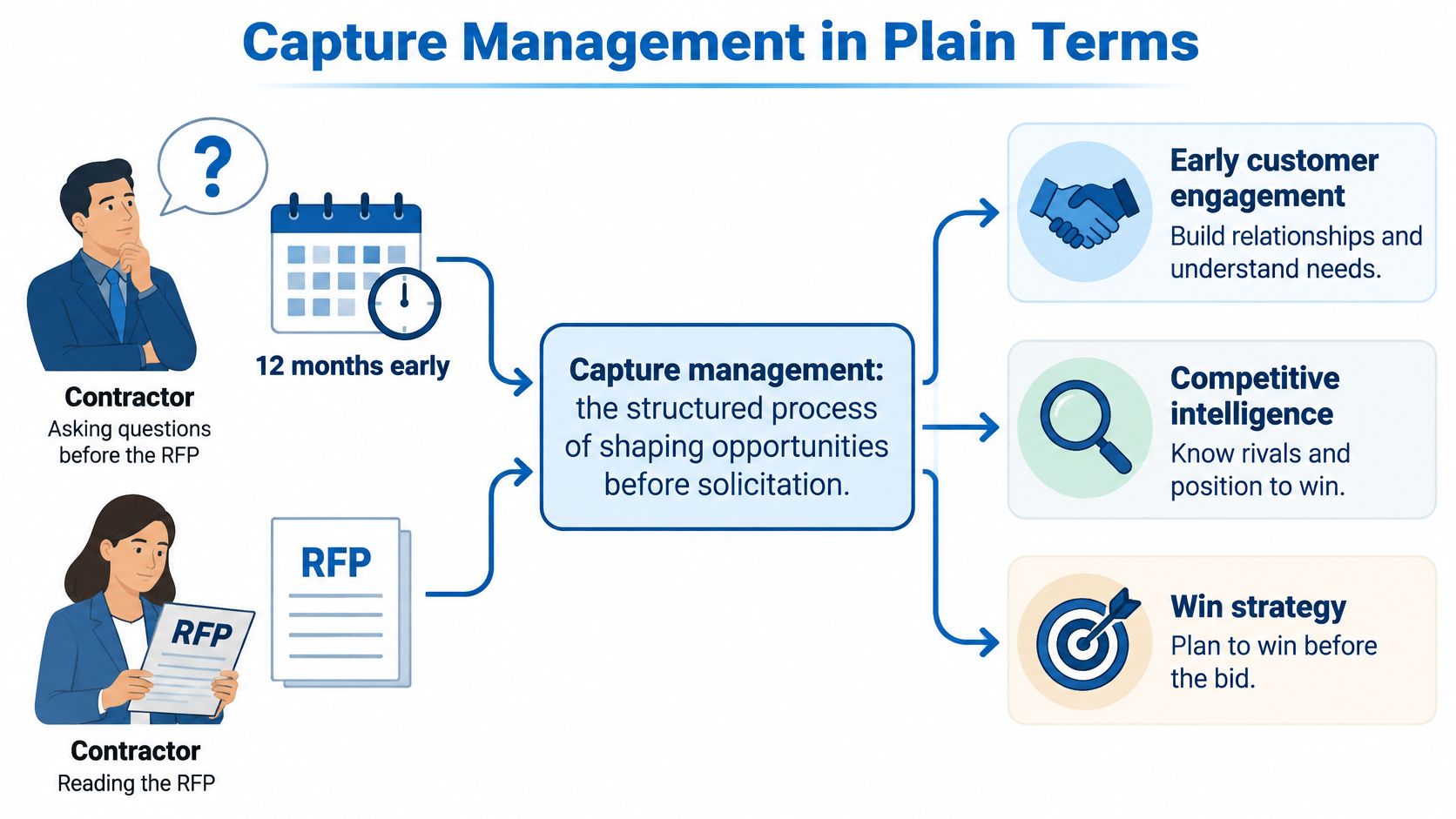
Say two contractors hear the same news at the same industry day. An agency needs to replace the system it uses to track training records, and someone from the program office mentions a recompete in the works.
The first contractor asks what breaks today, which offices rely on the system, and whether the requirement will be bought through an existing multiple-award vehicle. The second contractor notes the date and waits for the solicitation.
Twelve months later the RFP appears, and only one of them writes a proposal that reads like an answer to a question the customer already asked.
The definition in one sentence
Capture management is the structured, pre-solicitation discipline used to improve a contractor's probability of winning a government opportunity, as a long-running GovCon practitioner account of how the discipline evolved describes it. It starts long before anyone writes proposal prose, and it works on nine things at once:
- Customer need: the mission problem the agency is trying to solve
- Money: the funding source and whether it's programmed or aspirational
- Timing: when the acquisition is likely to move
- Vehicle: whether the work arrives as an open competition, a task order, or a set-aside
- Incumbent: who holds the work now and how the customer rates them
- Competitors: who else will bid and on what strength
- Solution: the technical and staffing approach you'd bring
- Teaming: which gaps you fill with partners and which you close yourself
- Evaluation: the criteria the award will most likely turn on
The property analogy
Capture is scouting a property, checking the zoning, and lining up financing before you make an offer. Proposal writing is the offer itself.
Newcomers get confused here because both phases involve talking to the customer and both involve documents. The distinction is what the work produces. Capture produces a decision and a strategy. Proposal produces a compliant response.
Why the timing matters
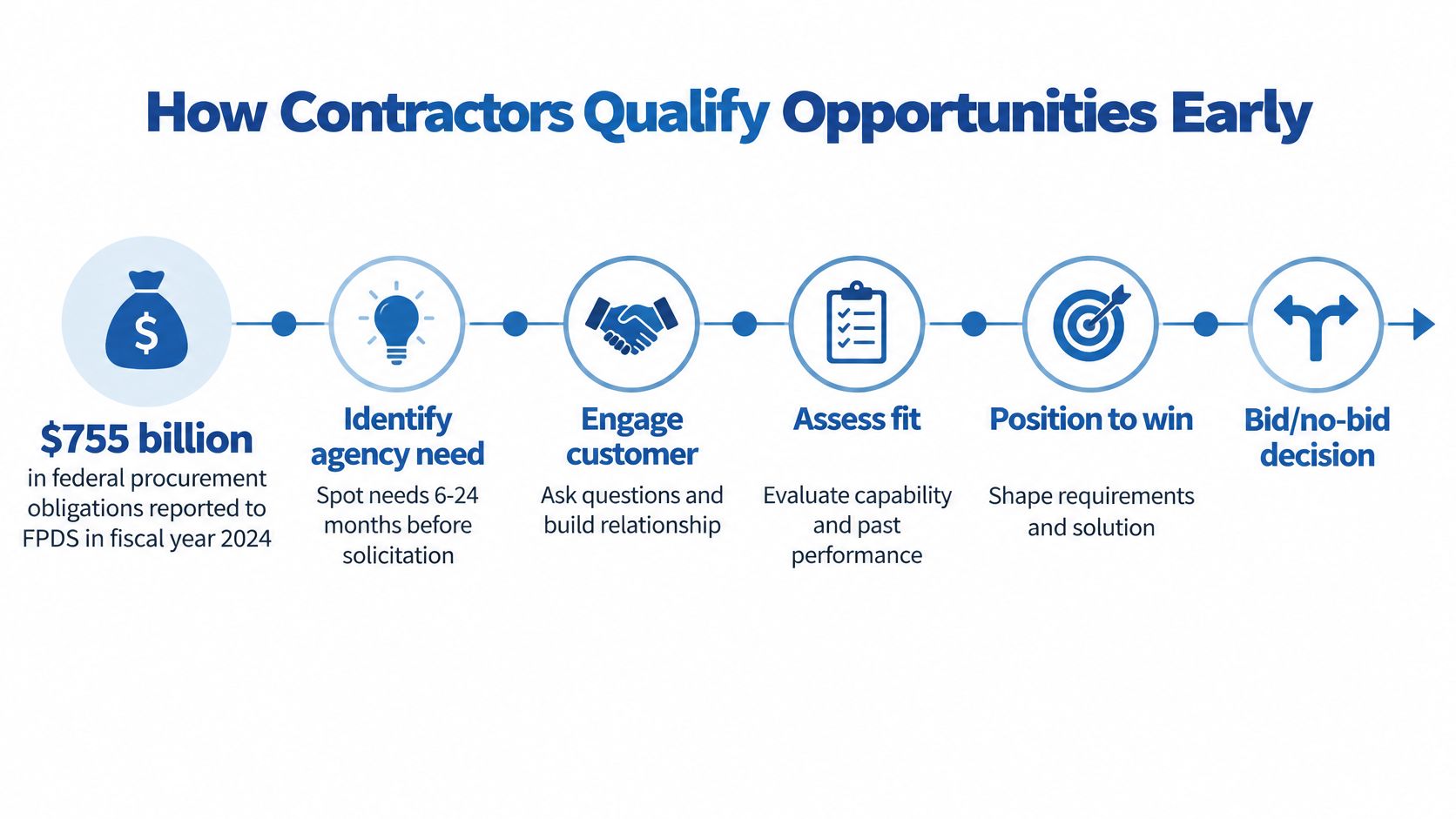
The commonly cited planning horizon is 6 to 24 months before RFP release. That number isn't arbitrary. It reflects how long it takes to learn a program, build credibility with a program office, and influence how a requirement gets written.
The discipline itself came out of U.S. aerospace and federal contracting in the 1980s, when firms began assigning managers to large strategic pursuits before a solicitation existed. Companies widened the method beyond their biggest programs late in that decade, dedicated full-time capture roles grew common through the 1990s, and by about 2005 capture management was a recognized professional specialization in many organizations.
The question that separates capture from bid response: not "Can the company submit a proposal?" but "Can it shape, qualify, resource, and competitively position the pursuit early enough to make a win plausible?"
If your team only sees opportunities once they're public, the staged tracking problem is familiar from other industries too. The pipeline management approach used by government ICT recruiters works the same way, moving prospects through named stages with an owner and a next action at each one, rather than waiting for a requirement to become urgent.
Capture is an early-market activity. Treat it as a last-minute response function and you'll spend your proposal budget answering questions someone else already framed.
Who Runs a Capture Pursuit
Every stage in a pursuit needs a named owner, or it becomes nobody's job.
The capture manager leads the pursuit, owns the capture plan and runs the gate reviews. A business development lead holds the customer relationship and logs what the program office and buying office say. The solution lead tests whether the proposed approach survives technical and staffing constraints. A pricing lead builds the price-to-win analysis and the cost assumptions under it. A teaming manager negotiates partners and writes down each partner's proprietary constraints. Contracts or compliance staff review any customer contact that touches draft requirements. An executive sponsor makes the final bid or no-bid call and releases proposal funding.
Seven roles sounds heavy for a firm of twelve people. It isn't, because one person can hold several, provided the same person doesn't both shape the requirement and approve the bid without a documented review.
In 2024, 69% of government contractors reported difficulty winning new contracts, and 45% said they lacked business-development resources, according to the CohnReznick and Unanet 2024 GAUGE Report. Thin teams are normal. Unnamed responsibilities are what hurt.
Practical rule for small firms: write the role names onto the capture plan even when two or three of them belong to the same person. The page should show who decided, not just what was decided.
A three-person shop might have the founder as executive sponsor, an engineer as solution lead, and a contracts manager covering pricing and compliance. At handoff, the proposal manager takes the compliance matrix, win themes and schedule, while the capture manager stays accountable for the win strategy until submission.
The Eight Stages of a Capture Pursuit
The stages below are a sequence you move through, not a checklist you finish once. Teams loop back constantly, and intelligence gathering keeps running while positioning and solution shaping advance. Each stage answers a specific question and defines what you should be holding before you move on.
| Stage | Core question | Typical output |
|---|---|---|
| Opportunity identification | Is a real requirement coming? | Named program, funding source and expected timing |
| Qualification | Can we compete and comply? | Eligibility, set-aside, clearance and certification findings |
| Customer and market intelligence | Who decides and what do they value? | Stakeholder map and evaluation hypotheses |
| Competitive positioning | Who wins against us? | Incumbent and competitor assessment |
| Solution shaping | What will we offer? | Technical approach and staffing plan |
| Price-to-win analysis | What price is needed to win? | Target price range and cost assumptions |
| Bid/no-bid decision | Should we invest proposal resources? | Go, redirect or no-bid decision with reasons |
| Transition to proposal | What must carry into the bid? | Compliance matrix, win themes and proposal schedule |
How the stages overlap in practice
Picture a contractor watching a civilian agency's budget justification and spotting a line for IT service desk support. Opportunity identification gives them the program office that owns the line and the contracting office that buys for it. Qualification tells them the work sits on a multiple-award vehicle with a small business set-aside they can hold. Intelligence work surfaces the incumbent's expiring task order and the two offices that complain about ticket resolution times.
Competitive positioning then asks who else holds that vehicle and which of them has past performance the customer trusts. Solution shaping picks a staffing model that covers 24/7 coverage without gold-plating. Price-to-win puts a target range on the table before anyone writes a narrative. Only then does the bid decision get made, and the transition hands the proposal team a compliance matrix, win themes and a schedule.
Note the order. The price range comes last because it depends on everything above it. Teams that build a price first usually reverse-engineer a strategy to justify it, and evaluators can tell.
Where a weak pipeline usually breaks
When a pipeline is thin, the instinct is to look harder for solicitations. That's rarely the fix. The weakest stages are almost always qualification and customer intelligence, because a gap in either one wastes every stage that follows. You can spot the pattern in how the market behaves: in 2024, 81% of government-contracting business-development teams focused on improving opportunity identification, while 77% pursued pricing-to-win strategies and 71% explored teaming opportunities, according to Deltek's Clarity industry study.
If you can't explain how a requirement reaches its contracting office, or which evaluation criteria will decide it, fix that before you add another saved search. Understanding how RFPs and RFQs differ in structure and response expectations is a useful next step, since the two demand different capture lead times.
Staying Within Procurement-Integrity Limits
Here's the uncomfortable part that most explanations of capture skip. Relationship building is standard practice, and some of it carries real legal and evaluation risk.
Capture teams interact with program personnel, incumbent staff, industry days and draft requirements while the government is still developing its acquisition strategy. That's the normal condition. The question worth asking, as a GovDash glossary entry on capture management puts it, is "What can a capture team do before an RFP without creating procurement-integrity, organizational-conflict-of-interest, or unequal-access risks?"
The permissible list is longer than nervous newcomers assume: responding to requests for information, participating in public industry engagement, improving your own capabilities, and documenting customer needs you learn about on the record. The risky list is short and specific: seeking nonpublic source-selection information, tailoring requirements around a proprietary advantage, and using conflicted personnel without disclosure.
GAO procurement-review material shows that staffing and incumbent-related approaches can become material evaluation issues, not merely internal business-development choices. In other words, the way you staffed a pursuit can cost you the award.
| Role | Permissible before RFP | Risky without review |
|---|---|---|
| Capture manager | Attend public industry days, respond to RFIs, document public requirements | Requesting nonpublic source-selection information |
| Former government employee | Share general market knowledge outside any restriction | Using nonpublic information or shaping requirements from past government roles |
| Consultant | Public research and market analysis | Access to incumbent or competitor proprietary data |
| Proposed key personnel | Confirm availability and disclose prior government roles | Recruiting incumbent staff without disclosing conflicts |
| Teaming partner | Agree teaming terms and share public capabilities | Shaping requirements to favor one partner's proprietary advantage |
Escalation triggers worth writing down
Stop and route the question to the contracting officer or your ethics contact when any of these happen:
- A conversation touches draft requirements or language you suspect will land in the statement of work.
- Someone offers nonpublic data, including budget figures, evaluation notes or a competitor's pricing.
- A former government employee joins pursuit planning and was involved with the same program.
- You plan to recruit incumbent staff or the incumbent's key personnel.
- A teaming partner raises a proprietary constraint that could shape the requirement itself.
Small businesses without in-house counsel should set these triggers in writing before pursuing an opportunity, not after a protest. The line between shaping a market and getting an unfair advantage is usually crossed in a single conversation, and it's a lot easier to decline that conversation when the rule exists on paper.
"We can discuss what the agency needs. We can't discuss what the evaluation team thinks." Rehearse that sentence with anyone on your team who meets customers.
Nothing here forbids market research, and reading about sole source versus single source awards is a legitimate way to understand how agencies justify limited competition without ever seeking inside information.
How Contractors Qualify Opportunities Early
Federal agencies reported approximately $755 billion in procurement obligations to the Federal Procurement Data System in fiscal year 2024, according to a GAO report on federal contracting data. That scale is why capture teams study historical awards and buying patterns instead of chasing single notices.
The same GAO material notes that Federal Acquisition Regulation requirements make contracting records central to market research: agencies must keep files with documentation sufficient to provide a complete history of the transaction. Those files are public, so a capture team can reconstruct how an opportunity came to exist without touching anything restricted.
Signals worth checking, in roughly the order they pay off:
- Budget justification lines that name a program or a system, not just an office
- Acquisition forecasts and whether the same item has slipped year after year
- Program ownership, meaning the office that runs the mission and the contracting office that buys for it
- Prior awards to the same agency for similar work, including ceiling, period and task order history
- Incumbent performance, including any documented issues a customer mentions publicly
- Expected recompete timing, especially where option years are running out
- Contract vehicles and set-aside status, since these decide whether you're eligible before anything else matters
Timing sits upstream of the award interval
The Department of Defense defines procurement administrative lead time as the period from solicitation issuance to contract signature, and Congress directed DOD in the Fiscal Year 2018 National Defense Authorization Act to establish a department-wide definition, measurement plan and public reporting approach. Capture works upstream of that interval entirely. Everything you do happens before the clock the government measures starts running.
That's the trap for newcomers. If your first awareness of a requirement arrives when the solicitation posts, you're operating inside the interval the government already knows how to measure, and your competitor has been outside it for a year.
The video below walks through how early qualification looks when a team is evaluating whether to bid at all.
The qualification test, in one pass
Ask whether you can meet the clearance, certifications, past-performance, staffing, schedule and price constraints. Any "no" needs a named fix: a partner who holds the clearance, a certification you can earn before the deadline, or a documented reason to walk away.
A qualified opportunity looks specific on paper. It names the program and funding line, the contracting office, the vehicle, the incumbent, the expected evaluation weighting, your own evidence of relevant past performance, and a stated confidence level that someone is willing to defend in a review.
If you're used to eligibility screening from grants work, the logic is the same shape as this Grantlas eligibility checklist for nonprofits, where every criterion resolves to met, closable or disqualifying. Contract qualification just adds a competitor.
Finish with a documented decision the team can revisit when budgets or requirements shift. Solid federal business opportunity research is what makes that decision revisitable instead of a one-time guess.
Capture Plans, Gates and Bid/No-Bid Decisions
The capture plan is the control document. It records customer priorities, competitive intelligence, relationship actions, owners, milestones and the intended win strategy. Without it, the pursuit lives in someone's head and leaves when they change jobs.
APMP's Capture Practitioner preparation guide recommends a four-part flow: external analysis, internal analysis, strategy development and execution monitoring, with formal decision gates determining whether to advance, redirect or terminate. Gates matter because they create a cause-and-effect relationship. Qualifying capability, access, compliance and competitive risk early reduces the chance that expensive proposal resources go into an unwinnable or ineligible pursuit.
| Criterion | Advance | Redirect | No-bid |
|---|---|---|---|
| Win probability | Clear discriminator and an addressable incumbent advantage | Win possible with a changed approach or partner | Entrenched incumbent and no credible discriminator |
| Eligibility | Set-aside, clearance and certifications all met | Gap closable with a partner or certification before the due date | Hard blocker such as an unmet set-aside or clearance |
| Return on investment | Expected award value justifies proposal cost | Value depends on a leaner bid or a partner's share | Proposal cost exceeds expected award value |
| Risk | Each risk has an owner and a mitigation | Risks reduced by specific staffing, pricing or teaming actions | Unmitigated risk in pricing, staffing or schedule |
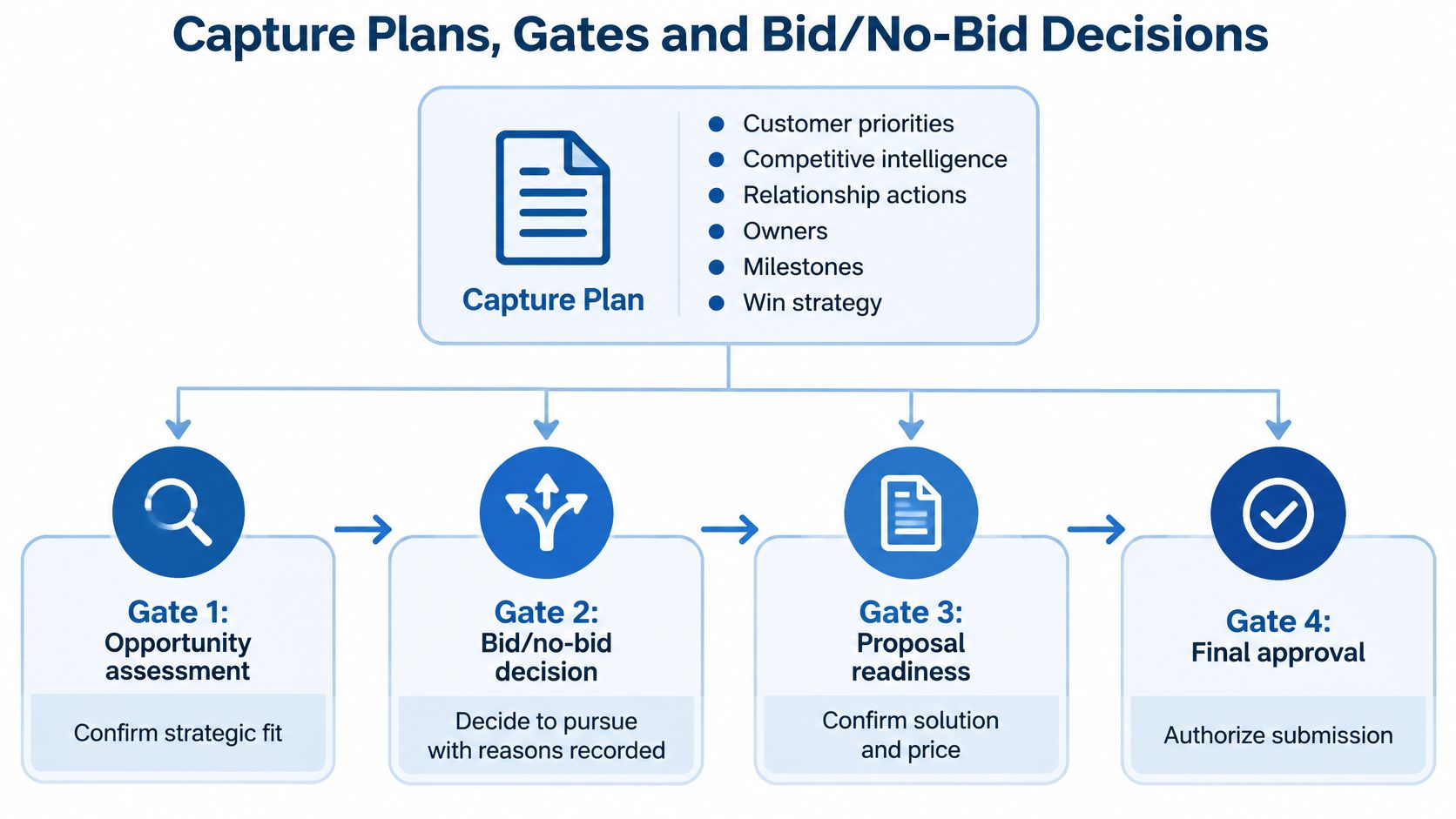
Eligibility overrides everything else in that table. One failed set-aside or missing clearance cancels strengths that would otherwise carry the bid, which is why it belongs in the first gate rather than the last.
A no-bid is a result, not a failure. Record the reason and the date. Requirements come back, and the reason you declined this year is often the intelligence that wins it in three.
Building the win strategy after a go decision
Once you commit, the work sharpens. Identify agency objectives and the stakeholders who hold them, validate the requirements you expect, and assess the incumbent's real advantages rather than the ones you'd like them to have. Map competitors and partners, then develop discriminators and win themes that survive contact with the evaluation criteria.
A National Veterans Institute session on capture, propose and price-to-win frames the bid decision around return on investment, win probability and risk, and ties value propositions directly to customer pain points and procurement priorities. It also argues for a living capture record with evidence, owners, dates, assumptions and confidence levels, revisited as budgets, timing, requirements or stakeholder feedback change.
That record is what makes traceability possible. Every proposal claim ties back to a customer need or an evaluation criterion, and every identified gap gets a mitigation, a partner, a staffing answer, or an explicit no-bid. Small businesses weighing set-asides and past-performance constraints get the most from this discipline, because a wrong assumption about eligibility costs them the most.
At handoff, capture outputs move into the compliance matrix, solution narrative, teaming plan, pricing strategy and proposal schedule. They shouldn't stay as informal business-development knowledge, because the proposal team can't cite what it can't find.
Decide Whether to Build a Capture Process Now
Three questions tell you where you stand. Do you see requirements six to 24 months before they reach a solicitation? Does one person own each pursuit by name? Do you write down every bid decision with its reasons, including the no-bids?
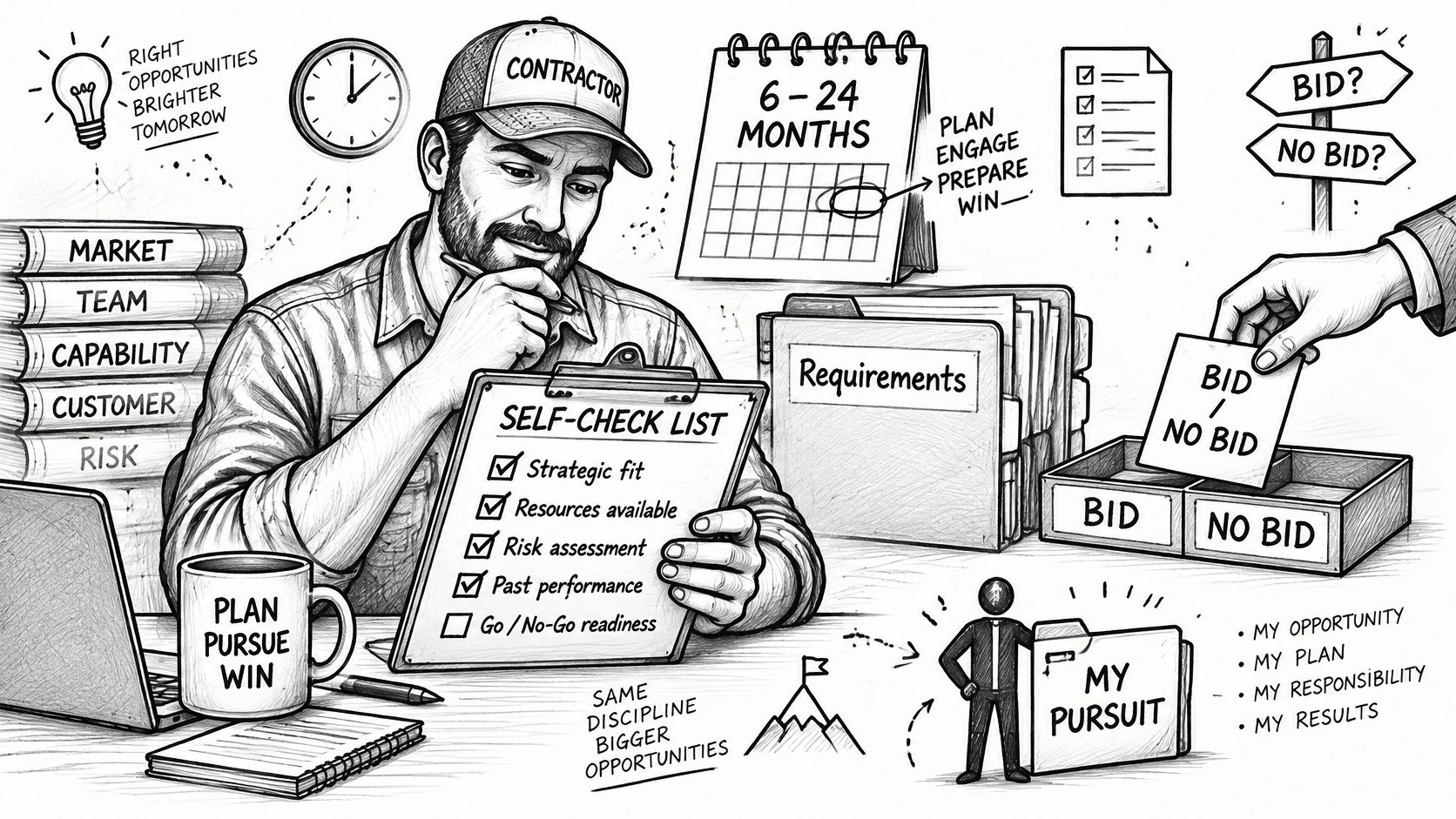
If some of those answers are shaky, start smaller than you think you should:
- Name one capture lead, even part-time, with authority to call a gate review.
- Choose three live pursuits already in your pipeline rather than inventing new ones.
- Write a one-page capture plan for each, with owners, milestones and the win strategy in plain language.
- Set a date for the first gate decision on each pursuit, and hold it.
- Log evidence and a confidence level for every assumption, so the plan can be challenged.
The process can run on existing pursuits before anyone gives it a name or a budget. What it can't do is run in someone's memory.
Once the steps are real, research tooling removes the slowest part of them. FederalPipeline follows defense budget lines to the program offices that own them and the contracting offices they buy through, years before the requirement reaches SAM.gov, and its Pipeline feature tracks what you're pursuing by stage with the next action and research attached. Match scores, eligibility checks and email alerts handle the front end of qualification when new opportunities appear.
Test one pursuit this quarter against the stages and gates in this guide. If you can't fill in the customer intelligence column, you've found the stage that will decide whether you win.
FederalPipeline connects opportunities, budgets, buyers and awards so capture teams can see what's coming and judge whether they can bid before the solicitation lands. Capture briefs pull out the requirements, clearance, set-aside, incumbent and deadlines from each solicitation, while the pipeline keeps every pursuit at its current stage with the next action attached. Start with a free account, or visit FederalPipeline to see how a pursuit looks when the research is already done.