Sole source means the agency solicits and negotiates with only one source, and it can do that only under a documented exception, typically FAR 6.302-1 with a written justification approved under FAR 6.303 and 6.304. Single source is a looser description: it can mean one eventual awardee after several firms had a chance to compete, one visible supplier, or a buy that started competitive and drew a single offer.
The most repeated advice in capture shops is to treat one name on an award as a closed door. Pull the notice, spot the incumbent, no-bid, move to the next record. That shortcut costs small businesses more winnable work than any other habit, because the label on a notice describes how the agency bought, not who the agency is allowed to talk to.
Two questions decide whether a notice deserves your bid week. Is a regulation barring another vendor, or did a program office conclude that competition looks thin? And what evidence would change that conclusion before the response date?
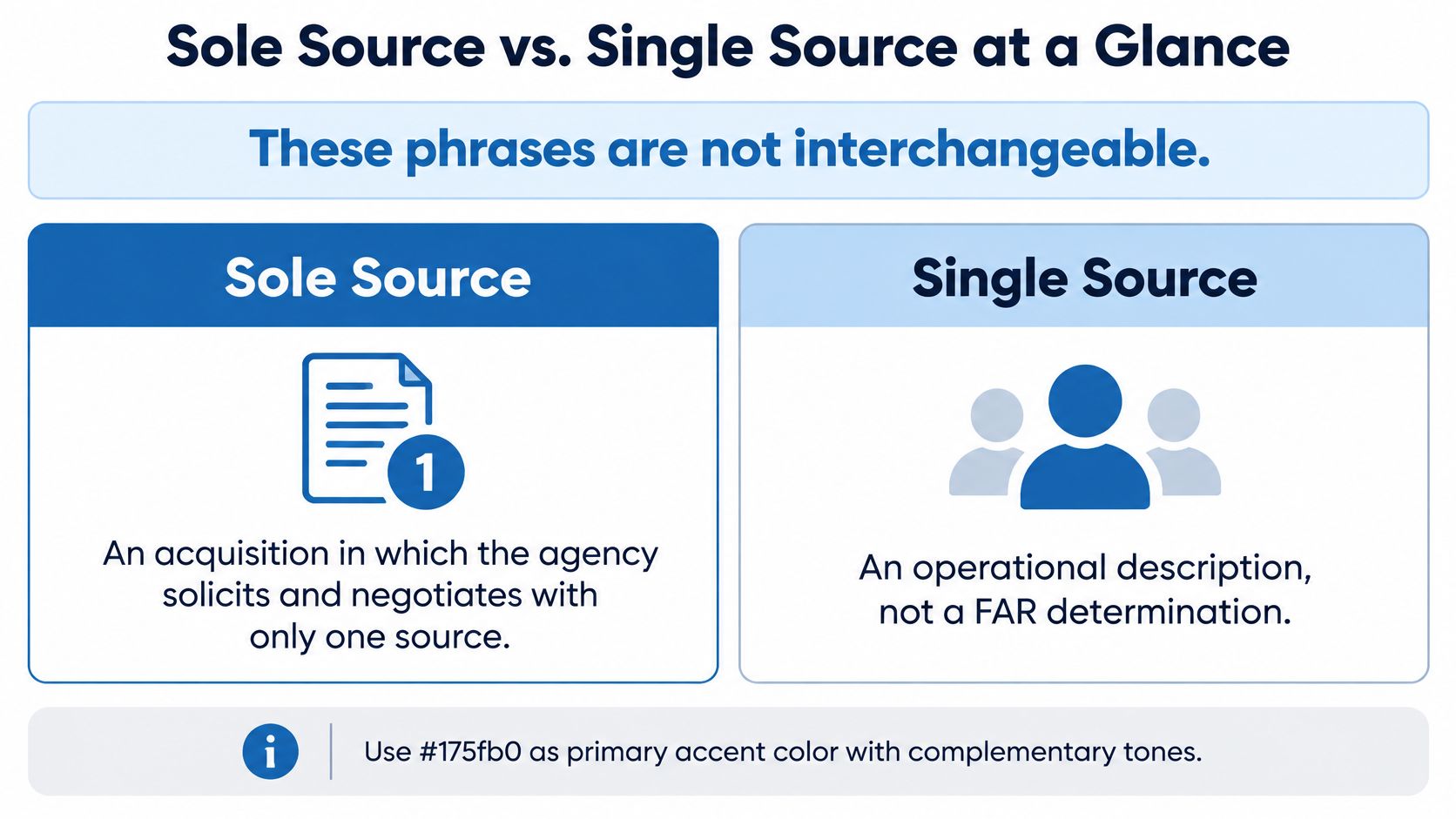
Sole Source vs. Single Source at a Glance
The two phrases aren't interchangeable, and treating them as synonyms is the fastest way to drop a winnable opportunity. Sole source is a regulatory determination: the agency solicits and negotiates with only one source. Single source is an operational description, and it usually doesn't mean the agency is legally barred from considering another vendor.
The Federal Acquisition Regulation is precise about the first term and silent about the second. A sole-source acquisition is one in which the agency solicits and negotiates with only one source. "Single source" can describe only one known capable supplier, one incumbent the program office prefers, one approved manufacturer, or a procurement that began competitively and ultimately received one offer. Existing explainers flatten that difference, which leaves capture teams unsure whether a notice signals a legally restricted procurement or merely weak market response.
The table below separates the labels a notice might carry and what each one fails to prove.
| Label | Who is solicited | Competition status | Usual authority | What it does not mean |
|---|---|---|---|---|
| Sole source | Only one source | Exception to full and open competition | FAR 6.302-1 plus written justification and approval | A preferred incumbent, or a belief that one firm would perform better |
| Single source | One eventual awardee; others may have been invited | Often follows a competed solicitation | Single-award structure, including some single-award IDIQs | A legal bar on considering another vendor |
| One offer received | Multiple firms could offer; only one did | Competition was available | May remain a competitive award if market research was adequate | An automatic sole-source determination |
| Approved source or OEM | Qualified manufacturers or authorized channels | Competition among approved sources may still occur | Qualification, compatibility, or data rights | Automatic sole source to the brand owner |
| Socioeconomic sole source | One eligible small firm after fewer than two are expected | Set-aside rules are considered first | Program rules, responsibility, fair price, and dollar ceilings | Any single visible candidate, especially above $250,000 |
Read the middle rows closely, because that's where most misclassification happens. A single-award vehicle can sit on top of a fully competed solicitation, and a brand-name parts buy can still leave three authorized distributors fighting for the order.
The capture implication: classify by solicitation history, not by the number of names on the award.
A public intent to sole source is a statement of present intent, not a locked door. It can invite capability information, and the agency can withdraw the intended approach if competition looks feasible. Abandoning a notice because one incumbent is visible is a decision made on the wrong evidence. The right question is which exception is claimed and whether the record behind it holds up.
Sole Source Authority and the Evidence Test
Competition is the default in federal buying. An agency that wants to skip it has to build a record first, and that record is where sole-source decisions either hold or collapse.
Under FAR 6.302-1, an agency may proceed without full and open competition when the required supplies or services are available from only one responsible source and no alternative can satisfy the requirement. For the Department of Defense, NASA, and the Coast Guard, the same authority reaches situations with only one or a limited number of responsible sources.
Read the exception narrowly.
The justification is the case, not the paperwork
The exception does not execute itself. It generally requires a written justification and approval under FAR 6.303 and 6.304 that states the facts, the rationale, and why adequate technical data, specifications, or a competition-ready statement of work are unavailable, the requirements FAR Subpart 6.3 spells out.
Qualifying grounds must connect to the government's minimum need. Unique capability, proprietary rights, compatibility with an installed system, or data rights the agency does not own can support the exception. Incumbent status cannot. Neither can a program office's comfort with a vendor, nor a belief that one firm would perform better or cost less. Preference dressed up as necessity is the most common way a justification collapses.
What survives review: a restriction tied to a minimum need the government actually has, plus a reason every other route fails to meet it.
The same discipline, a stated requirement on one side and checkable evidence on the other, is what you apply when you compare ai service selection criteria for a commercial buy.
Four questions to run on any notice
- Name the exact restriction. Is it a proprietary interface, a named system in the statement of work, a data-rights limit, or a qualification requirement? You can't test a restriction you can't quote.
- Map it to exclusivity. Does the restriction depend on a capability only one firm holds, or on technical data the agency says it lacks? Those are different arguments with different weak points. A capability claim points at the market. A data claim points at what the government owns and could release.
- Test a less restrictive specification. Ask whether a performance-based requirement would let another firm meet the same minimum need. Often the restriction is a drafting choice, not a technical necessity.
- Locate the approved justification, its approval level, and the estimated value. If the file doesn't exist publicly, that's a fact worth recording too.
| Signal | Proof to locate | Classify as sole source only if | Otherwise treat as |
|---|---|---|---|
| Intent to sole source | Notice text plus any responses invited | Approved justification shows no alternative meets the need | Still open to a capability challenge |
| Proprietary interface | Data-rights or technical-data statement | Government lacks adequate data and no equivalent interface works | A specification that could be rewritten |
| Brand-name part | Approved-source or qualification list | Only one responsible source can supply the required item | Competition among qualified or authorized sources |
| One offer | Abstract of offers plus the market-research memo | Market research shows no other responsible source could perform | A competed solicitation awaiting a stronger record |
| Incumbent follow-on | Justification narrative | Compatibility or transition risk is tied to minimum needs | Preference for the current performer |
A missing justification, or a restriction copied straight from the incumbent's configuration, is a reason to question the premise. It isn't a reason to stop reading.
What Single Source Can Mean in Practice
Treat single source as an operational description and the confusion mostly clears. The cleanest example is the single-award indefinite-delivery contract: one contractor receives the vehicle after a solicitation, and that award can follow a real competition. Under FAR 16.504, an agency may justify a single award when only one contractor is capable of performing the work, or when the expected orders are so integrated that only one contractor can reasonably handle them.
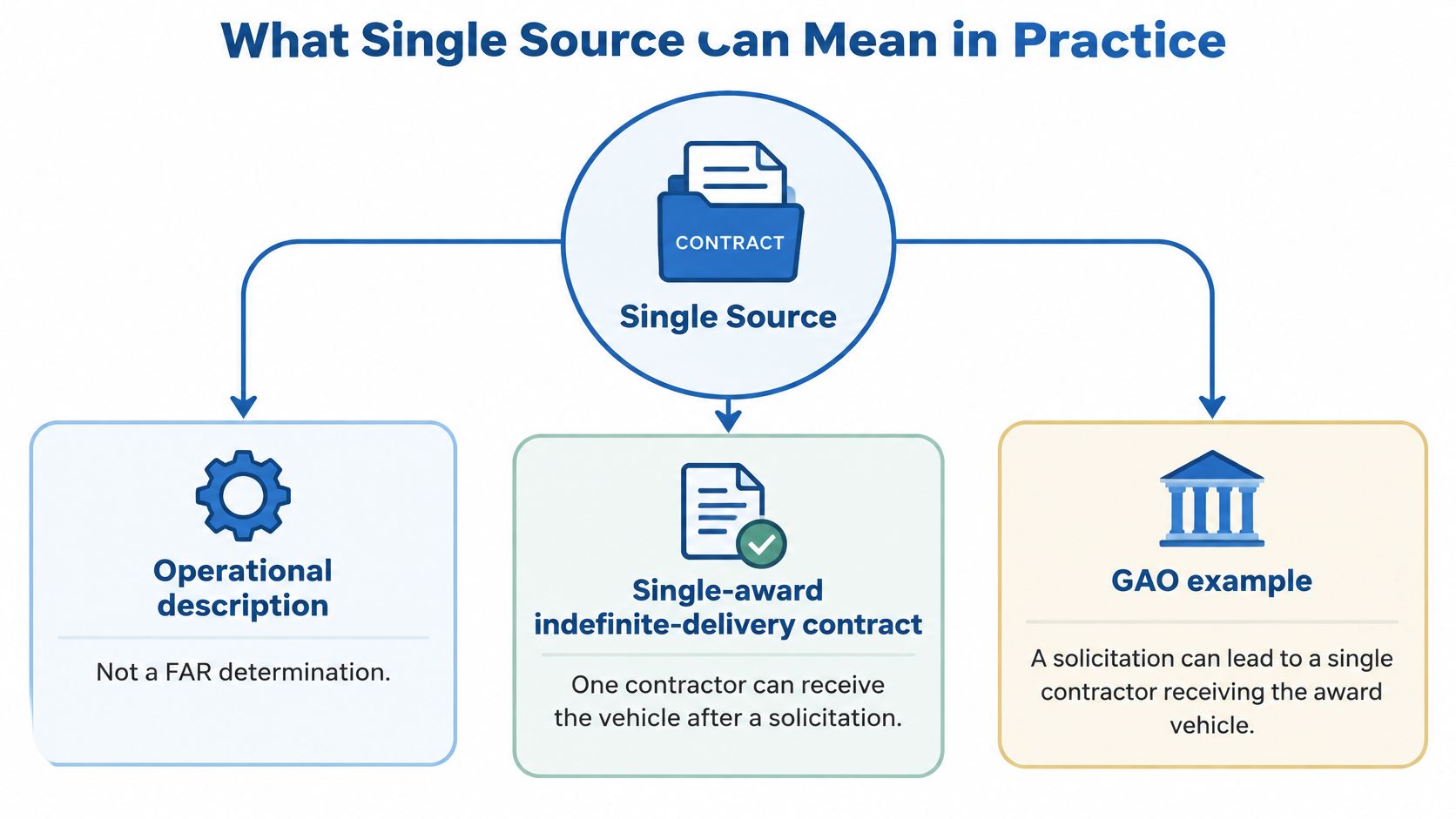
The competition stage is what separates the two labels. Sole source means only one supplier was solicited or negotiated with. Single source can mean one eventual awardee after multiple firms had a chance to compete. The difference works like a race with one entrant versus a race with many entrants and one finisher: the podium looks identical, but the starting line tells you whether anyone else was ever allowed to run.
Three buys that all get called single source
Several firms propose, one wins the vehicle. A single-award IDIQ is issued after a real competition. Future orders may still be competed among nobody but the holder, or directed to the holder. The vehicle structure and the order practice are separate facts, and both belong in your notes.
A solicitation is open and only one offer arrives. That's a weak response, not proof that no other capable source exists. An agency that receives one offer on a competitive solicitation has still run a competition.
A brand-name or approved-source parts buy. The item may be restricted to specific manufacturers or authorized channels, while several authorized distributors can still quote. A DLA DIBBS or Navy NECO request for a named part number often works exactly this way, with one part number on the page and several resellers able to bid on it.
A short walkthrough of how these labels appear on live notices makes the distinction concrete.
The four facts worth recording
For every award you classify, capture the original number of offerors or invited sources, whether the vehicle itself was competed, the stated rationale for a single-award structure, and whether later task orders are competed or directed. A notice showing five offerors and one award reads differently from one showing a single offeror total. The first describes a market you can still enter. The second describes a door that may never have been open.
That record prevents false competitor exclusion. It also makes incumbent analysis and market sizing honest, because you're measuring who competed rather than who happened to sign.
Set-Asides When Only One Small Firm Appears
Here's the question small businesses ask most often, and the answer is more conditional than most guidance admits. An agency can't sole-source to a favored socioeconomic-category firm because only one candidate is visible in the market.
SBA guidance, summarized in its set-aside procurement guidance, sets the path. When at least two small businesses can perform at a fair price, the procurement generally should be set aside competitively. When fewer than two are reasonably expected, a sole-source route may be authorized, or the requirement may stay full and open. For actions above $250,000, agencies must consider socioeconomic programs before choosing a sole-source or set-aside approach.
Eligibility still decides the outcome
Program rules, responsibility, a fair-price finding, the assigned NAICS code, dollar ceilings, and the required justification all continue to control the result. WOSB sole-source awards are the clearest illustration: they require a determination that at least two qualified firms aren't reasonably expected, and value limits still apply.
Low visible competition doesn't prove sole-source eligibility. Inadequate market research, an incomplete vendor pool, or an incumbent's proprietary configuration can be challengeable rather than dispositive. A notice that says no other firm can perform is a conclusion, and conclusions about the market get tested.
Ask the harder question: what did the agency do to look, and does the answer survive contact with your capability statement?
What proof changes the outcome
- Capability mapping: line your past performance up against the assigned NAICS code and the specific tasks in the statement of work, not against the agency's mission in general.
- Equivalent-part documentation: for parts buys, show form, fit, and function against the named item, including any qualification testing that already exists.
- Authorized reseller status: a letter from the manufacturer can dissolve a brand-name restriction faster than any argument about fairness.
- A transition plan: if compatibility is the stated barrier, describe how you'd absorb the work without disruption and on what schedule.
- A timely response to the notice: capability information submitted after the response date is a courtesy, not evidence.
Small businesses that track set-aside dollars and competition mix by market before a notice posts tend to file stronger challenges, because they already know which buyers restrict work and how often. Our guide to small business set-asides walks through how those programs are structured before a single notice appears.
Classify a Live Notice and Choose Bid Challenge or Pass
Classification starts with the notice type. A sources sought is market research in public. An intent to sole source is a stated plan with a response window. A brand-name justification restricts the item but not necessarily the channel. A competed solicitation naming an incumbent is just a competition where one firm has history on its side. Each one calls for a different response.
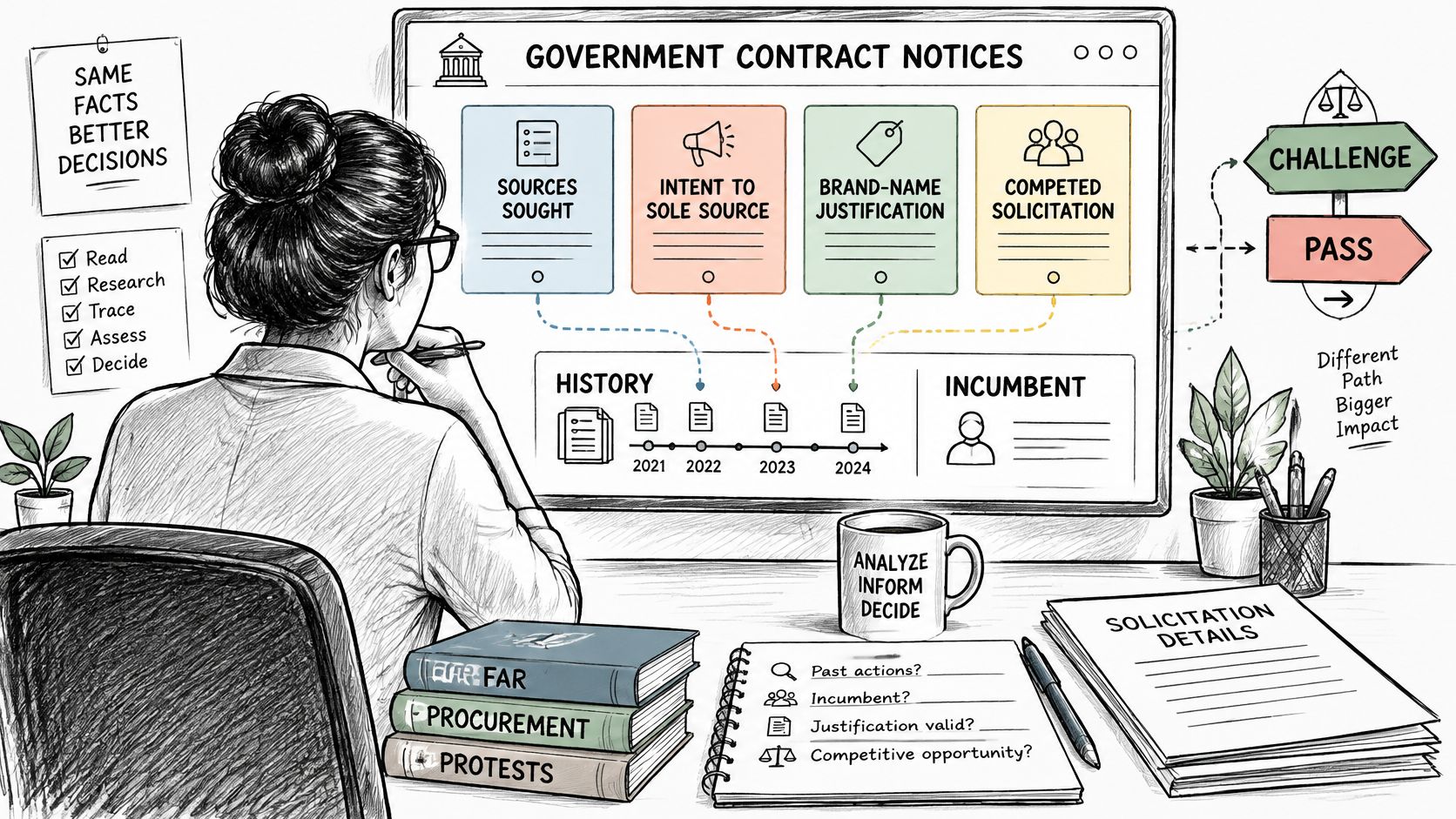
Trace history before you judge the label
Check whether the predecessor contract or vehicle was competed, how many firms held the IDIQ, GWAC, or BPA, and whether orders under it were competed or directed. FederalPipeline's contract vehicle records cover every IDIQ, GWAC, and BPA, showing who holds it and who orders through it, which is the fastest way to see whether "single source" meant one winner after a competition.
Then compare the notice against the wider market. FederalPipeline provides market data for every NAICS market by year, including spend, growth, buyers, set-aside and sole-source amounts, and which companies win. A high sole-source share in a market is a signal to investigate restrictions. It's not a verdict on this notice.
Build the record from public sources
Link the buyer, the program, and the prior suppliers using records that update regularly. FederalPipeline is built on SAM.gov, FPDS, USAspending, DoD budget justification books, Congress.gov, DLA DIBBS, and Navy NECO, updated daily, so a notice, its predecessor award, and the budget line behind it can sit in one view. Add the four classification facts you recorded earlier, plus the justification status and estimated value.
| Decision | Evidence that triggers it | Next action |
|---|---|---|
| Bid | Competed solicitation, single-award vehicle with competed orders, or approved-source list the firm can join | Submit the response and capability statement |
| Challenge | Intent to sole source without justification, incumbent configuration, thin market research, or two or more small firms able to perform at a fair price | Submit capability evidence and questions before the notice closes |
| Pass | Approved justification ties unique capability or unavailable data to minimum needs, and the firm can't offer an equivalent, data-rights workaround, or eligibility before the response date | Record the reason and revisit if the solicitation is amended or the approach withdrawn |
A single offer or a favored incumbent is not a pass signal on its own. Neither is a prior loss. The decision turns on whether the restriction is legally grounded and whether you can produce evidence against it in time.
FederalPipeline's Pipeline feature tracks what you're pursuing by stage, with the next action and the supporting research attached to each pursuit, so a classification made this week is still usable when an amendment lands next month. For more on reading notices end to end, see our walkthrough of procurement and government contracts.
Respond to an Intent to Sole Source Notice
Once a notice clears the classification test as a challenge candidate, the response is a sequence, and the sequence is the point. Every step leaves a record you can point to later, which matters because the agency can withdraw the intended approach when competition looks feasible.
- Read the notice for three things. The stated basis for the restriction, the response date, and whether capability information is invited. Capability submissions are worth making even when the agency has already signaled a noncompetitive award, because they're the only formal way to put an alternative on the record.
- Write the capability statement against the restriction. Map your experience to the NAICS code, the statement of work, and the specific requirement the agency says only one firm can meet. Generic corporate boilerplate answers a question nobody asked.
- Attach the proof that addresses the actual barrier. Equivalent-part documentation for a named item, an authorized reseller letter for a brand-name restriction, or a transition plan that answers a compatibility concern. Match the evidence to the stated reason, not to the reason you find most persuasive.
- Ask the contracting officer in writing for the justification and the market research behind the approach. Note the date of the request. A short, factual email beats a long argument, and it creates the timeline.
- Track amendments and any withdrawal of the intended sole-source approach. Notices change. A restriction can narrow, broaden, or disappear, and the firms that notice first get the better position.
- Escalate in writing if the justification never appears, or if it doesn't connect the restriction to the minimum need. State the gap plainly: what the justification asserts, what it doesn't establish, and what evidence you've already provided. Keep it tied to a specific requirement.
Keep each response short, factual, and anchored to one requirement at a time. A clean record of what you offered and when you offered it is more useful than a forceful letter, especially if the acquisition is later reviewed or recompeted. Timing matters more than volume, and a two-page submission filed before the response date outranks a thorough argument filed afterward.
If you're still working out whether the opportunity is worth pursuing at all, our guide to federal business opportunities covers how to qualify a notice before you spend the bid week.
FederalPipeline gives capture teams the evidence side of this decision: market data for every NAICS market by year with set-aside and sole-source amounts, contract vehicle records showing who holds each IDIQ and who orders through it, and a pipeline that keeps the next action attached to every pursuit. When an intent to sole source lands, you can pull the buyer, the prior award, and the competition history before you commit a bid week. Visit FederalPipeline to browse without a credit card and see the records behind a live notice.