The most popular advice about RFPs and RFQs is too simple: use an RFP for quality and an RFQ for price. That shortcut can send a federal capture team into the wrong response strategy. An RFQ can evaluate past performance, require a substantive technical response, or mean a request for qualifications rather than a request for quotation.
Read the governing authority, evaluation factors, and offer language before allocating proposal resources. The acronym is a starting point, not an acquisition strategy. Those checks tell you what to submit, how the government will compare responses, and what commitment your company makes when it responds.
RFP and RFQ Differences at a Glance
A request for proposals, or RFP, asks suppliers to explain how they'll meet a requirement, including their technical approach, management, qualifications, and price. A request for quotation, or RFQ, generally asks for pricing and delivery terms for clearly specified goods or services. These are useful working definitions, but the governing rules decide the details.
RFP vs RFQ across core bid criteria
| Criterion | RFP | RFQ |
|---|---|---|
| Buyer's core question | Which approach and team deliver the best outcome? | Who can supply this defined item or service at the best price and delivery terms? |
| What you submit | Technical proposal, management plan, past performance, and price volume, as instructed | Quote with price, delivery terms, and any required labor or staffing assumptions |
| Role of price | Evaluated alongside non-price factors under the stated method | Often decisive, but tradeoff factors can apply |
| Response effort | Usually substantial, including compliance analysis, proposal writing, and solution design | Usually lighter, including mapped compliance, a priced quote, and supporting evidence |
| Binding offer | Generally a firm offer the government can accept to form a contract | Generally not a contract-forming offer; the government's purchase order is typically the offer |
| Typical evaluation | Source selection against published factors and significant subfactors | Comparison of compliant quotes against stated criteria |
| Negotiation | Discussions are possible in negotiated procurements, but aren't guaranteed | Exchanges may occur under the applicable procedures; don't assume a revision opportunity |
| Typical use | Complex or custom work requiring differentiated approaches | Repeatable, well-defined goods and services |
Use the comparison to assign work
A parts RFQ doesn't automatically need a proposal writer. It may need a sourcing specialist who can verify the approved manufacturer, obtain reliable availability, and reconcile freight and delivery commitments. A services RFQ, however, may require operations and pricing staff to develop a defensible labor mix.
Likewise, don't treat every RFP as an invitation to submit an elaborate solution. Write to the requested format and evaluation method. Unrequested content consumes review time without necessarily improving your competitive position.
Routing rule: Assign effort according to the evidence the buyer requires, not the letters in the notice title.
For broader contractor education alongside solicitation-specific analysis, the GovCon Reviews blog is a useful supplementary resource. Keep general guidance separate from your compliance decision: the solicitation and applicable acquisition rules control the response.
The binding-offer row deserves particular attention. A technically strong response can still create unacceptable commercial exposure if the company hasn't approved the price, delivery promise, or period for which its offer must remain open.
Why the RFQ Label Can Mislead Bidders
RFQ does not reliably mean lowest price wins. GSA's shorthand describes a request for pricing, cost, delivery, and related information, but buyers use the acronym in materially different ways. The first task is to identify what the buyer means by it.
The same acronym can require different strategies
GSA's RFIs, RFQs, and RFPs training draws clean lines between the three request types: an RFI gathers market information, an RFQ solicits pricing and related terms, and an RFP invites a full proposal for evaluation and negotiation. Real solicitations blur those lines.
Some architecture and engineering solicitations carry the RFQ label yet request qualifications first and negotiate price afterward with the top-ranked firm. That is a qualifications-based selection wearing a price-request label. Show up with a supply-quote playbook and your pricing sits in a response that was never supposed to contain it, while the firms that understood the format compete on credentials.
The federal quotation route is not uniformly price-only either. GSA's solicitation-types presentation recognizes that RFQs can apply tradeoff factors such as past performance, so a quotation may be scored on more than the number at the bottom of the page.
Ask what the buyer will evaluate
For a qualifications RFQ, lead with relevant project experience, key personnel, and evidence that the firm can perform the assignment. Keep unsolicited pricing out of a process that excludes it.
For a federal quotation request with past-performance factors, a bare price sheet is incomplete. Give evaluators the project references, performance evidence, and technical information they specifically requested.
The label also cannot settle whether your response is a binding offer. Establish that from the applicable authority and solicitation language. If the notice title, response instructions, and award language point in different directions, ask the contracting officer to resolve the ambiguity before your company commits resources or approves pricing.
What Each Response Package Must Contain
Start with the buyer's instructions, not your company's standard template. A polished response that omits a required artifact is worse than a plain response that makes every requirement easy to verify.
Build the RFQ package around verifiable compliance
For GSA Schedule orders involving services with a statement of work, FAR 8.405-2 requires the RFQ to include the work statement and evaluation criteria, and requires the ordering activity to evaluate responses against those criteria, consider the proposed level of effort and labor mix, and determine whether the total price is reasonable.
That makes a services quotation more than a rate sheet. Build the package around these components:
- Requirement map: Identify where the quote addresses each mandatory task, deliverable, qualification, and submission requirement.
- Staffing basis: Show labor categories, hours, coverage assumptions, and responsibilities. Explain how the proposed staffing supports the required workload.
- Price support: Retain relevant Schedule rates, historical pricing, or comparable market evidence supporting your quotation.
- Delivery commitments: State availability, performance periods, dependencies, and any assumptions that affect execution.
For commercial products and services, evaluation may be simplified around technical capability, price, and past performance. Simplified doesn't mean unsupported. If the buyer requests evidence of capability, provide something an evaluator can verify rather than a generic assurance.
Build the RFP package around traceability
Use separate technical, management, past-performance, and price volumes when the instructions require them. Don't impose that structure on a solicitation that specifies another format.
The technical volume should explain how the team will perform the work. The management content should identify ownership, staffing, transition, subcontractor oversight, and risk controls. Past-performance examples should demonstrate relevance to the evaluated requirement rather than merely showcase recognizable customers.
Pricing must describe the same solution. If the technical narrative promises dedicated coverage but the price model assumes shared staff, fix the contradiction before review.
A hypothetical compliance-matrix entry could look like this:
| Requirement | Technical response | Staffing support | Price mapping |
|---|---|---|---|
| Requirement 3.2, help desk response within four hours | Technical section 4.1, triage and escalation process | Staffing line 2, 1.5 full-time equivalents for tier-one support | CLIN 0003, help desk support |
Those identifiers and staffing figures are illustrative, not prescribed requirements. The technique is what matters: connect the promise to the people and the price.
Preserve the original solicitation, attachments, amendments, and final response baseline. Reviewers need to know which requirement version the team used, especially when staffing or evaluation language changes during preparation.
For the simplified-acquisition route, check the applicable authority and aggregate acquisition value rather than assuming that an RFQ automatically falls under FAR Part 13. That part governs acquisitions within the applicable simplified acquisition threshold, subject to its governing provisions.
Your capture record should retain solicitation type, required artifacts, evaluation factors, delivery or labor assumptions, price basis, and acquisition procedure. These fields support an informed bid decision before drafting begins.
How Each Route Is Evaluated and Awarded
In a negotiated RFP, the government must disclose the evaluation factors and significant subfactors that drive source selection and evaluate proposals against those published criteria. The FAR Part 15 overhaul guidance also describes an authorized approach that evaluates non-price factors first, identifies the highest technically rated proposal, and then tests that offer's price for fairness and reasonableness.
A lower price is not automatically the winning price. Your strategy must match the stated selection method.
Evaluation methods and what they mean for bidders
| Method | How award is decided | Typical use | What it means for bidders |
|---|---|---|---|
| Lowest price technically acceptable | Select the lowest-priced acceptable response under the stated rules | Defined goods and repeatable services | A low price won't cure a technical failure |
| Best-value tradeoff | Weigh price against evaluated technical merit, past performance, and risk | RFPs and some RFQs with tradeoff factors | A higher-priced response can win when its benefits justify the premium |
| Non-price first, then price test | Rank proposals on non-price factors, then test the top offer's price for reasonableness | Negotiated RFPs using this authorized approach | Technical ranking matters, but the price must still pass the required test |
| Qualifications-based selection | Rank firms on qualifications, then negotiate price with the highest-ranked firm | Applicable architecture and engineering services | Compete on qualifications rather than an upfront price discount |
The same competing responses can produce different winners
Consider a hypothetical competition with a lower-priced compliant response and a higher-priced compliant response supported by stronger relevant past performance. Under a tradeoff RFP, the agency can select the higher-priced response when the evaluated benefits justify paying more under the published criteria.
Under a lowest-price technically acceptable method, stronger performance beyond the acceptability standard doesn't itself justify a premium. If both responses meet the requirements, the lower price separates them.
Don't sell a premium solution to an evaluation method that gives the buyer no basis to pay for it.
Keep source selection separate from contract type. An award can use fixed-price terms without making the competition lowest-price-only; understanding fixed-price contracting helps your pricing team assess performance exposure without confusing it with the selection method.
Model the decision before writing
Build an internal evaluation worksheet using the actual factors and their stated relationships. Where the solicitation doesn't provide numerical weights, don't invent an official scoring formula. Use a qualitative assessment of compliance, relevance, strengths, weaknesses, and execution risk.
Then confirm whether price is decisive, part of a tradeoff, or subject to a reasonableness test. That answer determines whether your team should prioritize cost reduction, stronger substantiation, or a differentiated approach worth its premium.
Offer Status, Timing and Amendments
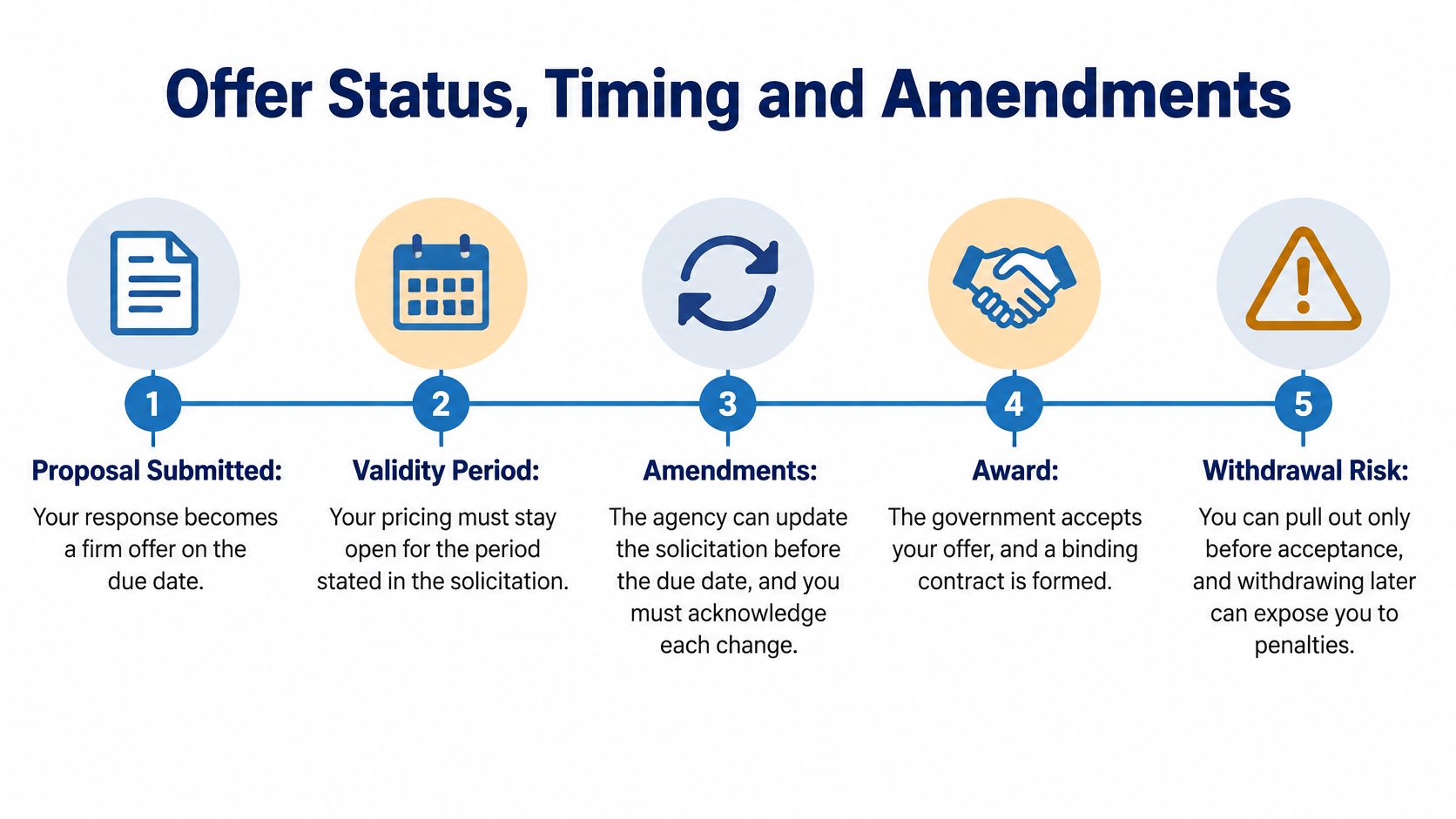
Offer status sets the commitment risk. An RFP response is generally a firm offer the government can accept to create a contract. A quotation normally isn't a contract-forming offer; the government's purchase order is typically its offer to buy.
That distinction does not make a quotation consequence-free or mean that issuing a purchase order always completes contract formation. Your team must examine the applicable acceptance mechanism, order terms, and subsequent conduct. Don't authorize performance merely because someone describes an RFQ as nonbinding.
Use the timeline as an orientation, then apply the actual solicitation terms.
Manage the schedule from release through award
At notice release, save the complete attachment set and assign a response owner. During the question window, resolve issues that affect eligibility, technical compliance, delivery, and pricing. Don't spend that window asking questions the attachments already answer.
When an amendment arrives, compare it with the baseline the team is using. Route changes to the technical lead, pricing lead, and approving executive as appropriate. A changed delivery location can affect freight; a changed evaluation factor can affect the entire response.
Route differences at each timing stage
| Stage | RFQ | RFP |
|---|---|---|
| Offer status | Usually not a contract-forming offer; the purchase order is typically the offer | Generally a firm offer the government can accept |
| Question window | Use the stated cutoff to resolve specifications, availability, and quote requirements | Use the stated cutoff to resolve scope, instructions, and evaluation issues |
| Amendments | Can revise quantities, specifications, delivery terms, or evaluation requirements | Can change evaluation factors, not just quantities |
| Preparation time | Follow the published deadline; organize sourcing and quote approval immediately | Follow the published deadline; allow for solution development and integrated review |
| Commitment after submission | Track order terms and the applicable acceptance process | Manage offer validity, permitted revisions, and withdrawal exposure |
Control the final submission baseline
Treat the RFP submission deadline as a hard offer deadline. Don't assume the agency will conduct discussions, permit a correction, or extend the date because an amendment requires substantial work.
For both routes, maintain an amendment log showing the change, its owner, its pricing effect, and required acknowledgment. Before release, verify that the technical response and pricing files reflect the same baseline.
Confirm the stated offer or quotation validity period before finalizing price. Supplier expiration dates, labor-rate assumptions, and delivery availability should support that period. If withdrawal or acceptance becomes an issue, get procurement counsel involved rather than relying on a blanket rule about when a response can be withdrawn.
Choosing the Route That Fits Your Situation
As a bidder, you don't choose the agency's procurement procedure. You choose whether to pursue the opportunity and how to resource the response. Make that choice through the actual rules, not through a price-versus-quality stereotype.
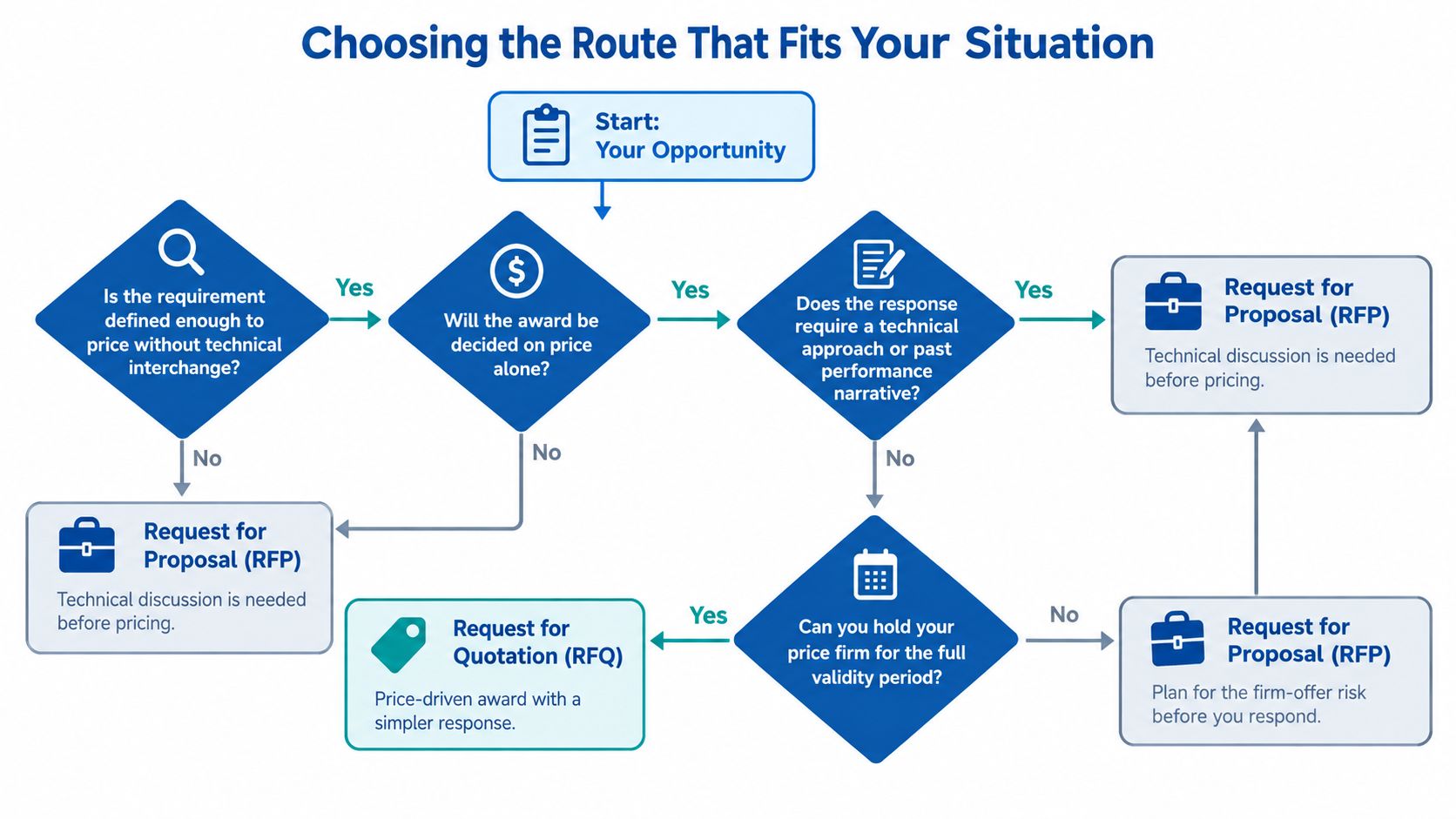
Apply the decision logic
Ask these questions during qualification:
- Can we price the defined requirement? If essential scope is missing, identify the clarification needed before committing to a delivery model.
- How will the buyer select the winner? Determine whether price alone separates acceptable responses or whether evaluated advantages can justify a premium.
- What commitment does submission create? Obtain commercial approval appropriate to the response's offer status.
- Does a special rule change the route? Check qualifications-based selection, set-aside eligibility, and access to the applicable ordering vehicle.
Use the flowchart as a screening aid, not as a legal classification tool. Technical narratives and past performance can appear in RFQs, and inability to hold a price doesn't convert an RFQ into an RFP.
Match resources to the opportunity
A repeatable-parts supplier should prioritize the requested item, approved sources, quantity, availability, and delivery economics. A defined parts RFQ usually calls for disciplined sourcing and accurate quoting, not extensive solution writing.
A modernization team facing weighted technical factors needs solution architects, delivery leadership, pricing, and a compliance owner. Don't approve that pursuit merely because the company can perform the work. Establish why its approach can outperform competing responses.
A small business must resolve set-aside eligibility and ordering access before proposal development. Understanding what a contract vehicle is helps distinguish an attractive requirement from an order the company can realistly compete for. An architecture firm must separately check whether an RFQ requests qualifications without upfront pricing.
For another explanation of the solicitation distinctions, review the accompanying video.
Be stricter about resource-intensive pursuits. Organizations reported a median new-business RFP win rate of 37% in 2024, according to the QorusDocs 2025 Proposal Management Benchmark Survey. That isn't your company's predicted win probability, but it supports a practical discipline: require a credible competitive advantage before committing substantial proposal labor.
Confirm the Solicitation Type Before You Bid
Make solicitation classification a documented qualification task. The capture lead should record the conclusion and unresolved questions before asking writers, estimators, or suppliers to begin production.
Run the pre-bid sequence
Identify the governing authority. Read the header, incorporated provisions, ordering instructions, and acquisition references. Record the solicitation type and whether the buyer is using Schedule ordering, simplified acquisition, negotiated procurement, or another identified procedure.
Locate the evaluation factors. For an RFP using the uniform contract format, look in Section M, but check attachments and other stated locations too. Determine whether price is evaluated competitively, tested for reasonableness, or excluded from the initial qualifications assessment.
Read the response instructions. Extract the required format, page limits, submission channel, file requirements, deadlines, and validity period. Where the uniform contract format applies, inspect Section L rather than relying on the notice summary.
Resolve offer status in writing. Identify the provisions establishing whether the response is an offer or quotation. If they're unclear, ask the contracting officer to identify the controlling language.
Question contradictions before submission. An RFQ with tradeoff factors isn't contradictory by nature. Instructions that omit the supporting information needed to evaluate those factors warrant clarification. Ask a precise question tied to the relevant provision.
Log amendments against the priced version. Record the technical, delivery, eligibility, and commercial effect of each change. Complete required acknowledgments and obtain fresh approval when the change affects your commitments.
Set alerts and assign an owner. Route matching notices and amendments to someone responsible for acting on them. A shared inbox without an accountable owner isn't a pursuit-control process.
Before approving a bid: Require a clear answer to what governs, what gets evaluated, and what the company commits to.
Connect qualification with notice monitoring
Use a consistent federal opportunity research workflow so qualification decisions remain attached to the documents supporting them. Keep the next action explicit: clarify eligibility, validate sourcing, resolve pricing, or decline the pursuit.
At FederalPipeline, our capture briefs identify what's being bought, required clearances, set-asides and certifications, the incumbent, ceiling, and every deadline. Our DLA DIBBS and Navy NECO parts RFQs include quantities, buy history, and approved sources, while saved-search and notice alerts email users when something changes. Use that workflow to identify bid blockers early, then verify the controlling solicitation language before submission.
FederalPipeline connects solicitation requirements, buyer information, and pursuit research so your team can qualify RFPs and RFQs before committing response resources. Visit FederalPipeline to review matching opportunities, examine capture briefs, and set alerts for the notices your team is pursuing.