In fiscal year 2024, the U.S. federal government committed approximately $755 billion on contracts, according to the U.S. Government Accountability Office. That's national-economy scale purchasing, executed through purchase orders, task orders and formal solicitations. A single misread eligibility rule can remove your company from a competition worth more than its annual revenue.
Here's the reframe that saves capture teams the most wasted effort. Federal contract requirements aren't one universal checklist. They're gates that open or close for each solicitation. A rule that blocks you on one notice may be irrelevant on the next, and a rule you've never heard of may be the reason you lose. The work is figuring out which gates bind a specific opportunity before you spend capture hours on it.
What Federal Contract Requirements Actually Are
A federal contract requirement is any rule a company must satisfy to be considered for an award, to win it, and then to perform it. That spans legal dollar thresholds, eligibility status, registrations and certifications, evidence of capability, and the clauses written into a particular solicitation. Some bind every vendor in every procurement. Most bind only the ones the notice names.
Think about how a city handles construction permits. A garden shed gets a quick review. A ten-story building gets structural drawings, inspections and a fire review. Nobody changed the rules out of spite; the scrutiny scales with value and risk. Federal buying scales the same way, so the size, type and urgency of a purchase decide how many procedures attach to it.
Four layers to check on every opportunity
- Money. The estimated value and the applicable dollar threshold decide whether this is a simplified purchase or a formal procurement.
- Who may bid. Set-aside status, size standard and socioeconomic category determine whether your company is even in the competition.
- Records. Registration, representations, certifications and payment details must already exist and be current.
- What the solicitation adds. Evaluation factors, conditional clauses and submission rules that apply to this buy and no other.
Three documents produce those layers. The Federal Acquisition Regulation sets the government-wide baseline. Agency supplements, such as the Defense FAR Supplement, add requirements on top for that agency's contracts. The solicitation itself states which combination governs this particular acquisition, which is why two notices from the same office can demand very different things.
The practical habit is to check all four layers in that order and stop the moment one closes. A missing registration doesn't become fixable because the technical fit is excellent, and an attractive contract value doesn't make you eligible for a category you don't fit.
Dollar Thresholds That Set Your Buying Rules
The first gate is arithmetic, and the arithmetic changed recently. Under the FAR, the micro-purchase threshold rose from $10,000 to $15,000 on October 1, 2025, and the simplified acquisition threshold rose from $250,000 to $350,000 on the same date, as recorded in the FAR threshold change notice on Acquisition.gov. Emergency and overseas authorities push those ceilings much higher.
| Threshold | Before October 1, 2025 | From October 1, 2025 | When it applies |
|---|---|---|---|
| Micro-purchase threshold (standard) | $10,000 | $15,000 | Purchases that may generally use simplified methods |
| Simplified acquisition threshold (standard) | $250,000 | $350,000 | Purchases above the micro-purchase threshold and up to this value use simplified procedures |
| Micro-purchase threshold, emergency, work inside the U.S. | Emergency authority required | $25,000 | Qualifying acquisitions supporting emergencies, disasters or certain national-security situations |
| Micro-purchase threshold, emergency, work outside the U.S. | Emergency authority required | $40,000 | Qualifying emergency-related acquisitions performed outside the United States |
| Simplified acquisition threshold, domestic emergency-related | Emergency authority required | $1,000,000 | Certain domestic emergency-related contracts |
| Simplified acquisition threshold, performed outside the U.S. | Emergency authority required | $2,000,000 | Qualifying contracts performed outside the United States |
The three bands in plain terms
Purchases at or below the micro-purchase threshold may generally use simplified methods, which means less formality and faster buying. Purchases above it and at or below the simplified acquisition threshold follow simplified acquisition procedures, still lighter than a full competition but with real documentation. Above the simplified threshold, expect fuller competition, formal evaluation and heavier compliance research.
The dated change matters more than most bidders realize. Say a requirement is estimated at $320,000. Issued in September 2025, it sat above the then-current simplified threshold of $250,000, so the agency would have run a more formal procurement. Issued in November 2025 at the same value, it falls inside the simplified band and can be bought with lighter procedures, a different solicitation format and a shorter approval path. Same work, same buyer, different rulebook.
Before judging an opportunity, walk these five checks.
- Confirm the estimated value, including options and any extension periods, because the evaluated total sets the band.
- Check the issue date against the October 1, 2025 change and use the threshold version in force when the acquisition was issued.
- Note the place of performance, since work performed outside the United States can carry different ceilings.
- Check whether an emergency authority is cited. Disasters, emergencies and certain national-security situations allow the higher figures.
- Assign the procedure band, then note the contract type and any statutory exception the notice mentions.
Do that before anything else. The band tells you how formal the process will be, roughly how much competition to expect, and how much compliance research the bid deserves.
Small-Business Eligibility and Set-Aside Checks
Buying a ticket to a ballgame means choosing a category. General admission and a reserved section cost different amounts, and the usher won't seat you where your ticket doesn't apply. A set-aside works the same way: the contracting officer assigns the requirement to a category, and only firms that fit that category compete for it.
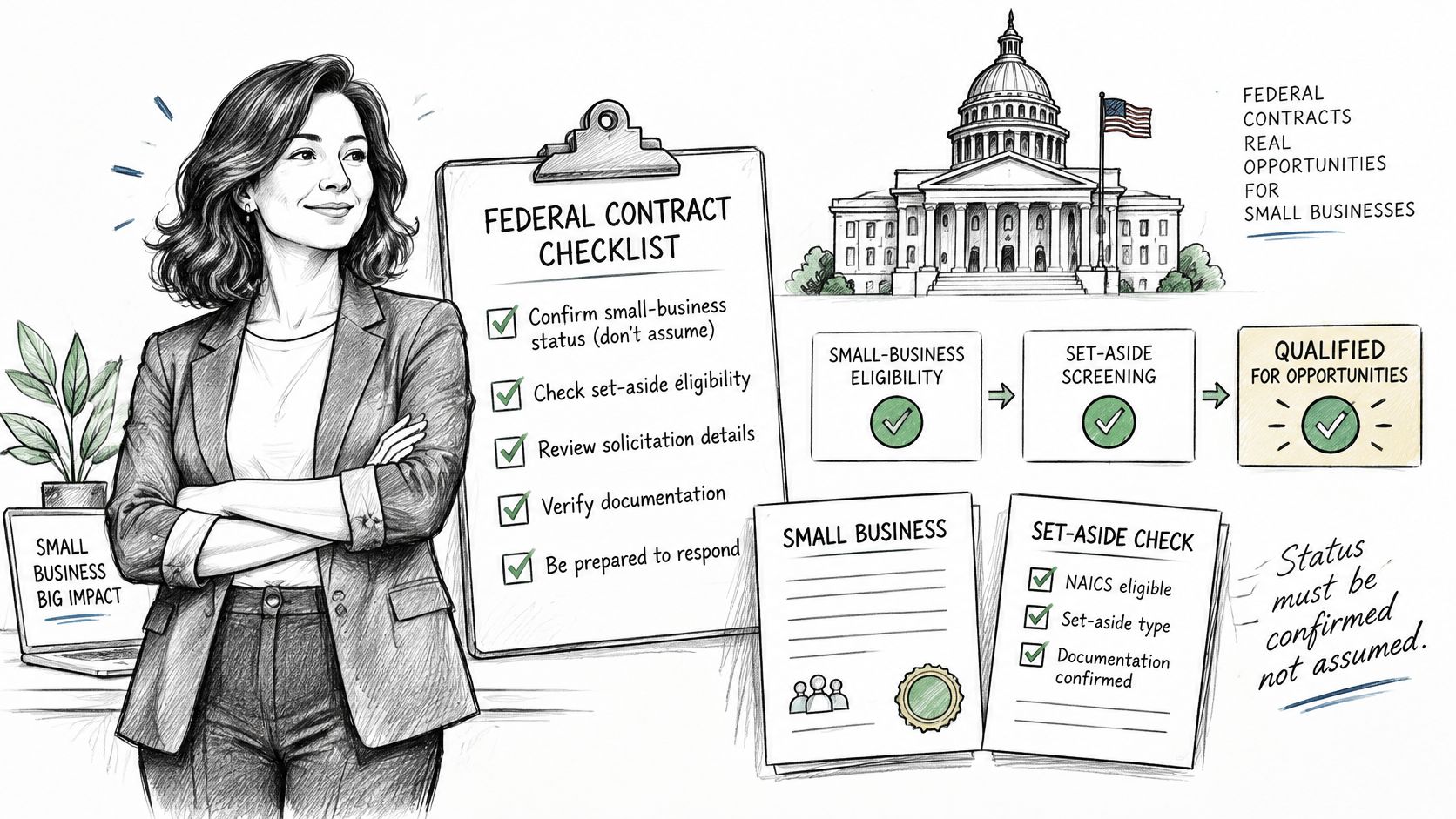
The rule is concrete. Acquisitions for supplies or services with an anticipated value above the micro-purchase threshold but at or below the simplified acquisition threshold shall be set aside for small-business concerns, subject to applicable exceptions and acquisition rules, under FAR 13.003. That band covers purchases into the hundreds of thousands of dollars, so this isn't a technicality reserved for tiny orders.
Practical rule: Technical strength doesn't buy a ticket into a category you don't qualify for. Check the category before you write a single win theme.
Three checks in order
- Is the requirement set aside at all? Read the notice header and the applicable clause. Plenty of notices are unrestricted, and small business shows up only as a subcontracting consideration.
- Do you meet the SBA size standard for the NAICS code printed on the notice? Size is measured against that code's revenue or employee limit. A firm that describes itself as small can be other than small for a specific code, and the label on your website doesn't count for anything.
- Does a socioeconomic reservation apply? Service-disabled veteran-owned, women-owned, HUBZone and 8(a) programs each carry their own certification conditions. The ownership and control tests for an SDVOSB, for instance, catch applicants who assume that veteran ownership alone is sufficient, as this guide to what qualifies as an SDVOSB sets out.
A single "small business" badge misleads because status is code-specific. Registering under several NAICS codes is routine, and a company is often small in one line of work and large in another. The only determination that matters is the one tied to the code on that particular solicitation.
Affiliates complicate the math further. A parent company, a sister firm, or shared ownership and management can be counted alongside you when the size calculation runs, so a business that looks comfortably under the limit on its own may not be once the corporate family is included.
When the size check fails
Say an integrator with strong past performance bids a set-aside for IT services. The notice assigns a NAICS code whose size standard is measured by average annual receipts, and the integrator's three-year average sits above it once an affiliate is counted. The proposal can be excellent and still ineligible. Nothing about the solution was wrong; the category was.
If the size check fails, or the solicitation's limitations on subcontracting can't be met with your planned team, decide early. Capability alone rarely justifies pursuing work you can't be awarded, and a subcontracting or teaming role may be a practical path to revenue on that contract.
Registrations and Certifications to Keep Current
Some gates belong to your company rather than to any one solicitation. They must already be open the day an opportunity appears, because you can't fix them in time to bid. The core set is an active System for Award Management (SAM.gov) registration with a Unique Entity Identifier, the representations and certifications entered there, and any agency accounts your team needs to submit quotes or invoices.
Treat these like a passport. You don't renew it at the airport counter, and an expired one cancels the trip no matter how good the itinerary is. Registration lapses are the most common self-inflicted disqualification in federal contracting, and they're entirely preventable with a calendar reminder.
A yearly check that prevents most surprises
- Confirm the registration is active and note the expiration date. Put the renewal date on the same calendar as your bid deadlines, with a reminder set well ahead of it.
- Review size, NAICS codes and socioeconomic representations. Contracting officers filter on these fields when they build a small-business search, so a stale entry can hide you from exactly the notices you want to see.
- Match the legal name, address and banking details to your records. A mismatch between the registered name and the entity on the offer, or wrong payment information, stalls an award after you've already won it.
- Verify every certification tied to a set-aside program you claim. Certifications have their own application timelines and can lapse independently of your registration.
- Name an owner for each renewal. Unowned renewals expire. Give each field group one person who confirms it, even when someone else does the data entry.
A lapse mid-bid is worse than a lapse between pursuits. If registration goes inactive while your proposal is under evaluation, the agency may be unable to make an award to you, and the repair takes days you may not have. Working through a structured eligibility checklist once a year is enough to keep the records layer from closing on you.
Reading Solicitations for Requirements That Score
The most expensive reading mistake in federal contracting is to study the statement of work and skim the evaluation section. The statement of work tells you what the agency wants to buy. The evaluation section tells you how it will decide who wins. Those are different documents with different consequences for your proposal.
Federal solicitations have to make that decision auditable before proposals arrive. FAR Subpart 15.3 requires consistency among the requirement, the proposal instructions, the evaluation factors, the provisions, the clauses and the data requirements. FAR 15.304 goes further, requiring every factor and significant subfactor that can affect award, along with its relative importance, to be stated clearly in the solicitation. In effect, the scoring sheet is published in advance.
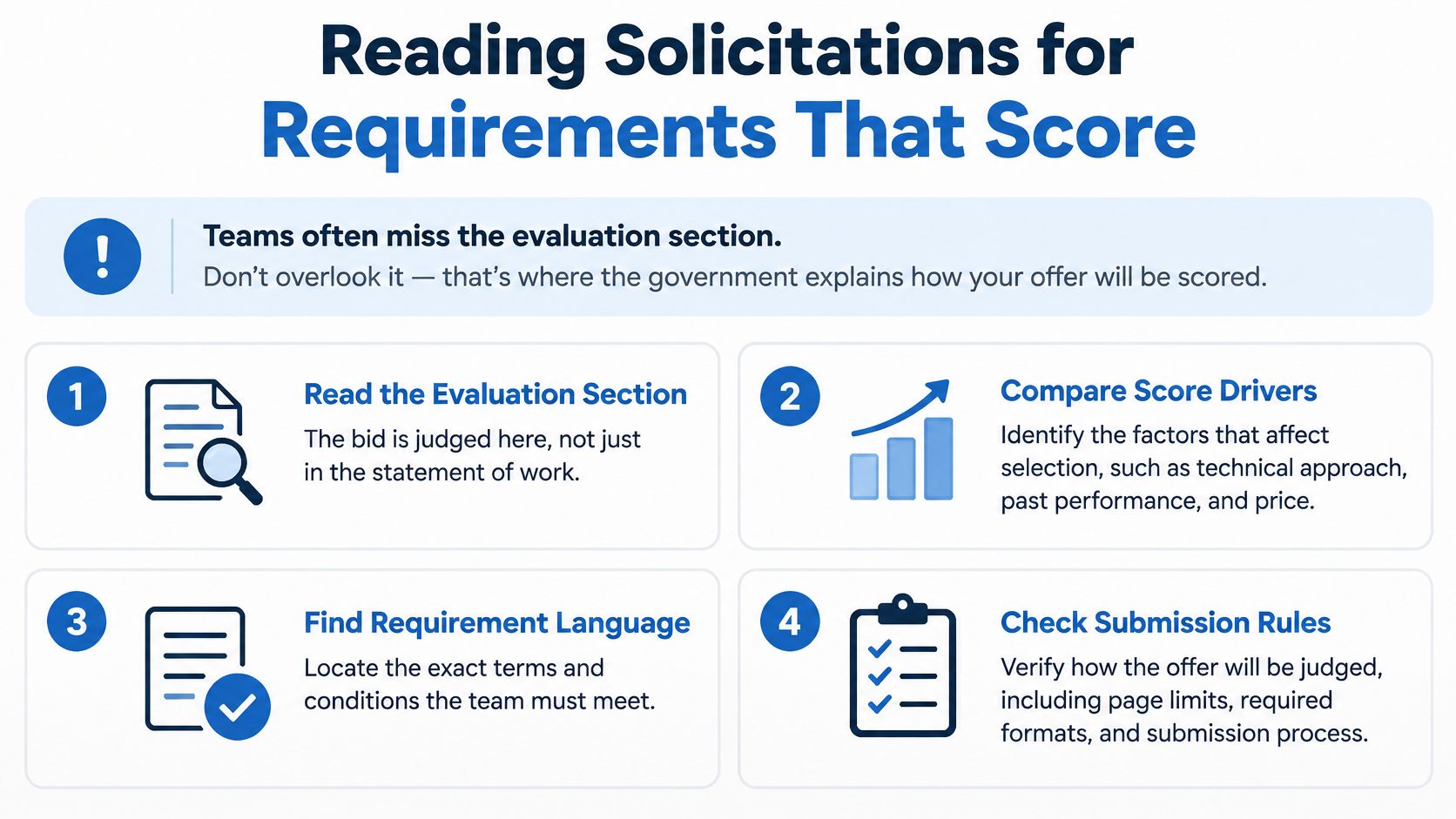
Map every requirement to a factor
- Extract the factors and subfactors verbatim into a table, with the stated weights or order of importance beside each one.
- Attach the evidence each factor asks for. A factor about key personnel wants resumes and commitment letters, not a paragraph of assurance that the team is strong.
- Assign an internal owner per row, with a due date well ahead of the submission deadline.
- Re-read the final draft against the table. Technical, management, past performance and price volumes should each trace back to a factor that exists.
Missing a mandatory submission, or optimizing for a preference the buyer never stated, can hurt more than offering a merely adequate solution. Evaluators must apply the disclosed framework, so a preference you guessed correctly earns nothing, while a skipped form can make the offer unacceptable.
A technically strong proposal that ignores the stated weighting loses to an average proposal that follows it. The evaluator is scoring the solicitation, not your best idea.
Small-business capture teams face an extra scoring risk. In certain consolidated or bundled requirements that aren't set aside for small business, the contracting officer must evaluate past performance in meeting small-business participation goals and the proposed small-business subcontracting participation when there's significant subcontracting opportunity. Bid as a large business or as a mentor with protégés, and that becomes a scored factor rather than a compliance formality.
Picture a team that drafts the price volume first, builds the staffing model around it, and only on the final read notices that small-business subcontracting is a scored subfactor. Reworking the subcontracting plan at that point means reworking price. The finding needs to land in week one. The same applies when you're weighing an RFP against an RFQ: the format tells you how much of this analysis the buyer expects.
A short list to run on any solicitation. Does every evaluation factor have an owner and evidence? Are all mandatory forms identified, with the volume each belongs in? Does the proposal's structure mirror the factor order? Is every conditional clause, from a subcontracting plan to a security requirement, captured with a deadline? And is the submission method confirmed in the agency's own system rather than a third-party summary?
Conditional Rules for Cybersecurity and Cost Accounting
A cybersecurity clause and a cost accounting rule can sit side by side on a compliance checklist and behave completely differently. Each works more like a door with its own key: it opens only when the solicitation in front of you carries the trigger. Preparing for a requirement that never appears in your pursuits is wasted money, and missing one that does appear is a lost award.
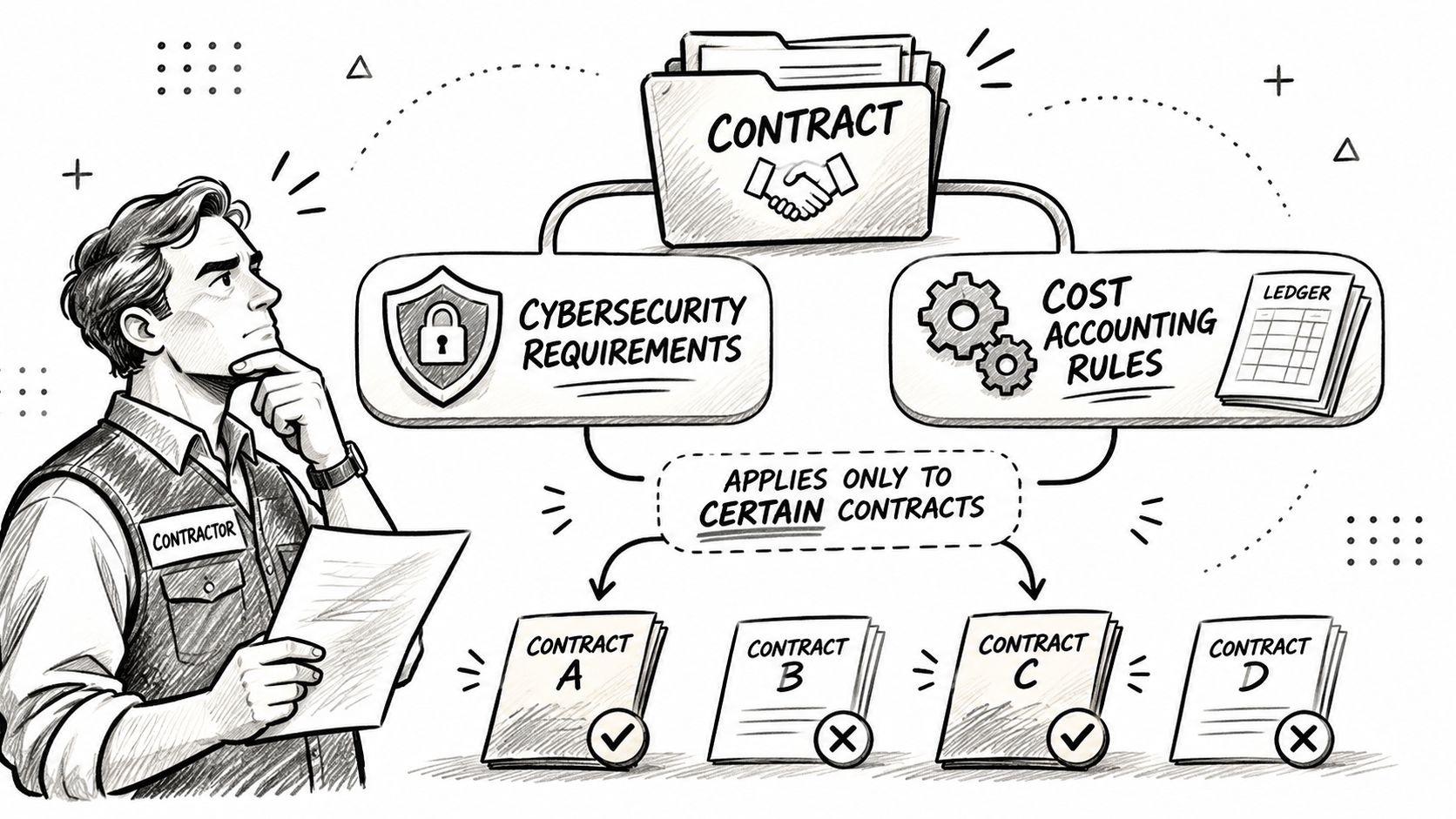
Cybersecurity makes the distinction plain. Recent DFARS guidance, described in the Federal Register notice on assessing contractor implementation, states that CMMC is not itself an evaluation factor or a set-aside requirement. When a solicitation does identify CMMC requirements, however, the agency cannot award the contract, task order or delivery order to an offeror that fails to meet them. The same rule sits dormant on one pursuit and hard-blocks another.
That split explains the policy's shape. Ransomware and other intrusions have imposed heavy reported costs across the U.S. economy, which pushes agencies to write enforceable controls into contracts while confining those controls to the solicitations that name them. So the questions that matter run per notice. Does this solicitation trigger the requirement? Which information category and assessment level apply? Does it flow down to your subcontractors, and by when must the evidence exist?
A short walkthrough helps when the layers start to blur.
Cost accounting has its own trigger
Cost Accounting Standards gate the same way. On a CAS-covered negotiated contract, the contractor must disclose its actual cost-accounting practices in writing, apply the standards in 48 CFR 9904, and accumulate and report contract cost data consistently with what it disclosed, as FAR 30.101 requires. Change an allocation method or an indirect-cost treatment without managing that consistency requirement, and the reliability of your incurred-cost and pricing data comes into question.
CAS generally does not apply to small-business concerns, sealed-bid contracts, or firm-fixed-price acquisitions of commercial products and services where the price-adjustment mechanism isn't based on actual incurred costs. Before pricing, run a contract-type and exemption review across value, vehicle, product or service status, business size, pricing mechanism, disclosure statement and accounting system. When that review turns up gaps in how indirect costs are accumulated and disclosed, Hire CPAs can connect you with an accountant who works on contract cost accounting rather than personal returns.
| Rule | Applies when | Generally does not apply when | Checked at |
|---|---|---|---|
| CMMC requirements | The solicitation names CMMC requirements | The solicitation contains no CMMC requirement | Proposal, award or performance, as the clause specifies |
| Cost Accounting Standards (CAS) | A CAS-covered negotiated contract | Small businesses, sealed-bid contracts, or firm-fixed-price commercial products and services without actual-cost price adjustments | Pricing, disclosure and incurred-cost reporting |
| Small-business subcontracting plan | Certain large or consolidated requirements with significant subcontracting opportunity | Small-business set-asides and requirements below the plan threshold | Proposal evaluation and contract administration |
Read any notice against that table the same way each time. Find the clause. Find the point at which evidence must exist, whether that is proposal, award or performance. Find whether the obligation reaches your subcontractors. A rule that fails all three checks belongs to a different pursuit, and your capture hours belong elsewhere.
Confirm Each Requirement Before You Bid
Run the gates in order and stop at the first failure. Each check is cheaper than the one after it, and a gate that closes early saves the capture hours you'd otherwise spend on a bid you can't win.
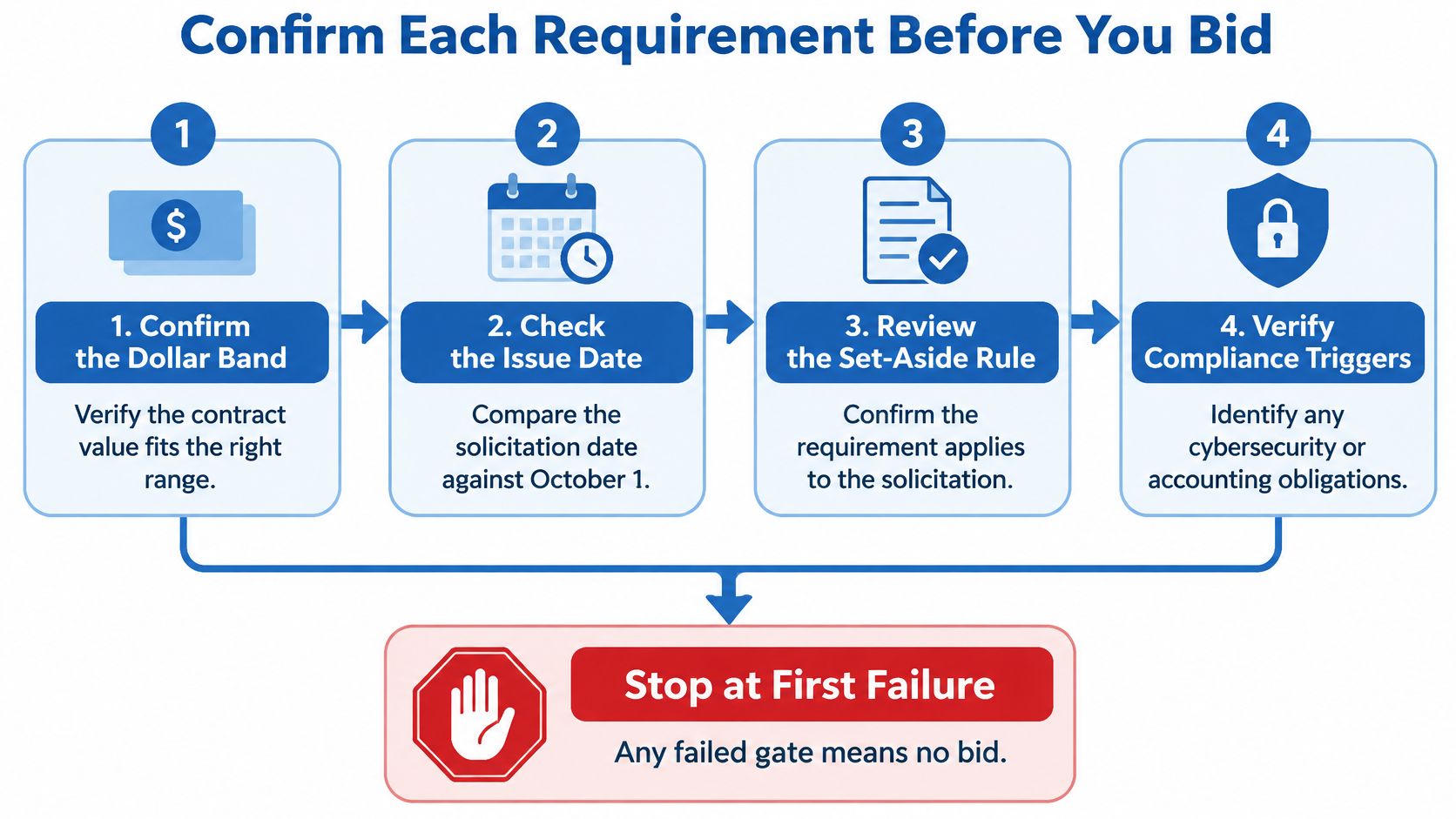
- Money. Confirm the estimated value including options, confirm which threshold version applies from the notice's issue date, and note the place of performance and any cited emergency authority.
- Category. Confirm size status against the NAICS code printed on the notice, and confirm the set-aside or unrestricted status in the solicitation itself rather than in a summary of it.
- Records. Confirm SAM registration, representations and certifications are active, and that your legal name, address and banking details match your company records.
- Scoring and clauses. Map each evaluation factor and any conditional clause, from CMMC to a subcontracting plan, to an internal owner and a date by which the evidence must exist.
- Decision. Weigh whether capability plus compliance justifies the capture effort, or whether a teaming role or a different opportunity is the better use of the same hours.
Record the result of every gate, with the date checked and the owner, in one shared file before any capture hours are spent. Teams that keep that record can compare two pursuits on the same terms and drop a bid early when a gate fails, instead of discovering the blocker after the proposal is drafted.
FederalPipeline reads every solicitation and produces capture briefs that state what's being bought, the clearance, set-aside and certifications required, the incumbent, the ceiling and every deadline, and it flags bid blockers up front, including the incumbent, the prior contract and requirements pulled from the attachments. That turns the four-layer check into a review of a page or two rather than a full read of a hundred-page document set.
Write down the outcome of each gate before you commit capture resources. A one-page record per opportunity beats a strong memory and a rushed bid every time.
FederalPipeline connects opportunities, budgets, buyers and awards so your team can see what's coming, whether you can bid, and who you're up against, which is exactly what the gates above ask you to establish. Set alerts on the NAICS codes where you're small and on the agencies that buy your work, then keep each pursuit's gate record in one pipeline so nothing expires unnoticed. Start at FederalPipeline and check your next opportunity against all four layers before you spend a single capture hour on it.