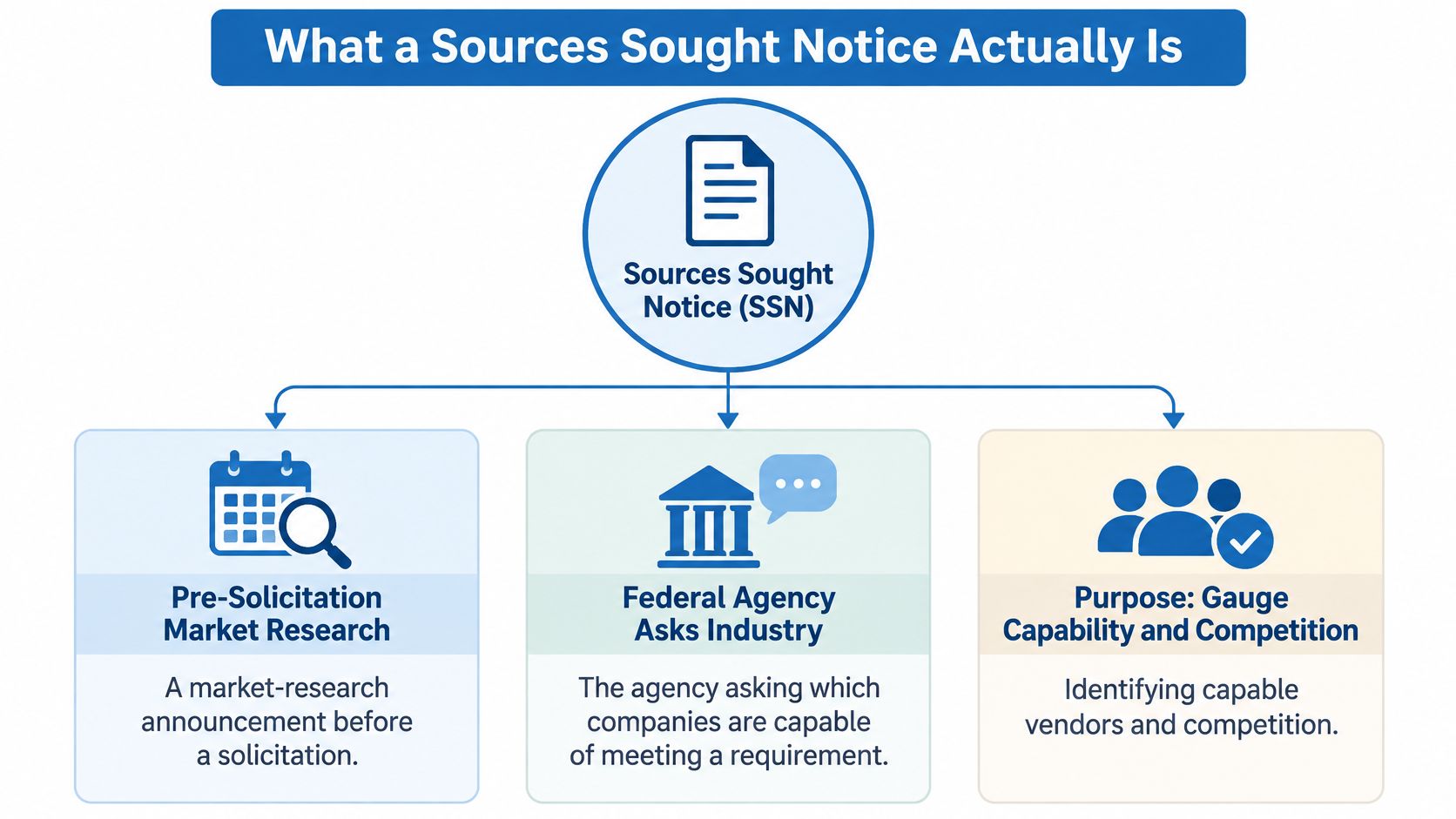
A sources sought notice is a pre-solicitation market-research announcement in which a federal agency asks industry for capability information before deciding how to buy.
If you can't win a contract by answering it, why should your team spend time responding? Because the agency may still be deciding what qualified suppliers can deliver, whether small businesses can perform the work, and how to structure the acquisition. The opportunity is to provide useful evidence while those decisions remain open, not to submit an early bid.
What a Sources Sought Notice Actually Is
A sources sought notice, often shortened to SSN, asks a practical question: which companies could meet this government requirement? The agency needs more than expressions of interest. It wants information it can use to understand the supplier market.
The agency's purposes follow a logical order:
- Identify capable businesses. Determine which companies have relevant experience, resources, and availability.
- Refine the requirement. Learn whether the proposed scope, delivery expectations, or technical approach match what industry can realistically provide.
- Assess competition. Evaluate whether enough qualified suppliers exist to support the acquisition approach under consideration.
Think of a homebuyer discussing a floor plan with builders before deciding whether to commission a custom house, use a standard design, or buy an existing property. The buyer is investigating feasible options, not accepting a construction offer. An SSN serves a similar discovery function, although its central request is usually capability information rather than a binding price.
What the agency wants to learn
A notice may ask about your experience, availability, contract vehicles, socioeconomic status, and ability to perform particular tasks. A contract vehicle is an existing purchasing arrangement the government might use; socioeconomic status identifies relevant business categories, such as qualifying small-business classifications.
The Federal Acquisition Regulation guidance on special notices describes advance notices that let potential sources submit capability information for evaluation and identifies small-business access and competition as purposes of publicizing proposed acquisitions. That context explains why an agency wants a specific account of what your business can do, rather than a general sales introduction.
Practical rule: Recognize an SSN by its purpose and requested response, not just the opportunity title.
Look for language about market research, identifying potential sources, and demonstrating capability. A document can describe substantial work without inviting anyone to bid on it.
For planning purposes, record the notice date. That's when your team can begin checking eligibility, investigating the buying office, researching incumbents, and deciding whether to assemble a response. Waiting for formal proposal instructions means giving up that preparation time.
How It Differs From RFIs, RFPs and Presolicitations
| Document | Main purpose | What vendors submit | Binding offer? |
|---|---|---|---|
| Sources sought notice | Identify capable sources and refine the requirement | Capability information, including experience, NAICS, socioeconomic status, and availability | No; capability information, not binding offers |
| Request for information (RFI) | Gather market input | Information or comments on an approach | No; information gathering alone doesn't necessarily satisfy proposed-action notice requirements |
| Presolicitation notice | Publicize a proposed contract action | Interest in the opportunity; no proposal at this stage | No |
| Request for proposals (RFP) | Solicit formal offers for award | Priced proposals following solicitation instructions | Yes, under solicitation terms |
The most important distinction is between researching a purchase and requesting an offer. The FAR rules on market research address determining whether available products, services, or nondevelopmental items can meet the government's need. An SSN helps answer that question; an RFP asks contractors to compete under stated solicitation terms.
An SSN is therefore nonbinding, not a solicitation or a promise that the agency will compete the work. Don't put its possible contract value into committed revenue or treat its response deadline as a proposal deadline.
Why the document type changes your response
For an SSN, lead with evidence that your company can perform. For an RFI, answer the market or technical questions the agency asks, which may extend beyond identifying suppliers. Bidwell's guidance on responding to public sector RFIs offers a related resource for teams organizing that kind of informational response.
For a formal buying document, follow its offer instructions instead. Understanding RFPs and RFQs helps prevent your team from applying proposal assumptions to an early research request.
The counterintuitive point is that the lack of commitment can make an SSN worth answering. The agency may still be considering alternatives rather than evaluating offers against settled requirements.
Classify the notice before assigning work:
- Capability discovery. Can suppliers perform the proposed scope?
- Small-business interest testing. Can qualified small businesses support it?
- Commerciality assessment. Could an existing commercial solution meet the need?
- Potential sole-source validation. Is the agency testing whether credible alternatives exist?
This classification tells you which facts deserve the most space. A generic capability statement rarely answers all these questions equally well.
How Agencies Use the Responses They Receive
The agency's work begins before publication. Acquisition staff identify an information gap, develop questions for industry, and use the notice to collect evidence that can inform their purchasing decisions.
A typical sequence looks like this:
- Publish the notice on Contract Opportunities. The agency describes the potential requirement and explains how vendors should respond.
- Collect capability information. Staff receive descriptions of relevant experience, resources, technical approaches, and availability.
- Assess small-business capability. They examine whether small businesses can support the scope and performance conditions.
- Document market research. The acquisition team records its findings and the supporting facts.
- Choose an acquisition strategy. The agency determines how it intends to proceed, which may lead to a solicitation or no solicitation.
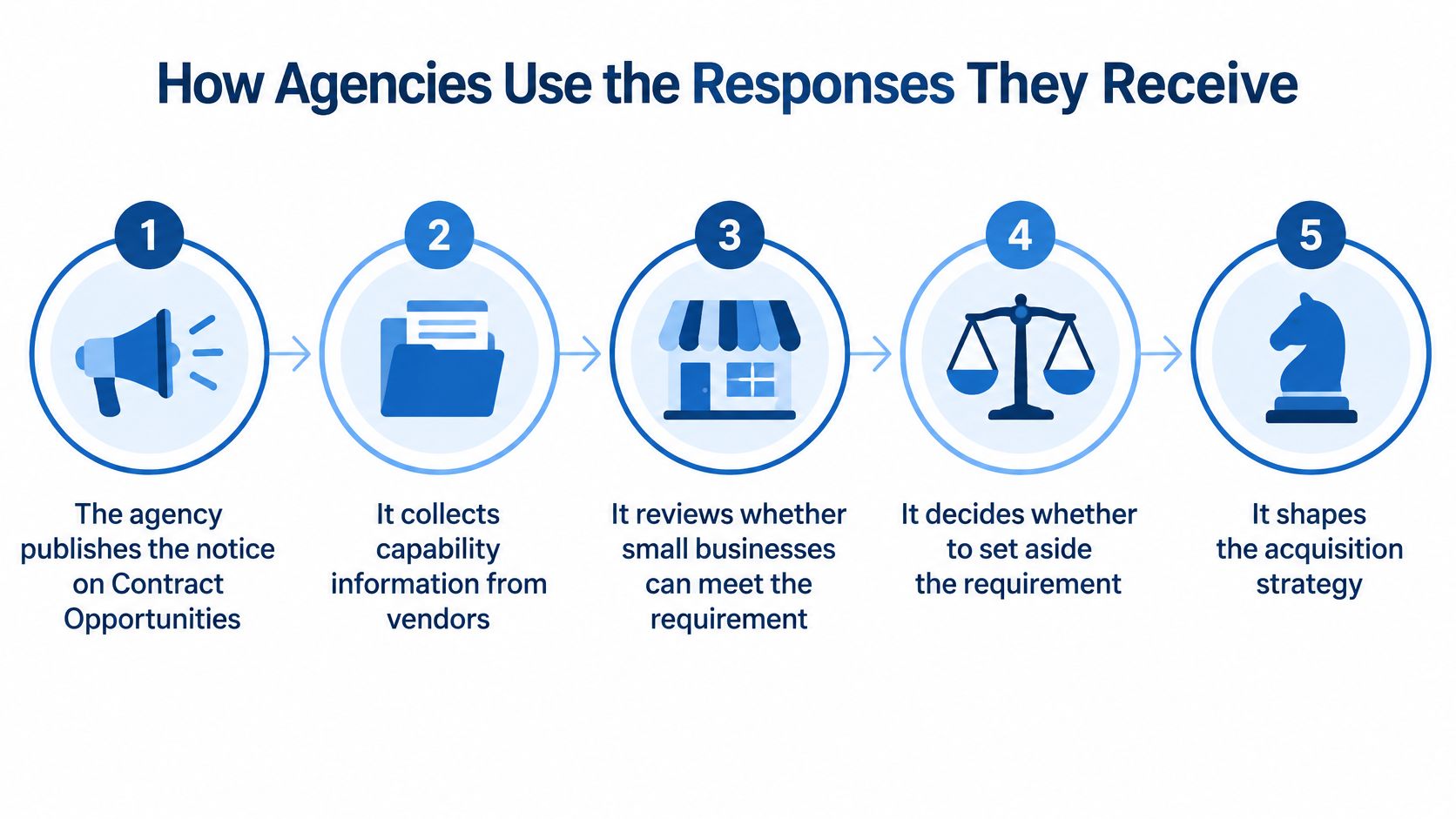
How information becomes a strategy decision
Say an agency needs equipment maintenance across geographically separated facilities. A response stating that your company provides nationwide service leaves important questions unanswered. A response identifying staffed locations, dispatch coverage, relevant maintenance experience, and realistic mobilization conditions gives the agency something it can evaluate.
The same logic applies to small-business participation. An agency needs to understand performance capacity, not merely count businesses that express interest. Explain which work your company can perform itself and where partners would be necessary.
For acquisitions whose estimated total life-cycle value exceeds $50 million, Defense acquisition guidance on competition requirements allows the contracting officer, when an SSN or RFI has been posted to Contract Opportunities, to update the announcement after market research and approval to identify the acquisition strategy. That's a reason to watch the announcement after responding, not a reason to assume every SSN concerns a major acquisition.
That guidance also distinguishes research documents from public-notice requirements. A qualifying SSN can satisfy certain proposed-action notice requirements when it includes the required information; an RFI alone may not satisfy those requirements when a sole-source procurement may result.
What the process doesn't establish
Keep these boundaries clear:
- No contract. The notice doesn't establish an agreement to purchase from your company.
- No assured solicitation. The agency may change direction or decide not to proceed.
- No established winner. Publication alone doesn't show that the agency has selected a contractor.
Your next monitoring target is the acquisition-strategy update, if the agency publishes one. Look for changes in the intended competition, purchasing vehicle, set-aside approach, or requirement.
Sole-Source Signals and How to Challenge Them
Say a notice describes equipment compatibility and past experience in terms that appear built around an incumbent's product. Your team suspects the agency believes only that supplier can perform. Responding can still make sense, but an accusation of favoritism won't demonstrate an alternative.
Build your response around the assumption you can disprove. If compatibility appears decisive, explain your interface and testing evidence. If delivery speed appears decisive, provide records showing comparable production or mobilization performance.
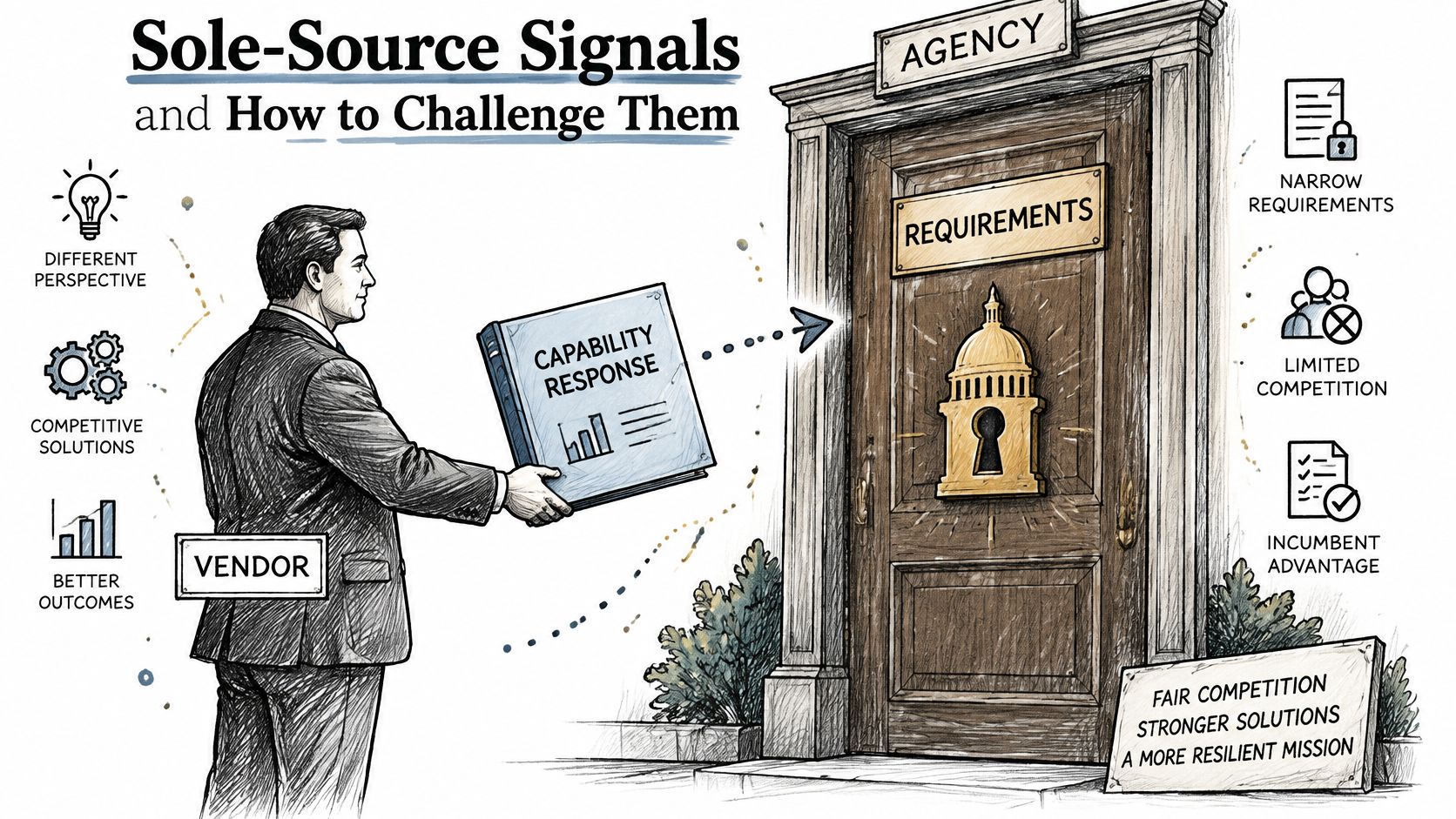
Replace objections with verifiable alternatives
Useful evidence includes comparable performance, production or delivery records, interoperability documentation, authorized-source status, and the ability to meet schedule and security constraints. Address each relevant constraint directly rather than insisting that your company deserves an opportunity.
Under the FAR guidance on publicizing contract actions, timely sources-sought responses receive consideration, subject to applicable exceptions. Consideration isn't a requirement to create unrestricted competition, nor does it assure an invitation to submit an offer.
A credible challenge explains how another supplier can meet the government's actual need, not simply why more competition would benefit that supplier.
If terminology is creating confusion inside your team, distinguish sole-source and single-source purchasing before deciding how to characterize the agency's approach. Use the notice's actual language in communications with the contracting officer.
Watch for signals that warrant closer examination:
- Narrow qualifications. Experience requirements appear more restrictive than the described work seems to need.
- Named products. A particular brand or product appears central to the requirement.
- Incumbent-specific history. The notice emphasizes experience that may be unique to the existing contractor.
- Unusual teaming restrictions. Conditions appear to limit otherwise workable combinations of suppliers.
These are reasons to investigate, not proof of an improper procurement. There may be legitimate technical, security, continuity, or schedule constraints that aren't obvious from a first reading.
Submit a factual response through the stated channel, preserve the supporting records, and continue monitoring the agency's strategy decision. Treat clarification questions as requests for information, not opportunities to make unsupported allegations.
How to Write a Response Agencies Can Use
Write for the person who must explain what the supplier market can support. The FAR companion guidance emphasizes documented market research and supporting facts about small-business capability. Your response should make that assessment easier by connecting each claim to the proposed work.
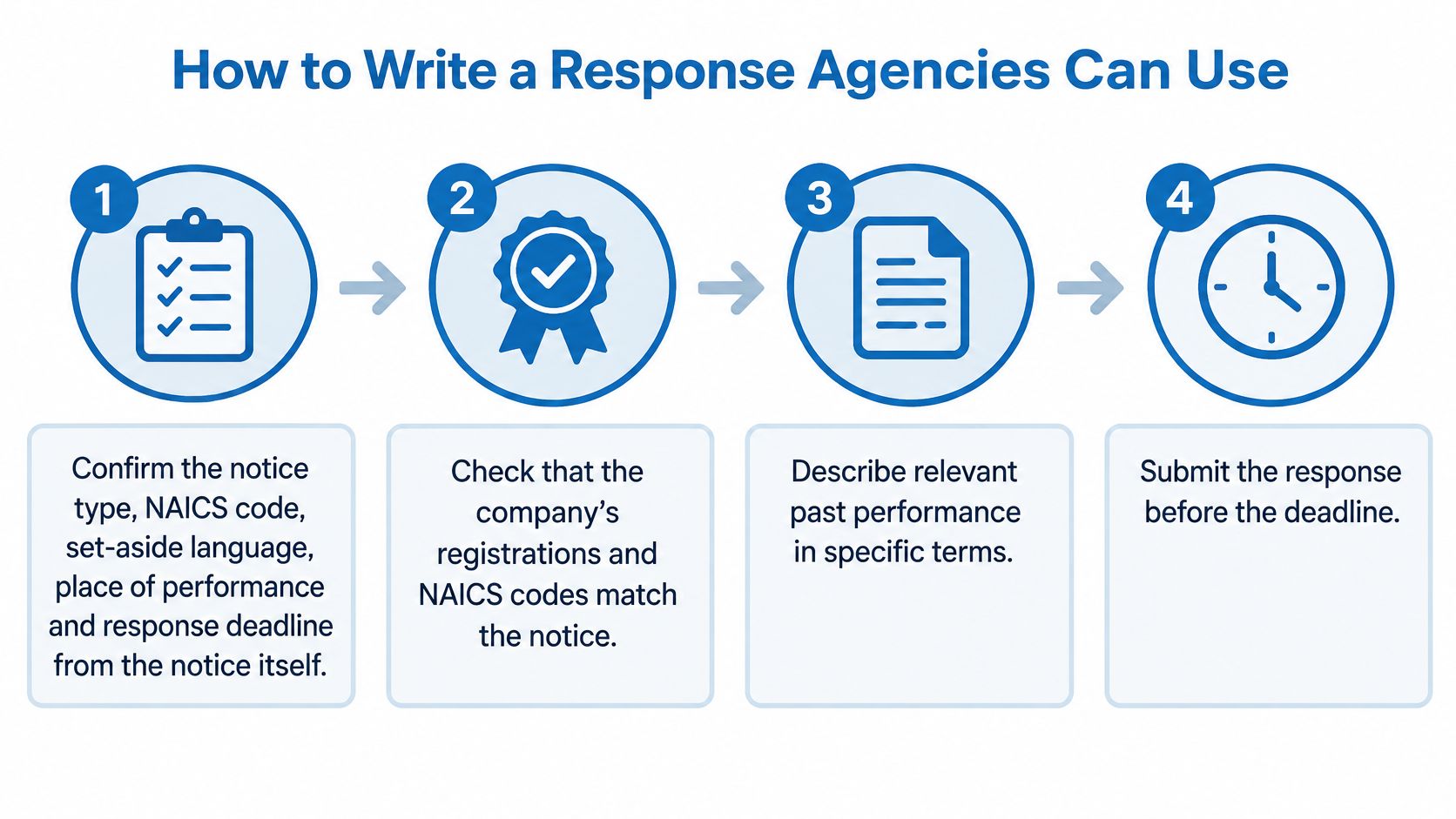
Assemble the evidence before polishing the narrative
Confirm the notice details. Record the notice type, North American Industry Classification System (NAICS) code, set-aside language, place of performance, and response deadline. Copy the submission address, file requirements, and requested headings into a compliance checklist so administrative mistakes don't undermine useful content.
Verify registrations and classifications. Check your company's registration details and stated NAICS information against the requirement, and confirm the basis for any size or socioeconomic representation. Retain supporting registration records and certification documents rather than relying on an old marketing sheet.
Map capabilities to performance objectives. Build a requirement-to-evidence matrix, then use it to organize the narrative. For comparable contracts, identify the customer or agency, value, performance period, relevant scope, and outcome, supported by records your company is authorized to share.
Describe the resources available. List relevant contract vehicles, socioeconomic status, clearances, facilities, and geographic coverage. Be precise about what belongs to your company, what is available through a partner, and what would need to be obtained.
Explain the approach and teaming structure. Describe at a high level how you would perform the work and which tasks you would self-perform or subcontract. Identify likely partners only when you have a realistic basis for describing their participation, and label unconfirmed arrangements accurately.
Provide relevant past performance and availability. Include performance summaries, permitted customer references, and dated availability information for critical resources. Distinguish current capacity from capacity that depends on hiring, equipment acquisition, or completion of another commitment.
Remove unnecessary sensitive information. Don't volunteer proprietary pricing, internal cost models, or technical secrets that the agency hasn't requested and doesn't need. Review disclosure instructions and markings, then include only the information necessary to substantiate your answer.
Submit and preserve the record. Send the response before the deadline using the required channel and retain the submitted files and transmission confirmation. Log the notice date, response version, evidence owners, and follow-up action so someone can maintain the pursuit.
Test usefulness, not salesmanship
Clear proposal-writing principles can help you organize evidence. Zemith's guide to turn ignored proposals into closed deals is a related writing resource, but don't mistake this capability response for a sales proposal or formal offer.
Submission test: Can every material claim be backed by a document the agency could check?
If not, qualify the claim, obtain the evidence, or remove it. A concise explanation of a genuine limitation is more useful than an unsupported promise of complete capability.
Track the Notice Until the Solicitation Appears
Complete this tracking checklist this week, rather than leaving the submitted response in an email folder:
- Save the notice. Put it in a market-research pipeline stage with an owner and next-action date.
- Record the deadlines. Retain the notice date, response deadline, submitted response, and any agency correspondence.
- Set change alerts. Follow the agency, NAICS code, relevant keywords, and notice. Our FederalPipeline alerts email users when saved searches or notices change, helping the team catch updates without repeating manual searches.
- Record your decision. Mark the pursuit as responded, declined, monitoring, or needing teaming support, with a brief explanation.
Keep the pursuit conditional
Use the same discipline you apply when qualifying a federal business opportunity: separate evidence from assumptions. Record what would make the requirement attractive, what could prevent participation, and which unanswered question deserves attention next.
A supported response can improve the agency's understanding of your business and give your team preparation material if a solicitation appears. It guarantees nothing.
Choose respond, monitor, or pass based on verifiable capability, the cost of preparing a useful answer, and the available indications that the agency intends to proceed. Continue tracking until the requirement becomes actionable, changes direction, or no longer merits your team's time.
FederalPipeline connects opportunity research with pursuit tracking, and its capture briefs identify what's being bought, required clearances and certifications, set-asides, incumbents, ceilings, and deadlines. Visit FederalPipeline to research a sources sought notice, organize your next action, and follow the requirement as the agency decides how to buy.