NAICS 541519, Other Computer Related Services, covers a residual industry that recent Census Bureau figures put at more than 13,000 employer establishments and tens of billions of dollars in sales, shipments, or revenue. The word "other" hides that scale. Contractors meet the code on buys that look nothing like a computer-services shop.
A 541519 label does not prove a company is eligible, that a solicitation is a services buy, or that an award describes work a new bidder could take over. Eligibility and market size follow from the scope and value mix of each procurement, not from the code printed on the record.
Hold those apart and three questions get sharper. Is the firm small under the size standard that attaches to this code? Which companies collect the federal dollars tagged 541519? And is the solicitation in front of you work the team performs, or a product renewal filed under a services classification?
What NAICS 541519 Covers and Where It Sits
NAICS code 541519, Other Computer Related Services, is the U.S. industry classification for establishments whose primary activity is delivering computer-related services outside three separately classified activities: custom programming, systems integration design, and computer facilities management. Everything that looks like computer services but doesn't fit those three lands here.
The code's scale is easy to underestimate because the word "other" sounds like leftovers. It isn't. The Census Bureau's 2024 Annual Integrated Economic Survey profile for 541519 reports employer firms under the classification generated $67,212,061,000 in sales, shipments, or revenue across 13,275 employer establishments nationally. That's a commercial market, not a footnote.
The hierarchy in full
The six digits aren't decoration. Each level narrows the classification, and knowing where a code sits tells you which parent standard and which neighboring industries apply.
| Level | Code | Title |
|---|---|---|
| Sector | 54 | Professional, Scientific, and Technical Services |
| Subsector | 5415 | Computer Systems Design and Related Services |
| Industry group | 54151 | Computer Systems Design and Related Services |
| Industry | 541519 | Other Computer Related Services |
Split the revenue by establishments and you get roughly $5.06 million per employer establishment. Treat that number with care. It's an unweighted average, so a relatively small number of very large establishments pulls the mean upward, and it says nothing about the size of a typical firm. What it does establish is the order of magnitude of the market you're screening.
Why a residual code produces surprising vendor lists
Firms providing specialized computing support, technical services, or other computer-related activities appear under 541519 even when nobody would call them software publishers, custom programmers, or systems integrators. Screen only for 541511 and 541512 and you'll miss capability that lives one code over.
Practical rule: Pull the vendor list under every IT code that could plausibly hold your competitors, then read what each company actually does. The code sorts the market. It doesn't describe the company.
That gap shows up when you're sizing a team or a subcontract pool. A firm registered here may be an infrastructure shop, a cybersecurity boutique, or a software house that chose the residual code because its work crosses boundaries. Compare what the company delivers against a specialist offering custom software engineering services from Faberwork LLC before you assume two 541519 vendors bring the same capability to a team.
Your first action is unglamorous. Confirm that the company, solicitation, or market report you're reading uses this code, at this six-digit level, and remember that codes attach to establishments rather than to corporate brands. One parent company can hold several codes across its locations.
Scope Boundaries With Adjacent Codes
A residual category only means something in relation to the codes it sits beside. Read the comparison below before you use 541519 to describe a market, because each of the four rows carries a different size standard, a different competitive pool, and a different set of bidders.
| NAICS code | Title | Principal activity covered | Choose it when |
|---|---|---|---|
| 541511 | Custom Computer Programming Services | Writing software to client specifications | The work is primarily custom software development |
| 541512 | Computer Systems Design Services | Designing and integrating computer systems | The work is primarily systems design or integration |
| 541513 | Computer Facilities Management Services | Operating a client's computer facilities | The work is primarily managing facilities or operations |
| 541519 | Other Computer Related Services | Computer-related services not classified in the three codes above | None of the three specific codes describes the principal activity |
The Census Bureau's 2022 NAICS entry for 541519 confirms the structure: a 2022 NAICS industry inside Sector 54, Subsector 5415, and Industry Group 54151, intended for computer-related services not more specifically classified as custom programming (541511), computer systems design (541512), or computer facilities management (541513).
The three specific codes and the gap between them
Start at the top of the boundary set. If the buyer is paying for code to be written to a specification, that's 541511, even when the deliverable runs on someone else's cloud. If the buyer is paying for architecture and integration across systems, that's 541512. If the buyer is handing over operation of a data center or a desktop fleet, that's 541513.
541519 catches the remainder, and the remainder is wide. Specialized technical support, cybersecurity services delivered as an ongoing capability, integration support that stops short of designing the system, and a long list of other computer-related services all fall inside. That breadth is why the code works well for market discovery and badly for capability claims.
Classification is establishment-based, and the establishment is classified by its primary activity. A company can legitimately hold multiple codes while only one describes a given establishment. So a vendor appearing under 541519 in one location may appear under 541512 in another, and neither entry is wrong.
The test that decides it: name the principal activity in a single sentence, then ask which of the four codes that sentence describes most precisely.
What actually lands in 541519
Federal work descriptions rarely hand you the answer neatly. A statement of work labeled as an integration effort may be 90 percent staffing and support, which points at 541519 or elsewhere entirely. A cybersecurity services requirement might belong here, or under a security-specific code, depending on whether the buy is advisory, operational, or product-based.
That's why a 541519 tag opens a market but can't close a scope question. Read the solicitation-level work description and decide whether the principal activity is programming, systems design, facilities management, cybersecurity, integration, support, or another specialized service. The same discipline applies across IT categories: our breakdown of the NAICS code for telecommunications shows how one classification choice reshapes which vendors appear in a market.
When a 541519 requirement turns out to be mostly development under the surface, the evaluation shifts toward delivery experience and past performance on shipped software. Buyers weighing that shift get better outcomes by choosing the right development partner on evidence of comparable builds rather than on a code printed on a registration.
The decision rule is short. Use 541519 to find the market, then confirm the principal activity in the statement of work before you rely on it for anything else.
Size Standards and the ITVAR Exception
Small business eligibility under this code runs through two different tests, and the one that applies depends on what the contract buys. For federal small-business eligibility, SBA's standard for NAICS 541519 is $34.0 million in average annual receipts, with a distinct 150-employee exception for Information Technology Value Added Resellers, per 13 C.F.R. § 121.201.
| Test | Threshold | Outcome |
|---|---|---|
| Standard size test | $34.0 million in average annual receipts | Applies to most 541519 procurements |
| ITVAR employee exception | 150 employees | Applies to IT value-added resellers that meet the value-added test |
| Value-added share below 15% | Under 15% of total contract price | Work generally belongs under a manufacturing NAICS |
| Value-added share from 15% to 50% | 15% to 50% of total contract price | ITVAR pathway available when the other conditions are met |
| Value-added share above 50% | Over 50% of total contract price | The NAICS describing the predominant service may fit better |
The ladder that decides which test applies
The ITVAR exception isn't a loophole you claim by registering. It applies when the contractor provides a total IT acquisition solution involving multi-vendor hardware and software plus significant value-added services such as configuration, systems integration, installation, customization, training, technical support, maintenance, or end-user support.
That definition puts a value-added share test in the middle of every product-heavy requirement. For a government procurement classified under the exception, value-added services must represent at least 15% and no more than 50% of total contract price. Below 15%, the procurement should generally use a manufacturing NAICS. Above 50%, it should use the NAICS describing the predominant service.
Read those bands as a diagnostic rather than a formality. A hardware refresh with a thin layer of deployment support sits below the floor and probably shouldn't be coded here at all. A managed solution with meaningful integration and training sits inside the band. A services engagement where hardware is incidental sits above the ceiling.
Capture note: The assigned NAICS on a solicitation and the code on your SAM.gov profile are two different facts. Only one of them decides which size standard the contracting officer applies.
Where affiliates enter the arithmetic
Size is measured on the offeror, and required affiliate considerations apply. Receipts averaging and employee counts both run through the affiliation analysis, which means a company that looks comfortably under $34.0 million on its own can fail the test once related entities are combined.
The practical sequence for any 541519 opportunity is fixed. Validate the solicitation's assigned NAICS and the contract's product and service mix first, then test the offeror against the applicable receipts or employee threshold, including affiliates. Never assume the $34 million standard governs just because the solicitation carries this code. Our guide to the small business set-aside walks through how those eligibility determinations play out in practice.
Why Unrelated Contracts Carry 541519
A cloud-foundation renewal, a software renewal, a communications equipment purchase, and an enterprise IT support requirement can all carry 541519. One code can cover four buys whose scope, value mix, and bid path have almost nothing in common.
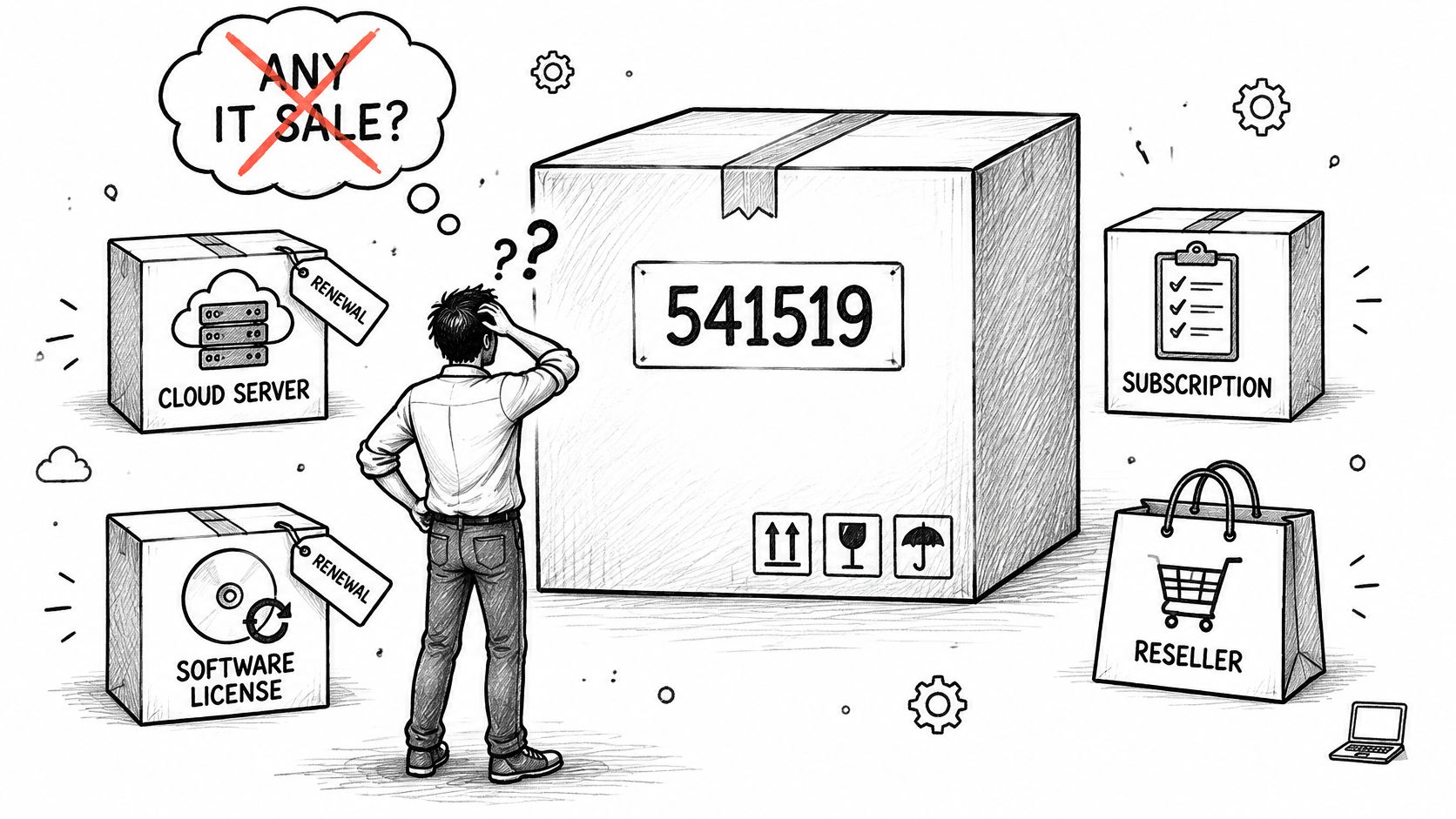
The code records the industry classification assigned to the contract. The work statement, the PSC code, and the product and service mix describe what the government is buying. Four records can share 541519 and still be four different procurements. Treating the code as proof that a firm is eligible, or that the work matches its capabilities, reads a label as if it were the buy.
What to read under the label
Open any solicitation coded 541519 and check five facts, in this order.
- The PSC code. It classifies the specific product or service in that procurement. A mismatch between PSC and NAICS is the earliest signal that the buy is not what the industry code suggests.
- The work statement. Name the deliverable in one sentence: renewal, license transfer, hardware delivery, integration, or an ongoing service.
- The buy type. Products, services, and a renewal locked to an existing platform are three pursuits, with three bid strategies.
- The set-aside status. It narrows who can bid before any technical question is reached.
- Solicitation-specific limitations. Language that restricts competition to a vehicle, a brand, or an approved source settles the pursuit faster than a market-level reading of the code.
The nonmanufacturer rule as a separate test
On a product buy, a reseller that does not manufacture the item faces a test that sits on top of size. The nonmanufacturer rule requires a qualifying small business to supply the product of a small business manufacturer, or to obtain a waiver. A reseller can clear the size test and still fail eligibility because the product source does not qualify.
What the label proves: a contractor registered and coded under 541519 has been classified in that industry. The code does not establish the scope of a given contract or the value mix inside it.
Before bidding, answer three questions. Does the work statement describe a service the team performs today? Does the product and service mix support the pathway the solicitation claims? And can the offeror pass the size test that applies to this buy, whether the measure is receipts or headcount?
Market Size and Establishment Trends Over Time
Employer establishments classified under NAICS 541519 decline steadily on the 2010–2022 chart. That line counts locations the Census Bureau placed in the code. It is not federal IT demand, and it is not evidence that every award carrying 541519 is the same mix of resale, services, and renewals.
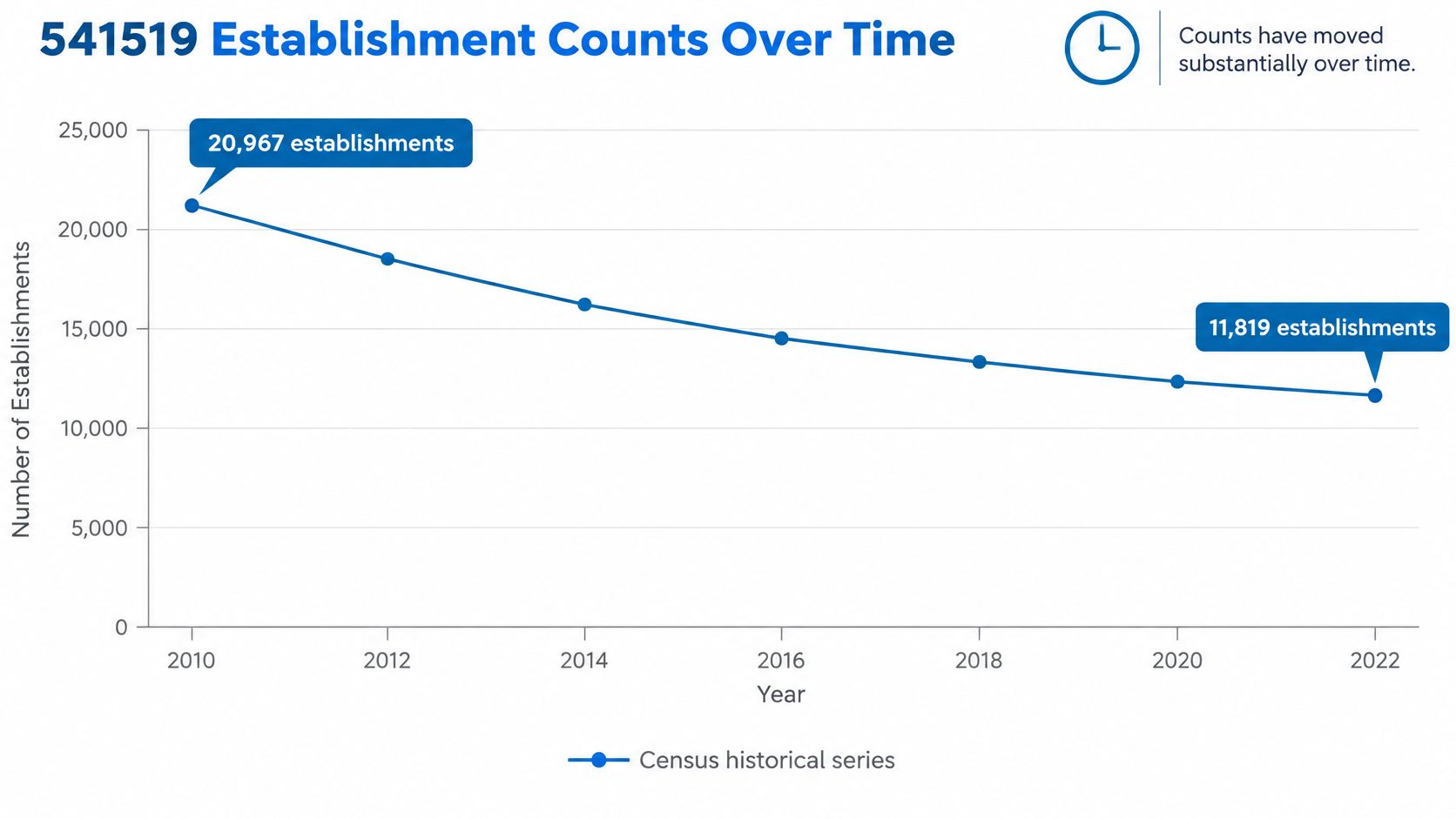
A smaller roster can sit on a larger dollar market. Exits, mergers, and shifts into neighboring professional-services codes all cut the count while surviving locations book more revenue. The slope is a reason to separate classification headcount from the value mix of each buy.
| What moved the count | Effect on the series | What it does not prove |
|---|---|---|
| Formation or exit | Adds or removes locations coded 541519 | That federal demand moved at the same rate |
| Consolidation | Fewer establishments, often more revenue per survivor | That the code became a tighter eligibility test |
| Reclassification | Moves firms into or out of adjacent Sector 54 codes | That the work itself changed |
| Coverage and revisions | Restates earlier years after response or coverage corrections | A real year-over-year change if only one year was revised |
Count changes can reflect formation, consolidation, reclassification, survey revisions, or a change in how services are delivered. A falling count is a signal to investigate, not a verdict that the market shrank.
Published service-industry estimates are often restated after corrections to individual responses and after changes in statistical coverage. Pairing a revised year with an unrevised year produces a trend that was never in the data.
An analyst reads the series in four steps:
- Note the classification year. A 541519 establishment under one NAICS vintage is not automatically the same activity after the next revision.
- Place the establishment count beside revenue for that same year. Direction matters more than either series alone.
- Flag any year in which locations and receipts move in opposite directions. That split is where the industry label and the value mix come apart.
- Read revision notes before publishing a comparison.
Read establishment counts with revenue and with the classification-year definition. A declining count among businesses that each generate more revenue can describe a larger market, not a shrinking one. The industry total still does not say whether a given award is a service, a product resale, or a platform renewal. That split lives in the procurement, not in the establishment chart.
Reading Federal Spending Figures Correctly
About $6.88 billion in FY2025 541519 spending ran through the GSA Schedule, according to the FY2025 GSA Schedule NAICS analysis, across 2,894 contractors. That total made 541519 the leading NAICS on the schedule. A parallel look at DoD prime obligations over a recent trailing year shows the opposite movement: defense prime spending under the same code fell from the prior period. Same code, two windows, two stories.
| Measure | Reported figure | What it signals | Limitation |
|---|---|---|---|
| GSA Schedule spending | About $6.88 billion in FY2025 across 2,894 contractors | Schedule demand for 541519 is large and broad | Schedule sales are not the same as open competitive opportunities |
| DoD prime obligations | Recent trailing-year prime obligations declined from the prior period | Direction of defense prime spending, not its level | Totals include renewals, so one large recompete can swing the change |
| Prime contractor concentration | A small share of prime contractors accounts for most of the spending | Headline demand sits with incumbents | A new entrant faces a narrow set of winners |
| Net versus positive obligations | Read both totals from USAspending for the same period | Separates new awards from deobligations | Requires detailed USAspending records to calculate |
Four numbers that answer four different questions
The GSA figure answers a schedule question: is volume flowing through this vehicle under this code? It is the strongest yes in the set. It says nothing about whether those orders were competed last month, or whether the dollars were services, resale, or product.
The DoD figure answers a direction question. A decline from the prior period describes recent momentum on prime obligations at one department. The baseline includes renewals, so a single large recompete can move it either way. The code on the award does not tell you which of those effects you are seeing.
Concentration answers the question a new entrant needs. Most of the money sits with a small group of incumbents holding vehicles, past performance, and agency relationships. Headline demand is not accessible demand.
The useful question is narrower than the code total: which spending measure points to an opportunity your company can realistically win, and what share of that contract is the work you perform.
Where a new entrant can still find room
Build the comparison on purpose. Set fiscal-year totals beside trailing-period trends so you see direction, not just scale. Separate net obligations from positive obligations, because deobligations can make a growing program look flat. Map incumbents and the vehicles the work is ordered through.
Then classify the buy, not just the code. A product renewal, a reseller arrangement, an integration effort, and a genuinely contestable service requirement can all carry 541519 and still have nothing in common on value mix. Only the last one turns a market-sizing exercise into a bid worth writing. Treating the code as proof you are eligible, or that the dollars are yours to chase, skips that split.
Less-concentrated agencies and upcoming recompetes are where the openings are. Pull a department's 541519 awards, sort by contractor, and find the agencies where the top vendor holds a share rather than the whole. Then look for contracts approaching the end of their period of performance. That work is slower than reading a headline total. It is also the version that produces a name and a date.
How to Verify 541519 on a Solicitation
A notice can carry 541519 and still buy hardware, custom programming, or IT value-added resale. The printed code is the buyer's classification. It is not, by itself, an eligibility finding or a description of the work.
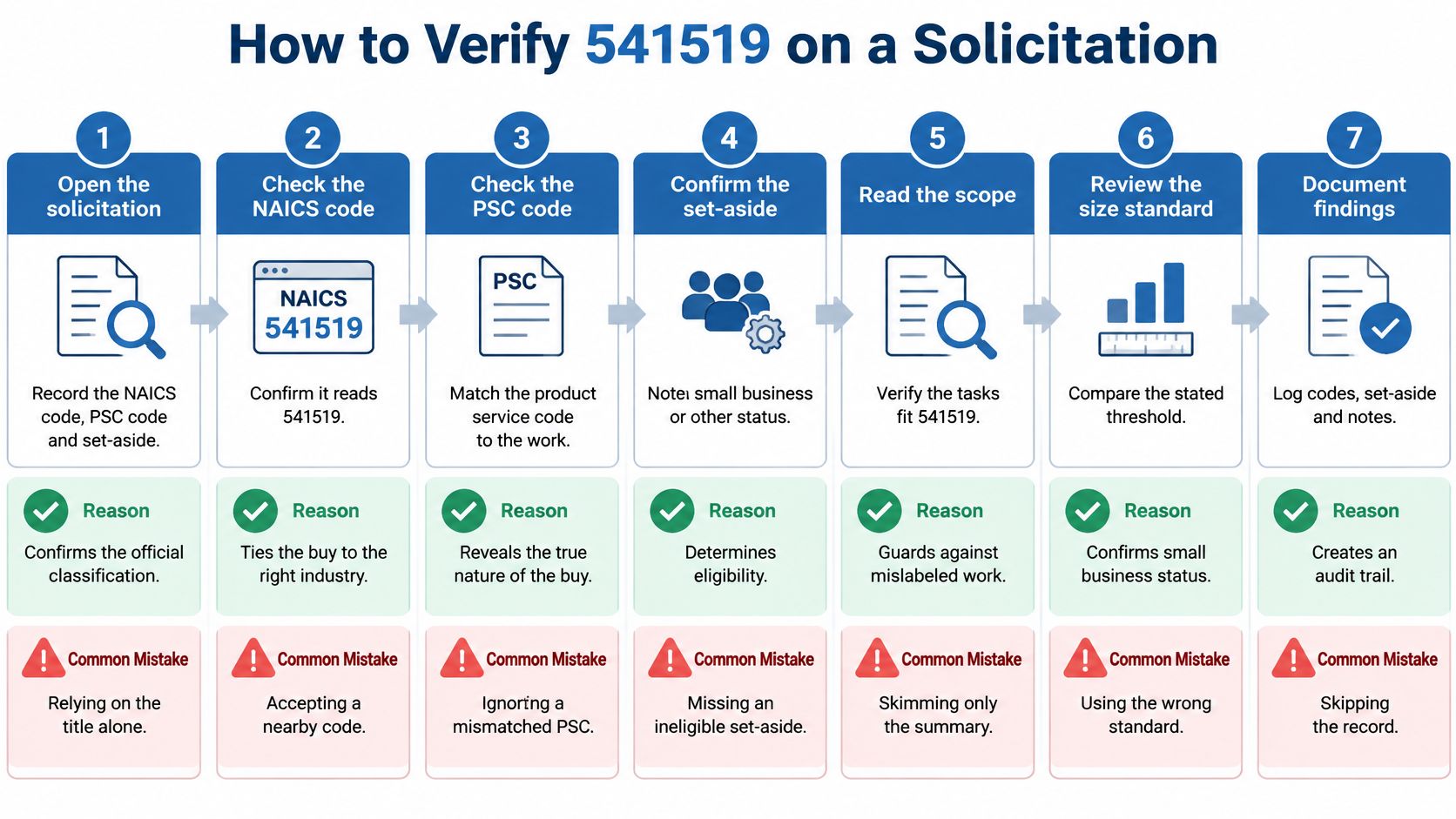
Run these seven checks on one live solicitation and write each result down. The decision later is only as good as that record.
- Record the assigned codes and set-aside. Open the solicitation and copy the NAICS code, the PSC code, and the set-aside status exactly as printed. A SAM registration code or a portal summary is not the solicitation. Teams that bid from the summary chase work they cannot submit.
- Name the principal activity. Read the statement of work and reduce it to one sentence: what the buyer is paying for. The label on the cover is the common miss, and a wrong sentence here throws off every later check.
- Estimate the value-added share on product-heavy buys. If hardware or software is in the price, calculate what share of total contract value is services. Skip that math on a product buy and you never test whether 541519 still fits.
- Apply the right size test. For most 541519 procurements, test average annual receipts against $34.0 million, with affiliates included. Test headcount against 150 only when the buy is an ITVAR procurement that meets the value-added test, again with affiliates included. Using the employee cap on an ordinary 541519 buy, or the receipts cap on a qualifying ITVAR buy, calls eligibility wrong in both directions.
- Confirm the code against its neighbors. Decide whether the work fits 541519 or 541511, 541512, or 541513. Treating 541519 as the leftover code when another code matches the principal purpose is how a size protest gets filed, and lost.
- Read the dollars on this notice. Note the estimated value, option years, and whether the set-aside applies to the whole requirement or only part of it. A large ceiling on a vehicle order is not the same contest as a standalone services competition of similar size.
- Map the incumbent and the vehicle named in the file. Identify who holds the current work and which IDIQ, GWAC, or BPA the requirement will be ordered through. A strong technical volume does not open a competition that the ordering vehicle already closed.
Record the findings, not the impression. Seven fields, one page, dated. The pursuit call three weeks later depends on what you wrote the day you read the solicitation.
The federal business opportunity research workflow connects those seven fields to budgets, buyers, and award history when the notice alone is not the full record.
Confirm 541519 Fit Before You Pursue an Opportunity
Four tests decide whether a 541519 opportunity deserves your proposal hours, and each one produces a different action when it fails.
- Scope match. The code and the statement of work point at the same principal activity you identified in step two. If they diverge, the code is describing something other than what the buyer needs.
- Size test. Your company passes the applicable threshold on receipts or employees, with affiliates counted. Failing this test isn't a scoring risk, it's a disqualification.
- Value mix. The services share supports the pathway the solicitation claims, or a different code describes the buy better. A product-heavy requirement with thin services work usually belongs elsewhere.
- Competitive position. The incumbent and contracting pattern leave room for a new entrant. A renewal locked to one vendor and one vehicle is a pass no matter how well your team performs.
Pursue when all four clear. Team when the scope or value mix falls short but a prime or incumbent is positioned to carry the work and needs what you have. Pass when the size test fails, or when the requirement is a renewal or product buy tied to a vehicle you don't hold.
We publish market data for every NAICS market by year, including spend, growth, buyers, set-aside and sole-source amounts, and which companies win, and our capture briefs pull what's being bought, the clearance and certifications required, the incumbent, the ceiling, and every deadline out of each solicitation.
Verify every figure against SAM.gov and the solicitation itself before you act. Your procedure findings are only as reliable as the document you pulled them from, and a stale registration status or a revised notice invalidates the analysis behind it.
For a wider view of how agencies buy managed technology services and what they expect from contractors, the public sector IT resource from Finchum Fixes IT is worth reading alongside your solicitation review.
One action this week. Pick a live 541519 solicitation, run the seven-step check against it, and write the pursue, team, or pass decision down with the reasons. That single record will teach you more about this code than any market total.
FederalPipeline matches your registration, past awards, and capability profile against open opportunities and scores each one, then flags the eligibility checks, set-asides, and incumbents that decide whether a bid is worth your time. Market data for every NAICS market by year, capture briefs built from the solicitation attachments, and alerts when new 541519 work appears give you the position before you commit proposal hours. Visit FederalPipeline to run the seven-step check on your next 541519 opportunity.