A Federal Supply Schedule is a GSA-managed, governmentwide program of prequalified contracts that lets federal agencies buy commercial products and services at pre-set prices and terms, with competition among schedule holders when required.
If a business has already qualified to sell through the program, why does it still need to win the buyer's order? That distinction separates getting access to the federal marketplace from building a federal sales pipeline. For a contractor, much of the work begins after GSA awards the contract.
Federal Supply Schedule Defined in Plain Terms
A Federal Supply Schedule gives agencies an established contractual route to commercial suppliers. The U.S. General Services Administration, or GSA, manages the program and awards the underlying contracts. Individual agencies then use those contracts to meet their purchasing needs.
You'll also encounter the names GSA Schedules and Multiple Award Schedule, usually shortened to MAS. In this context, they describe the same purchasing framework, not separate steps that a contractor must complete.
The word schedule can be confusing. It doesn't mean a delivery calendar. It refers to a contracting arrangement with approved offerings, prices, and terms.
Schedule Vocabulary at a Glance
| Term | Plain meaning | Example |
|---|---|---|
| Federal Supply Schedule (FSS) | GSA-managed, governmentwide program for buying commercial products and services | Also called GSA Schedules or Multiple Award Schedule (MAS) |
| Schedule contract | Indefinite-delivery contract GSA awards to a firm for stated prices, terms, and coverage | A firm's approved MAS contract that agencies can order from |
| Special Item Number (SIN) | Category code describing what a schedule contractor is authorized to sell | A SIN for IT professional services |
| Authorized pricelist | Published list of the contractor's schedule prices, items, and terms | The price list an ordering office reviews before buying |
| Ordering activity | Federal agency or authorized office that places an order | A federal office buying a needed service |
| Delivery or task order | Order placed against a schedule contract as a need arises | A buyer requesting a set quantity of supplies |
| Blanket purchase agreement (BPA) | Arrangement with schedule holders for repeated purchases | Recurring purchases of routine supplies |
These terms describe different layers of a purchase. The SIN identifies the category, the pricelist describes the contractor's approved offering, and the order specifies what the agency wants delivered.
For a tangible product example, you can browse GSA electrical procurement options from ATEK Distribution, then consider the questions an ordering office would ask: Does the offering match the requirement? What terms apply? Can the supplier meet the delivery need?
The program has distinct participants: agencies act as buyers, and businesses participate as schedule holders. Keeping those roles separate makes the rest of the terminology easier to understand. GSA establishes the contract framework; the ordering activity makes the purchasing decision.
Why Agencies Buy Through a Prequalified Schedule
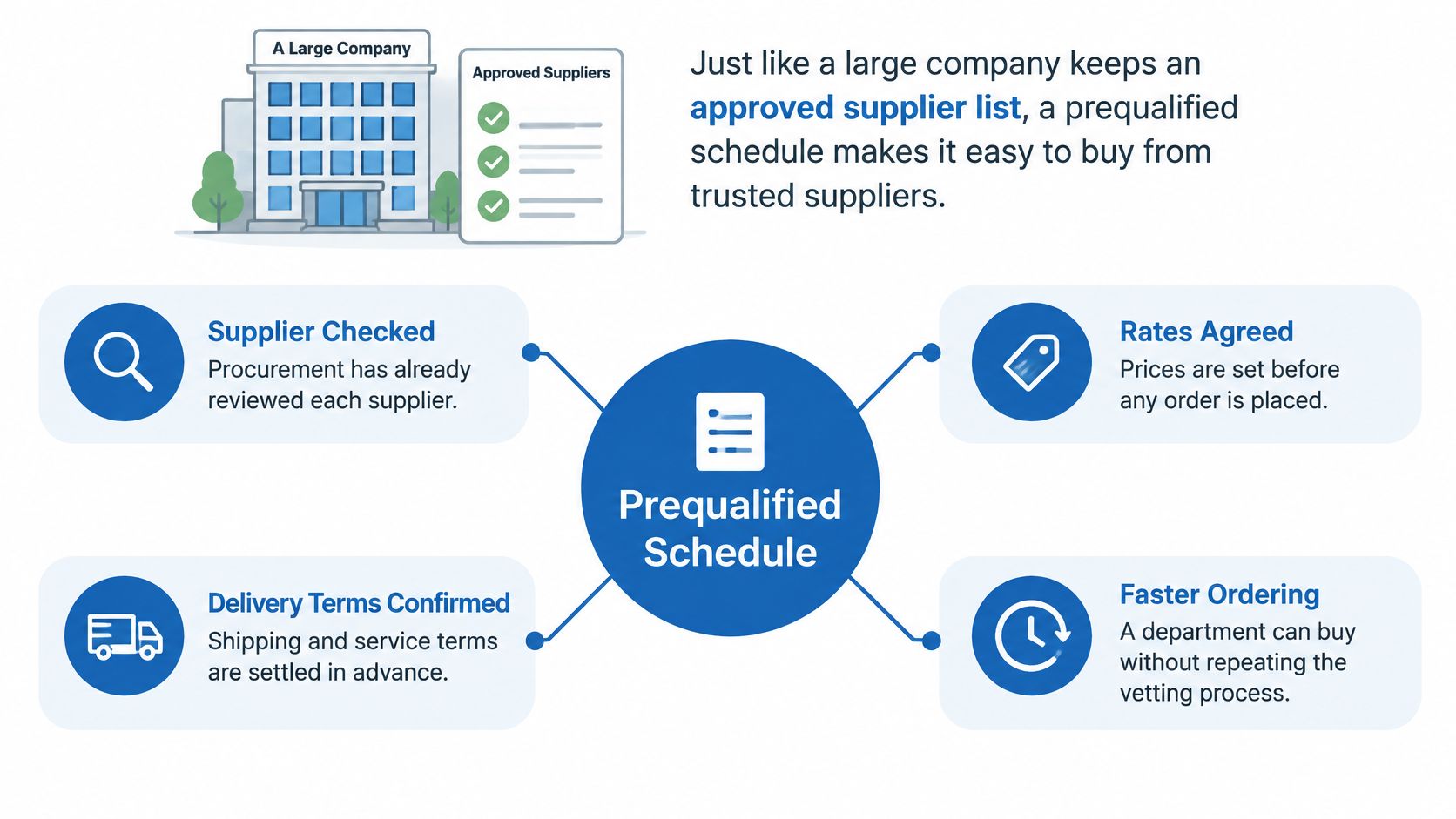
A large company might maintain an approved supplier list. Its procurement team reviews suppliers, agrees on rates, and settles delivery terms so departments don't have to start from scratch whenever they need routine supplies.
The schedule uses a similar idea at government scale, but with formal contracts and prescribed ordering procedures. Under Federal Acquisition Regulation Subpart 8.4, agencies can use GSA-established contracts and contractor-published authorized pricelists to acquire commercial products and services.
The distinction between supplier qualification and an actual purchase is central to the arrangement.
Contract Award and Agency Purchase Are Separate Events
At the contract-award stage, GSA establishes the purchasing foundation. It competitively awards indefinite-delivery contracts for stated periods, prices, terms, and geographic coverage. The contractor's authorized pricelist identifies the supplies or services, SINs, prices, and terms available under that contract.
At the ordering stage, an agency acts on a specific requirement. The ordering office determines what it needs and places a delivery order, task order, or establishes a BPA as appropriate. The buyer can obtain quantities suited to its requirement rather than committing to every possible future purchase when GSA awards the underlying contract.
The practical benefits resemble an approved-supplier arrangement:
Less Repeated Setup, Not Less Buyer Responsibility
The Federal Acquisition Regulation's schedule framework emphasizes simplified acquisition of commercial products and services and opportunities for volume discounts. Agencies don't have to rebuild an independent contract from the beginning for every routine acquisition, but they still have to define their needs and follow applicable ordering procedures.
For a facilities example, Pacific Mobile Structures, Inc.’s resource on fast modular construction for federal facilities gives readers a concrete setting in which to consider procurement access. A facilities buyer would still need to establish the required configuration, location, timing, and applicable contract scope before choosing a supplier.
Practical rule: An established contract removes some procurement setup. It doesn't remove the buyer's responsibility to make a sound purchase.
That's why prequalified is more useful than preselected when describing schedule contractors. GSA has established a contractual foundation, but the agency must still determine which available offering meets its requirement.
The buyer's test is straightforward: if the underlying contract is already established, focus on ordering well rather than recreating the contract-level qualification process.
Pricing and Competition Among Schedule Holders
GSA has already determined schedule prices for supplies and fixed-price services and established fair-and-reasonable hourly rates for labor-hour services, as explained in FAR 8.404. An ordering activity generally doesn't repeat the full baseline determination, but it must conduct the applicable order-level evaluation and may seek additional discounts.
The distinction between fixed-price offerings and hourly rates is useful when comparing quotes:
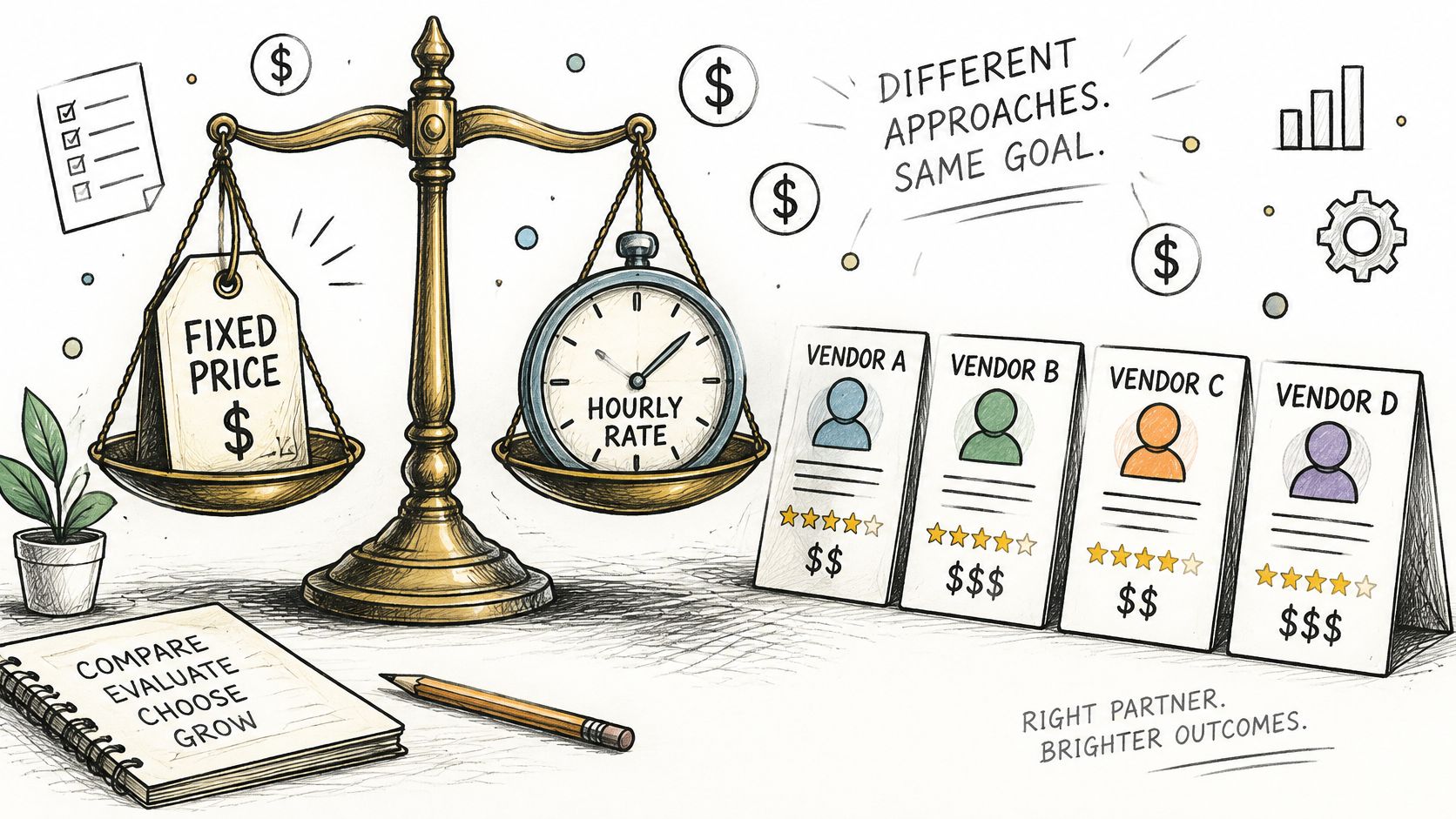
A published hourly rate doesn't tell the buyer how much an entire project will cost. The proposed labor mix, effort, and scope also matter. Likewise, a fixed-price offering needs to match the actual requirement, not merely carry an attractive catalog price.
For a closer explanation of how a defined price relates to delivery obligations, see our guide to fixed-price contracting.
What Buyers Weigh Beyond the Catalog Rate
| Factor | What the buyer checks | Why it can change the award |
|---|---|---|
| Technical fit | How closely the offer matches the statement of work or specifications | A cheaper offering that fails the requirement isn't an acceptable substitute |
| Special features | Capabilities beyond the base item or service | Useful additional capabilities can justify a higher price |
| Administrative cost | Effort needed to place, receive, and manage the order | Simpler administration can outweigh a small price gap |
| Delivery | Timing, location, and delivery terms | An offer may be unsuitable if delivery won't meet the requirement |
| Total cost | Price plus applicable support, delivery, and administration | The lowest sticker price may not produce the lowest total cost |
| Discounts | Additional reductions from schedule prices | A discount can improve an otherwise comparable offer |
| Socioeconomic eligibility | Whether the firm qualifies for the set-aside or preference involved | An ineligible firm may be excluded from a set-aside |
Defense purchases can involve additional checks, including supply-chain-risk evaluation for covered information-technology systems and consideration of Supplier Performance Risk System assessments. These aren't interchangeable with a simple price comparison.
The following video provides another format for reviewing schedule purchasing:
For contractors, the lesson is practical: your published rate isn't your complete competitive position. Compare your offer with likely order requirements, incumbent capabilities, delivery expectations, eligibility conditions, and potential discounting.
A firm with an attractive rate can still propose the wrong personnel or miss a required delivery date. A stronger quote explains how the contractor will meet the requirement and what the buyer will pay for the complete result.
How an Agency Places an Order Step by Step
An agency begins with a need, not a contractor's catalog. The ordering office must translate that need into a purchase that fits the underlying schedule contract and follows the applicable procedures.
A schedule is a type of purchasing mechanism. Our explanation of what a contract vehicle is helps distinguish that mechanism from the individual order placed through it.
From Requirement to Delivery
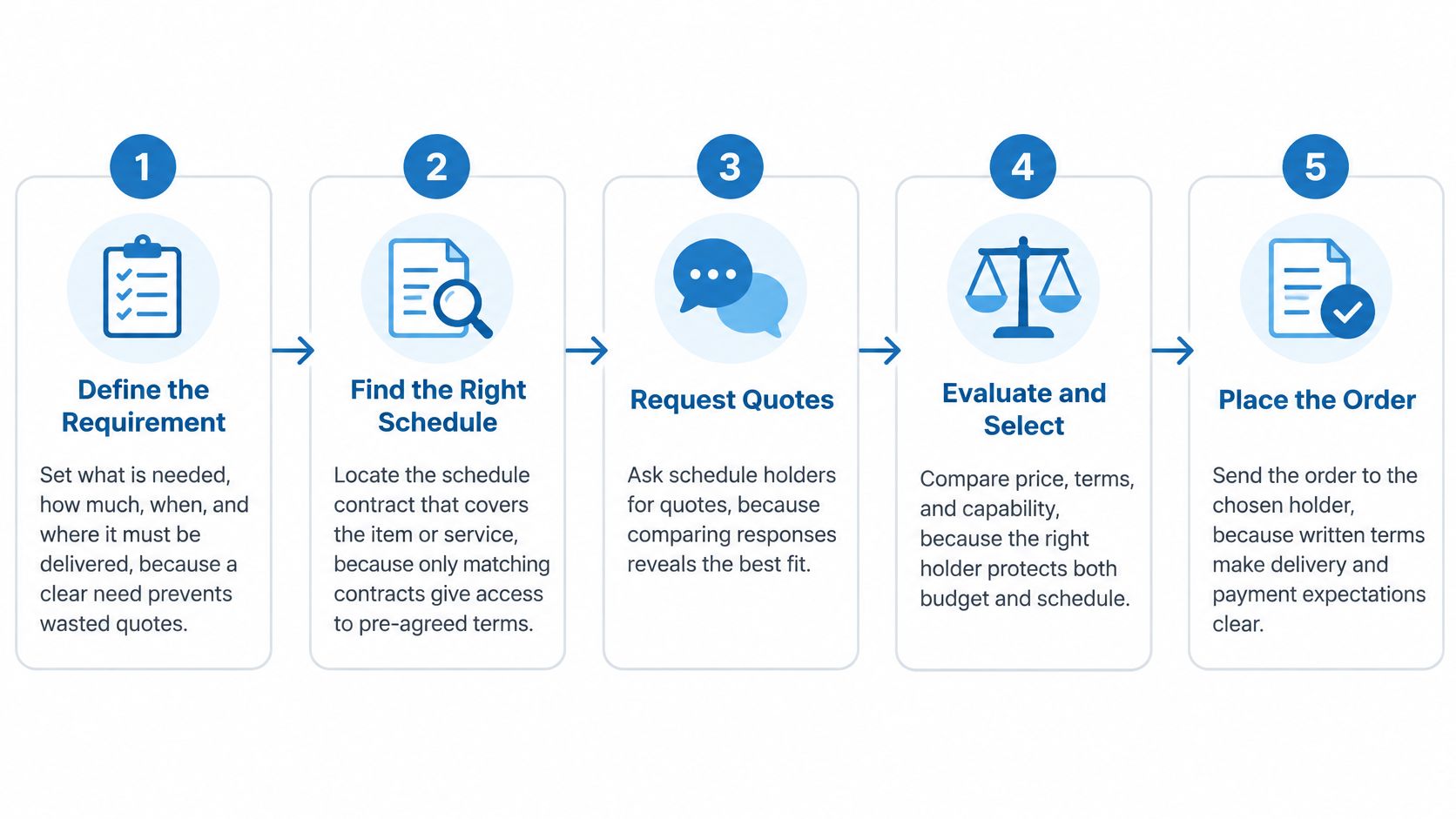
Define the requirement. State what the agency needs, the quantity or scope, the delivery location, and the required timing. For a service, describe the expected work and results clearly enough that contractors can prepare comparable responses.
Find the matching SIN and schedule holders. Identify the category that covers the requirement, then confirm that prospective contractors offer the relevant products or services under their contracts. This prevents the buyer from treating a company's general commercial capabilities as though everything it sells were automatically available through its schedule.
Choose the ordering method. Determine whether the purchase involves supplies or services that don't require a statement of work, services that do require one, or recurring needs suited to a BPA. This choice matters because the ordering process must fit the purchase, rather than forcing every requirement into the same template.
Request quotes when competition is required. Give the relevant schedule contractors the same requirement and enough information to understand the requested scope, delivery, and evaluation considerations. Comparable instructions help the buyer distinguish genuine differences between offers from differences caused by unclear requests.
Evaluate responses for best value. Assess technical fit, delivery, total cost, discounts, and applicable socioeconomic eligibility, rather than ranking catalog prices alone. For example, a quote for equipment that arrives after the required installation date may not meet the agency's need even if its price is lower.
Award the order and manage performance. Document the selected requirement and terms, then track delivery or service performance against them. The contractor now has an actual agency order to fulfill, with expectations that should be clear to both parties.
The visual below groups the process into broader stages, combining method selection with the surrounding purchasing activities:
Ordering Mistakes to Avoid
The FAR ordering framework differentiates purchase methods, so buyers should confirm the procedures and any applicable agency deviations governing their particular acquisition. An educational sequence is a useful orientation, not a replacement for the contracting office's current instructions.
Buyer check: Confirm the required competition before requesting quotes, and confirm the evaluation basis before selecting a contractor.
The common slips are skipping competition when it applies and assuming the lowest listed price automatically wins. Both mistakes come from treating the schedule as a completed buying decision instead of a foundation for an order-level decision.
Why Schedule Access Does Not Guarantee Sales
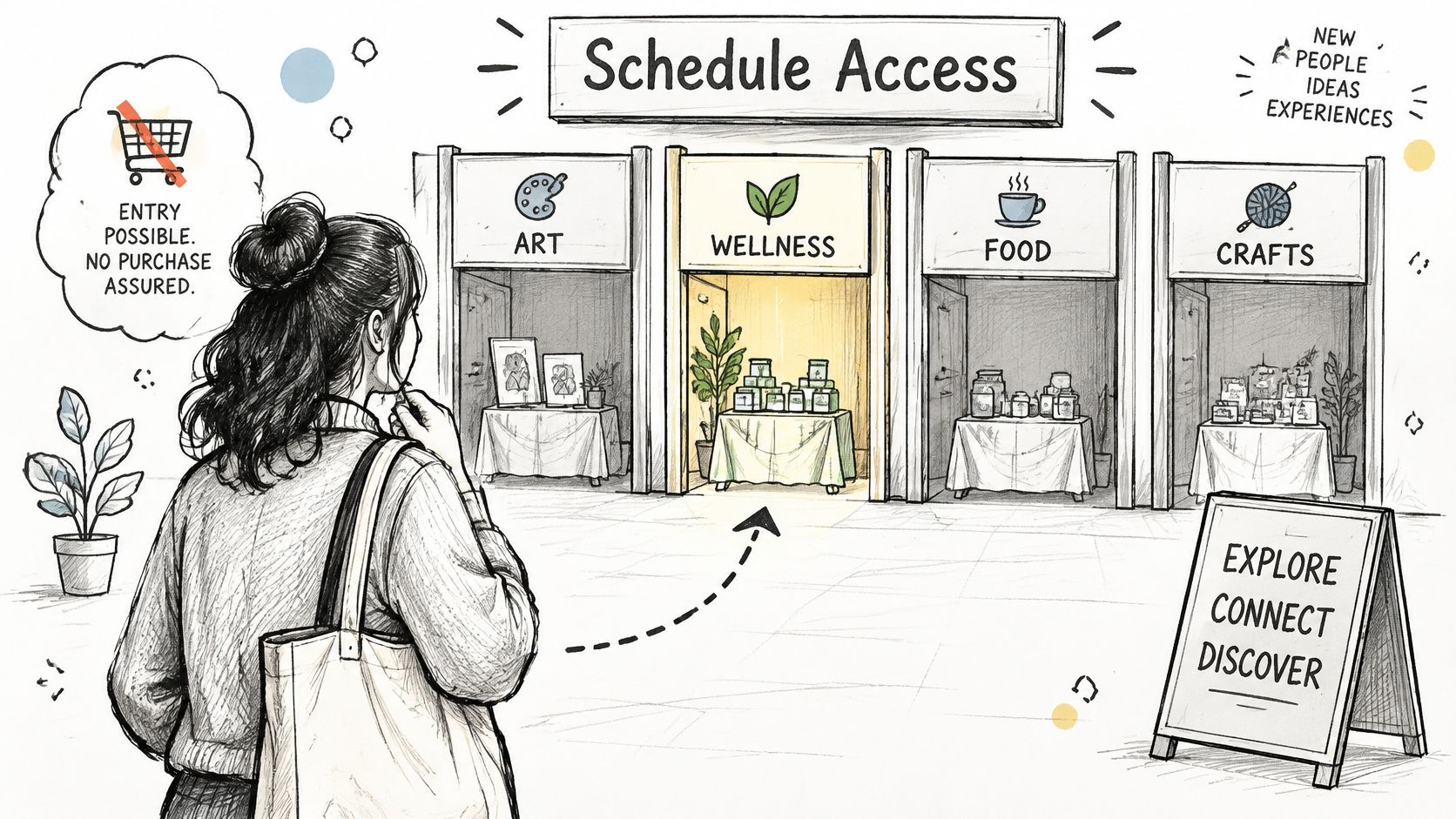
A schedule contract does not guarantee sales. Agencies generally aren't required to purchase from any particular schedule holder, so a contractor must distinguish eligibility to receive orders from actual buyer demand.
The Federal Procurement Data System's FSS reporting guidance helps clarify the distinction between an underlying schedule arrangement and the purchasing activity recorded against it. A company's schedule status alone doesn't establish that an agency has ordered from it or committed funds.
The difference resembles gaining access to an event where participants still choose which offerings interest them:
Eligibility Is Not Demand
A contractor can satisfy the contract-level requirements yet receive no orders. Buyers may not know about its capabilities, its offering may not match an active requirement, or competitors may submit more compelling quotes.
Consider a hypothetical IT services business that obtains schedule access but markets only a broad description of its capabilities. An ordering office looking for a specific migration service still needs evidence that the firm understands the environment, can supply suitable personnel, and can meet the requested timetable. Contract eligibility doesn't answer those questions.
The work after award therefore includes:
- Buyer research. Identify the offices that purchase the relevant services or products.
- Incumbent analysis. Understand who currently performs the work and what capabilities a challenger must demonstrate.
- Requirement tracking. Follow agency plans and prospective needs before deciding which purchases to pursue.
- Capture activity. Develop a credible approach, prepare competitive quotes, and pursue appropriate orders or BPAs.
Schedule access is infrastructure, not a pipeline.
That distinction matters when evaluating the administrative commitment of becoming a schedule holder. The question isn't merely whether the company can qualify. It's whether identifiable buyers have requirements the company can credibly win.
A firm should also distinguish schedule sales from total federal contracting activity. An agency may purchase through another contract vehicle, use open-market procedures, or select a different schedule holder. Strong federal demand for a service doesn't automatically mean the target buyer uses the schedule route for that service.
The better business-development question is specific: Which ordering offices use this route for requirements we can fulfill competitively?
Schedule Buying in Three Common Situations
Different requirements lead to different purchasing approaches. Repeat purchases, clearly specified products, and specialized services don't create the same ordering problem, even when all are commercially available.
The examples below are typical situations, not records of particular agency purchases. The final row identifies a reason to investigate a different purchasing route.
Likely Buying Route by Situation
| Buying situation | Likely route | Why it fits |
|---|---|---|
| Routine supplies bought repeatedly | Blanket purchase agreement with schedule holders | Recurring purchases can use an established arrangement for the same items |
| Specialized services with a defined statement of work | Task order competed among schedule holders, as required | The buyer needs comparable proposals against a defined scope |
| Item with a clear specification and no competing technical need | Order from a schedule holder under applicable ordering procedures, using schedule pricing or negotiated discounts | Established prices and terms simplify the purchase, but don't eliminate required competition |
| Need with no matching Special Item Number | Open-market procedure or another vehicle | The buyer needs a route that properly covers the requirement |
For routine supplies, the buyer's concern is repeatability: consistent specifications, ordering terms, and delivery. For specialized services, the concern shifts toward scope and execution, so the quote request must let contractors explain their proposed approach.
A clear product specification reduces ambiguity, but it doesn't itself authorize a buyer to bypass competition. The ordering-method and quote-request decisions still determine how the agency proceeds.
Test the Buying Pattern Before Choosing a Strategy
GSA's Acquisition Oversight Division states that its Schedule Sales Query Plus dashboard provides searchable schedule sales data from fiscal year 1991 through the present and is updated quarterly.
Use the dashboard to investigate the relevant schedule market, paying attention to the categories, contractors, and reporting dimensions available. Compare similar categories and consistent periods rather than combining unrelated offerings into a single apparent trend.
Then pair that market view with agency award and order records. Aggregate schedule sales can help establish whether contractors are selling in a category, but they shouldn't be treated as proof that a particular ordering office buys your offering through that vehicle.
For a capture team, the useful result is a purchasing hypothesis supported by records: the target office has bought a relevant requirement, used an accessible route, and selected contractors with capabilities you can match. That's more actionable than assuming a large federal market must contain suitable schedule opportunities.
Confirm a Schedule Fits Before You Apply
Before investing in schedule access, build a short qualification file. It should connect what you sell to identifiable buyers, a suitable contract category, and a realistic competitive approach.
Use the following checks to reach a decision, not merely to assemble application paperwork.
A Practical Go or No-Go Checklist
Match the SIN to your actual offering. Compare the category's scope with the products or services you intend to deliver. A nearby-sounding category isn't enough if the proposed work doesn't fit.
Identify the buying offices. Name the agencies and offices that purchase the relevant offering. Confirm that the intended ordering activity can use the route you're evaluating.
Inspect purchasing history. Use Schedule Sales Query Plus for the category-level picture and order records for buyer-specific evidence. Look for relevant requirements, not just large totals.
Compare existing competitors. Review schedule holders' capabilities, pricing structures, delivery commitments, and other contract access. Identify a defensible reason a buyer would select your offering.
Check offer readiness. Review the current solicitation's requirements, including applicable System for Award Management registration requirements and required pricing documentation. Distinguish materials needed for the offer from the authorized pricelist the contractor must publish after award.
Estimate the administrative commitment. Account for offer preparation, contract maintenance, pricing work, reporting, and quote preparation. Compare that effort with plausible orders, not the entire federal market.
Make the decision explicit. Pursue access when buyers are active, the scope fits, and you have a credible competitive case. Defer it when those conditions remain unproven.
Turn Research Into a Pursuit Decision
An opportunity notice is useful only if your team can connect it to buyer demand and bidding eligibility. Our guide to evaluating a federal business opportunity provides a complementary way to assess a prospective pursuit.
For this research, we provide contract vehicle data for every IDIQ, GWAC, and BPA, including holders and ordering buyers, alongside yearly market data for every NAICS market covering spend, growth, buyers, set-aside and sole-source amounts, and winning companies.
The go-or-no-go rule is simple: seek schedule access when the purchasing evidence and your delivery capabilities justify the effort. Schedule enrollment is a route to orders, not a substitute for market research or business development.
FederalPipeline connects opportunities, buyers, awards, and contract vehicle records so you can investigate whether schedule access fits your target market. Visit FederalPipeline to research prospective buyers and competitors before committing to an application; our free plan includes access to every opportunity, award, agency, budget, and policy page.