The most repeated advice on BPA vs IDIQ is to memorize the labels, then chase whichever cover page shows the bigger number. That advice fills pipelines with vehicles that never become funded work.
A ceiling is the most the government may order. A BPA estimate is a planning figure for repetitive buys. Neither figure is revenue until a buyer places a funded call or order, and until you can see who already wins that work. Holder count and incumbent concentration decide whether your company can reach any of it.
Put the vehicle name second. Historical obligations, order frequency, and who receives the orders come first. Read the legal status so you don't book a minimum the government never owed. Then recheck commercial vehicles against the 2025 buying changes, because a restriction that once steered agencies away from a single-award BPA can loosen, and a vehicle that looked strategic can go quiet after the new text takes effect.
What Separates a BPA from an IDIQ
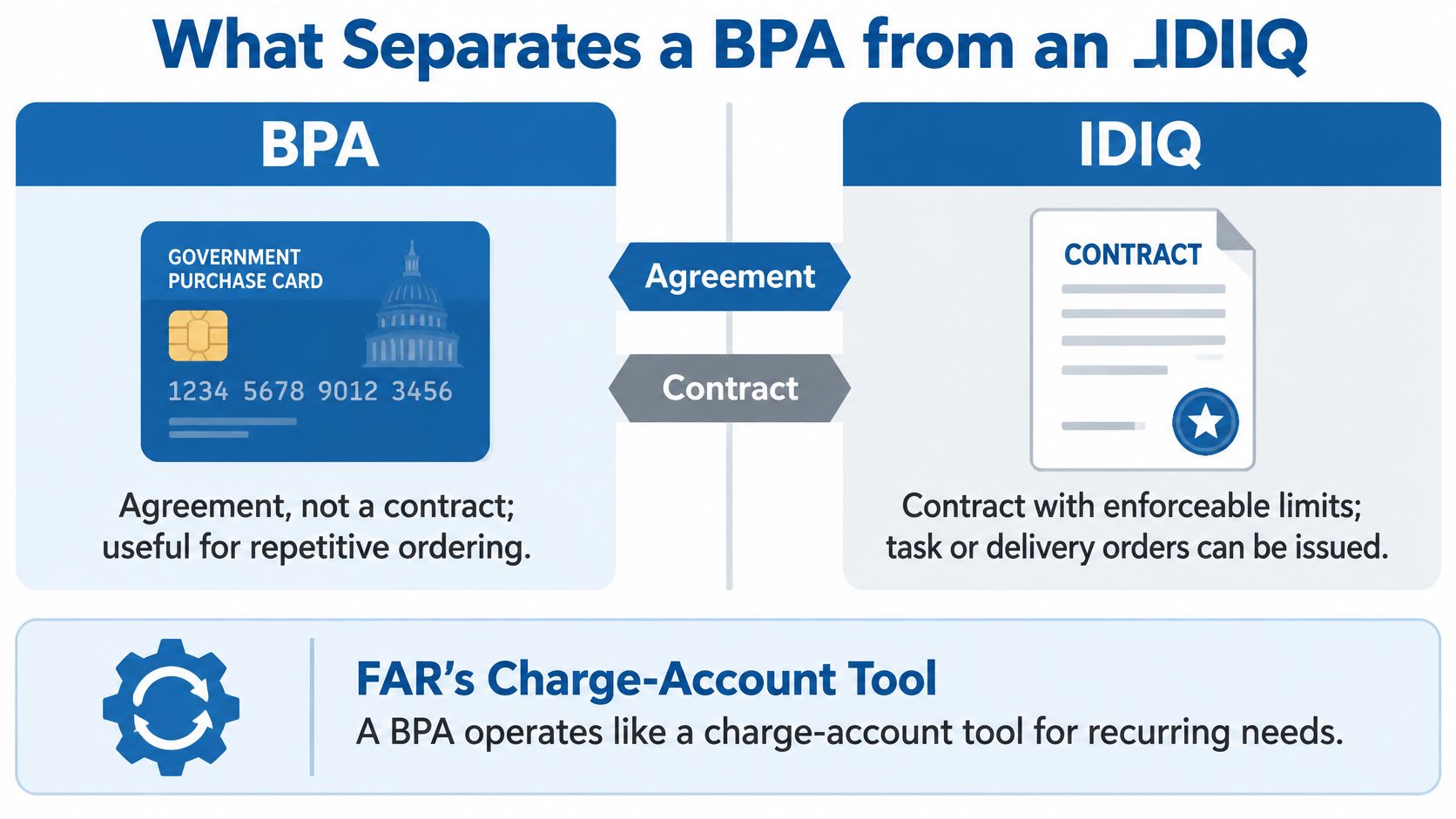
A blanket purchase agreement (BPA) is an agreement. An indefinite-delivery, indefinite-quantity (IDIQ) contract is a contract. That difference changes a forecast, because only one of them creates an enforceable buy.
Under the Federal Acquisition Regulation, a BPA functions like a charge account for anticipated, repetitive purchases. It establishes prices, ordering procedures, and other conditions for future orders. It does not itself obligate the government to buy any minimum quantity or dollar amount. The vendor is generally not required to perform until it accepts an order, and funds are obligated when orders are placed, not when the BPA is established. The GAO report on indefinite-delivery contracting describes BPAs as simplified tools for repetitive needs, and IDIQs as vehicles used when exact quantities and delivery timing are unknown at award.
An IDIQ provides for an indefinite quantity of supplies or services within stated minimum and maximum limits during a defined period. The government issues task or delivery orders for individual requirements. It must order at least the stated minimum, and the contractor must furnish that minimum. Book the minimum as the commitment at award. Everything above it is capacity that still has to be ordered.
| Question | BPA | IDIQ |
|---|---|---|
| What is it | Agreement, not a contract | Contract |
| Government buy commitment | No minimum quantity or dollar amount | Must order at least the stated minimum |
| Contractor duty | Generally none until an order is accepted | Must furnish the minimum |
| When funds are obligated | When orders are placed | Minimum at award; additional funds on later orders |
| How work is issued | Calls or orders under the agreement | Task or delivery orders |
| Typical uncertainty | Items, quantities, and delivery vary inside a known category | Timing and volume unknown inside a defined scope and ceiling |
| Revenue signal at award | A purchasing mechanism only | An enforceable minimum, not the ceiling |
What the rows still leave open
The table separates status, duty, funding point, and the paper used to issue work. It does not tell you whether your company will see competitive volume.
A BPA signals an available purchasing mechanism. An IDIQ is a contractual vehicle with enforceable ordering commitments and limits. Neither vehicle, by itself, guarantees a specific volume of competitive opportunities for every vendor. Later orders can still cluster with one holder.
Technology buyers often meet both instruments in the same category of spend. A sourcing guide for CIOs from MR2 Solutions is useful context for how technology leaders frame vendor selection, but it doesn't replace the federal instrument check. If the office already buys from schedule, read what a Federal Supply Schedule is before you assume this BPA or this IDIQ is the path in front of you.
A signed agreement with no calls is not a pipeline, and a contract funded only at the minimum is not its ceiling.
How Ordering and Competition Actually Work
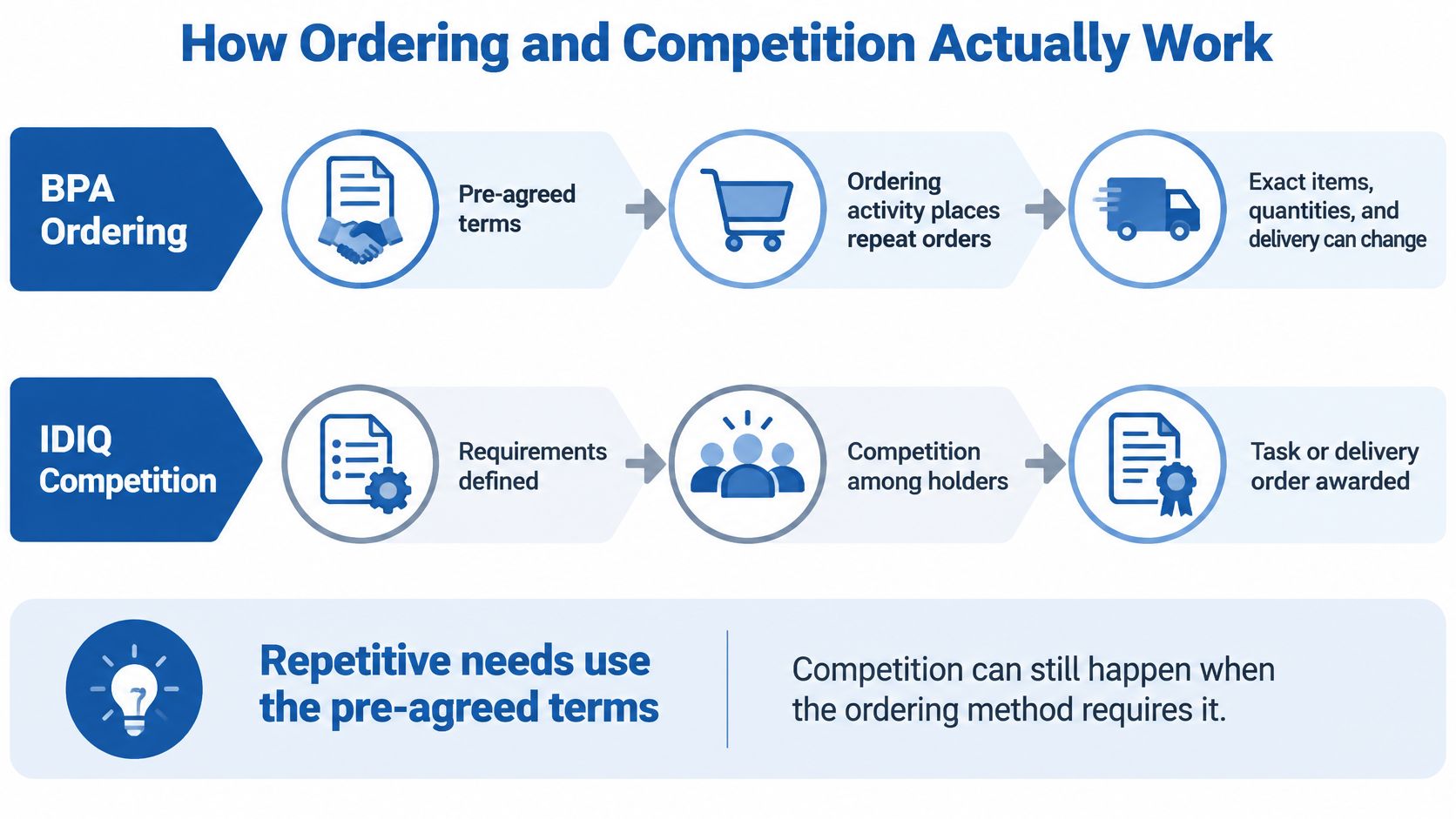
Competition on a BPA vs IDIQ pursuit doesn't happen at the same moment. One path reuses terms the buyer already accepted. The other turns each requirement into an order, often after a contest among holders.
Calls against terms already set
An ordering activity uses the pre-agreed terms for repetitive needs. Exact items, quantities, and delivery can change from call to call, because the category is known and the basket inside it is not. The FAR subpart on simplified blanket purchase agreements treats that pattern as the point of the tool: the broad category of supplies or services is known, while the exact items, quantities, and delivery requirements may vary considerably.
For a schedule BPA, the ordering activity establishes the agreement with schedule contractors that provide the best value, then uses it to fill repetitive supply or service needs. A single holder concentrates later calls. Multiple holders mean the buyer may still choose among BPA holders, so holder count and call history matter more than the agreement date.
Orders inside a period already written
On an IDIQ, the ordering period, the minimum, and the maximum are already set. Each requirement becomes a task order or a delivery order. When multiple awards are practicable, most later work moves into fair-opportunity competitions among holders rather than a second full open solicitation. A single-award IDIQ skips that holder-versus-holder step. Orders go to one contractor, so the competitive event was largely at award.
Four facts on the live notice
Read these off the order or the quote request, not off the vehicle announcement:
- Who may order: One office, or any activity the vehicle names.
- Set-aside status: Every holder, or a socioeconomic pool only.
- How offers are requested: A short quote, or a fuller package. The difference between an RFP and an RFQ changes page count, pricing format, and the past-performance burden.
- Scope type: Supplies, services, or a mix. Staffing risk and price risk don't travel together.
Winning the vehicle only puts the company in the pool or on the agreement. It doesn't place the next funded order.
If your team is new to that handoff, this walkthrough shows how ordering officers move from a standing vehicle to a specific buy.
Where Federal Dollars Really Flow
A ceiling tells you where money could move. Obligations tell you where it went. IDIQs carry a large share of federal contract dollars, and the mix inside that share decides which vehicles are even worth opening.
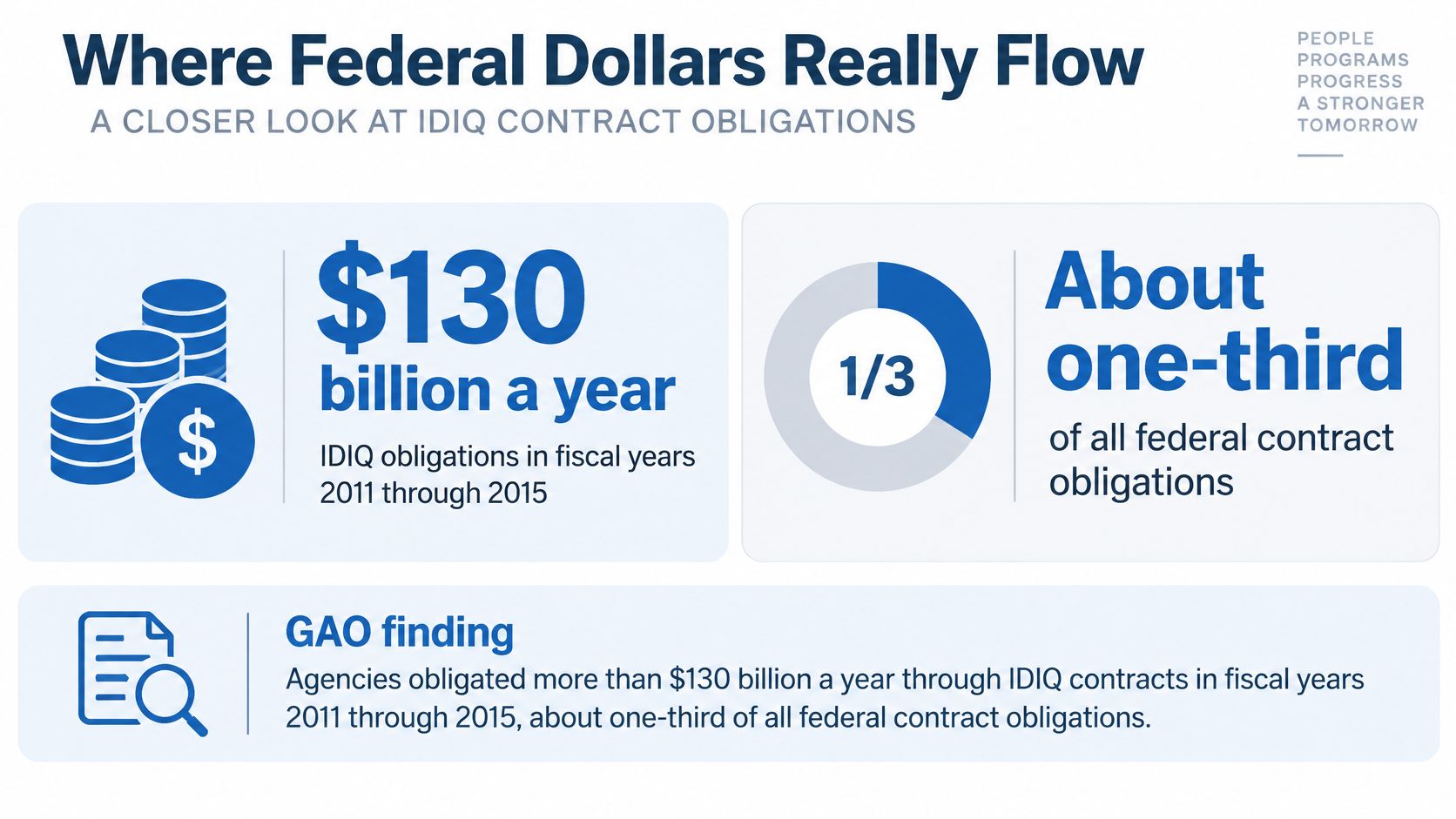
Pull the current totals in FPDS or USAspending for the agency and NAICS you plan to bid before you size anything. Five cuts matter more than the headline figure.
| Measure | What to pull before you plan |
|---|---|
| Annual IDIQ obligations | Obligated dollars on IDIQs for your target agency and NAICS |
| Share of total federal contract obligations | IDIQ obligations measured against all contract obligations in that market |
| Defense versus civilian concentration | Which departments obligate through the vehicles you can hold |
| Services versus products | Obligations split by product or service code |
| Single-award versus multiple-award dollars | How much routes through vehicles where orders stay with one holder |
How to read the mix
Start with which departments obligate on the vehicles you can hold. If the obligations sit in defense and your past performance is civilian, you are describing a market you cannot yet reach.
Split services dollars from product dollars before calling a market addressable. A hardware seller gains nothing from a services-heavy total, and a labor shop should not count catalog-driven obligations as demand.
Then weigh holder count and incumbent concentration. Dollars on a multiple-award vehicle get re-competed among holders order by order. Dollars on a single-award vehicle, once the minimum is met, stay with the incumbent until the vehicle turns over. The same top-line figure can describe two very different amounts of reachable revenue.
BPAs don't enter the same total
Establishing a BPA does not create an obligation the way an IDIQ minimum does. Size a BPA market from the calls placed against it and the dollars those calls obligated, not from the agreement record. Separate vehicle structure, award type, ordering activity, and downstream orders before anyone puts a ceiling into a market-size chart.
Obligation patterns shift, and 2025 commercial-buying policy can move which channel holds the flow. Re-pull the agency and NAICS splits in FPDS or USAspending before a gate review reuses last year's shares.
Situations That Favor Each Vehicle
Match the pattern the office already buys, not the vehicle your last win used. The fit below is a starting sort. The last column is the reason to leave.
| Buying situation | Better fit | Why | Walk away if |
|---|---|---|---|
| Repetitive commercial supplies, shifting quantities | BPA, often schedule-based | Category is known; items and timing vary; no minimum required | No recent calls or obligations |
| Ongoing services, unknown annual volume | Multiple-award IDIQ | Minimum, ceiling, and fair opportunity cover repeated task orders | Scope or clearances do not match |
| One office, repeat buys, small vendor pool | Single- or multi-holder BPA | Charge-account speed if calls are real | Orders stay with one incumbent you cannot displace |
| Multi-year professional services program | IDIQ task orders | Labor mix, ceiling burn, and order cadence are visible | Ordering period is nearly expired |
| Best-value repeat buys already on Schedule | Schedule BPA | Ordering activity selects schedule holders on best value | You are not on the relevant schedule |
| One competed award plus a guaranteed minimum | Single-award IDIQ | Enforceable minimum and later orders go to one holder | You are not the holder and orders are not competed |
Two patterns that fool a label match
Say a program office buys help-desk labor every quarter, with the same NAICS and a shifting headcount. The category looks like a BPA. If the last eight calls all went to one holder, and that holder still has the cleared staff on site, the "small vendor pool" row is a trap. Speed of ordering helps the incumbent, not the newcomer. Team only if that holder needs a niche you perform.
Now say a professional-services IDIQ still has four years on the ordering period, a visible labor mix, and task orders every month. The row says stay. If the next order requires a facility clearance your team doesn't hold, and a teammate who holds it already sits on the vehicle, you are a subcontractor conversation, not a prime bid. Ceiling burn tells you the work is real. It doesn't put your people on the contract.
When the better fit is still a no
A schedule BPA is the right instrument for best-value repeat buys only if you already hold the schedule those contractors were chosen from. Chasing the BPA solicitation without the schedule is a paperwork exercise. A single-award IDIQ with a real minimum is a strong vehicle for the company that won it, and a closed door for everyone else when later orders aren't competed.
Choose the vehicle the buyer already uses for that pattern, then test it against orders, not against the label.
What 2025 Procurement Reform Changes
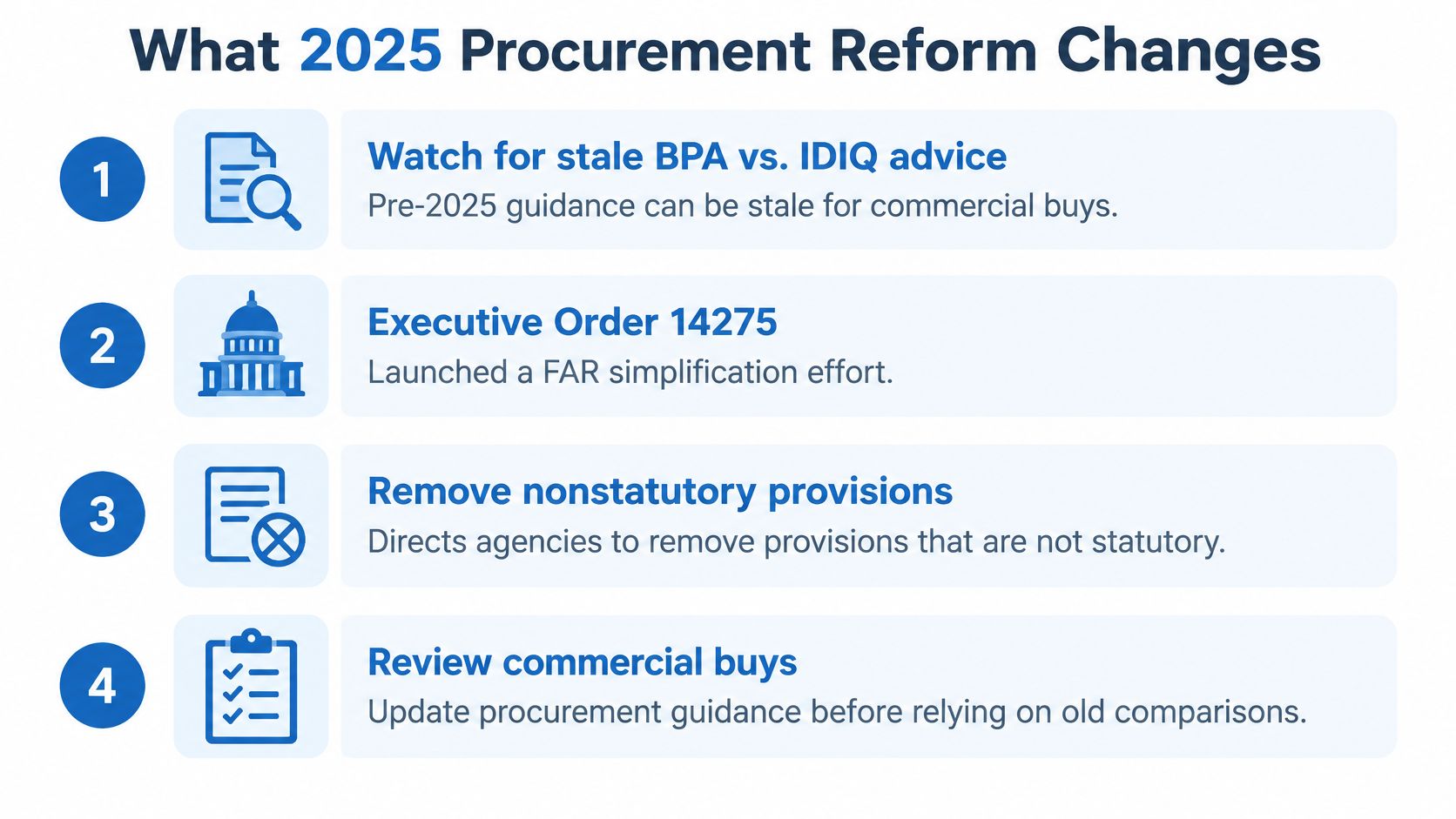
Advice written before 2025 can misread a commercial buy. Executive Order 14275 launched a FAR simplification initiative directing agencies to strip provisions that are not statutory or required for usability, efficiency, or national security, according to the Federal Register notice on restoring common sense to federal procurement.
The practical effect is that the rules structuring commercial buys, including where schedule procedures sit and how single-award BPAs get treated, have been rewritten or relocated since much of the existing guidance was published. A vehicle's legal status in 2025 can differ from what a pre-2025 capture plan assumed, so the current FAR and GSAM text is the only version worth pricing against.
Why a capture plan goes stale
A single-award BPA that older guidance treated as exceptional at high dollar values may now be an ordinary option for the buyer. When agencies get pushed toward existing government-wide contracts and best-in-class vehicles, the first vehicle a buyer reaches for can change without a new solicitation ever being posted.
Adoption is uneven. Ordering rules and approval steps differ by supplement and by effective date, so two agencies buying the same service can operate under different rules in the same quarter. An old plan that assumed uniform treatment will misclassify vehicles that are still live.
Recheck a vehicle in this order
- Read the text now in force. Pull the governing FAR or GSAM provisions, not the printout in last year's plan.
- Look for deviations. An agency deviation or a class deviation can keep an old restriction, or drop it ahead of the government-wide text.
- See how buyers classify it. Note whether the vehicle is treated as best-in-class or as an existing government-wide solution they are pushed to use.
- Track orders after the effective date. If calls or task orders stop, the vehicle has lost its buyers, whatever the old pattern was.
The label on the vehicle rarely changes. The demand routed under it does. A vehicle stays on the bid list only if buyers still order through it after the rule change.
Judging Reachable Revenue and Qualifying the Vehicle
Stop asking whether the better label is a BPA or an IDIQ. Ask how much obligated value, how much order frequency, and how much incumbent concentration sit under the vehicle you are about to bid.
The FAR guidance on indefinite-quantity contracts fits this read. Those contracts are appropriate when the government knows the general supplies or services and expects ongoing, repeated needs, while exact volume or timing stays unknown. The structure you can measure is a fixed ordering period, stated limits, a duty to order at least a stated minimum, and a contractor duty to furnish it. Task or delivery orders are what make ceiling consumption, order cadence, and recompete timing visible.
A large ceiling isn't revenue potential. Say one IDIQ shows a $500 million ceiling, a small minimum, and two orders in three years. A smaller vehicle that obligates every quarter can be the better pursuit. Performance depends on funded orders, fair-opportunity procedures, labor or product scope, and how many strong holders already sit on the contract.
What to calculate before a color code
On an IDIQ, pull the minimum guarantee, the ceiling, the obligated-to-ceiling ratio, annual order velocity, average order value, ordering period remaining, holder count, and whether orders are competed or directed. On a BPA, pull call frequency, realized purchasing against the estimated value, and whether one holder takes most of the calls. The ratio matters more than the cap. A vehicle that has obligated a modest share of a huge ceiling is a slow market, not a prize.
Five steps, then pursue, team, or drop
- Label it and list the people on it. Record BPA or IDIQ, the holders, and the term before you type a revenue number.
- Put the cap next to the money. Set the minimum and ceiling, or the BPA estimate, beside obligated dollars to date.
- Read the recent orders. Scope, set-aside, size, and winner on the last several buys are the demand. Track the order the way you track any federal business opportunity, or you will miss the notice while you stare at the vehicle page.
- Test the next order against your company. Clearance, certifications, NAICS, and staffing either fit or they don't. A mismatch here is a teammate problem or a drop, not a writing problem.
- Make the call. Pursue when recent funded orders match your work and the field is beatable. Team when the scope fits but past performance or holder status doesn't. Drop when orders are absent, the ordering period is nearly over, or the work is locked to an incumbent.
FederalPipeline includes contract vehicles data for every IDIQ, GWAC, and BPA, showing who holds it and who orders through it. The same workspace covers 29,765 open opportunities, 13,322 open parts RFQs, $793B in FY2025 contract spend across 563 markets, 11,466 contract vehicles, and 233.3K companies with federal awards. Attach the order history to the pursue, team, or drop decision so the ceiling never sits in the file alone.
Drop rule: If you can't name the last three funded orders and who won them, you aren't ready to bid the vehicle.
FederalPipeline ties IDIQ, GWAC, and BPA records to the agencies that order and the companies that hold them, so you can judge reachable demand instead of a headline ceiling. Line up obligations, holders, and open opportunities before proposal hours go into a vehicle that doesn't order. Visit FederalPipeline and qualify the next vehicle against its orders.