A contract vehicle is a pre-negotiated contract framework, such as an IDIQ, GWAC, BPA, or GSA Schedule, that lets agencies place task or delivery orders against set terms without running a new full procurement each time. It sets the terms, pricing structure, ordering rules, scope, and eligibility before any individual order exists.
You've probably hit this term in the least helpful way. You find work you can do, you know the customer, and then someone tells you the requirement isn't open market. It's going through a vehicle you don't hold. That's the moment when what is a contract vehicle stops being vocabulary and becomes a business question. You're not really asking for a definition. You're asking who gets to compete, how money moves, and whether pursuing a seat is worth your bid and proposal dollars.
What Is a Contract Vehicle and Why It Matters
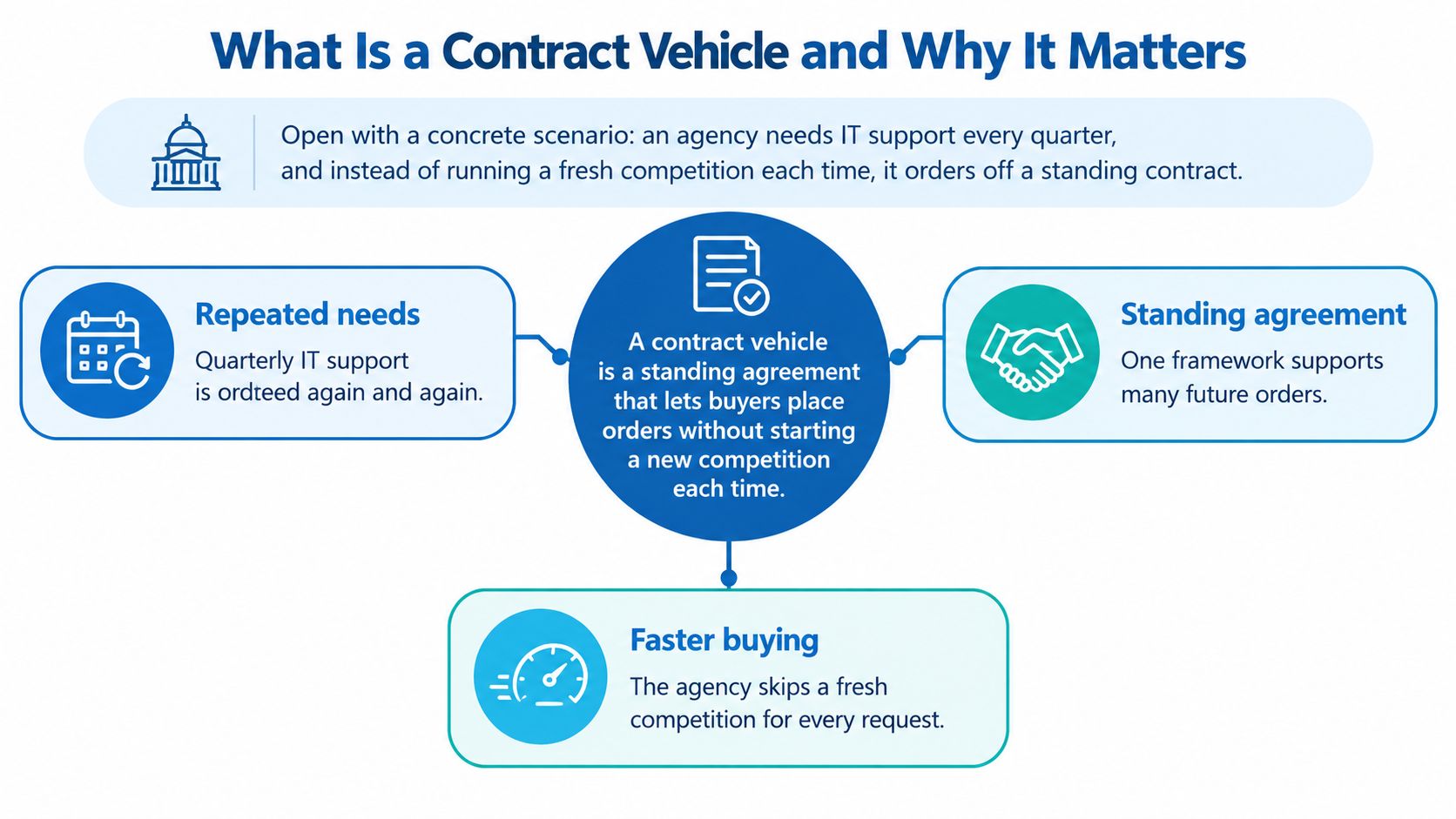
Picture an agency office that needs IT support every quarter. The work changes a little each time, but the need is recurring. If the contracting officer ran a brand new, full competition for every request, the office would spend months repeating the same groundwork. Instead, the agency orders from a standing arrangement where the basic deal is already in place.
That's the core idea. A contract vehicle is a contract, or group of contracts, that gives government agencies an efficient way to buy recurring products or services from one pre-selected vendor or a pool of pre-selected vendors, as described in GSA's guidance on its schedule framework. The vehicle establishes the framework first. The purchases come later, as individual orders.
Think Umbrella, Not Receipt
A useful analogy is an umbrella agreement. The umbrella says who's allowed to sell, what they can sell, how prices are structured, and how an agency places an order. It doesn't, by itself, say the agency will buy a specific amount on a specific day. Each order underneath the umbrella is closer to the receipt. That's where quantity, delivery schedule, and a statement of work become concrete.
Newcomers often get tripped up here, so don't rush past it. Winning a seat on a vehicle and winning work under it are two different wins. The first makes you eligible to be considered. The second puts funded work on your books. If you blur those together, you'll misread award notices, overvalue press releases, and chase vehicles that look impressive but rarely produce orders in your lane.
Plain rule: The vehicle is permission to compete for orders. The order is the revenue event.
The scale of this system is easiest to see on the GSA side. On October 1, 2019, GSA consolidated products and services formerly offered through 24 separate schedules into a single Multiple Award Schedule to simplify access and administration for federal, state, and local buyers. One framework replaced a tangle of separate ones. That consolidation tells you what agencies value here. They want a standing route to buy, not a fresh procurement maze for every recurring need.
Why Contract Vehicles Dominate Federal Buying
If you only watch standalone solicitations, you're watching part of the market and calling it the whole. Contract vehicles are one of the main channels through which federal dollars move, and the data has pointed that way for a long time.
The older baseline alone makes the case. Four vehicle categories, meaning multi-agency contracts, IDIQ contracts, blanket purchase agreements, and GSA schedules, accounted for 25% of federal procurement expenditures during fiscal years 1994 through 1999, according to GAO's analysis of contract vehicle use. A quarter of procurement spending was already flowing through these mechanisms before they became routine. That is a structural feature of federal buying, not a niche tool.
The Share Grew From There
GAO's later work on indefinite-delivery contracting describes a market where these vehicles carry a substantially larger share of obligations than that 1990s baseline, on both the defense and civilian sides of the government. Exact percentages vary by agency and by year, so treat any single figure cautiously. The direction, though, is consistent across the reporting: agencies shifted recurring demand into standing vehicles and kept it there.
For a seller, that shift changes where competition happens. When dollars move through a vehicle, only the seat holders can compete for the orders underneath it. The vehicle isn't just a channel. It's a gate.
Why Agencies Prefer This Route
The mid-1990s acquisition reform era, the same period that produced the Clinger-Cohen Act of 1996, is commonly credited with normalizing governmentwide buying arrangements like GWACs. Whatever the legislative cause, the practical incentives since then explain the staying power better.
Agencies keep choosing vehicles for reasons you can feel as a seller. The terms are already negotiated, so an order moves faster than a fresh procurement. The vendor pool is already vetted for eligibility, so the contracting officer isn't starting from zero. And when multiple agencies buy through the same structure, the government can use aggregated buying power instead of fragmenting demand across dozens of separate buys. Speed, pre-set terms, and combined volume explain the dominance better than any slogan about efficiency.
The Main Types of Federal Contract Vehicles
The acronyms blur together fast, so use the table as your map first. Then read the notes underneath for the distinctions that affect strategy.
Federal Contract Vehicle Types at a Glance
| Vehicle Type | How It Works | How Agencies Order | Typical Use |
|---|---|---|---|
| IDIQ | Sets a fixed period, scope, and minimum and maximum limits, with quantity and timing left open | Issues task orders for services or delivery orders for supplies | Recurring needs where exact quantity can't be known at award |
| GWAC | A governmentwide, IDIQ style vehicle built for use across agencies | Any eligible agency places orders against the shared framework | Broad buying programs, commonly for technology related services |
| Multi-agency contract | One contract structure serves several buying organizations | Participating agencies order under common terms | Shared needs that cut across agency lines |
| BPA | A simplified charge account style arrangement for anticipated repetitive needs | Places calls or orders as needs arise | Frequent, lower complexity repeat purchases |
| GSA MAS | A long-term, governmentwide framework for commercial products and services at prices determined fair and reasonable | Orders directly from schedule holders or competes among them | Commercial products and services bought governmentwide |
What Each Type Is Really Doing
An IDIQ, short for indefinite-delivery, indefinite-quantity, is the engine under much of this system. The government knows it'll need supplies or services over a fixed period, but it can't state the exact quantity or delivery timing on day one. So it sets stated minimum and maximum limits and fills in the specifics order by order. If you understand IDIQs, you understand the logic most other vehicles borrow.
A GWAC, or governmentwide acquisition contract, takes that IDIQ style logic and opens it across the government. A multi-agency contract does something similar for a defined set of agencies rather than everyone. The practical difference for you is reach. A seat on a broadly used vehicle can put you in front of buyers you've never met, while a narrower vehicle ties your fate to a smaller set of ordering offices.
A blanket purchase agreement is simpler in spirit. Think of it as a standing charge account for needs the agency expects to repeat. The Multiple Award Schedule program is the big commercial storefront, a long-term governmentwide framework giving agencies access to millions of commercial products and services. Both reward being easy to buy from, because the buyer chose this route to avoid friction.
The Split That Changes Everything
Forget the acronyms for a second and ask one question. Is this single-award or multiple-award?
On a single-award vehicle, one contractor holds the position. Orders flow to that holder within the vehicle's scope, so winning the seat is very close to winning the work stream. On a multiple-award vehicle, you're one holder among a pool, and you'll usually compete again at the order level. Same word, vehicle, completely different commercial reality. That single detail should change how much you're willing to spend to win a seat.
How Ordering Works Under a Contract Vehicle
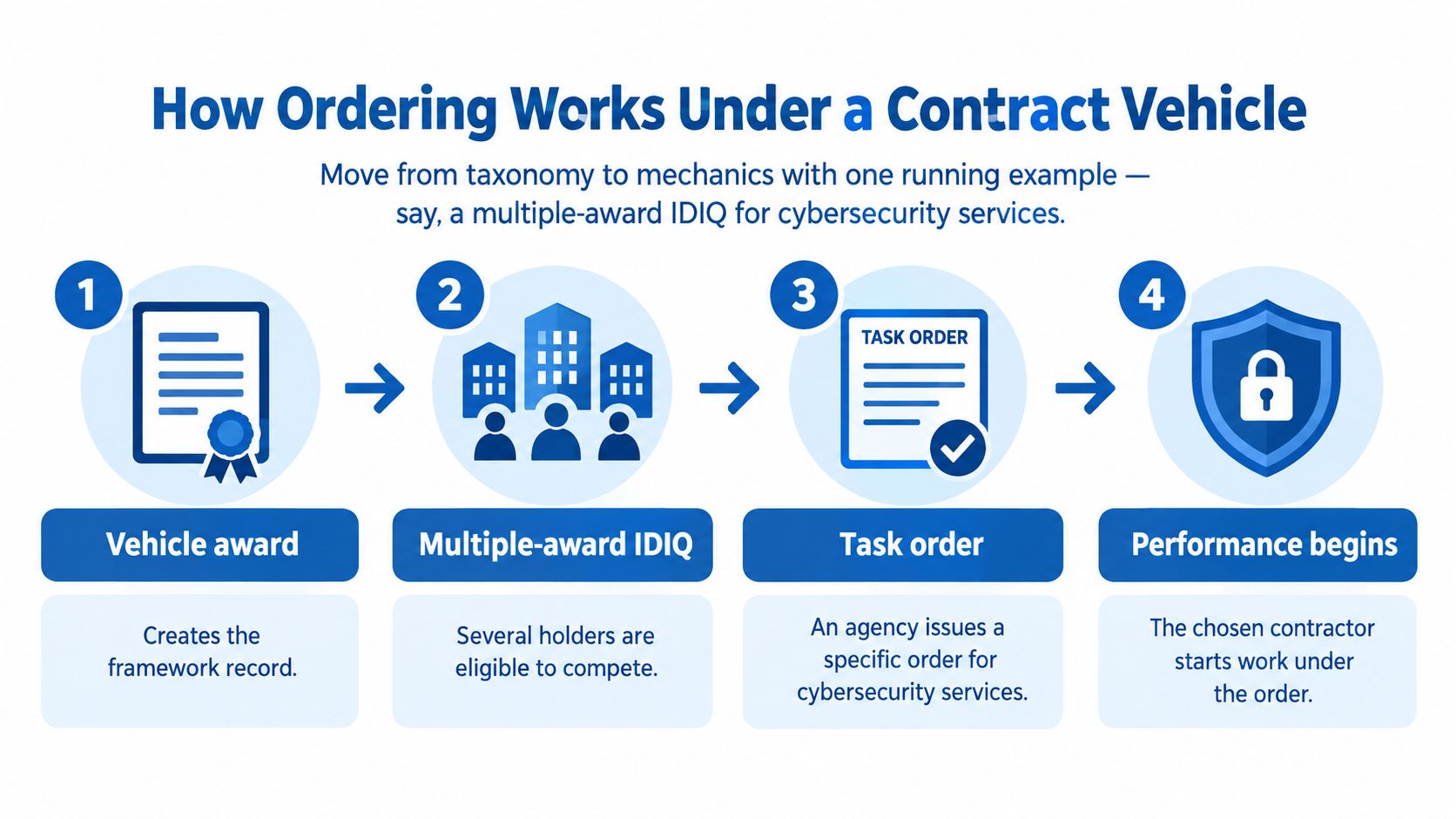
Taxonomy only helps if you can see the mechanics. So follow one running example, a multiple-award IDIQ for cybersecurity services. Several firms win seats. No agency has bought a single hour of work yet.
The vehicle award creates the parent contract. It sets the fixed ordering period, the scope of cybersecurity services covered, the ceiling, the ordering rules, and the stated minimum and maximum limits, while leaving exact quantity and delivery timing to future requirements, as laid out in GAO's description of IDIQ structure and ordering. Agencies use this structure precisely because they can't define quantities and timing at initial award. They know incidents, assessments, and support needs will come. They don't know exactly when or how much.
From Parent Contract to Funded Order
Months later, an agency component needs a security assessment and ongoing monitoring support. Now it issues a task order, the child record under the parent. That order carries its own unique procurement instrument identifier and also identifies the underlying contract it belongs to, a parent and child relationship reflected in FAR subpart 5.7 on task and delivery order vehicles. Each task or delivery order converts an anticipated need into a funded, enforceable procurement action. That's the moment anticipated demand becomes real work somebody performs and invoices.
This is why market research that only counts vehicle awards misleads you. The parent award tells you who holds seats. The orders tell you which buying offices spend, which incumbents perform, and what labor or product mix moves. If you want demand, follow the children, not just the parent.
Fields to Read on Every Vehicle
Before you get excited about any vehicle, read these fields the way a capture manager reads them:
- Scope: Does your offering fit inside what's covered, or are you adjacent to it?
- Ceiling and minimum guarantee: How much could flow through, and how little is promised?
- Ordering period: How much time is left to win and perform orders?
- Labor categories or product coverage: Are your people or products even listed in a way buyers can order?
- Security and socioeconomic eligibility: Do clearances or set-aside status gate the orders you want?
- Order competition procedure: How will holders compete when a requirement appears?
Security shows how the two levels interact. For classified IDIQ work, a basic DD Form 254 may cover multiple orders when security requirements are identical. If an order adds requirements, that documentation must be revised or supplemented. Vehicle level eligibility doesn't automatically clear every order, so check both levels every time.
On a multiple-award vehicle, holders are generally given a fair opportunity to compete for individual orders, with limited exceptions for noncompetitive ordering. In our cybersecurity example, the agency would normally let the seat holders compete for that assessment task order. Your seat gets you into that competition. It doesn't hand you the work.
What a Contract Vehicle Award Does Not Guarantee
Now for the correction that separates useful advice from happy talk. A vehicle award is routinely described as if it were revenue. It isn't, and treating it that way burns real money.
An IDIQ vehicle establishes terms, scope, ceiling, and the ordering mechanism for future orders, but it does not specify a firm quantity beyond required minimums, as explained in GAO's examination of IDIQ minimums and ordering. Agencies still must issue orders. Contractors still must win those orders. A vehicle provides eligibility and access without creating a funded pipeline.
A seat on a vehicle is a hunting license, not a purchase order.
Two Myths That Cost Small Businesses Money
The first myth is award equals revenue. Your actual revenue depends on agency demand materializing, on each order's scope fitting what you sell, on your price and past performance holding up against other holders, and on your ability to meet each order's technical and compliance requirements. Any one of those can fail while your seat sits perfectly valid. Companies have held seats for years and won little because the orders that flowed didn't match their strengths.
The second myth is that fair opportunity means equal treatment in practice. It doesn't mean equal visibility with the customer, a guaranteed number of competitions you'll be invited into in any given year, or an obligation for the agency to buy from every holder. Documented exceptions also permit limited noncompetitive ordering. A holder the customer already knows and trusts starts each order competition with an advantage no rule erases.
The Counterintuitive Part
Here's the judgment call experienced capture people make. A prestigious vehicle crowded with holders can be worth less than a smaller, less famous vehicle with concentrated, recurring orders and buyers you already have relationships with. Fame isn't order flow. A long holder list means every order is a scrum, and your fair opportunity is shared with every other name on that list.
So before you spend bid and proposal dollars, ask the harder questions. How much work has moved through this vehicle? How concentrated is it among a few incumbents? How much ceiling is left, and do the agencies that order here buy what you sell, at sizes you can perform? If you can't answer those, you're not evaluating an opportunity. You're buying a logo for your capabilities statement.
How to Judge Whether a Vehicle Is Worth Pursuing
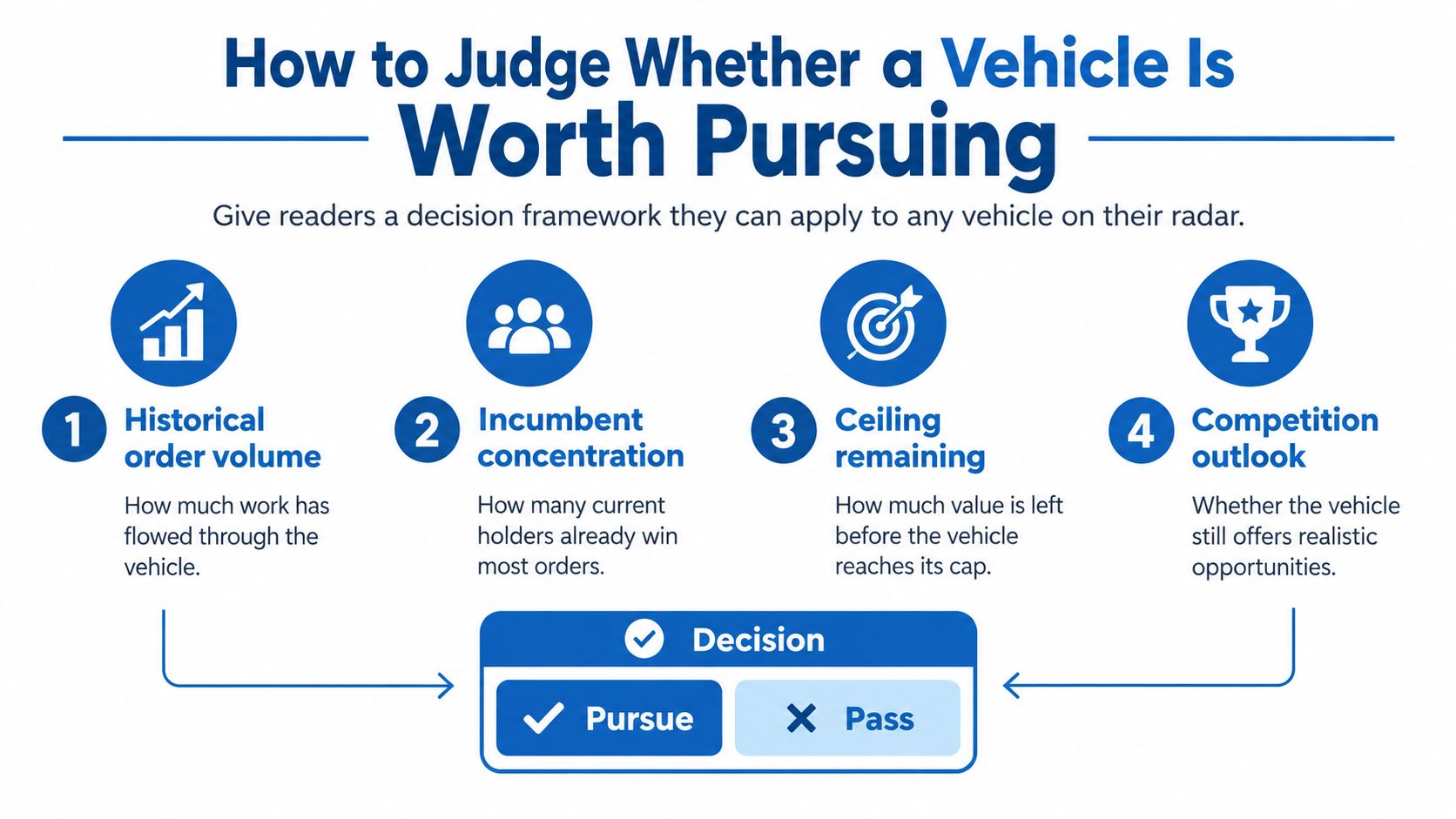
You need a decision framework you can run on any vehicle in an afternoon, not a gut feeling. Work through these checks in order, because a bad answer early should save you from bothering with the rest.
The Six Qualification Checks
- Historical order volume: Look at orders issued under the vehicle, not the ceiling in the announcement. A large ceiling with thin order history is a warning, not a promise.
- Incumbent concentration: If a handful of holders win most orders, ask what relationships or capabilities explain that, and whether you can realistically displace them.
- Ceiling remaining: Compare what's been obligated against the cap. A vehicle near its ceiling or late in its ordering period may offer little runway.
- Actual agency users: Confirm which agencies and buying offices order through it. A vehicle your target customers don't use doesn't help you, however respected it is elsewhere.
- Scope alignment: Map your offerings against the vehicle's labor categories or product coverage. Adjacent isn't inside, and orders outside scope can't come to you through this route.
- Typical order size: Match the usual order against your capacity to staff, deliver, and finance the work. Orders far above or below your sweet spot both create problems.
Pricing structure belongs in this review too. Ceiling rates and how order level pricing gets competed shape your margins long before you perform. If you're weighing how vehicle orders get priced, our overview of fixed-price contracting basics is a useful companion read.
The Thresholds That Change Your Rights
Most explainers skip the legal mechanics, but they decide who can compete and who can complain. Agencies may limit task or delivery order competition to firms awarded the underlying multiple-award contract, a point central to GAO's decision in B-411699 and B-411796. If you're not a holder, you may be locked out of the order entirely, however capable you are. Your alternative path in is teaming with or subcontracting to a prime who holds a seat.
Within the holder pool, dollar thresholds change the process:
- Above $3,500: Holders generally receive a fair opportunity to be considered for the order
- Above $5.5 million: Enhanced competition procedures apply to the order
- Above $25 million for DoD orders: GAO generally has protest jurisdiction, or where an order allegedly exceeds the contract's scope, period, or maximum value
- Above $10 million for civilian agency orders: GAO generally has protest jurisdiction, with similar scope related exceptions
Read those protest lines carefully. Below those thresholds, an unsuccessful holder often has no GAO protest path for an order, even if the loss stings. That changes your risk calculus on expensive order proposals. It also explains why scope questions matter so much, since an order that allegedly exceeds the vehicle's scope, period, or maximum value can open a door the dollar amount alone wouldn't.
Putting Contract Vehicle Intelligence to Work
Everything above compresses into one line you can tape to your monitor. The vehicle is the gate, the orders are the revenue. If you keep that straight, your research questions change. You stop asking how to get on every vehicle you hear about, and you start asking where orders in your capability area flow.
Your Next Research Session, Concretely
Pick one target vehicle and work it properly before you look at a second. Pull its order history and note which agencies and buying offices order through it. Identify which incumbents dominate those orders and how concentrated the wins are. Then check where your direct competitors already hold positions, because a vehicle where three rivals sit and you don't is a different problem from one where nobody in your niche has bothered.
That same order-level view sharpens everything downstream, from teaming choices to which recompetes deserve early capture effort. It's also the habit that protects you when an opportunity looks open but is routed through a vehicle. If you're building that early warning discipline, our guide to spotting a federal biz opportunity before it hardens into a solicitation pairs well with vehicle research.
Where FederalPipeline Fits
We built our contract vehicles data for exactly this work. FederalPipeline covers every IDIQ, GWAC, and BPA, showing who holds each vehicle and who orders through it, so you can judge order flow instead of guessing from an award announcement. You can also open any competitor to see their customers, vehicles, and teaming partners, which tells you whether a rival's advantage is a seat, a relationship, or both.
The database behind that research spans 11,466 contract vehicles, 29,765 open opportunities, and $793B in FY2025 contract spend, so vehicle analysis sits next to the live opportunities and award history it needs to be useful. You're not stitching together spreadsheets from separate systems. You're tracing a requirement from vehicle, to ordering agency, to incumbent, in one place.
Do one concrete thing this week. Choose the vehicle you're most tempted to pursue, pull its actual order history, and write down the top ordering offices and the holders winning that work. If your name can't plausibly join that second list within the ordering period, pass and put the pursuit budget somewhere it can. That single afternoon of order level homework will save you more money than any vehicle award announcement ever made you.
Before you commit capture budget to a vehicle pursuit, check who holds the seat, who orders through it, and which competitors are already winning its task orders. FederalPipeline gives you that vehicle, order, and competitor view in one research platform, so your next pursuit decision rests on real order flow rather than a ceiling number.