The most common advice about sole-source contracting is also the least useful: “Find the incumbent and build a relationship.” Knowing the incumbent can help you understand the buying history, but it doesn't establish that an agency can lawfully award the work without competition, or that your company qualifies to receive it.
No competition doesn't mean no qualification contest. Agencies still need a defensible legal basis, eligible and responsible contractors, documented approvals, and a price they can support. For capture teams, the right starting point isn't guessing who will win. It's checking what limits competition, which rules apply, and what evidence the agency has to document.
What Sole-Source Contracting Means in Plain Terms
Sole-source contracting is a federal agency's award of a contract to one source without full and open competition. It's an exception to the general expectation that agencies seek competing offers, not a shortcut around procurement rules.
Think of a homeowner who needs a locksmith to open a lock, but only one locksmith has the key or tool that can do it. The homeowner still needs a defensible reason for choosing that locksmith alone. In federal contracting, the agency must document the legal and practical reason competition isn't being used.
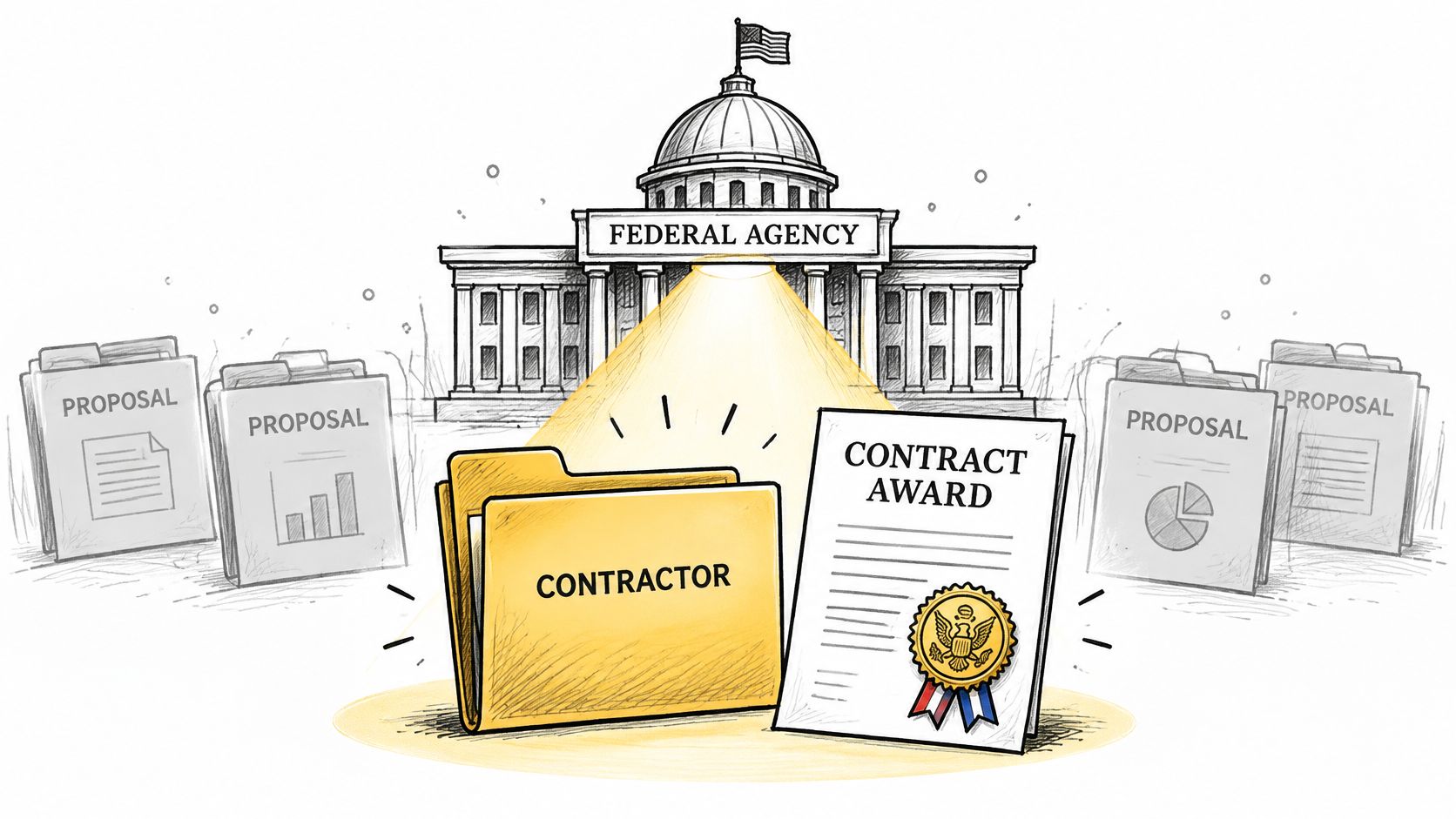
Three situations commonly explain why an agency might consider a sole-source award: only one responsible source can meet the requirement, a statute authorizes or requires an award to a particular source, or an urgent need makes a competition delay unacceptable. The agency's justification should identify the applicable authority and connect it to the requirement. “We've worked with this company before” isn't a substitute.
Three misconceptions that distort capture strategy
Incumbency is not eligibility. A prior award can give a contractor useful knowledge, but it doesn't prove that only that company can meet the government's need. If another supplier can satisfy the requirement as written, the agency needs a stronger rationale than the incumbent's familiarity with the work.
A sole-source award isn't an informal purchase. The agency generally needs a written justification, a contracting officer's certification, and approval at the level required for the action. Skipping competition doesn't eliminate the need for a procurement record.
A small-business set-aside is a different acquisition tool. A set-aside can restrict competition to eligible small businesses while still allowing competition among those firms. Sole source, by contrast, means the agency has a legal basis to award without full and open competition.
Start with the documented limit: Ask what condition the agency says prevents competition, not which company is receiving the work.
That distinction matters whether you're pursuing an award or assessing a competitor's notice. The company name tells you who the agency favors; the documented limiting condition tells you whether the acquisition strategy has a defensible basis.
Legal Authorities That Allow a Sole-Source Award
The Federal Acquisition Regulation's authorities for other-than-full-and-open competition give agencies seven legal reasons to proceed without full and open competition. Start with the authority named in the justification, then test whether the stated facts fit it.
| Authority | FAR citation | Typical situation |
|---|---|---|
| Only one responsible source | FAR 6.302-1 | Unique capability, proprietary data, or compatibility limits the field to one source |
| Unusual and compelling urgency | FAR 6.302-2 | Competition would delay a needed response unacceptably |
| Industrial mobilization or capability | FAR 6.302-3 | The agency needs to maintain a production, engineering, or research capability |
| International agreement | FAR 6.302-4 | A treaty or agreement requires an award to a specific source |
| Authorized or required by statute | FAR 6.302-5 | A statute names the source or requires the award |
| National security | FAR 6.302-6 | Competing the requirement would compromise national security |
| Public interest | FAR 6.302-7 | The agency head determines that competition isn't in the public interest |
Test the authority against the requirement
The authority capture teams are most likely to encounter is FAR 6.302-1, which applies when the agency determines that only one responsible source can satisfy the requirement. For DoD, NASA, and the Coast Guard, the authority can also apply when only one or a limited number of responsible sources can meet the need.
That's a requirement-specific test, not a reward for past performance. A justification should explain how a claimed differentiator, such as a unique capability, compatibility, standardization, or proprietary data, prevents another source from meeting an objective performance need. If the agency could reasonably change the requirement and permit another supplier, that possibility weakens an argument based only on the incumbent's advantage.
The contracting officer generally must prepare the written justification, certify that it's accurate and complete, and obtain the approval required under FAR 6.304 before negotiations or award. Those steps matter because the agency's selection must be supported by the record, not just by a preference expressed during market research.
Read the table as a screening tool. Find the authority the agency cites, identify the limiting condition that authority covers, and compare both with the stated need. If the justification invokes urgency but the explanation doesn't connect competition to an unacceptable delay, or invokes a unique source without linking it to a specific requirement, the rationale deserves closer review.
Small Business Sole-Source Ceilings and Current Dollar Limits
The ceiling for a small-business sole-source award depends on the program and whether the work is treated as manufacturing. Don't apply a dollar limit until you've checked the assigned NAICS code and the work it covers.
| Program | General ceiling | Manufacturing ceiling |
|---|---|---|
| 8(a) | $5.5 million | $8.5 million |
| Women-Owned Small Business (WOSB) | $5.5 million | $8.5 million |
| HUBZone | $5.5 million | $8.5 million |
| Service-Disabled Veteran-Owned Small Business (SDVOSB) | $5 million | $8.5 million |
The Government Accountability Office's review of large sole-source 8(a) awards describes a separate set of written-justification thresholds. For DOD 8(a) sole-source contracts, the threshold rose to above $100 million on March 17, 2020. Civilian-agency 8(a) awards received a separate threshold of above $25 million on October 1, 2020. These are oversight triggers for large 8(a) awards, not the small-business program ceilings in the table.
Apply the right ceiling
Use the NAICS code to confirm whether the procurement is treated as manufacturing or services. For example, a hypothetical $6 million 8(a) requirement coded as manufacturing falls below the manufacturing ceiling, while the same value coded as a service exceeds the general ceiling.
That classification can change whether a sole-source route remains available. It's also why a dollar figure lifted from another procurement doesn't settle your analysis: the program, the nature of the work, the buying agency, and the award date all matter. For a broader comparison of how set-asides work, see this guide to small business set-asides.
For large 8(a) awards, check the buying agency and the rule in force on the award date before assessing the justification requirement. DOD and civilian agencies don't share the same threshold, so the same contract value can trigger different oversight depending on who is buying.
How a Sole-Source Justification Gets Approved
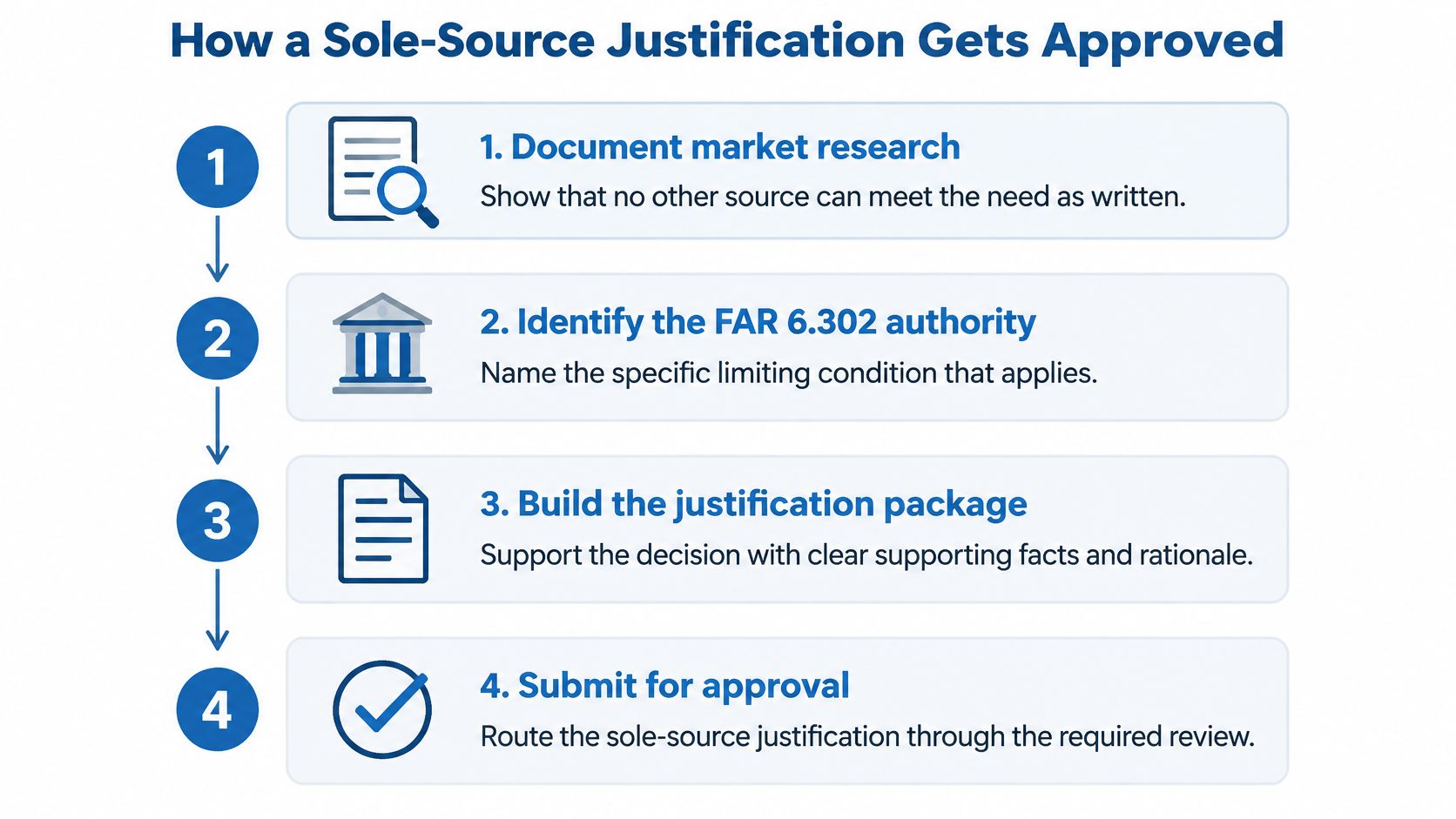
A sole-source justification should be built from the agency's need outward. Each step creates evidence for the next; a claim of uniqueness that isn't supported by market research won't become more persuasive just because it appears in a polished package.
Document market research. Show that no other source can meet the need as written, and explain what sources the agency considered. A common weakness is treating the incumbent's performance history as proof that no alternative exists.
Identify the FAR 6.302 authority. Name the legal basis and the specific condition that limits competition. If the explanation relies on urgency, for example, it should connect competition with the delay the agency can't accept.
Draft the written justification. Tie each reason to an objective requirement, such as a needed capability or compatibility constraint. Don't make “the contractor already knows the system” the center of the argument.
Have the contracting officer certify the package. The officer generally certifies that the justification is accurate and complete. The supporting facts should be checked before certification, not added later to patch gaps.
Obtain the required approval. FAR 6.304 sets approval levels according to the action and its value. Don't route the package as though a draft justification or an unfinished price analysis were a completed basis for approval.
Complete price analysis. The agency still needs support for a fair and reasonable price, even when there's no competitive bid benchmark. Keep the pricing evidence organized with the justification package.
Publish required notice, unless an exception applies. Check the notice rules and any applicable exception for the procurement. A missed publication requirement can create a procedural problem separate from the merits of the sole-source rationale.
Award and preserve the record. Keep the complete file ready for review, including the market research, justification, approvals, notice records, and pricing support. A defensible decision depends on a coherent record, not on a justification in isolation.
Dates matter as much as documentation. The Fiscal Year 2010 National Defense Authorization Act required a written justification and approval before an 8(a) sole-source award above $20 million, but the FAR implementation did not take effect until March 2011. During the gap, agencies reported 42 awards above $20 million totaling more than $2.3 billion that weren't subject to the new justification requirement, according to the Government Accountability Office's account of the implementation delay. That history is a practical warning: verify the rule and its effective date, not just the award value.
Pricing a Sole-Source Award Without a Bid Benchmark
Sole-source status isn't pricing power. Without competing bids, the government still has to determine whether the anticipated price is fair and reasonable. FAR 6.303-2 requires the contracting officer to make that determination, so a supplier should prepare evidence the agency can evaluate independently.
A strong pricing file lets the agency examine the proposed price rather than rely on the contractor's assertion that it's reasonable. Keep the support auditable and tied to the work being purchased:
- Labor categories and rates: Identify the labor mix and explain the basis for proposed rates.
- Direct-material assumptions: Show what the estimate includes and how the assumptions relate to the requirement.
- Subcontractor quotes: Preserve current, scope-matched quotes and the assumptions behind them.
- Historical prices: Provide prior pricing that can be compared meaningfully with the proposed work.
- Engineering-change effects: Show how changes in design, specifications, or production affect cost.
- Comparable transactions: Include relevant commercial or prior government sales, with enough context to make the comparison useful.
For defense procurements, DFARS provisions may add procedural controls for certain 8(a) sole-source awards and other-than-full-and-open actions. A published justification can also help a competitor assess the cited authority, the government's uniqueness rationale, approval status, and the price-analysis method. Those details are useful signals for understanding whether the award rationale is complete, not proof by themselves that the price is wrong.
Consider a parts supplier that is the only qualified source for a specific item. The supplier should show recent unit prices, the quantities previously purchased, and any comparable government sales that match the scope. That gives the contracting officer a basis for analysis even though another bidder isn't available.
Pair a technical reason for sole-source treatment with a credible pricing file, and assemble that file before the agency asks for it.
Using Threshold Changes to Target Sole-Source Pipelines
Higher ceilings make early research more valuable, but they don't guarantee more opportunities. An agency can still choose competition or reject a sole-source route after market research. The pipeline question is whether the work, buyer, and program align, not merely whether the estimate falls below a ceiling.
The 2025 update effective October 1 raised the general and manufacturing ceilings for 8(a), WOSB, and HUBZone awards to $5.5 million and $8.5 million, respectively. SDVOSB ceilings became $5 million generally and $8.5 million for manufacturing. The SAME regulatory update on small-business sole-source thresholds notes that FY2025 sole-source obligations approached $30 billion. That scale makes the channel worth tracking, but the ceiling alone doesn't tell you which opportunity is addressable.
Track these four items before a notice appears:
- Forecasted requirements: Look for emerging needs in agency forecasts and budget activity so you can assess fit before the solicitation arrives.
- NAICS treatment: Confirm whether the requirement is manufacturing or services. That classification can change the applicable ceiling.
- Incumbent and socioeconomic program: Identify the current supplier, the buyer's likely acquisition approach, and whether your business qualifies for the relevant program.
- Options and total value: Check whether options could push the contract's value past the applicable limit. If an option increases cumulative value above the ceiling, the agency may need a different acquisition approach.
A useful capture workflow combines those checks with an understanding of how an opportunity may be purchased. Review the potential contract vehicle alongside forecasts and award history, rather than treating a sole-source notice as a complete picture of the buyer's plan.
The right conclusion from a higher ceiling is research earlier and qualify more carefully. It isn't “assume more awards will be sole source.” Agencies retain discretion to compete, apply program rules, and change course after market research.
Challenging a Sole-Source Award Through Protest and Market Research
A sole-source justification can be challenged when the agency's explanation does not match the requirement or public record. Find the notice and justification, then compare the cited FAR 6.302 authority with the specific condition the agency says applies.
Focus on evidence. The requirement may be written so narrowly that another source cannot qualify, the cited authority may not fit the stated need, or the agency's price analysis may be thin. A belief that the incumbent has an unfair advantage is not enough. Tie any concern to documents, specifications, and the agency's stated rationale.
Raise the issue before or after award
Before award, raise factual concerns with the contracting officer during market research or through the appropriate response to the notice. The agency can then address an error or reconsider the requirement before finalizing the acquisition. A federal contracting opportunity search can help teams find notices to examine.
After award, an interested firm may protest at GAO. GAO's filing deadlines depend on the protest's basis and the circumstances, so identify the applicable deadline promptly and do not let informal discussions delay action.
For example, a firm may find that a justification says only one source can provide a capability that the solicitation does not require. The firm can document that mismatch, ask the contracting officer to reconsider the acquisition, and monitor any protest deadline at the same time. A persuasive challenge connects the record to the agency's chosen authority and explains why the stated need does not support it.
Confirm Your Position Before Pursuing a Sole-Source Notice
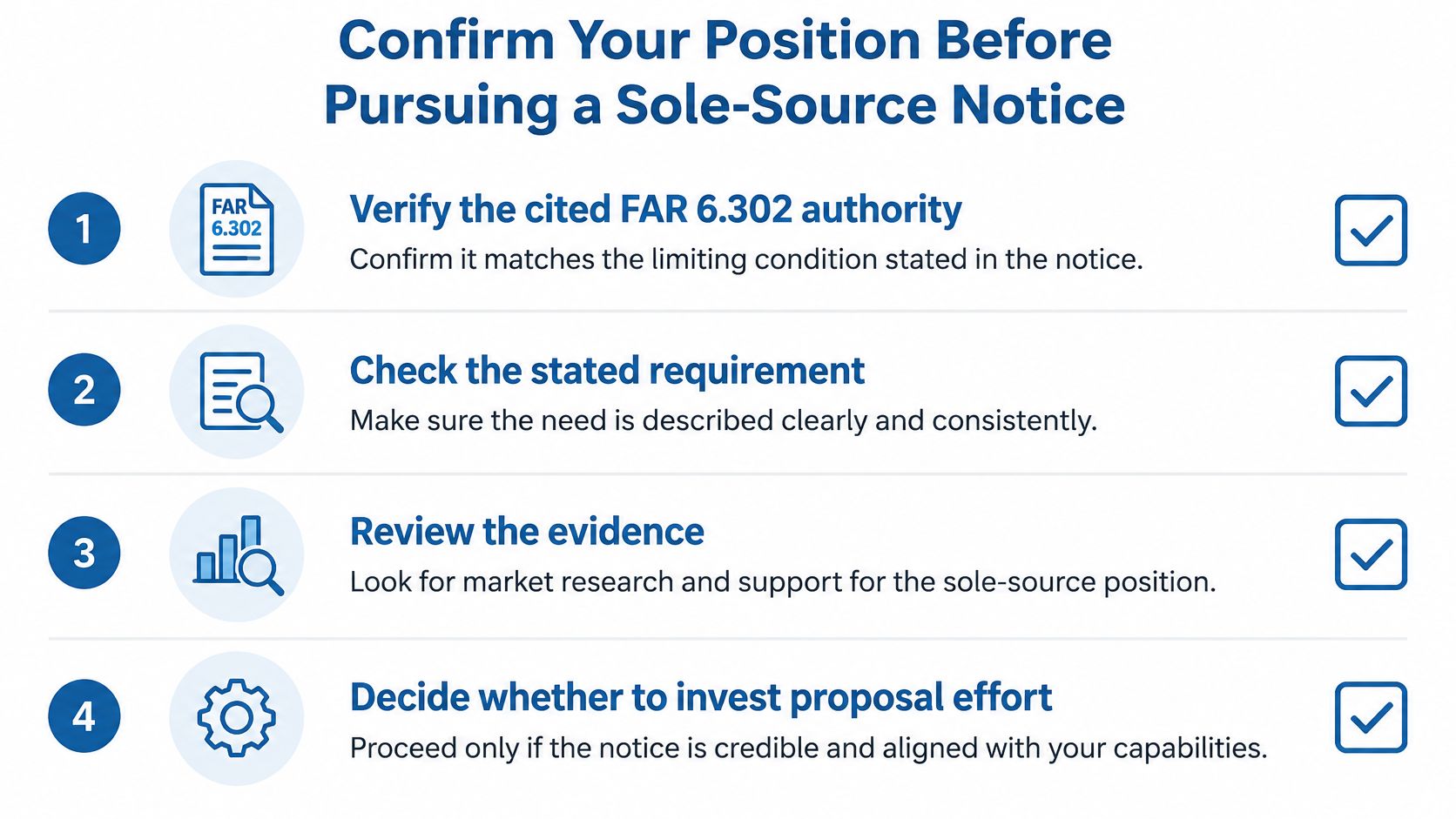
Before committing proposal effort, run these checks in order:
- Match the authority: Confirm that the cited FAR 6.302 authority fits the limitation stated in the notice.
- Map your capability: Tie your offering to a traceable, objective requirement. Prior award history alone isn't a sufficient argument.
- Check eligibility and value: Verify program eligibility, NAICS treatment, the applicable ceiling, and total value including options.
- Assess the incumbent: Review the prior contract and any exposure that could prompt a challenge.
- Check your pricing file: Make sure your cost and transaction support is ready for review.
- Verify the process: Confirm the notice deadline and whether the justification has received the required approval.
Pursue when the authority, eligibility, ceiling, and pricing evidence all line up. If one is missing, treat the notice as a monitoring item until you can verify the record or the agency's forecast changes.
FederalPipeline reads solicitations and creates capture briefs that surface requirements, incumbents, ceilings, and deadlines; it also flags bid blockers, including requirements pulled from attachments. Use it to monitor notices against your company profile and focus capture effort on opportunities your team can qualify.
Use FederalPipeline to match new federal notices against your company profile, check eligibility, and receive alerts when opportunities fit. Its capture briefs surface the incumbent, requirements, ceiling, and deadlines, so your team can decide whether a sole-source notice merits pursuit before proposal effort is committed.