NAICS code 238990, All Other Specialty Trade Contractors, carries a reported federal small-business size standard of $19.0 million in average annual receipts, per the SBA small-business size standards dataset. That figure qualifies a contractor only after the code itself is confirmed.
The code is a residual classification: it captures specialized construction trades that more specific categories exclude, so its boundaries shift with the work performed. That makes 238990 useful for discovery but unreliable for qualification on its own. A contractor can match the industry label without matching the work, and a spending total under the code can include awards that contractor could never pursue. Before estimating reachable federal dollars, confirm the work classification, the NAICS version, and the applicable size standard against the solicitation and the governing SBA regulation.
What NAICS Code 238990 Covers at a Glance
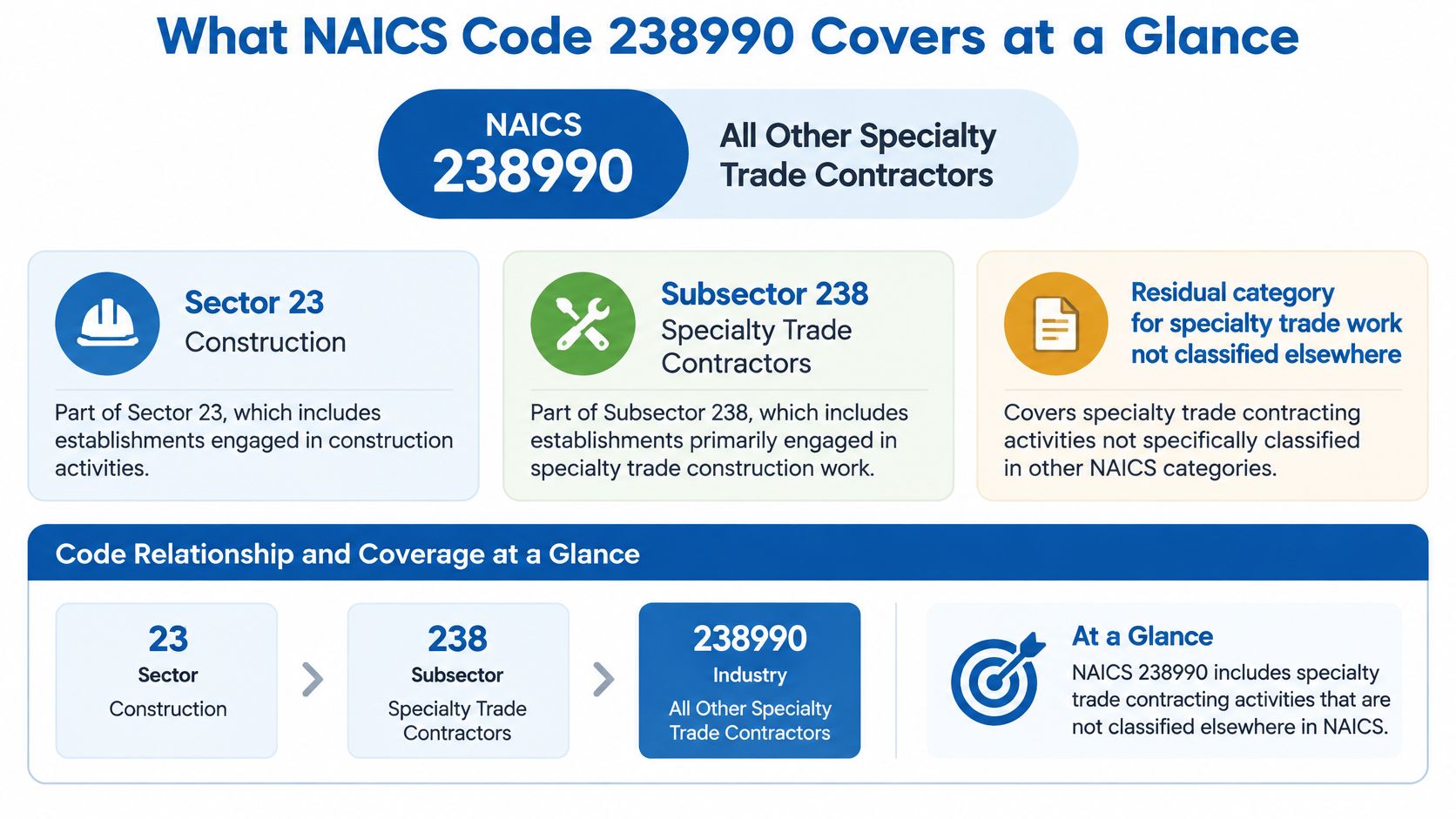
NAICS code 238990 identifies All Other Specialty Trade Contractors, establishments primarily engaged in specialized construction trades outside the more specific excluded trade groups, according to the Census Bureau industry definition.
| Item | Value | Why It Matters |
|---|---|---|
| Official title | All Other Specialty Trade Contractors | Search SAM.gov and NAICS tables using this exact title |
| Sector | 23 Construction | Places the code in the broader construction sector |
| Subsector | 238 Specialty Trade Contractors | Contains the trade-specific classifications to check first |
| Scope | Specialized trades not classed elsewhere | Applies after more specific classifications are ruled out |
| Work types | New construction, additions, alterations, maintenance and repairs | Both project-based and recurring work fall within the definition |
| Federal small-business size standard | $19.0 million average annual receipts | Verify the governing SBA table against the solicitation |
| Current NAICS version | NAICS 2022 | Record the classification vintage when comparing records |
Residual means that the classification describes what remains after more specific trade categories have been excluded. It isn't a general-purpose label for any contractor that performs unusual work, and it doesn't replace a specific classification because a project includes several tasks.
Classify the activity, not the marketing description
NAICS groups establishments according to similarities in production processes, rather than only the products or services they advertise. For capture research, that distinction means a company's capability statement should explain how it performs the work, not just list broad service labels.
Consider a business advertising facility maintenance. That description alone doesn't establish whether its activity is electrical repair, painting, site preparation, or a residual specialty construction trade. Read the actual task descriptions before treating its industry code as evidence of capability.
The same discipline applies to competitors. Two companies sharing this classification may have little practical overlap in equipment, workforce, operating territory, or relevant experience.
Practical rule: Use the code to build a candidate list. Use work descriptions, past performance, and award details to decide who actually belongs in the competitive market.
Keep separate fields for classification, capability, and procurement eligibility in your research. Combining them into a single industry-match flag conceals the differences that determine whether an opportunity deserves capture effort.
Specialty Trades That Belong to Other Codes
The exclusions define the boundary: foundation, structure and building exterior work; building equipment; building finishing; and site preparation belong outside the residual category. Begin with those groups rather than searching for a reason to place familiar trade work under an all-other label.
The following lookup organizes the trade codes by the work they cover.
| Category | Subsector 238 Codes | What It Holds |
|---|---|---|
| Foundation, structure and building exterior | 238110, 238120, 238130, 238140, 238150, 238160, 238170, 238190 | Poured concrete, structural steel, framing, masonry, glass and glazing, roofing, siding and other exterior work |
| Building equipment | 238210, 238220, 238290 | Electrical, plumbing and HVAC, and other building equipment |
| Building finishing | 238310, 238320, 238330, 238340, 238350, 238390 | Drywall, painting, flooring, tile, finish carpentry and other finishing |
| Site preparation | 238910 | Clearing, excavation and grading |
| Remaining specialized trades | 238990 | New work, additions, alterations, maintenance and repairs outside the groups above |
A building project isn't a single trade
A construction project can involve several establishments performing different trades. Don't assume that every subcontractor on the same building should carry the project's broad description as its industry classification.
Say a contractor replaces a roof. The relevant comparison is the roofing classification, 238160, not whether roof replacement can also be described as facility repair. Calling the job maintenance doesn't erase the underlying trade.
Likewise, a contractor painting interior walls should check 238320, the painting classification within building finishing. The fact that its customer is a federal installation doesn't turn painting into residual specialty work.
For an electrical package, build the scope around the electrical installation, labor, materials, and equipment before comparing classifications. A resource such as Exayard electrical estimating software is relevant to preparing that trade-specific estimate, but an estimating tool doesn't establish the solicitation's governing NAICS designation.
Separate classification from estimating convenience
Estimators may group access equipment, cleanup, surface preparation, and installation into a single bid package. That's useful for pricing, but it isn't a reason to select the residual code.
Ask what the contractor is principally engaged in doing. Incidental tasks should be understood in relation to that activity rather than treated as independent reasons to broaden the classification.
Before accepting an all-other designation, write down why the excluded groups don't describe the work. A short exclusion check produces a more defensible classification decision than matching a keyword such as repair, installation, or maintenance.
Choosing Between 238990 and a More Specific Code
Distinguish the solicitation's principal purpose from the contractor's primary economic activity. The first concerns the procurement being classified; the second concerns the establishment, and neither can be settled by a service label alone.
The Census Bureau's residual industry definition places the category outside the named construction trade groups. That makes the actual work decisive, especially when similar descriptions conceal different production activities.
| Work Situation | Usually Coded | Check First |
|---|---|---|
| Crane service with operator | 238990 for qualifying specialty construction activity | Site preparation classification if excavation or site-preparation work defines the requirement |
| Fence installation or repair | 238990 for qualifying fencing work | Exterior construction classifications if the requirement principally concerns a different structural activity |
| Industrial sandblasting or surface cleaning | 238990 for qualifying specialized construction work | Painting classification if painting or coating is the principal purpose |
| Steeplejack work on tall structures | 238990 for qualifying steeplejack services | Structural or exterior classifications if construction or repair of the structure defines the work |
| Facility repair across several trades | Consider 238990 only after reviewing the whole requirement | A specific trade classification, or another construction classification that better describes the principal purpose |
| Single-trade job matching a specific code | The specific trade code | Use that classification rather than defaulting to the residual category |
These are screening comparisons, not automatic reassignment rules. Working on an exterior structure doesn't by itself displace a specifically described residual activity, and a mixed-trade requirement doesn't automatically belong in the all-other category.
Apply the tests in order
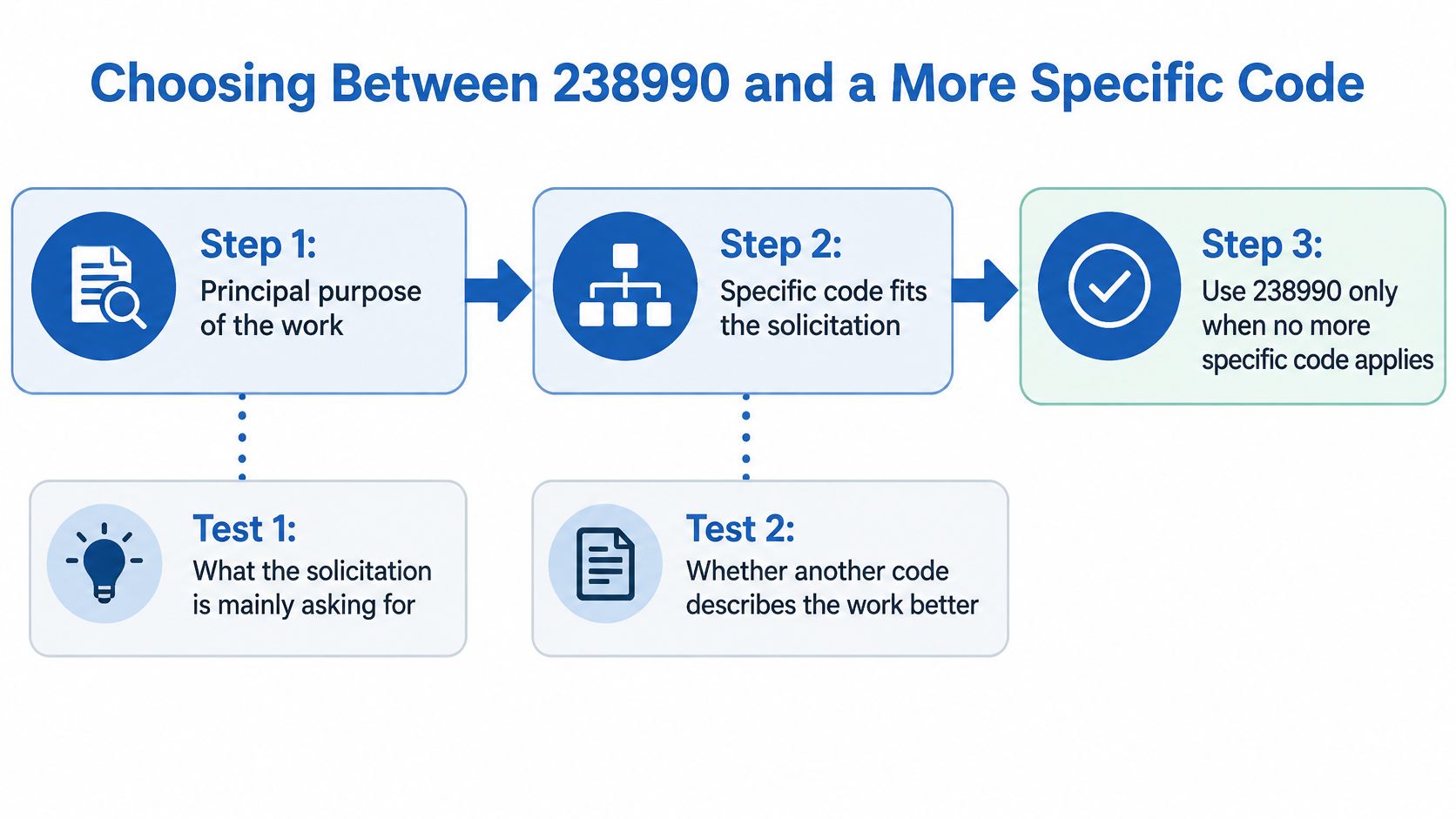
Start with the statement of work and identify the main deliverable. Then examine which trade supplies the principal activity, using the pricing schedule, task descriptions, and required performance as evidence rather than relying on the solicitation title.
Check the specific trade definitions before considering the residual category. If several trades are involved, examine whether one defines the principal purpose or whether a broader construction classification better describes the procurement.
For example, surface cleaning performed to prepare for a coating system calls for a different analysis from a standalone specialized blasting requirement. The shared word sandblasting doesn't settle the classification.
Keep secondary codes separate from eligibility
The available classification guidance doesn't settle whether a particular firm should list this as a secondary code in its registration. Confirm the applicable SAM.gov registration rules and discuss solicitation-specific uncertainty with the contracting office before relying on that approach.
A broader registration description can improve discoverability, but it can also make a capability profile less precise. Pair any residual classification with concrete descriptions of self-performed activities, equipment, relevant projects, and operating locations.
A code can help a buyer find your company. It can't explain which part of the requirement your company is qualified to perform.
Checking the NAICS Version Behind Any 238990 Data
Use NAICS 2022 as the current reference identified in the cited classification material, and check the vintage of every historical extract against the Census Bureau's version-specific industry entry. NAICS is reviewed on a five-year cycle, so a matching code number isn't enough to establish a consistent historical comparison.
Revision years you may encounter include 2007, 2012, 2017, and 2022. A revision can change industry boundaries, but don't assume that this particular code changed at every review.
Make comparability an explicit check
Compare the definitions. Determine whether the title, inclusions, exclusions, or boundaries changed between the vintages represented in your files. Save the relevant definition with the analysis.
Inspect award-record treatment. Check whether the database preserves the classification used when an award was recorded or maps records to another vintage. Don't infer that treatment from the database's publication date.
Flag revision crossings. When a comparison spans different vintages, document whether you established comparability. If you haven't, qualify the trend rather than presenting it as clean market growth.
Say a contractor count increases between classification revisions. Some of the difference could reflect establishments moving into the category rather than additional construction activity. Until you check the boundaries, you can't reliably separate economic change from classification change.
| Record Alongside the Dataset | What to Capture |
|---|---|
| Classification vintage | The NAICS version used by the records |
| Source database | The system and extract or report name |
| Extraction date | When you retrieved the records |
| Comparability note | Whether definitions and record treatment were checked |
Where practical, compare records within a consistent vintage. If you restate older records, preserve the mapping method so another analyst can reproduce the result rather than merely accept the chart.
Verifying the $19 Million Size Standard for Set-Asides
SBA size standards determine whether a concern qualifies as small for federal contracting. The SBA size-standard dataset reports $19.0 million in average annual receipts for this classification, subject to the regulation governing the relevant period. For a residual code like 238990, that check carries extra weight. The assigned code, the table version, and the receipts calculation all have to line up before any spending total becomes a reachable-dollar estimate.
Read the assigned code in the solicitation. Open the notice and attachments in SAM.gov, then identify the contracting officer's designation. The assigned code comes from that designation, so your company's internal industry label doesn't substitute for it.
Verify the governing SBA table. Check the applicable table and its effective date rather than relying on a search-result snippet or an old capability statement. Preserve the version you used and confirm which regulatory timing rule applies to the procurement.
Calculate average annual receipts under the applicable rule. Use the averaging period, receipt definition, and treatment of relevant transactions that the governing regulation specifies. Don't compare the threshold with current-year revenue alone.
Apply affiliation rules. Identify related concerns whose receipts must be included under the applicable rules. A standalone company calculation can give the wrong result when the offeror belongs to a larger affiliated group.
Reconcile the SAM.gov self-certification. Confirm that the representation matches the calculation and the concern's circumstances. Keep the supporting calculation available for review rather than treating the registration checkbox as the analysis.
Size is only one eligibility gate
A successful size calculation doesn't establish that the contractor can perform the requirement or qualifies for a particular socioeconomic program. Keep size eligibility, program eligibility, and technical acceptability as separate decisions.
For the broader distinction between reserved competition and unrestricted procurement, use this guide to small-business set-asides. Then return to the actual solicitation to identify the restrictions that apply to that opportunity.
A fencing indefinite-delivery requirement, for example, may demand relevant experience, geographic coverage, or other qualifications beyond small-business status. A facility-repair requirement may contain project-magnitude or certification conditions that a similarly sized contractor can't meet.
Bid qualification checkpoint: Passing the size test removes one potential barrier. It doesn't establish responsibility, satisfy the technical evaluation, or prove program eligibility.
Preserve the basis for the decision
Create an eligibility record containing the solicitation identifier, assigned classification, governing size-standard version, receipt calculation, affiliation treatment, and supporting representations. Add the technical and program requirements as separate checklist items with references to their attachment locations.
If a condition remains unresolved, give it an owner and a next action. Don't let an unverified eligibility assumption become an approved pursuit merely because the industry code looks right.
Reading Federal Spending Totals for 238990
A large industry total isn't an addressable market. The SpendingVault industry extract reports $619.7 million in FY2025 obligations and $5.46 billion across FY2024 through FY2026 records, but its scope includes grants and other awards rather than only contract opportunities.
| Reported Figure | Value | What It Does Not Show |
|---|---|---|
| FY2025 obligations | $619.7 million | The extract includes grants and other awards, not only contracts |
| FY2024 through FY2026 records | $5.46 billion | A combined multi-period figure, not annual contract demand |
| Award records | 4,275 | Not a single-year census of awards |
| Department of Defense share of multi-year total | About $4.92 billion | Large defense awards can dominate the aggregate |
| Set-aside versus unrestricted dollars | Not supplied in the extract | The competitive segment reachable by an eligible small business |
Treat these as a description of the extract, not an independently established measure of obtainable work. The record count doesn't tell you how many distinct competitions occurred, and the combined dollar amount doesn't tell you what remains available.
Concentration matters more than the headline
Say most of a contractor's search results concern large defense vehicles held by incumbents outside its operating territory. Those records may be useful for identifying buyers or potential teaming partners, but they don't establish a direct bidding market for that contractor.
Residual classifications intensify this problem because unrelated specialty activities can sit inside the same total. A change in aggregate obligations could come from work that has no technical connection to the firm's services.
Keep these distinctions visible:
- Obligations versus ceilings. Don't treat maximum potential vehicle value as money already committed.
- Historical awards versus active opportunities. A completed award informs buying history, not current availability.
- Prime awards versus subcontracts. Separate direct federal competition from potential supplier or teaming routes.
- Set-aside versus unrestricted competition. Identify the competitive conditions before describing dollars as reachable.
Then inspect agency, place of performance, incumbent, vehicle access, and award size. Each filter answers a different question about practical access, and none should be replaced by an industry-wide growth percentage.
The useful question is narrower than market size: Which portion is timely, competitively reachable, technically aligned, and eligible for this contractor? An analyst should be willing to report that the available extract can't yet answer it.
Researching the 238990 Market Step by Step
Build the market view from traceable records, not a dashboard total copied into a capture plan. Use a consistent research file so someone else can inspect your inclusions, exclusions, and unresolved assumptions.
Build the evidence set
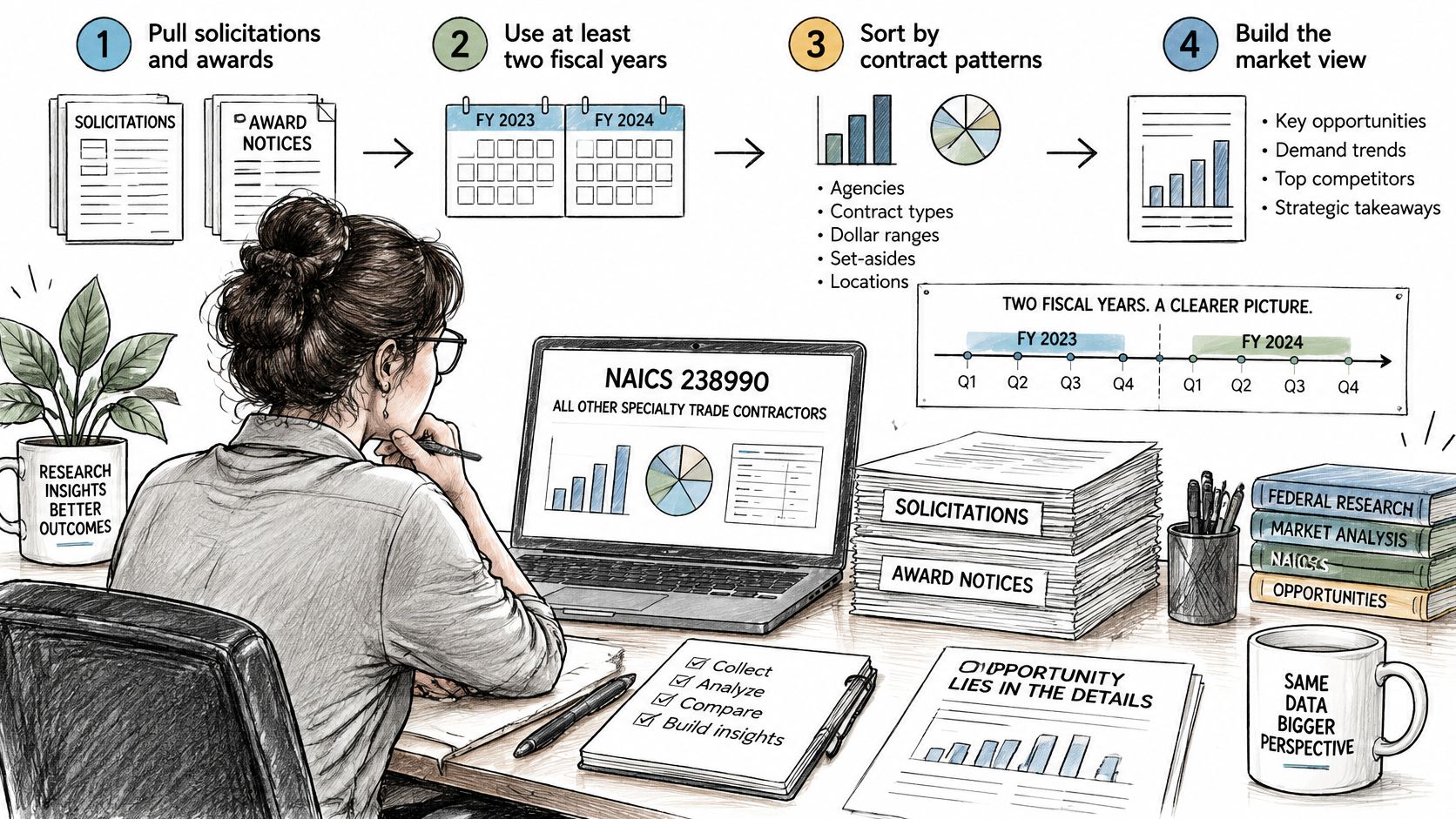
Pull solicitations and awards over a multi-year window. Include enough history to distinguish recurring purchasing from isolated activity. This produces a working inventory, not yet an estimate of available demand.
Record the classification vintage and source. Attach those fields before combining extracts. This is an easy check to skip, and skipping it can make older classifications appear current.
Separate the dollar measures. Put obligations, potential ceilings, and opportunity estimates in different fields. The output is a spending view that doesn't combine unlike measures.
Identify award type and participation route. Separate prime contracts from subcontract activity and exclude grants when evaluating contract demand. Keep potential teaming leads in their own list rather than deleting them as irrelevant.
Turn records into pursuit decisions
Map the buyers. Tabulate agencies, contracting offices, and places of performance. This produces a buyer list tied to the locations and requirements your company can serve.
Inspect incumbents and vehicles. Record the supplier, vehicle, ordering office, and any access constraints you can verify. This distinguishes an open-market prospect from work that may require a vehicle position or teaming relationship.
Qualify candidate requirements. Check the assigned classification, governing size rules, and attachment-level technical conditions. The result should be a documented bid/no-bid input, not merely a relevance score.
Log the pursuit and next action. Save the stage, owner, deadline, source record, and unanswered questions. Use a consistent federal business opportunity research process so discovery leads to action rather than repeated searching.
Don't force all records into a single reachable-dollar total. Keep directly pursuable opportunities, longer-term buyer intelligence, and potential subcontract routes separate.
A useful final worksheet also identifies why records were excluded. That makes the estimate auditable and lets the team revisit opportunities if its territory, certifications, vehicle access, or capabilities change.
Confirm the Code Before You Bid on 238990 Work
For a live opportunity, turn the research into a short decision record. Capture staff, estimators, and the person approving the bid should be working from the same solicitation and amendments.
Confirm the procurement basis
- Assigned classification. Verify the code shown in SAM.gov against the solicitation documents. Raise an apparent mismatch with the contracting office rather than substituting your preferred classification.
- Governing size rules. Confirm the applicable standard and regulatory version, then retain the calculation supporting the offeror's representation.
- Actual work fit. Compare the principal deliverable with the specific trade alternatives. Record why the residual category is appropriate or why the designation needs clarification.
- Reachable value. Exclude non-contract awards, ceiling-only amounts, and work outside the firm's practical reach before using dollars to justify pursuit effort.
The bid decision also requires a line-by-line review of experience, project magnitude, performance location, certifications, and other mandatory conditions. Use the distinction between RFPs and RFQs to organize the response, but let the procurement's own instructions determine what you must submit.
Our FederalPipeline market views provide annual spending, growth, buyers, set-aside and sole-source amounts, and winning companies; our capture briefs identify what's being bought, required clearances and certifications, the set-aside, incumbent, ceiling, and deadlines. Use those outputs to locate evidence and unresolved questions, not to replace the offeror's eligibility determination.
Approve a pursuit only when the team can explain both why it may compete and why it can perform.
Any research tool used to confirm classification, eligibility, or reachable dollars should be checked against the solicitation itself before the bid decision is made.
Use FederalPipeline to research the specialty-trade buyers, awards, and opportunities that match your actual capabilities, then save a qualified pursuit with a specific next action. Start with the Free plan to build your research file and alerts, and verify each candidate against its solicitation before committing estimating or proposal resources.