A blanket purchase agreement is a simplified federal arrangement with qualified suppliers for recurring needs, where orders are placed as needed and no minimum purchase is guaranteed. Capture teams still drop the ceiling into a forecast as if the buyer had already written the check.
Why does a signed vehicle look like booked work when the government has not promised to buy a single unit? The agreement opens the ordering channel. Each later call, and the funds behind that call, is what turns the channel into revenue. Hold that split and the paperwork starts to sort itself.
Blanket Purchase Agreements in Plain Terms
A blanket purchase agreement is a simplified federal purchasing arrangement in which an agency sets up a charge account with qualified suppliers for anticipated, repetitive needs, so it can order as requirements arise without running a new solicitation each time.
Blanket means one agreement covers many purchases. Purchase agreement means the commercial terms are settled before anyone places the first call. Federal rules describe the method as establishing “charge accounts” with qualified suppliers, so an office, installation, or project can obtain recurring supplies or services without creating an entirely new purchasing arrangement for every transaction, which is how 48 CFR 13.303-1 frames the tool.
The caveat is the part most introductions blur. The agreement sets the ordering framework, not a guaranteed quantity. Authorized users, covered products or services, prices or a pricing procedure, delivery terms, invoicing, and documentation live in that framework. Each order is the purchase, and the agency still has to keep obligations and expenditures inside available funds.
Why the channel is not the sale
For anyone tracking federal work, a BPA signals an established channel and recurring demand. Actual revenue depends on subsequent orders and funding. BPAs can be established under simplified acquisition procedures or against Federal Supply Schedule contracts, and the ordering activity must select contractor(s) representing the best value. The point is administrative efficiency: less repeated solicitation, with funding controls and documented decisions still in place.
Before you file the solicitation packet, edit and organize agency PDFs so the user list, the price schedule, and the ordering clause stay readable instead of buried in a scanned stack. Then test every vehicle you open with one question. Is this a BPA, a contract, or a schedule?
Practical rule: If nobody has placed a funded order, you don't have a sale. You have a channel.
How a BPA Sets Up a Charge Account
A BPA works like a standing account at a trade supplier. The department opens the account once, names who may buy, agrees the price list and the delivery rules, and then places a separate order each time it needs stock. Each order produces its own invoice.
Say a base facilities office expects to replace HVAC filters every month and can't predict the count. Winters are mild. Summers spike. The agreement covers the filter category, names the authorized facilities staff, and sets the price list plus delivery terms. In March the shop calls for 40 filters. In July a heat wave pushes the call to 90. Nothing on the signature page forced either number.
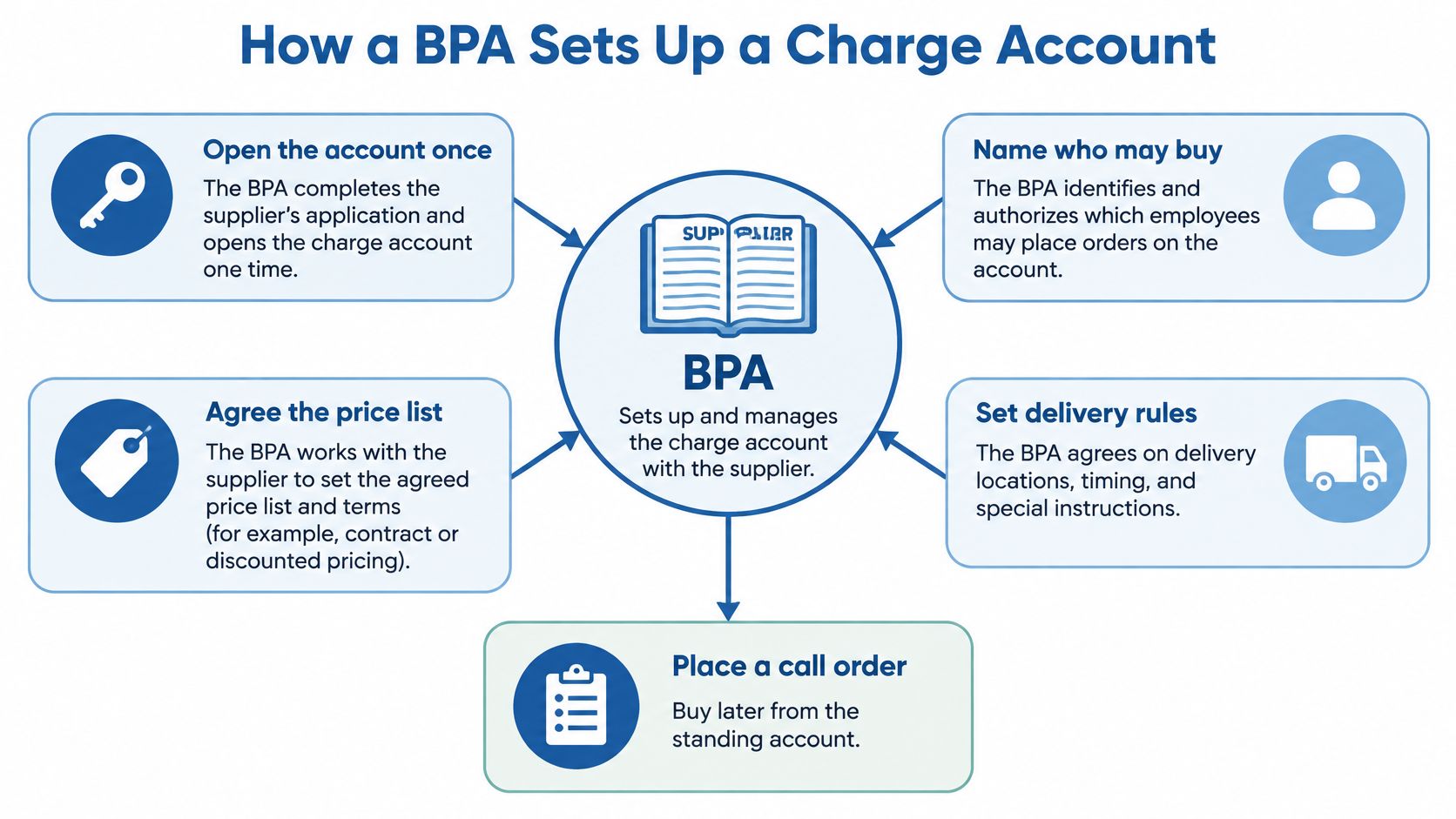
Set once, then set again on the call
The agreement defines users, the product or service category, pricing or a pricing procedure, delivery and invoicing rules, and the documentation each call must carry. The call fixes the quantity, the delivery date, and the funding it draws on. Funding is committed when the call is placed, not when the agreement is signed. A buyer can hold a perfectly valid BPA and still have no money obligated against it this quarter.
| Element | Set in the BPA | Set in each call |
|---|---|---|
| Authorized ordering users | Named in the agreement | Who places the specific call |
| Products or services | Covered category defined | Exact items and quantities needed now |
| Pricing | Fixed prices or a pricing procedure | Price applied to that call |
| Delivery and invoicing rules | Set once for all calls | Delivery date and invoice for that call |
| Funding | No guaranteed amount | Obligated when the call is placed |
Read the middle column as the standing account. Read the right column as this month's buy. A supplier who staffs to the signature, rather than to the calls, will be waiting on a dock that stays empty. The channel is real. The volume that reaches you is whatever the buyer funds, call by call.
How to Place a Call Against a BPA
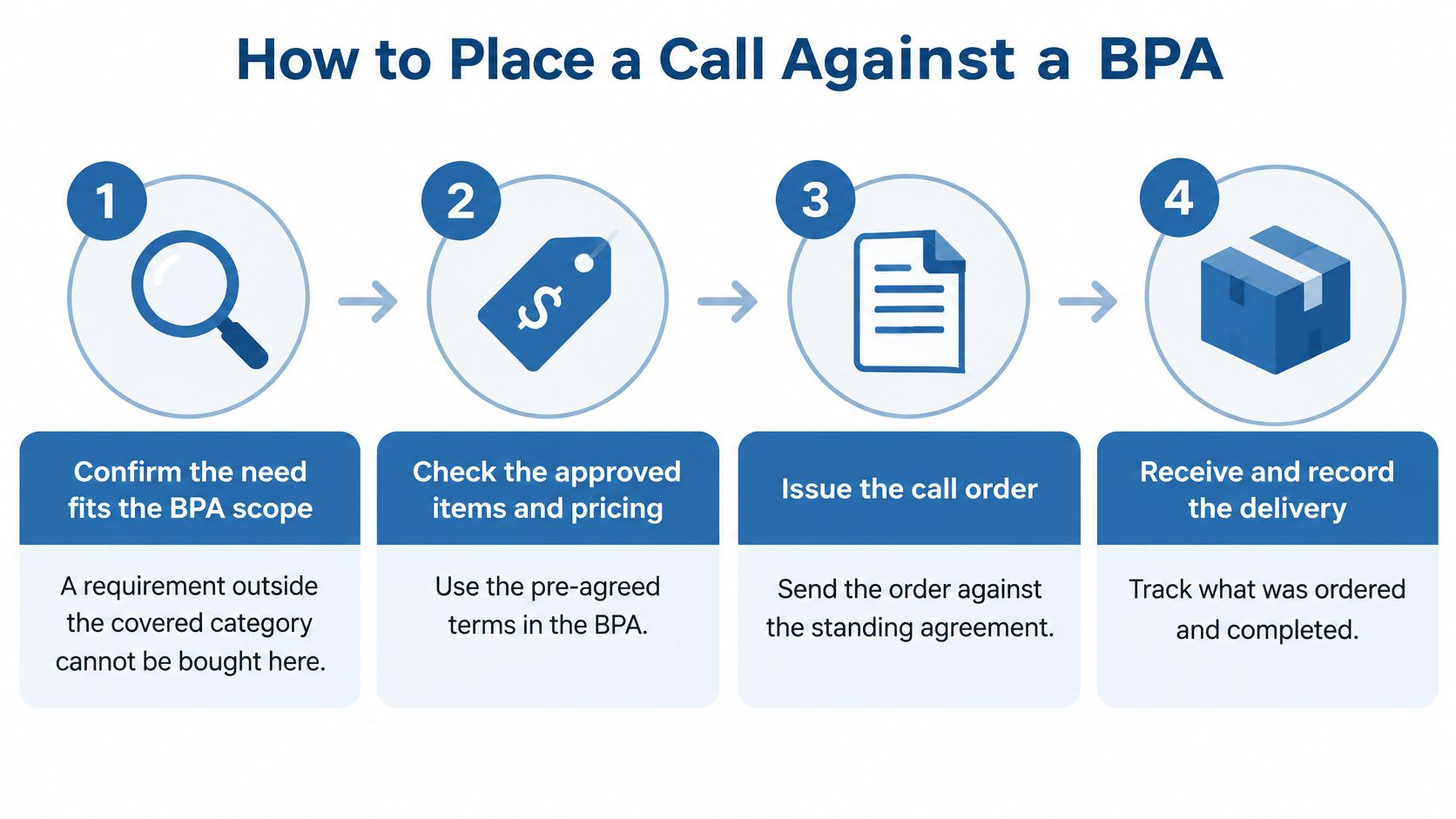
Ordering is a short sequence, and each step exists so the call stays inside the agreement and inside the money.
- Confirm the need fits the stated scope. A requirement outside the covered category can't be bought here. Filters on a filter BPA are fine. A chiller replacement is a different buy, even if the same shop needs it.
- Confirm the caller is an authorized user. The agreement names who may order. A well-meaning engineer who isn't on that list doesn't create a valid call.
- Check that funds are available for this amount. The order is what commits money. A polite email without an obligation behind it isn't a purchase.
- Select the supplier the structure requires. On a single-award BPA the call goes to the holder. On a multiple-award BPA you follow the ordering procedures written into the agreement, which may mean quotes from the pool or a best-value comparison.
- Issue the call with quantity, delivery date, and the BPA reference. That reference is how finance and the supplier tie the invoice back to the standing terms, the same way a line item on a contract line item number ties a price to a specific deliverable.
- Accept, deliver, invoice, and record. The supplier performs against that call. The buyer verifies receipt and keeps the documentation. Teams that already keep common project management documents in one place can drop the call, the receipt, and the invoice into that same file instead of starting a new folder every month.
A three-supplier month
Picture a pool of three filter suppliers. This month Supplier A is two days faster and a few cents under the others on the items the shop needs. The ordering procedures say the buyer requests quotes and picks best value. The call goes to A. Next month B might win it. Those stated procedures are what keep the pool fair, because a buyer can't feed every call to a favorite and still claim the agreement was competed at the order level.
The practical lesson for suppliers is uncomfortable and useful. Holding the agreement gets you into the pool. Responding quickly and cleanly to the individual call is what gets you the order.
Single-Award and Multiple-Award BPAs Explained
A BPA can name one supplier or several, and that choice changes where the next call goes. Schedule rules treat this as more than a paperwork preference. Under FAR 8.405-3, agencies may create BPAs under any schedule contract for repetitive supplies or services, and they must use best-value considerations such as price, past performance, delivery, warranties, maintenance, and special features. The same rule gives a formal preference, “to the maximum extent practicable,” to multiple-award BPAs rather than single-award ones.
The written-determination line
A single-award schedule BPA with an estimated value above $150 million, including options, cannot be awarded unless the agency head provides a written determination. The expected orders must be so closely related that only one source can reasonably perform the work, and the BPA must provide only qualifying firm-fixed-price orders with prices established for the products or specific services. For capture research, that dollar threshold signals unusually large single-provider arrangements that require detailed written justification. It is not a casual sole-source convenience.
A multiple-award BPA generally builds a pool of qualified contractors and requires stated procedures for placing orders among them. Competition, ceiling, ordering rules, and funding structure are what give the vehicle commercial value. The award itself isn't a guaranteed contract.
- Supplier count. One holder, or a pool.
- Default lean. Multiple awards, unless a stated reason supports one.
- Where the call goes. Straight to the holder, or through the written ordering procedure.
- Competition on the call. Little or none after award on a true single-award vehicle. On a pool, the procedure decides who is in the running that day.
When the BPA is single-award, the holder is the only ordering option. When it is multiple-award, read the ordering procedures before you assume any call belongs to a particular firm.
How BPAs Compare With Schedules and IDIQ Contracts
Picture two ways to buy the same filters for five years. An open tab has pre-agreed prices, and the buyer pays only for what it orders. A bulk membership has a guaranteed minimum the buyer must spend, plus a ceiling it can't exceed. The first picture is the BPA. The second is closer to an indefinite-delivery, indefinite-quantity contract, usually called an IDIQ.
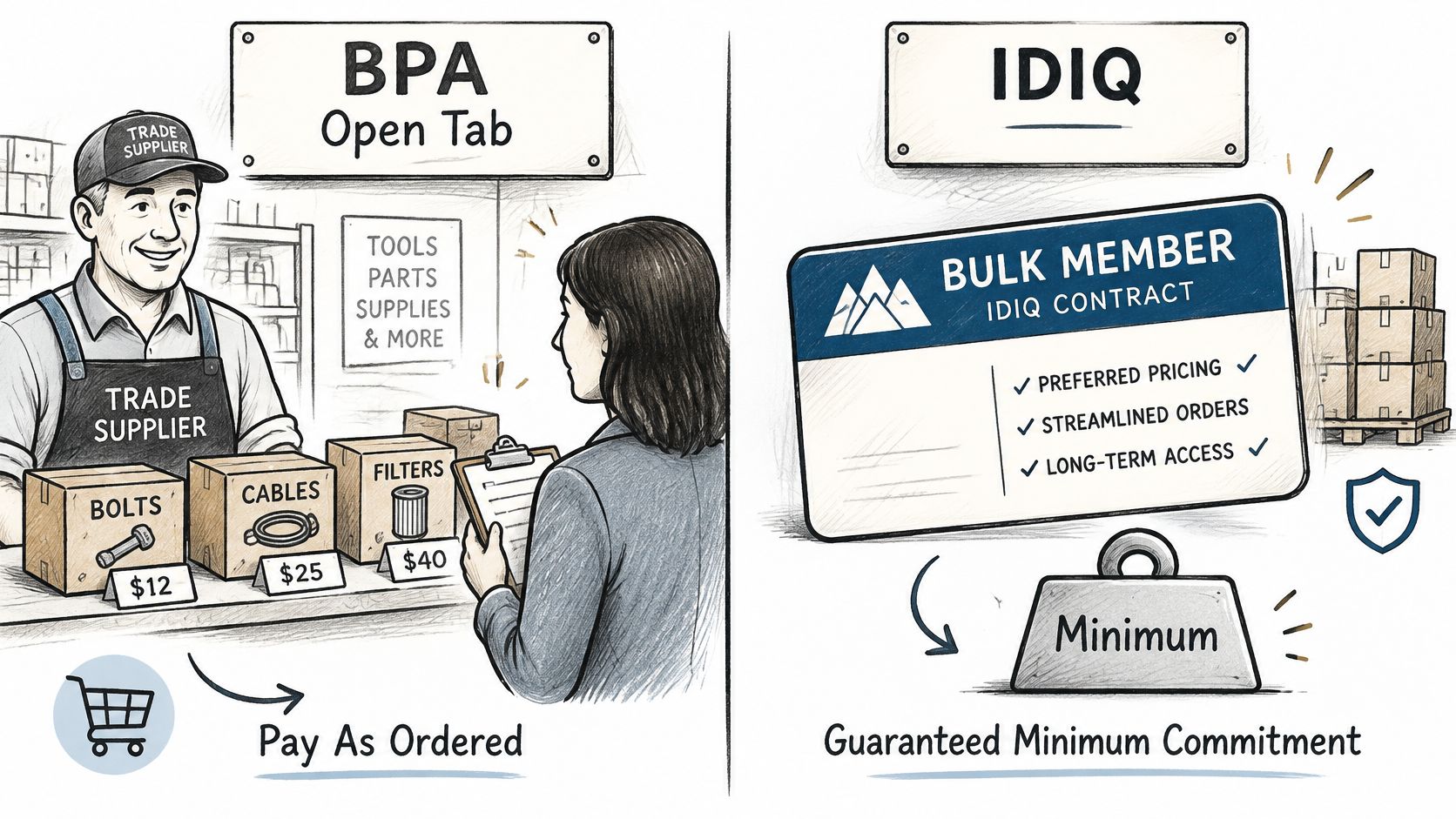
A Federal Supply Schedule is a contract vehicle with pre-negotiated terms for commercial supplies and services. A BPA can sit on top of a schedule, so the two are related rather than rivals. If you want the schedule's role spelled out on its own, the Federal Supply Schedule write-up is the cleaner place to start. An IDIQ, by contrast, pairs a guaranteed minimum with a maximum and then issues task or delivery orders over several years.
Which vehicle fits the need
Use the shape of the requirement, not the nickname on the cover sheet.
- Recurring, unpredictable volume, and no minimum wanted. A BPA fits. The buyer keeps flexibility and still avoids a fresh solicitation every month.
- A firm minimum across a multi-year scope. An IDIQ fits, because the minimum is the commitment and the ceiling is the cap.
- A commercial item with pre-set pricing. A schedule may be the channel, with a BPA layered on it when the same items will be ordered again and again.
- One known quantity, one time. A single purchase order is enough. Don't build a standing vehicle for a buy that won't repeat.
| Vehicle | Purchase commitment | How orders are placed | Typical use |
|---|---|---|---|
| Blanket purchase agreement | None guaranteed | Calls placed as needs arise | Recurring needs with unpredictable volume |
| Federal Supply Schedule contract | Not a purchase commitment | Orders placed under the schedule, or BPAs set up under it | Commercial supplies and services with pre-negotiated terms |
| IDIQ contract | Guaranteed minimum plus a ceiling | Task or delivery orders over several years | Multi-year work with a defined scope |
| Single purchase order | Fixed quantity for one need | One order for one requirement | Known, one-time purchase |
A short walk-through of how these vehicles show up in day-to-day buying makes the open-tab picture easier to keep straight.
Before you build a pursuit around a vehicle, read the minimum clause and the ordering clause. Those two sentences tell you what the agreement promises.
Misconceptions and a Pursuit Checklist
Four assumptions keep showing up in pipeline reviews, and each one inflates the opportunity.
A BPA guarantees revenue. It sets the ordering channel. Volume follows calls and the funding on those calls. A quiet year is still a valid agreement.
The ceiling is a promise. Say a supplier wins a multiple-award BPA with a $5 million ceiling and receives $200,000 in calls in the first year. That outcome is ordinary. The ceiling is a lid on what may be ordered, not a forecast of what will be ordered.
Winning removes competition. Orders still have to be competed or otherwise justified where the rules require it, and the stated ordering procedures decide how calls move across a pool. The award got you eligible. It didn't retire the buyer's choice.
A BPA carries a minimum the way an IDIQ does. It doesn't. That missing minimum is the defining commercial difference, which is why a ceiling without call history is a weak number to put in a revenue plan.
A BPA is a standing ordering framework, not a promise of volume.
Questions worth answering before you chase it
The signal to pursue is an established vehicle with recurring orders, not the mere existence of an agreement. The same judgment you use when you choose which facility RFPs to pursue applies here. A live channel beats a famous name on a cover page. Our contract vehicles data covers every IDIQ, GWAC, and BPA and shows who holds it and who orders through it, which is the fastest way to see whether the channel is moving.
Check these before you treat the vehicle as a revenue source:
- Scope. Confirm the covered products or services are ones you can deliver without a stretch.
- Structure. Identify single-award or multiple-award, then find the ordering procedures.
- Holders. See who has the agreement today and whether you would be joining a pool or displacing a single source.
- Call history. Review whether orders are being placed, and by which buyers.
- Funding path. Ask how the money is being appropriated, because a call without funds doesn't close.
Three questions decide the go or no-go. How many calls have been placed? Who holds the agreement? How are the funds being appropriated? If scope, structure, and call history line up, the pursuit is worth the bid cost. If any of those answers is still blank, don't commit the team yet. A federal business opportunity notice can look urgent and still sit on a vehicle that hasn't ordered in a year.
FederalPipeline connects BPA holders, the buyers placing calls, and the awards moving through those vehicles so you can see whether a channel is active before you staff a pursuit. Capture briefs pull out what is being bought, the clearance, set-aside and certifications, the incumbent, the ceiling, and every deadline, which is the same qualification work a BPA chase needs. Visit FederalPipeline and look up the vehicle before you put its ceiling in the forecast.