Stop chasing the biggest ceiling. That's the most popular advice in federal business development, and it misleads teams every quarter. Two solicitations can carry the same dollar value, yet one leaves you absorbing every cost overrun while the other reimburses allowable costs and exposes you to audit instead. The contract type decides that outcome before you write a word.
Federal buying is large enough that the distinction isn't academic. In FY2024, federal agencies reported approximately $755 billion in procurement obligations to the Federal Procurement Data System, according to the Congressional Research Service analysis of FY2024 contract types. Fixed-price arrangements accounted for approximately 57% of Department of Defense contract-award dollars and 63% of non-Defense dollars in that same analysis. Those are very different pursuits from cost-reimbursement work, even at identical award sizes.
Use this ranking of the Types of Government Contracts as a risk filter, not a glossary. Each entry below puts pricing structure and cost risk side by side, so you can test fit early. Ask who pays when actual costs move, what your accounting system must prove, and whether fee depends on a formula, a subjective grade, or hours billed. If you can't answer those three questions, you're not ready for a bid or no-bid call.
1. Firm-Fixed-Price (FFP) Contract
A firm-fixed-price contract sets one price that doesn't move because your costs moved. Under the Federal Acquisition Regulation Part 16, fixed-price contracts place substantially more performance-cost responsibility on the contractor. Deliver under budget and you keep the difference. Deliver over it and the loss is yours.
That's why FFP fits commercial items and mature production, where requirements and unit costs are stable. Think GSA Federal Supply Schedule orders for office equipment, routine purchases of commercial IT hardware and software licenses, or Military Department production buys of standardized items with established unit prices. The agency gets certainty, and you get freedom from cost audits, but you also get no relief valve.
What You Must Prove Before Bidding
Your estimate has to survive contact with suppliers, labor, and option years. Before you commit, review how fixed-price contracting evaluation and pricing interact, then test your model against the solicitation.
- Section L and M discipline: FFP awards are often decided heavily on price, so read evaluation criteria before you polish technical volume.
- Economic price adjustment check: Confirm whether an adjustment clause or option periods protect you, or whether year three is priced at year one costs.
- Benchmark discipline: Use FPDS and USAspending award data to test your unit price against similar buys.
Practical rule: If you can't price uncertainty, don't call an FFP opportunity simple.
2. Fixed-Price Incentive (FPI) Contract
Start with the numbers, because they're easy to misread. This infographic breaks the moving parts into target cost, target profit, and ceiling price.
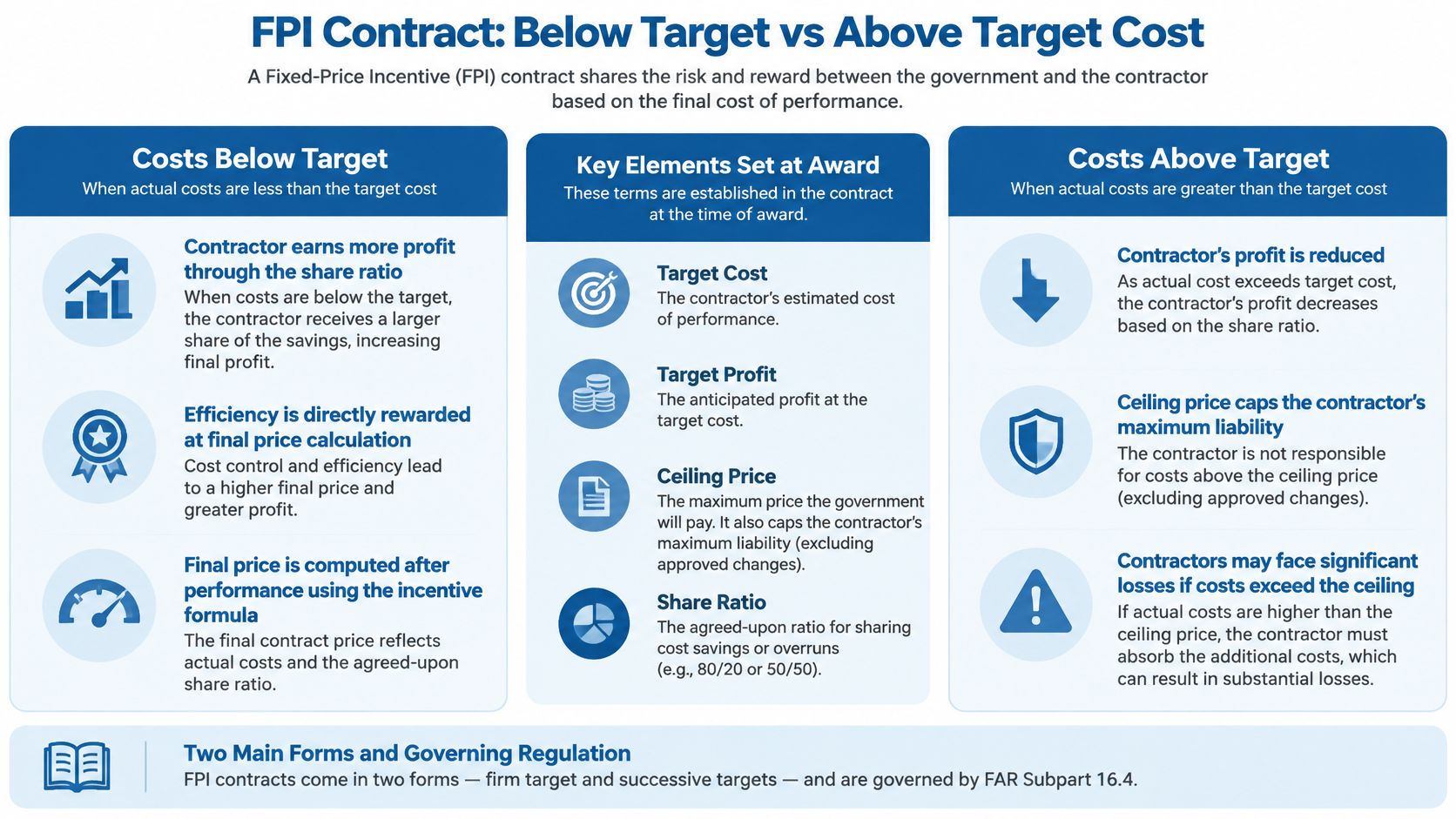
An FPI contract uses a share ratio to compare actual cost to target cost. Come in below target and your profit rises. Come in above target and it falls, until the ceiling price transfers the remaining risk to you. Risk sits between the two parties rather than on one, which is the point of the structure.
That split suits moderate cost uncertainty, especially defense production for weapon systems, aircraft components, shipbuilding, and missile programs where the government wants cost discipline without putting all uncertainty on you. FPI is a common pricing structure across major defense acquisition programs for exactly that reason. If you're weighing whether a solicitation fits, FAR Subpart 16.1 on selecting contract types lays out when contracting officers reach for incentive pricing over firm-fixed-price or cost reimbursement.
This walkthrough shows how the share line changes profit as costs move.
Model at least three cost outcomes before bidding: your expected case, a credible overrun, and a credible underrun. Then check where each one lands against the ceiling. Confirm your accounting system produces reliable cost data, because the share ratio only rewards you if you can prove what you spent. I wouldn't pursue FPI work without that model.
3. Cost-Plus-Fixed-Fee (CPFF) Contract
Picture a research team that can't price the outcome in advance. That's CPFF territory. The government reimburses allowable costs and pays a fixed fee negotiated at award, and that fee doesn't change when actual cost changes. The government carries most cost risk, which is why you'll see CPFF on NASA space science experiments, DoD basic and applied research with universities, and level-of-effort studies.

The trade is administrative, not pricing, risk. You need a DCAA-adequate accounting system, clean segregation of allowable versus unallowable costs, and documentation that survives audit. If you're still building your cost model, LiveDocument's cost plus pricing walkthrough helps you see how costs and fee separate before you add federal allowability rules.
Qualification Checks That Matter
Check fee limits under FAR 15.404-4 when you build the proposal, and verify your billing and estimating systems before price discussions start. A firm with immature cost data can win CPFF work on paper and lose money through disallowed costs later. Track research funding lines early, because these requirements often look uncertain until a program office defines the study scope.
4. Cost-Plus-Incentive-Fee (CPIF) Contract
CPIF looks like CPFF until the fee starts moving. You still get reimbursed for allowable costs, but the fee adjusts by formula based on actual cost against target cost, inside minimum and maximum limits.
The Government Accountability Office description of cost-plus-incentive-fee contracts describes contractor compensation adjusting against target costs, potentially increasing or decreasing fees based on cost performance. That single mechanism changes your bid behavior. A target set too low doesn't look aggressive, it caps your realistic fee.
Where CPIF Works and Where It Bites
Agencies use CPIF for advanced aircraft and missile development, NASA space systems with cost and schedule incentives, and prototype efforts where technical uncertainty is real but cost discipline still matters. You need to control the incentivized variables, not just report them.
- Fee formula first: The share ratio tells you how much each dollar of variance is worth.
- Target realism: Challenge any target cost your engineers can't defend with data.
- Metric tracking: Many CPIF contracts add technical or schedule incentives, so cost tracking alone won't protect fee.
Compare prior CPIF award structures for the same program office when you can. It shows how aggressively that buyer sets targets.
5. Cost-Plus-Award-Fee (CPAF) Contract
Your fee here depends partly on judgment, not just math. CPAF reimburses allowable costs, pays a base fee, and adds an award fee based on the government's evaluation against an award-fee plan. That evaluation can be subjective, objective, or both.
You'll see this structure on NASA center operations and management contracts, Department of Energy national laboratory contracts, and large services programs where quality, management, and customer satisfaction are hard to capture in a single metric. The government accepts cost risk, but you accept evaluation risk.
How Strong Teams Protect Award Fee
Read the award-fee plan before you price the work. It tells you which criteria carry weight and how often you'll be graded. During performance, document results, customer feedback, and corrective actions throughout each period, not in the week before the board meets.
Communication matters more than many capture teams admit. If evaluators raise a concern in month two and hear nothing until month five, you've already shaped their score. Benchmark typical fee outcomes in FPDS and USAspending for similar work, but don't assume a strong technical proposal guarantees a strong award fee later. I treat CPAF as a relationship and evidence contract, because that's what determines whether the fee pool reaches your bottom line.
6. Time-and-Materials (T&M) Contract
T&M pays for time at fixed hourly rates plus materials at cost. The labor rate already includes wages, overhead, general and administrative expense, and profit. Because total hours can't be estimated precisely, the contract needs a ceiling price and active government monitoring.

This fits IT help desks, staff augmentation, short-term engineering support, and emergency technical assistance where scope is uncertain. It's a poor fit when the work could be defined and fixed-priced, which is why FAR 16.601 justification matters. Review the mechanics in this guide to time-and-materials contracts before you build rates.
Build each labor category carefully, because you can't go back and add overhead you forgot. Then track hours and ceiling use weekly. Teams get in trouble when burn rate looks fine in aggregate but one labor category is consuming the ceiling early. Set internal alerts well before you need a stop-work conversation, and confirm labor categories and ceilings in the capture brief before you staff a proposal team.
7. Indefinite-Delivery/Indefinite-Quantity (IDIQ) Contract
An IDIQ is permission to compete for revenue. The base contract sets the period, the minimum guarantee, and the ceiling, then agencies issue task or delivery orders as needs arise. The guaranteed piece is the minimum. The ceiling is room to order, and the bidder carries the cost of staying eligible while volume is uncertain.
Structure changes the odds. A single-award IDIQ can become a durable stream if you win, but losing ends the play. A multiple-award IDIQ spreads eligibility across holders, so a seat only earns the right to compete for each order on price, past performance, and response time. Ordering rules, minimums, and fair-opportunity procedures sit in FAR Subpart 16.5 on indefinite-delivery contracts.
Examples include Navy SeaPort-NxG and Army multiple-award vehicles for engineering, IT, and logistics support. If you are choosing where to put pursuit time, compare BPA vs IDIQ structures before you price the effort.
Forecast Orders, Not Ceilings
Judge the vehicle by funded order flow: ordering agency, awardees, ordering procedures, and historical order volume. Keep capability statements and past performance ready, because order competitions move fast. A large ceiling with no order history is weaker than a smaller vehicle with steady funded tasks.
8. Blanket Purchase Agreement (BPA)
A BPA is simpler than an IDIQ, and that simplicity can mislead new sellers. It's a charge account style agreement for anticipated repetitive needs, often under FAR Part 13 simplified procedures or on a Federal Supply Schedule. The BPA itself doesn't guarantee a quantity.

Typical uses include GSA Schedule BPAs for office supplies and IT products, agency BPAs for laboratory supplies and maintenance, and military base BPAs for recurring parts and consumables. Your risk isn't cost growth on one large task. It's volume risk. You may win the agreement and receive few calls if ordering offices prefer another holder or your prices drift.
- Terms review: Confirm ordering limits, duration, and whether any minimum is promised.
- Price freshness: Keep catalog and labor pricing current, because buyers compare quickly.
- Buyer tracking: Identify which agencies order, not just which agency signed the BPA.
Set saved searches in your NAICS codes for new BPAs. These vehicles reward vendors who stay visible and easy to order from.
9. Governmentwide Acquisition Contract (GWAC)
A GWAC extends the IDIQ idea across government. One agency establishes the vehicle, many agencies order through it, and the managing agency oversees holders and terms. That reach is valuable, but only if your services fit the vehicle's scope.
Known examples include GSA OASIS+ for professional services, NASA SEWP for IT products and services, and NITAAC CIO-SP4 for IT solutions. Each order still carries its own pricing structure, often FFP, T&M, or cost-reimbursement, so the GWAC label doesn't tell you who bears cost risk. The task order does.
Before You Chase a GWAC Seat
Map your NAICS codes and service categories to the vehicle's domains first. Then examine current holders, order volumes, and incumbent relationships to judge whether you'd be a credible competitor or just a name on a list.
Winning access to a vehicle and winning orders on that vehicle are two separate sales problems.
Factor GWAC fees and reporting requirements into pricing. Prepare short, responsive task order materials in advance, because deadlines are often tight and buyers already know the established holders. I recommend pursuing a GWAC seat only when you can name likely ordering offices, not just a governmentwide ceiling.
10. Other Transaction Agreement (OTA)
OTAs sit outside the FAR, and that's both the appeal and the trap. Authorized agencies, mainly within the Department of Defense, use them for prototype projects and certain follow-on production under 10 U.S.C. 4021 and 4022. Terms can be customized, timelines can move faster, and nontraditional companies can compete without building a full FAR contracting apparatus first.
You'll see Defense Innovation Unit prototype OTAs with commercial technology firms, DARPA technology demonstrations, and Army and Air Force rapid capability experiments. Payment is often milestone based, so your proposal needs clear deliverables, test points, and acceptance logic.
Don't treat flexibility as informality. Confirm the agency and program have OTA authority for the work, and read intellectual property, data rights, and follow-on production language carefully. Those terms are negotiable in ways FAR clauses usually aren't, which means your team has to know what to ask for.
Engage program offices early. OTA opportunities may not appear as standard solicitations, and waiting for a posting can mean the problem statement was shaped without you. Track budget lines and prototype programs so you know which offices are funding experimentation before an announcement appears.
How the 10 Federal Contract Types Compare on Pricing and Risk
| Item | Pricing Structure | Cost Risk Holder | Typical Use | Governing Reference |
|---|---|---|---|---|
| Firm-Fixed-Price (FFP) Contract | Fixed price; generally not adjusted for actual costs | Primarily contractor | Well-defined commercial buys and mature production | FAR Subpart 16.2 |
| Fixed-Price Incentive (FPI) Contract | Target cost and profit with a share formula and ceiling price | Shared; contractor exposure is capped by the ceiling | Defense development and production with moderate cost uncertainty | FAR Subpart 16.4 |
| Cost-Plus-Fixed-Fee (CPFF) Contract | Reimbursed allowable costs plus a fixed fee | Primarily government | Research, development, and uncertain level-of-effort work | FAR Subpart 16.3 |
| Cost-Plus-Incentive-Fee (CPIF) Contract | Reimbursed allowable costs; fee varies with cost performance within set limits | Shared, with government bearing much of the cost risk | Development work with cost-control incentives | FAR Subpart 16.3 |
| Cost-Plus-Award-Fee (CPAF) Contract | Reimbursed allowable costs plus base fee and performance-based award fee | Primarily government | Complex work where quality is difficult to measure objectively | FAR Subpart 16.4 and 16.405-2 |
| Time-and-Materials (T&M) Contract | Fixed labor rates plus materials at cost, subject to a ceiling | Primarily government, with ceiling and oversight controls | Uncertain-scope technical or short-term services | FAR Subpart 16.6 |
| Indefinite-Delivery/Indefinite-Quantity (IDIQ) Contract | Pricing established at award or through order competition; orders subject to minimum and maximum limits | Depends on pricing terms; government generally guarantees only the minimum | Recurring or uncertain requirements ordered as needs arise | FAR Subpart 16.5 |
| Blanket Purchase Agreement (BPA) | Pricing established by agreement or at order; no guaranteed purchase volume | Vendor bears risk of receiving no orders; government commits through orders | Repetitive, simplified purchases | FAR Subpart 13.3 |
| Governmentwide Acquisition Contract (GWAC) | Vehicle pricing with task or delivery order pricing | Depends on the vehicle and order terms | Governmentwide IT and professional-services purchases | FAR Subpart 2.1 definitions and FAR Subpart 16.5 |
| Other Transaction Agreement (OTA) | Negotiated terms; may use cost-sharing or milestone-based payments | Depends on negotiated terms | Prototypes, technology demonstrations, and eligible follow-on production | 10 U.S.C. 4021 and 4022 |
Choose the Contract Type Before You Chase the Award
Make contract type your first qualification filter, ahead of ceiling value, agency logo, or incumbent gossip. Pull the pricing structure from the solicitation, then ask four direct questions. Who pays when costs rise? Can your estimating system defend the price or target? Can your accounting system support allowable cost billing and audit? Can you measure and control whatever the fee formula rewards? If any answer is no, that's a bid blocker or a teaming requirement, not a detail to fix after award.
That discipline matters most for small businesses, where a set-aside label can look like an open door. SBA materials note that competitive set-asides generally apply when at least two small businesses can perform the work, as explained in SBA guidance on types of contracts. The government's broad small-business prime-contracting goal is 23%, but that aggregate goal doesn't prove a specific opportunity is reachable for your firm. Check the NAICS size standard, your 8(a), HUBZone, WOSB, or SDVOSB status where relevant, and limitations on subcontracting before you assume a smaller bidder pool means an easier win.
Next, separate vehicle access from funded demand. For IDIQs, BPAs, and GWACs, record holders, ordering offices, historical orders, period of performance, and whether the award is single or multiple. A vehicle with active ordering and a narrow holder pool deserves more capture time than a huge ceiling with thin history. For direct contracts, compare the incumbent's pricing structure and past modifications. They often reveal whether scope stayed stable under FFP or kept shifting under cost-reimbursement terms.
Build a simple scoring sheet and use it on every notice. Score cost risk, accounting burden, incentive control, cash-flow exposure, and order probability from one to five. Say a small IT services firm compares a fixed-price help desk with vague ticket volumes against a T&M task with clear labor categories and a firm ceiling. The fixed-price award may look cleaner, but volatile volume makes it riskier. The score makes that trade visible before proposal costs start.
Set up tracking before solicitations drop, not after. FederalPipeline can be one option for connecting vehicle holders, ordering activity, budgets, buyers, and award records in a single research workflow. That connection matters because the earliest signal is often a budget line or a prior task order, not the final notice. We flag bid blockers up front, including the incumbent, prior contract, and requirements pulled from attachments, so your team can qualify the pricing risk while there's still time to shape or walk away.
Don't let a familiar agency name override an unfamiliar risk structure. The best capture teams I trust decide fit in this order: contract type, eligibility, vehicle access, competitive field, then solution. Put dollar value last, where it belongs. A smaller award on terms your company can perform profitably beats a larger award that transfers uncertainty you can't price, document, or control.
Use FederalPipeline to research contract vehicles, holders, ordering activity, budgets, and capture briefs before you commit bid resources to the wrong pricing structure. Check eligibility, incumbents, ceilings, and bid blockers in one place, then build a pipeline around opportunities your cost model can carry.