A GSA contract is a long-term, governmentwide contract between the U.S. General Services Administration and a commercial supplier, most often a Multiple Award Schedule contract, that lets federal agencies buy prepriced products and services through later orders.
The popular advice to get a Schedule and start selling skips the hardest part: finding buyers with funded requirements your business can fulfill. Treat the award as an ordering channel that needs active management, not the finish line of your federal sales effort.
What a GSA Contract Is and Why Agencies Use One
The Multiple Award Schedule (MAS) also goes by the names Federal Supply Schedule and GSA Schedules Program. Buyers using any of them mean a single purchasing framework, so your company qualifies once rather than applying to three separate programs.
A Schedule works like an approved-supplier list at a wholesale club. Suppliers accept the membership terms and pricing boundaries upfront, and each customer still decides what to buy and when. Joining the list puts your catalog on the shelf; no one is obligated to fill a cart.
A Schedule provides prequalified, prepriced access. It does not provide a sales guarantee.
GSA negotiates offerings, labor categories, and ceiling prices in advance so agencies can place orders afterward. Above the micro-purchase threshold, buyers generally review offerings or price lists from at least three Schedule contractors, subject to applicable exceptions and agency procedures, according to GSA's MAS Ordering Quick Reference Guide.
That setup lets agencies run recurring commercial purchases without a full standalone negotiation each time. It pools government buying power while each agency keeps responsibility for choosing the offer that fits its requirement, which means schedule holders still compete for every order.
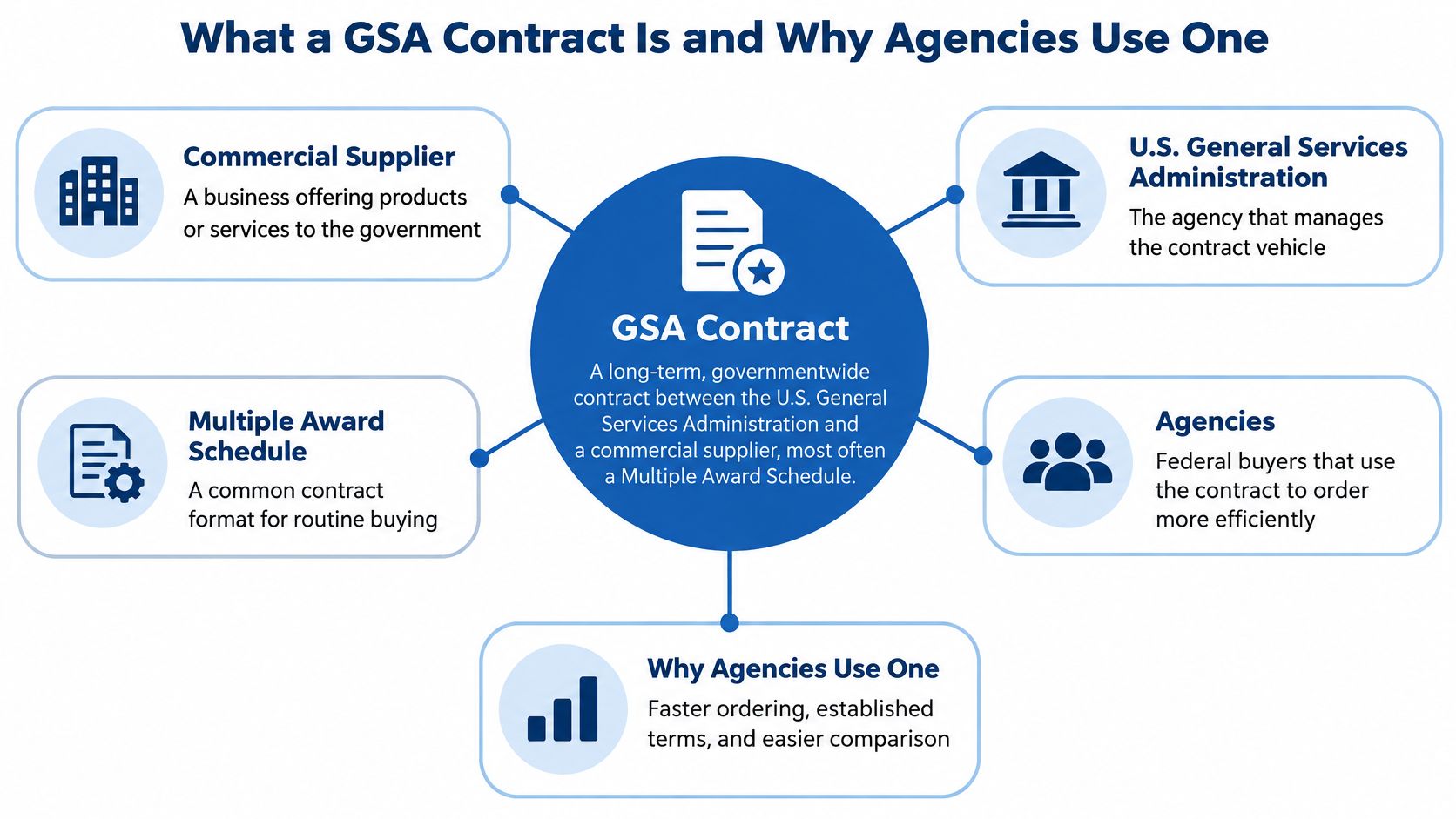
What the business receives
Your awarded catalog defines the products or services you may offer, including approved labor categories and pricing boundaries. This arrangement suits businesses selling commercial technology, professional services, equipment, or supplies to multiple federal customers.
If the wider buying process is new to you, understanding how government procurement contracts work helps separate the base agreement from the orders placed under it. Orders also come with document and signature steps; the guide to eSignatures for government contracts covers that workflow, though each agency prescribes its own signing process.
The core distinction is eligibility versus purchasing: GSA builds the framework, and customer agencies decide what to order.
Schedule, BPA and Task Order
| Vehicle | What It Is | Guaranteed Orders? | Who Sets Price | Typical Use |
|---|---|---|---|---|
| GSA Schedule (MAS) contract | Prequalified governmentwide contract with catalog and ceiling rates | No | GSA negotiates ceiling prices | Recurring commercial buys across many agencies |
| Blanket purchase agreement (BPA) | Agreement set up against a Schedule contract for repeated needs | No | Based on Schedule rates and agreed terms | Frequent buys from a chosen vendor or group of vendors |
| Task or delivery order | A specific purchase placed under a Schedule contract or BPA | Yes, once a valid order is placed, subject to its terms | Agreed for that order within Schedule terms | A specific requirement |
| Direct agency contract | Standalone award through the agency's applicable solicitation process | Yes, once awarded, for the stated commitment | Established through the procurement for that requirement | Requirements procured outside the Schedule channel |
GSA contract vehicles compared by what they guarantee: the important difference is whether the document establishes a purchasing arrangement or commits the agency to a defined purchase. Even an awarded order carries performance, acceptance, and payment conditions.
A Schedule contract establishes your catalog and contract terms. GSA's Vendor Support Center guidance distinguishes Schedule eligibility and negotiated pricing boundaries from subsequent agency requirements, evaluations, and order-level actions. Your company still needs to match the actual work to its awarded scope.
A blanket purchase agreement organizes repeat purchasing. A buyer might establish a Schedule BPA for recurring technical support rather than rebuild the administrative arrangement for each request. A BPA can include multiple suppliers, so don't assume the buyer has selected an exclusive vendor. Understanding what a blanket purchase agreement is helps you investigate who can receive purchases under that arrangement.
Find the document that commits the purchase
A task order typically specifies services, while a delivery order typically specifies products. These documents identify what the agency is buying and the applicable performance or delivery terms. For revenue planning, examine the actual commitment rather than treating a potential maximum as booked sales.
A direct agency contract is a separate procurement path, not a step underneath your Schedule. An agency may use it when the requirement falls outside Schedule scope or another acquisition approach better suits the purchase. Don't assume every standalone contract involves negotiation or that every large requirement must bypass MAS.
When a solicitation mentions a BPA, check:
- Underlying vehicle: Is it a Schedule BPA or another type of agreement?
- Scope: Does the relevant Special Item Number, or SIN, cover the requirement?
- Participation: Does your company hold the required contract or agreement?
For recurring needs, buyers may use a BPA; for a defined purchase, they may issue an order directly under a Schedule. Access is the entry ticket. The purchase commitment is the sale.
How Agencies Order Through a GSA Schedule
Schedule orders follow dedicated procedures under FAR Subpart 8.4, rather than the standard negotiated-procurement process. The agency buying your services, not GSA's central contracting team, defines the requirement and makes the order-level selection.
GSA states in its MAS solicitation materials that Schedule purchases account for approximately 21% of overall federal procurement spending, representing about $42 billion annually. That makes MAS an important channel, but not the entire federal market.
The ordering path moves from a defined need to a documented purchase.
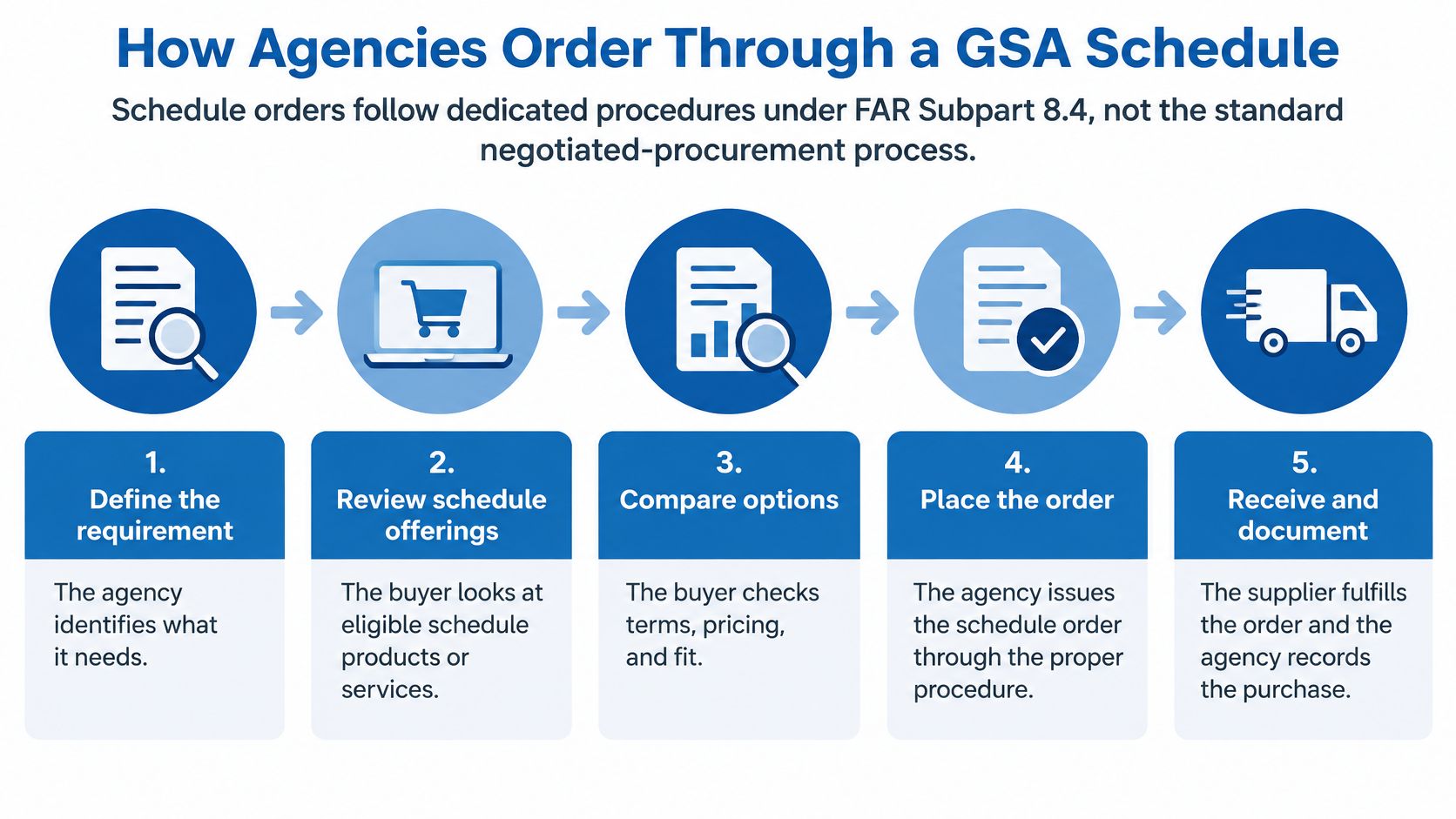
Follow the requirement through to delivery
The agency defines the requirement. The buyer identifies products, deliverables, staffing needs, or a statement of work. Read the deliverables before deciding you're qualified. A familiar project title can conceal unfamiliar technical obligations.
The buyer checks Schedule scope. The agency identifies the applicable contract coverage and SINs. Your company can perform a service commercially and still lack the awarded Schedule scope needed to quote it through MAS.
The agency reviews eligible offerings or requests quotes. The review or competition procedure follows the applicable ordering rules, value, and circumstances. Don't assume an existing relationship excuses you from providing a complete, responsive quote.
The buyer compares price and value. Depending on the purchase, the agency conducts comparative price analysis, documents its best-value decision, and justifies restrictions on consideration. Help the evaluator connect your quoted labor categories, quantities, and rates to the work requested.
The agency issues the purchase document. This may be a task or delivery order, or a purchase under an established BPA. Confirm the authorized scope, delivery schedule, acceptance requirements, and invoicing instructions before beginning performance.
The contractor performs and invoices. Deliver against the order's requirements and retain supporting records. Don't substitute products or staffing arrangements just because they appear equivalent to your team.
Prepare before the buyer asks
Keep a quote-readiness file containing your current catalog, SIN-matched products or labor categories, relevant experience, and a pricing worksheet. Use the worksheet to show how each quoted element connects to the requested work and your awarded terms.
For example, a cybersecurity quote should map the requested functions to the appropriate awarded labor categories, not offer a blended consulting rate. The easier you make that comparison, the less clarification the buyer needs to determine whether your offer fits.
Three Real-World Examples of Schedule Access
The three scenarios below are composites built from common patterns, not reports about specific companies. Each one holds the same variable constant (the contract itself) and changes what the business does with it. The differences in outcome come from relationships, catalog quality, and follow-through, not from the award.
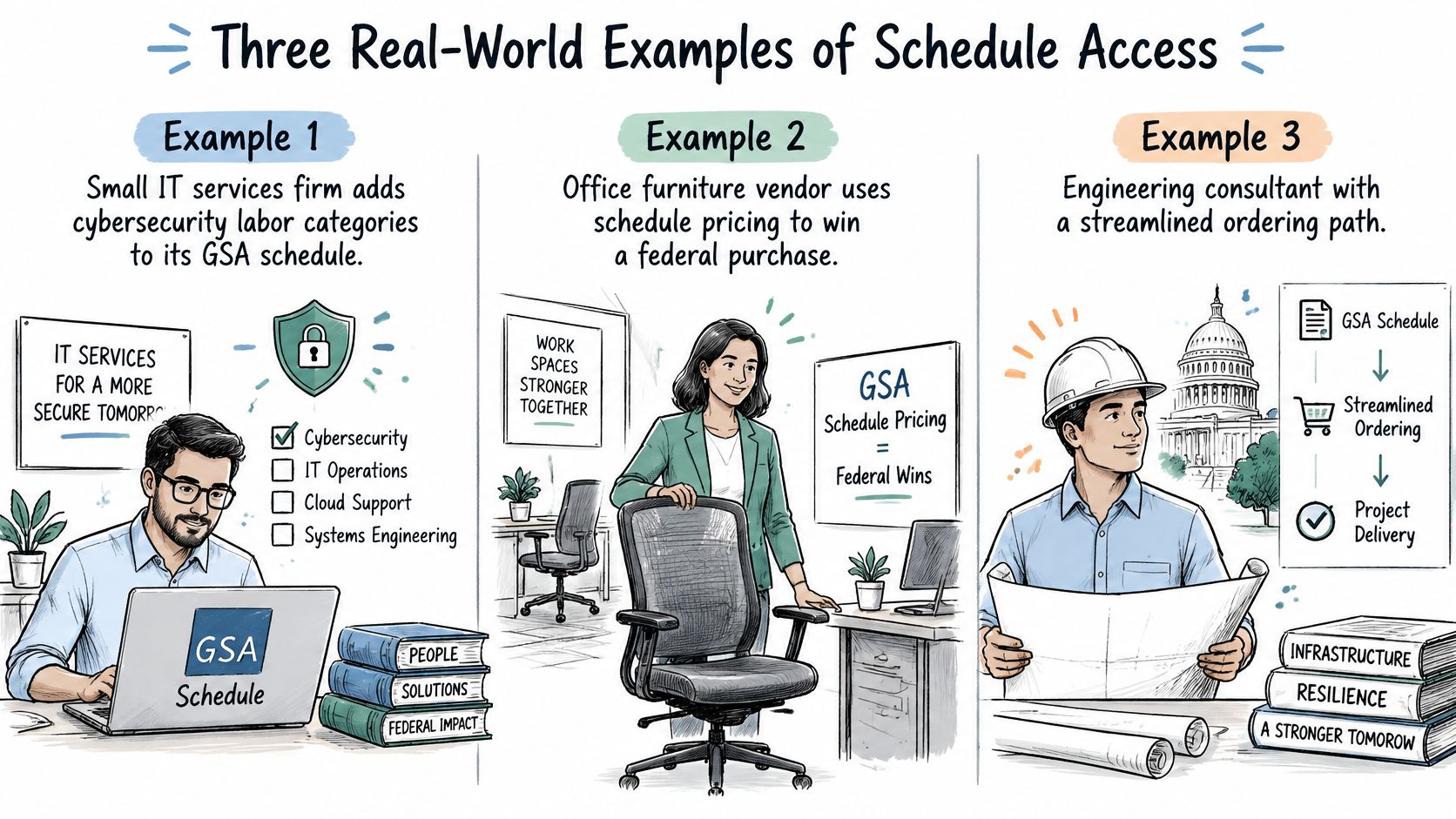
The IT firm that maintains buyer contact
A small IT services firm wins approval for cybersecurity labor categories. Its business development lead keeps answering agency market-research questions and discussing capabilities with prospective buyers. Months later, an agency that already understands the firm's experience requests a quote for work matching those categories.
The Schedule works here like a storefront lease. Signing it gives you a legal place to sell, but foot traffic still has to be generated. The agency returned because the firm stayed visible while the requirement was forming, so its name was already attached to the problem when the quote request went out.
Practical lesson: Use the award to support buyer conversations, not replace them.
The reseller that makes comparison easy
An office equipment reseller builds a catalog with recognizable product descriptions, consistent model identifiers, and explicit delivery information. Buyers from different agencies can match a requested item to the catalog without reconstructing the offer from scattered attachments. The reseller receives purchases because its offer is straightforward to evaluate, not because its prices are the lowest on file.
Scope boundaries matter just as much as catalog clarity. If an equipment requirement also calls for removal or disposition of old units, confirm whether that work sits inside your awarded scope before quoting it. When it falls outside, handle it as a separate line of work; a service such as Reworx Recycling business solutions handles electronics recycling and repurposing, which you can treat as its own arrangement rather than an assumed part of the equipment order.
What to copy: Make product matching easy, and verify any accompanying services before including them in a quote.
The consultancy that neglects order requests
A management consultancy announces its award, then leaves opportunity monitoring unassigned. Quote requests the firm could have answered pass without review, and staff later learn that target buyers route much of their purchasing through existing BPAs. The company holds access to a channel but has no method for spotting and pursuing the work moving through it.
The fix is procedural, not strategic. Assign a primary owner and a backup for incoming notices, buyer follow-up, and bid decisions. For each opportunity that surfaces, record which path leads to it: your Schedule contract, an established BPA, or a different vehicle entirely. A one-line routing note per opportunity is enough to show where your effort belongs.
What to avoid: Don't confuse appearing in a supplier directory with being positioned to win an order.
Common Misconceptions About GSA Contracts
The most costly misconception is that a Schedule award guarantees sales. It can encourage a business owner to invest in contract access before checking whether target agencies buy the company's offerings through that channel.
The distinctions below separate purchasing eligibility from commercial demand.
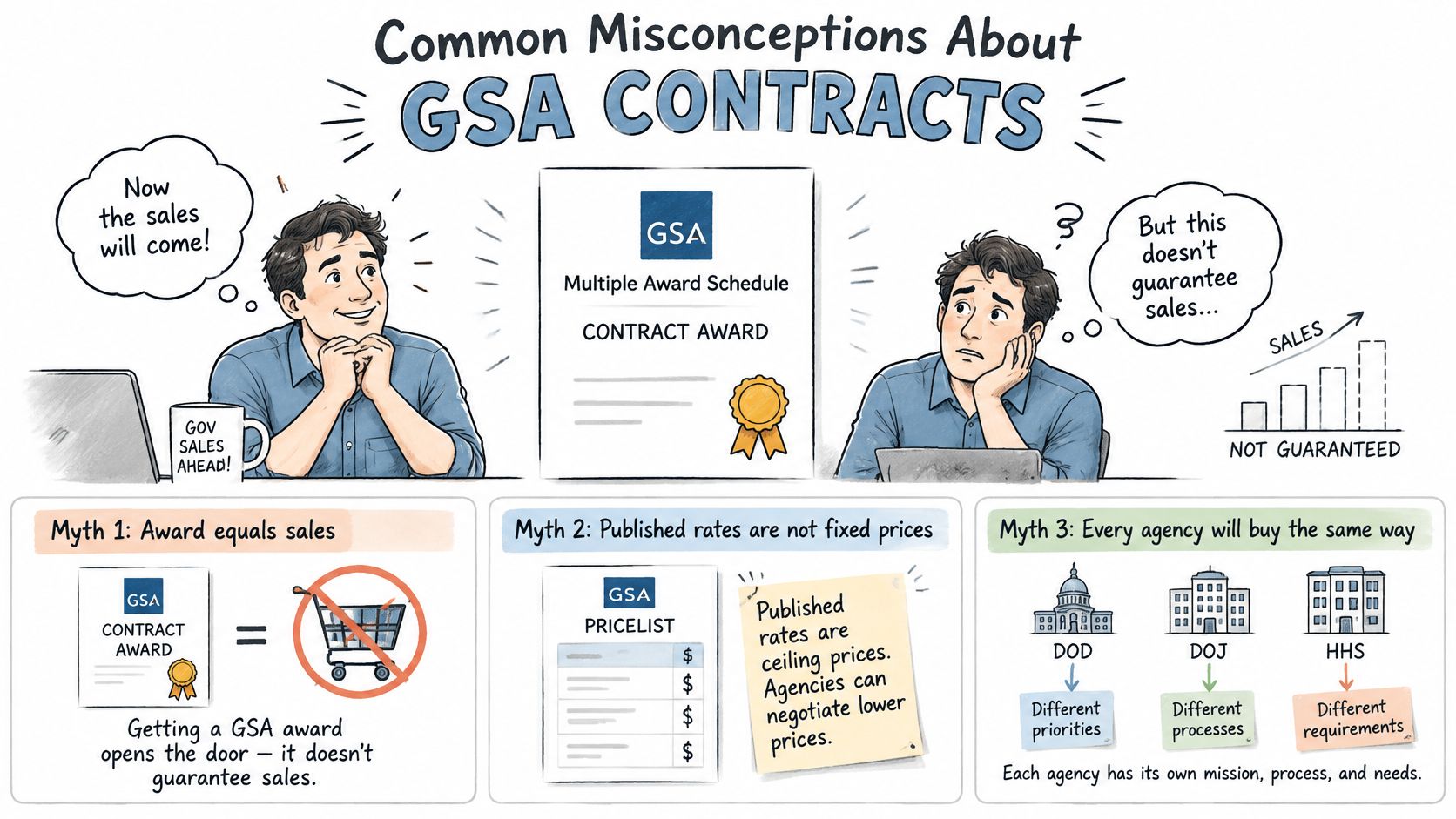
Correct the assumptions before building a forecast
A published rate isn't necessarily the final order price. A catalog entry doesn't tell you the complete staffing mix, quantities, delivery conditions, or technical requirements of a purchase. Build your forecast from a qualified requirement and a defensible quote, not from multiplying a catalog rate by hoped-for demand.
An award doesn't make you a preferred vendor. An agency still needs a reason to select your offer. Relevant experience, a clear technical approach, and an accessible purchasing route matter more than an announcement that your company now holds a Schedule.
MAS isn't exclusively for federal buyers. GSA's Multiple Award Schedule program overview identifies eligible federal, state, local, and tribal buyers, while separately describing ways suppliers pursue government business. Eligibility matters: don't assume every public entity can use every Schedule offering.
A Schedule is prequalified access, not a pipeline.
The following video offers an additional way to approach the topic.
Validate demand before forecasting sales
Start with agency buying history. Identify the purchasing offices that repeatedly buy what you sell, the suppliers receiving those awards, and the vehicles used.
Then examine forecasts and requests for information (RFIs) for emerging requirements. An RFI is an opportunity to understand and inform market research, not a purchase commitment. Check whether the relevant SINs and North American Industry Classification System (NAICS) classifications align with the actual work, rather than relying on a broad industry label.
Keep a buyer qualification note with the recurring requirement, incumbent supplier, likely purchasing route, and next research action. If you can't name prospective buyers who purchase your offering, pause the revenue forecast and investigate demand before treating the award as a business-development strategy.
Keeping Your Schedule Terms Current
Award day is when the paperwork starts changing. GSA periodically refreshes the solicitation behind every Schedule, and those refreshes update program terms and generate mass modifications for existing contractors. Your award may also carry category-specific clauses and exceptions layered on top of the standard terms.
Two GSA resources help you track this. eLibrary publishes current solicitation terms, while Contracts Online shows your specific award, its clauses, and any exceptions. Together they cover provisions such as small-business subcontracting plans and commercial-product or commercial-service subcontracts. Rely on your actual award and modifications to determine your obligations, because a generic MAS summary can miss the terms that apply to your SINs.
Give contract monitoring a named owner
A modification can take effect on its own schedule, whether or not anyone at your company has read it. Assigning one person the job of watching for changes keeps that from becoming a surprise.
Schedule a monthly review. Check refresh notices and clause updates, and act on modification notifications as they arrive rather than waiting for the calendar date. Some modifications carry their own response deadlines.
Retrieve the current award, modifications, and exceptions from your contract records and Contracts Online. Keep them in one place so pricing staff never quote from a superseded version.
Compare changes against your SINs. Read the relevant category requirements and clauses, then record whether a change affects your catalog, pricing method, reporting, subcontracting, or quote preparation.
Maintain a change log with the date received, required action, responsible person, and completion evidence. When a provision is unclear, record the question and get an answer before acting on an assumption.
Brief the people who bid and bill. Translate each change into specific instructions for quote templates, approval steps, and invoicing checks. Filing a modification accomplishes nothing if staff keep working under superseded terms.
Check pricing before every quote
Compare your current awarded ceiling rates with the requested work, delivery conditions, and proposed discounts. Confirm the products or labor categories are awarded under your contract, and that the quote reflects the latest modification rather than the version from last quarter.
The routine serves a simple purpose. The person preparing an offer should be able to answer two questions without hesitation: what the company may sell, and which terms govern this particular purchase.
Decide Whether a GSA Contract Fits Your Business
A Schedule deserves serious consideration when your business meets these practical conditions:
- Commercial offering: You sell products or services that fit an identifiable Schedule category.
- Repeat demand: You can identify agencies that regularly purchase comparable work.
- Administrative capacity: Someone can maintain catalog pricing, modifications, and compliance records.
- Response capacity: Your team can assess requests and serve multiple buyers without neglecting performance.
Map your offerings to relevant SINs, then examine purchasing history and incumbent suppliers. Read forecasts, RFIs, and budget documents to investigate requirements before solicitations appear, and set saved searches for the classifications you need. A disciplined federal business opportunity search should test fit, not merely collect notices.
For equipment-related work, investigate disposal obligations before quoting removal services. Beyond Surplus's guide to electronics disposal rules for public agencies is a useful starting point for identifying questions to resolve against the agency's actual requirements.
Pursue a Schedule when buyer demand and operating capacity support it. If target agencies buy through standalone contracts, pursue that route instead. If they use BPAs, investigate participation and underlying vehicle requirements rather than assuming a BPA bypasses Schedule eligibility.
Before investing in an application, build a short list of recurring buyers and document how they purchase your offering. That work gives you a defensible answer to whether this channel fits your business.
We provide capture briefs that identify what's being bought, required clearances, set-asides and certifications, the incumbent, the ceiling, and every deadline. We also connect defense budget lines to program and contracting offices so you can investigate demand before a requirement reaches SAM.gov. Visit FederalPipeline to research prospective buyers and qualify opportunities before committing to a Schedule strategy.