If a defense program has money in the budget, why can't your capture team find a solicitation for it? Because a DoD budget justification explains what the department wants to fund, not necessarily what a contracting officer is ready to buy.
The books are useful precisely because they appear before many purchasing decisions become public. Read them as a map of proposed work, then check the map's blind spots: funding status, program ownership, acquisition timing, and the route through which a buyer might place an order.
What a DoD Budget Justification Is
A DoD budget justification is the set of official materials the Department of Defense submits to Congress to explain requested funding by component, account, program, and budget line. Think of it as an itemized purchase plan, with explanations of the intended work and the organization responsible for it, rather than a list of available contracts.
Say your company supplies engineering support for personnel systems. Searching a department-wide spending headline won't tell you much. A justification book can help you identify the responsible defense organization, the proposed capability, and the work the organization says it needs to perform.
The packaging matters
The materials come in specialized justification books and data books, covering research, development, test and evaluation; operation and maintenance; military construction; family housing; working-capital funds; and classified programs. A book is a collection of related explanations and tables, while a volume is one part of that collection.
The Defense Human Resources Activity RDT&E justification book, for example, identifies the FY2026 Defense-Wide material as Volume 5 of 5 and presents Budget Estimates and Justification Data Submitted to Congress dated June 2025. Those cover-page labels help you establish which submission you're reading before extracting anything.
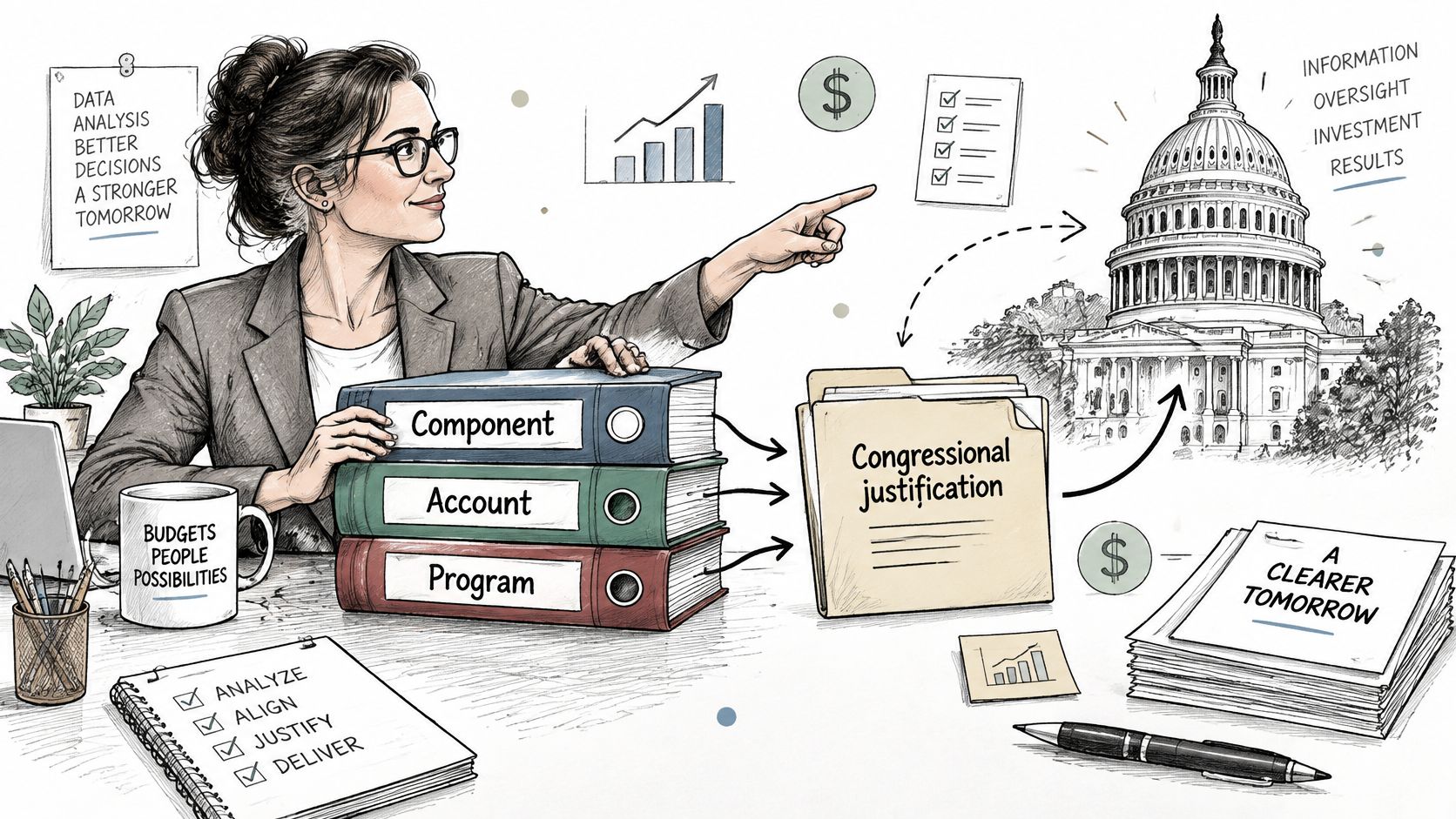
For a contractor, the important connection is proposed dollars to intended work to organizational responsibility. That connection gives you a starting point for investigating demand before a solicitation names the requirement.
Practical rule: Treat a justification book as evidence of government intent, not permission to put an opportunity into your bid forecast.
Document extraction can help, but the template must match the document. Matil's resource to extract data from Modelo 036 illustrates a separate, form-specific extraction use case, not a defense-budget parser. For budget books, preserve the appropriation, exhibit, identifier, and page alongside the extracted text so another analyst can verify the interpretation.
Which Justification Book Holds Your Line
Start with the type of work, not the most recognizable program name. An appropriation is a funding category established through law for particular purposes. Selecting the right appropriation book narrows your search to the tables and narratives that explain those purposes.
For research, development, test and evaluation, abbreviated RDT&E, open the R-1 first. An exhibit is a standardized budget table or explanation, and the R-1 organizes funding by program element, an identified development effort. The DoD Financial Management Regulation's RDT&E guidance describes this standardized structure and the identifiers used to trace development funding.
Read from the index into the project
Use the program-element index to locate the title, R-1 line reference, and page. Then move into the R-2 budget-item justification and R-2A project justification to understand the work beneath the summary.
A common mistake starts when a contractor finds a familiar title and stops. The title may describe a portfolio, while the project narrative identifies the actual technical effort. Read the identifier and description together.
Justification books and the exhibits to open first
| Appropriation book | What it funds | Exhibit to open first | Where the detail sits |
|---|---|---|---|
| Research, development, test and evaluation | Development, prototypes, testing and analysis | R-1 program element list, then R-2 and R-2A | Program-element index with R-1 line numbers and page references |
| Procurement | Equipment buys and production quantities | P-1 summary | Procurement line-item justification and supporting schedules |
| Operation and maintenance | Readiness, services and sustainment | O-1 summary | Separate Volume II data book |
| Military construction | Facilities and construction projects | C-1 summary | Individual project justification sheets |
| Family housing | Housing operations, leasing and improvements | Family housing summary tables | Family Housing Improvement Fund tables |
| Classified programs | Activities not shown in public volumes | Public summary, if disclosed | Separate classified volume, Volume III in the O&M submission |
The summary exhibit helps you locate the line; the detailed backup helps you interpret it. Don't expect every appropriation family to use the RDT&E hierarchy, and don't assume a summary provides enough information to qualify an opportunity.
Record the book name, component, volume, exhibit, and printed page before quoting a figure. Keep the PDF page location too, because printed page labels and a viewer's page counter may differ. That small habit makes your research reproducible and prevents a number from losing its context when it moves into a spreadsheet or capture brief.
Funding Columns That Change the Reading
A funding request becomes meaningful when you compare it with the other columns in the same exhibit. First check the table's fiscal-year labels and units. Don't assume every book presents the same years or expresses dollars in the same scale.
Read the prior-year actual as the reported historical amount, using the exhibit's accounting basis. It isn't automatically a measure of payments delivered to contractors, and it doesn't prove that the program executed exactly as planned. The appropriated amount records what Congress provided for the labeled fiscal year, which may differ from what the department originally requested.
Funding columns and what each one signals
| Column | What it shows | Reading to act on |
|---|---|---|
| Prior-year actual | Reported historical funding or execution amount | Establish the historical baseline and check the accounting basis |
| Appropriated amount | What Congress provided for the labeled fiscal year | Compare with that year's request to identify cuts or additions |
| Current-year estimate | The department's current estimate for that fiscal year | Investigate differences from the enacted baseline |
| Budget-year request | Amount requested for the next budget year | Examine the change from the current estimate |
| Price changes | Cost adjustments built into the request | Separate price effects from changes in work |
| Mandatory versus discretionary | Funding supported through different legislative mechanisms | Track each funding component's legal status separately |
Separate more money from more work
The current-year estimate updates the department's view of the ongoing year. A difference from the appropriation deserves investigation, but it isn't, by itself, proof of execution failure. Look for the explanation before labeling it a risk.
The budget-year request describes the proposed next step. Read it beside price changes, which can explain why the requested dollars rise without a corresponding expansion in deliverables. A larger request doesn't necessarily mean the buyer needs more units, more engineering hours, or another supplier.
Funding type matters just as much. Discretionary resources and mandatory resources shouldn't be merged into an undifferentiated opportunity estimate when their legislative paths differ.
Read the change in work before estimating the change in addressable revenue.
For pursuit research, write a short explanation beside the amount: expanded scope, price adjustment, revised schedule, or unresolved change. If you can't identify the reason, mark it as unknown rather than turning the difference into a sales assumption.
Worked Example from the FY2026 Books
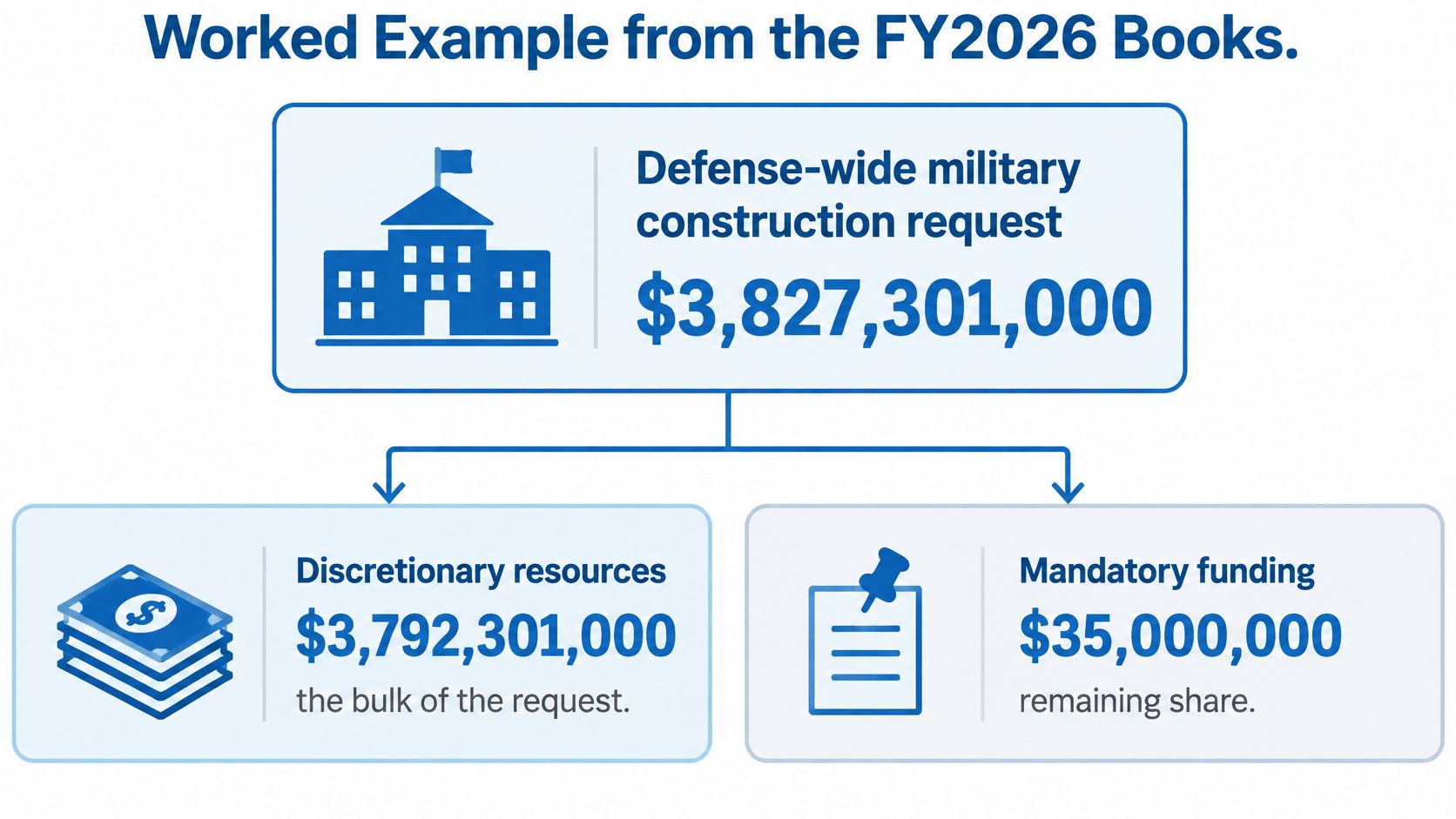
Begin with the labels, then check the arithmetic. The FY2026 materials report a Defense-Wide Military Construction total request of $3,827,301,000, consisting of $3,792,301,000 in discretionary resources and $35,000,000 in mandatory reconciliation funding supporting design requirements; the Defense-Wide justification materials also report a $5,143,000 family housing operation and maintenance request excluding leasing and an $8,315,000 Family Housing Improvement Fund administrative request.
The military construction check is straightforward: discretionary resources plus mandatory reconciliation funding equals the total request. But the analytical value lies in retaining the split. Design requirements don't establish an immediately available construction contract, and the funding categories require separate status checks.
Don't combine amounts with different purposes
The family housing amounts illustrate a different trap. An operation and maintenance request excluding leasing and a fund administrative request aren't interchangeable measures of housing-related contracting demand.
Before adding them, ask what question the combined amount would answer. If you're assessing maintenance work, an administrative funding line may not belong in your addressable-market calculation. Likewise, the explicit leasing exclusion tells you that the maintenance figure isn't a complete housing spending total.
Use a compact reconciliation note:
- Scope: State exactly which activities the amount includes and excludes.
- Funding type: Preserve discretionary and mandatory labels wherever the exhibit provides them.
- Purpose: Distinguish design, operations, administration, and implementation work.
- Arithmetic: Add only components that the document identifies as parts of the same total.
The Base Realignment and Closure, or BRAC, material adds another useful distinction: implementation costs, anticipated land-sale revenues, and expected savings answer different questions. A projected saving isn't a purchasing budget, and expected revenue isn't a contract opportunity.
For any candidate line, the repeatable check is simple: confirm that the stated components reconcile, then identify what each component supports. A correct total can still produce a poor forecast when the analyst assigns every dollar to the same kind of work.
How to Trace a Line to Its Program and Buyer
Tracing a line requires connecting budget evidence to acquisition evidence. The program organization explains the requirement, but the contracting office conducts the purchasing action. Those roles may sit in different parts of the department.
Build a traceable record
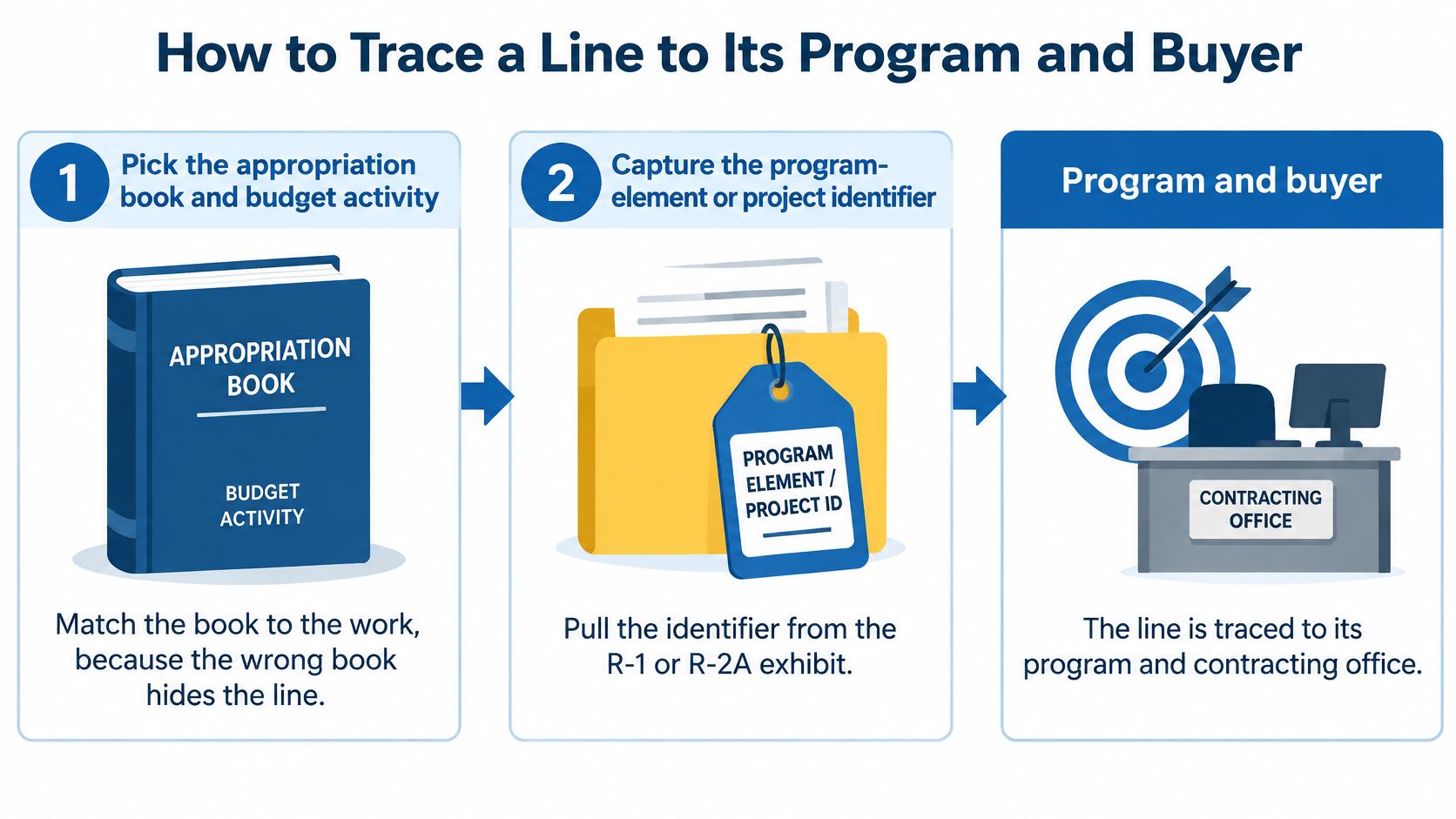
Pick the appropriation book and budget activity. A budget activity is a subdivision within an appropriation that groups related work. Match it to your capability, rather than searching only for a system name that might appear across development, procurement, and sustainment.
Capture the program-element or project identifier. Copy it exactly from the relevant exhibit, along with the title and page. Don't rely on title matching alone, and don't assume that a continuing identifier means the underlying scope never changes.
Record the fiscal-year profile. Capture the historical amount, current estimate, request, and any out-year projections, meaning planned amounts beyond the budget year. The usual slip is recording only the largest figure and losing the sequence that explains it.
Write down the capability or milestone. Look for a test event, integration task, prototype, software delivery, or deployment objective. “Supports modernization” is too broad to test against your company's offering; a defined deliverable gives you something concrete to investigate.
Identify the program owner and purchasing organization separately. Map the program office, its program executive office, or PEO, where applicable, and the contracting office. Don't label a technical point of contact as the buyer unless purchasing records support that conclusion.
Cross-check the acquisition record. Search solicitations, awards, and relevant ordering arrangements for evidence that the work is already being purchased. A related award may reveal an incumbent or an existing route to market, not a new open competition.
Separate an inferred buyer from a confirmed buyer
Say a project narrative calls for integrating a prototype into an operational environment. That supports investigating integration expertise, but it doesn't identify the purchasing office or prove that the work will be competed separately. Search the program name, identifier, technical terms, and known office names in acquisition records.
Use the federal business opportunity research guide when moving from budget investigation to public purchasing notices. Match the requirement's substance, not just shared words in the title.
Audit note: Mark the buyer as confirmed only when a public acquisition record establishes the connection. Otherwise, label the office as a research lead.
Finish with a single record containing book and page | identifier | funding profile | milestone | program owner | contracting office | evidence | next action. Keep unresolved fields visible. An explicit gap is more useful than a guessed buyer that later becomes an unsupported assumption in a capture plan.
Why a Budget Line Is Not a Contract Forecast
The common assumption is that a funded-looking line represents an approved purchasing plan. It doesn't. A requested dollar is an executive proposal, and even a program that survives congressional review may not generate a new solicitation.
The process includes distinct decisions, not a single approval.
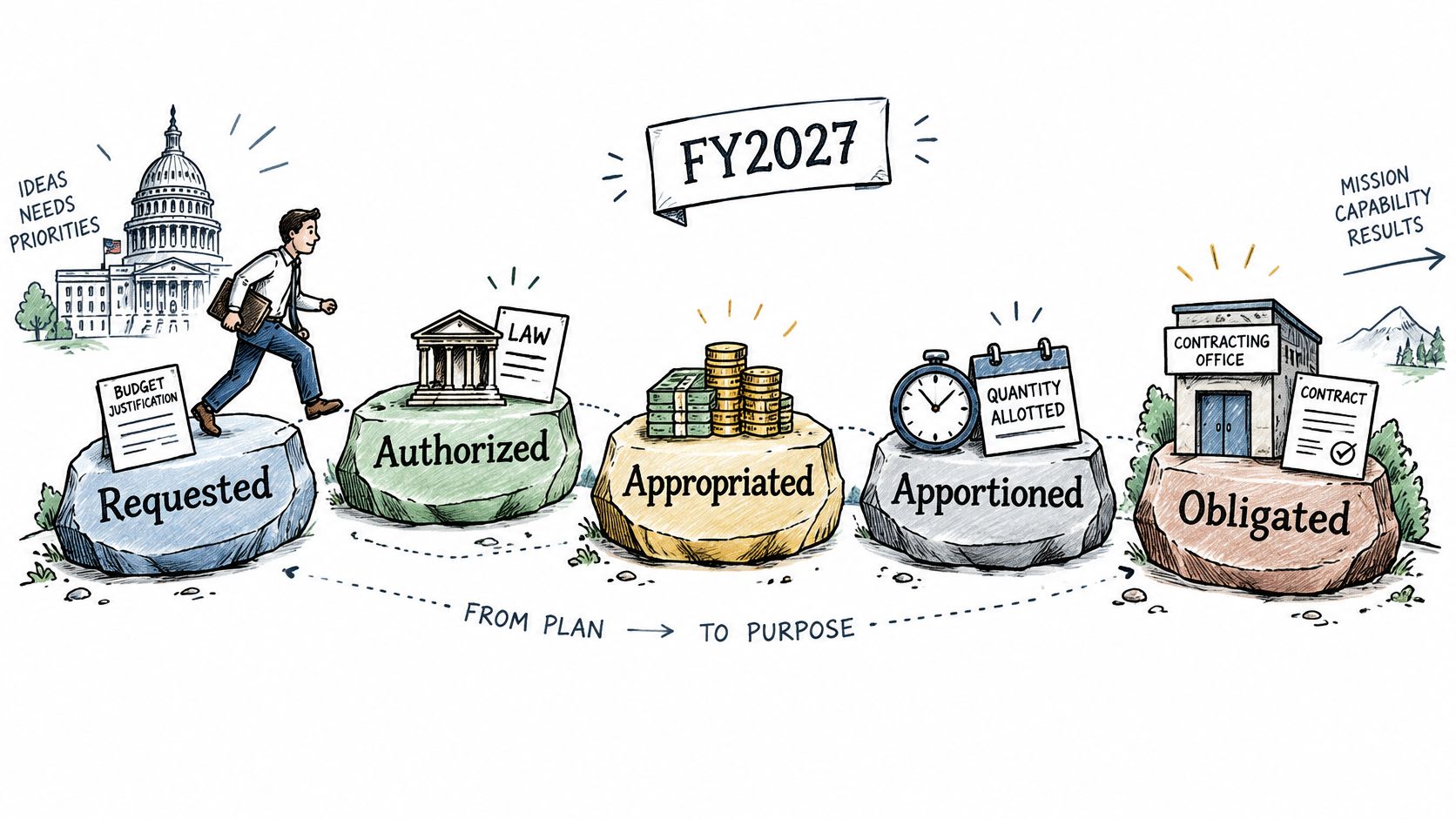
An authorized dollar reflects authority established through legislation; authorization alone doesn't provide appropriations. An appropriated dollar reflects budget authority Congress has provided, while apportionment distributes available resources for execution. An obligation is a legally binding government commitment, not necessarily a payment already made.
The Congressional Research Service analysis of selected weapon systems describes FY2027 proposals in which the House proposed authorizing $1.7 billion more discretionary funding than requested while the House Appropriations Committee proposed $3.2 billion less, with the NDAA not yet passed at the analysis's publication. These are proposed positions at that publication point, not enacted funding.
Track the legislative survival path
Check authorization text and appropriations committee reports on Congress.gov, OMB apportionment records for resource distribution, and USAspending for recorded obligations. Log additions, reductions, transfers, rescissions, and exposure to a continuing resolution, a temporary funding measure.
Even then, the buyer might use an existing ordering arrangement rather than publish a standalone competition. Understanding what a contract vehicle is helps distinguish potential work from directly accessible bidding opportunities.
For an additional visual explanation of the process:
Record where public evidence stops
The CSIS analysis of defense appropriations and reconciliation discusses transparency problems associated with consolidated lines, defense-wide flexibility, and classified supporting detail. Preserve predecessor identifiers, map successor accounts, separate funding types, and assign a confidence level when public information is incomplete.
If your team builds probability estimates, PlotStudio AI's explanation of forecasting models and accuracy metrics provides useful context for evaluating predictions. It doesn't replace legislative verification or establish that a particular program will solicit work.
A large topline isn't evidence of visible demand unless the public record supports the connection. Budget growth can leave you with more uncertainty when ownership, scope, or the buying route remains unclear.
Qualify Budget Lines Before You Chase Them
A promising line should support a specific explanation of why your company belongs in the acquisition conversation. Start with the appropriation and budget activity, the program-element or project identifier, the funding profile, and the stated deliverable.
The Office of the Secretary of Defense procurement justification illustrates why scope matters: budgeted work can include labor, materials, travel, studies, assessments, and capability-development activities. Don't treat every dollar under a technical program title as equipment production or engineering work you can pursue.
Signals that separate strong from weak budget lines
| Signal | Stronger evidence | Weaker evidence |
|---|---|---|
| Out-year profile | Sustained projected funding paired with milestones | Single large request with no schedule |
| Milestone type | Testing, integration, production-representative prototypes or deployment | Generic study, travel or administrative funding |
| Line scope | Program element with named deliverables | Broad program title mixing unrelated activities |
| Transition | Exploratory work moving toward prototype or fielding | Funding increase with no phase change |
| Continuity | Traceable program-element identifier and scope across years | Renamed or reorganized line without a documented crosswalk |
| Legislative status | Authorized and appropriated, with execution checks completed | Requested only, or exposed to a continuing resolution |
Turn evidence into a next action
Keep a short list of candidates that pass these checks. For each, assign a next action and target date, then update the record when funding status or acquisition evidence changes. Use a capture plan to connect that evidence to qualification, buyer research, and a bid decision.
Check prospective partners as carefully as programs. RichAPI's guide to source checks for company data is relevant when validating company identities and records before relying on a teaming assumption.
Our FederalPipeline research combines SAM.gov, FPDS, USAspending, DoD budget justification books, Congress.gov, DLA DIBBS, and Navy NECO, updated daily. It includes FY2025–FY2027 budget requests by line, program offices, PEOs and their systems, and contracting offices each program buys through; contract vehicle records cover every IDIQ, GWAC, and BPA, including holders and ordering organizations.
Commit pursuit resources only when funding continuity, a defined milestone, and buyer evidence support the decision. Keep newer or poorly documented lines on a watchlist rather than treating them as qualified revenue.
FederalPipeline connects defense budget lines with program ownership, contracting offices, awards, and purchasing records so you can investigate the path from requested funding to potential work. Visit FederalPipeline to research a candidate line, check its buying route, and save a pursuit with a specific next action and target date.