You're four days from a bid decision on a DoD solicitation. The technical lead has already signed off on the hardware approach, the pricing sheet is nearly closed, and someone drops the attachments folder into the shared drive with a note that the data requirements "look light." Two pages. A handful of rows. Then you open the exhibit and find a monthly report with a Government draft review, a technical manual due before first article, and a distribution marking that touches data your engineers built on your own money.
That's the moment the DD 1423 form stops being paperwork. Those rows are deliverables with due dates, reviewers and acceptance rules, and each one carries labor hours someone has to pay for. Reading the form as a delivery and acceptance risk document, then testing every row against the statement of work before you price, is the difference between a defensible bid and a contract you win and regret.
What DD Form 1423 Is and Where It Sits in a Contract
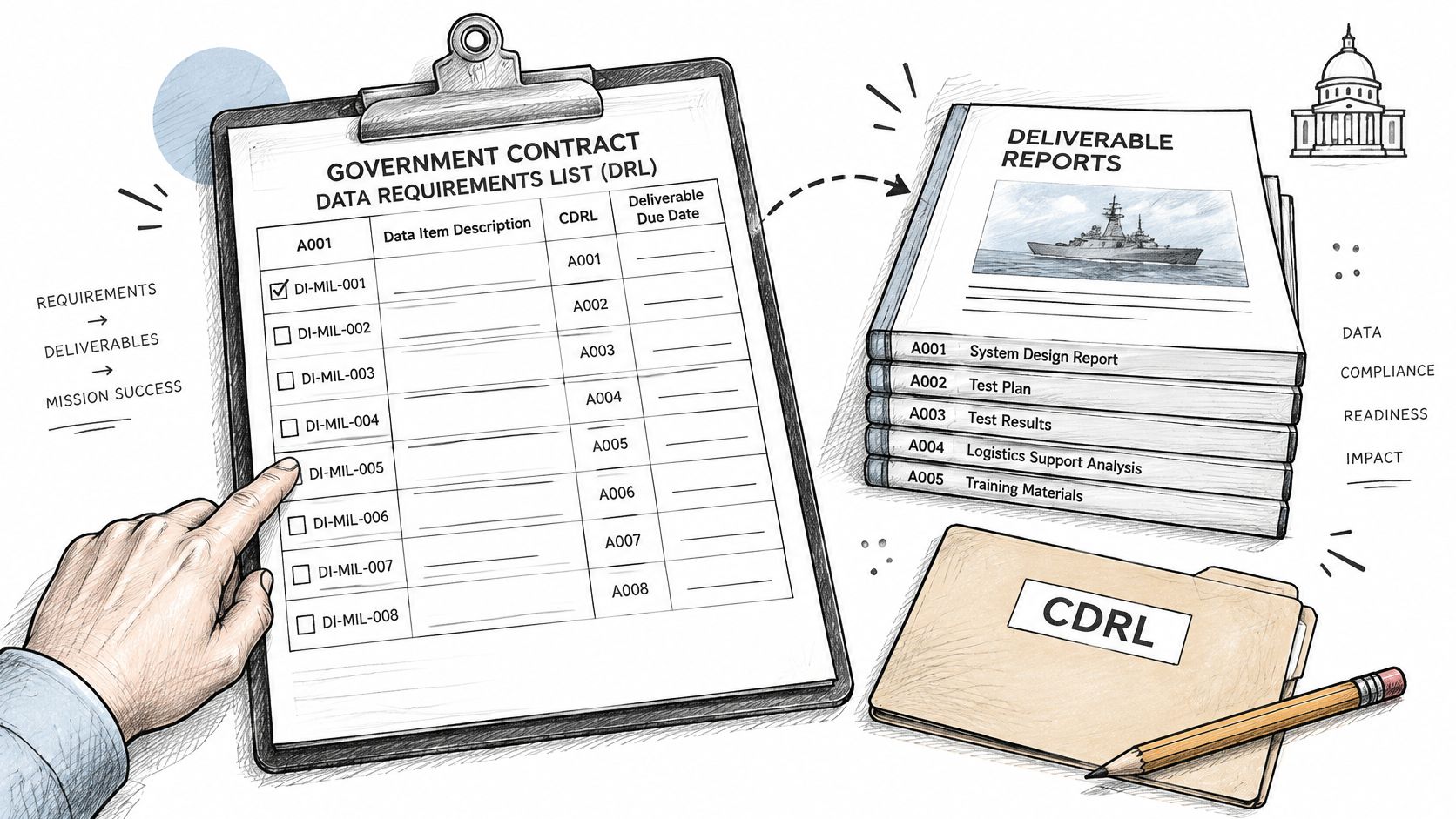
DD Form 1423 is the Department of Defense Contract Data Requirements List (CDRL), the structured list of data items a contractor must deliver under a contract: reports, technical manuals, inspection records, certificates, drawings. The Acquisition.gov forms reference covers the form, and DFARS identifies it as an exhibit to the contract rather than merely an attachment.
Here's the plain way to hold it in your head. Think of a construction job where the building is the work and the owner also hands the contractor a delivery checklist: which documents reach the owner, in what format, on what date, and who signs off. The checklist doesn't build anything, but miss an item on it and the owner has grounds to withhold sign-off on work that's otherwise finished.
Why exhibit status changes your risk
An exhibit is a formally incorporated contract document that establishes deliverable requirements. Each listed data item can therefore become an enforceable performance obligation, not a courtesy. A missing data deliverable can create schedule, payment, acceptance or contract-administration trouble even when the underlying hardware or service is technically compliant.
That's why the form belongs in scope review, next to the statement of work and the contract line-item structure, rather than in an administrative folder. The work creates the data, the line items decide how it's ordered and paid, and the exhibit defines what "delivered" means.
What qualification should verify on every row
Before your team calls the requirement manageable, confirm six things per entry:
- Responsible party: who inside your organization, or a lower-tier supplier, produces the item.
- Submission event: what triggers delivery, a calendar date or a milestone such as test completion.
- Format: the governing content and format authority named in the row.
- Destination: the office and recipients that must receive it.
- Review authority: who reviews, who accepts, and whether those are different people.
- Acceptance implications: what the Government can do with a nonconforming submittal.
Practical rule: if the Government tracks it, reviews it or can reject it, price it as managed work during capture, not as background support after award.
Pull the CDRL out of the solicitation before you estimate cost. Treat it as part of the scope, because that's what the contract makes it.
Which Form Version and DID List Govern a Solicitation
The instinct is to grab the newest template and assume you're current. That instinct is wrong often enough to cost real money. Public copies include a February 2024 DD Form 1423 posted with a SAM.gov opportunity, while older examples and legacy instructions still reference DoD 5010.12-M, and a newer DoD Manual 5010.12 issuance also appears in the available records.
So which form, which DID list and which instructions govern a solicitation issued today? The form itself doesn't settle it. Its instructions point users to the governing DoD manual and require the cited data-acquisition document to define content and format. The controlling authority lives in the contract's incorporated references, not in whichever PDF your team downloaded last.
The latest form isn't automatically the controlling form. Contract language and incorporated references control. A bidder who prices against a newer template while the solicitation incorporates an older reference can end up writing to the wrong content standard, then owning the rework.
A four-point comparison routine
Run this before you price data effort, and again whenever an amendment lands:
- Incorporated references: read the solicitation's reference list and note the exact manual, standard and DID identifiers it names, including revision letters.
- Amendment history: check whether any modification replaced a reference, added a data item or changed delivery conventions.
- The CDRL itself: compare the authority entries row by row against that reference list, and flag mismatches in writing.
- Current DID source: confirm the cited document exists and is active, then record the contract-required revision separately from the newest published one.
If those two revisions differ, ask the contracting officer which text governs. Don't substitute a newer download for the contract's reference.
Preserve the version you priced
Save the exact form, DID and instruction set your estimate was built on, with the amendment number beside it. That file is what lets you defend a price or a scope discussion months later. Fold the check into the same intake discipline you use for a structured proposal review process, because on long acquisition timelines the answer can change between the draft solicitation and the final amendment.
Fields on DD Form 1423 and What Each One Controls
Start with delivery frequency, not the title. Frequency is the field that sets your labor bill, because a recurring item multiplies every hour of drafting, internal review, transmittal and comment resolution across the period of performance. A one-time submittal is a task. A recurring submittal with a draft approval cycle is a small standing program.
The fields that decide cost and exposure
Read the authority entry next. The row cites a Data Item Description (DID), a military specification, a military standard or a one-time DID, and that document defines what the deliverable must contain and how it must be structured. A well-written report that misses the cited format can still fail acceptance.
Then read the contract task reference. It names the statement of work task that creates the requirement, which is how you find the work package that funds the deliverable. No traceable task means an estimating problem and a question to raise before bidding.
The remaining fields shape workflow rather than page count. The responsible technical office tells you who owns the item and who answers questions. The inspection or acceptance rule and any draft-approval requirement tell you when the work is finished. Distribution markings tell you who may receive and reuse the data, which matters when a deliverable would incorporate technical data you developed at private expense.
Field reference for capture and proposal teams
| Field | What It Controls | What a Bidder Checks |
|---|---|---|
| Data item number | Unique identifier for the deliverable, such as A002 | Matches the item in the statement of work |
| Title | Name of the data deliverable | Describes the same work the solicitation requires |
| DID, specification or standard | Content and format the deliverable must follow | Current source and version are identified |
| Contract task | The SOW task that creates the requirement | Task is funded and priced in the proposal |
| Responsible technical office | Office that owns the data item | Named contact is known for questions |
| Inspection or acceptance rule | How and by whom the item is accepted | Acceptance criteria are achievable by the team |
| Draft and approval requirement | Whether drafts go to Government review before final | Review cycles are scheduled and staffed |
| Distribution markings | Who may receive and reuse the data | Restrictions do not block reuse of existing technical data |
| Delivery frequency | How often the item is due, one-time or recurring | Recurring labor is included in the estimate |
| Delivery dates and recipients | When and where each item goes | Dates fit the schedule and recipients are confirmed |
The pricing group entry deserves its own look, since it signals how the Government expects data effort to be grouped and priced. One-time DIDs behave differently from recurring ones: a one-time item can be scoped as a discrete work package with a fixed end, while a recurring item needs a named owner, a standing calendar slot and a revision reserve.
How to scan the table in two passes
First pass, read the data item number and the authority entry for every row, and confirm you can obtain each cited document. Second pass, read frequency, dates and approval requirements together, because those three drive labor hours, cash flow and schedule exposure. Everything else is detail you resolve after you know whether the burden is priceable.
How to Read a CDRL Entry Step by Step
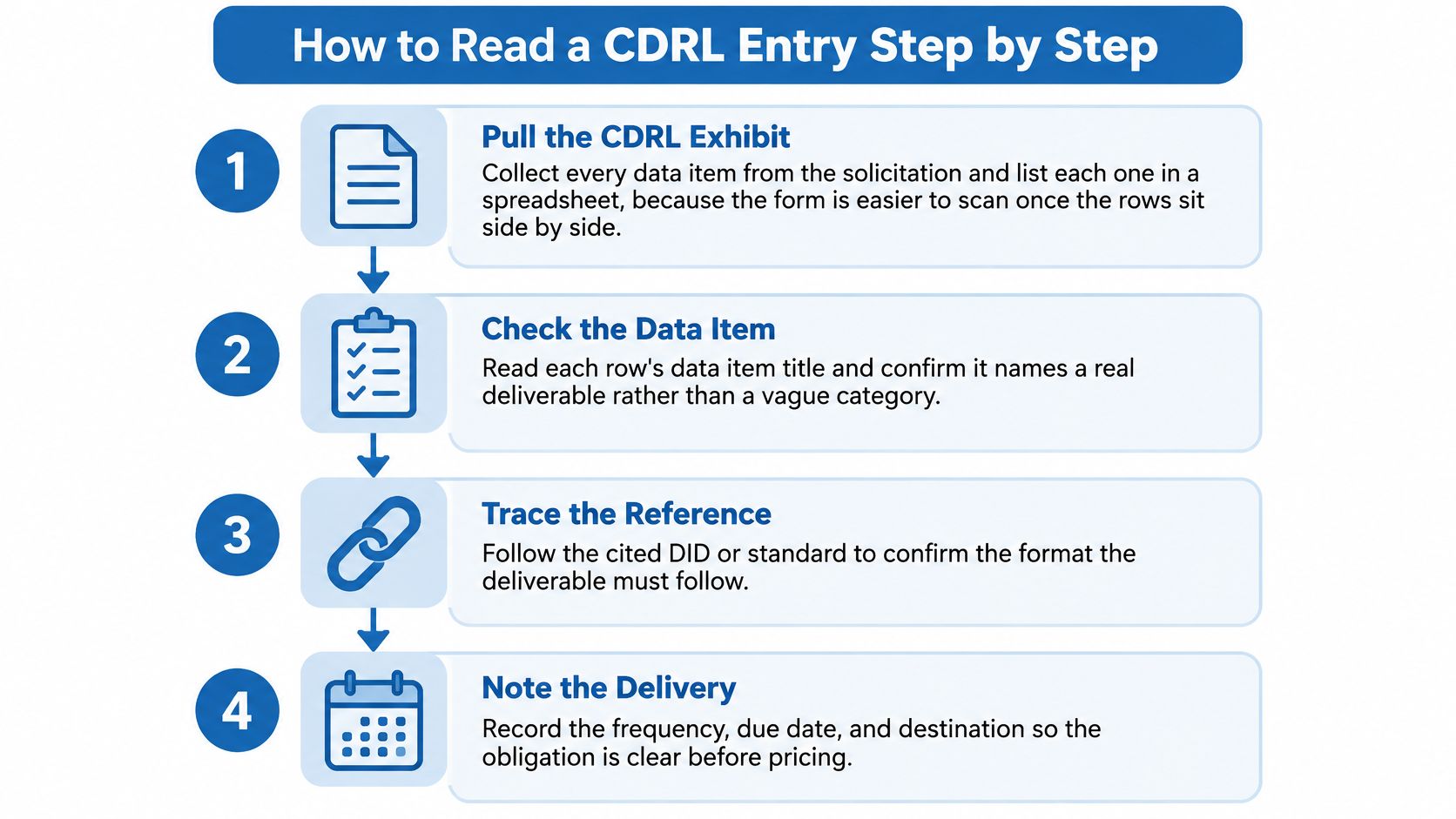
The form is easier to test one row at a time, and a spreadsheet beats a PDF for that job. The visual below shows the short version of the reading sequence.
Work from the CDRL version the latest amendment references, not a copy carried over from an earlier pursuit. Then run the rows.
- List every data item. Pull the exhibit from the solicitation and give each item its own spreadsheet row, including continuation pages. Side-by-side rows expose gaps that reading the form top to bottom hides.
- Trace the cited authority. Follow each row to its DID, specification, standard or one-time DID and note whether that source is current. The Navy's sample CEVM IPMR CDRL shows how a single entry carries the authority, the creating task, the responsible technical office, inspection and acceptance rules, draft-approval requirements, distribution markings, frequency, dates, recipients and pricing group together.
- Match the item to a statement of work task. Every deliverable should trace to work someone is performing. An item with no task is a written question to the contracting officer before you bid, not an assumption you absorb.
- Classify the obligation. Mark each item draft, final, recurring or conditionally required. Recurring and conditional items carry the effort teams miss, because a conditional item still needs a staffed response when the trigger fires.
- Confirm who accepts it. Name the accepting office and map the approval cycle, including comment turnaround and resubmittal. Submission and acceptance are different events, and only one of them closes the obligation.
- Check distribution markings against your own data. If a deliverable would embed pre-existing technical data, confirm the marking and release limits don't compromise your reuse of it. Data-rights work often gets discovered late.
- Estimate labor per item, then compare with price. Build hours from frequency multiplied by drafting, review rounds, formatting, transmittal and comment resolution. Decide whether the effort sits in its own line item or inside base effort, and understand how a CLIN structures ordering and payment before you make that call.
The walkthrough below covers the same reading discipline in video form if your team prefers to watch a pass through the form before running one.
Small firms feel this most. A supplier can price the hardware correctly and still underestimate technical-publication, configuration-management and data-rights work, because those hours don't appear in a bill of material.
A short CDRL can represent substantial recurring administrative and engineering effort. Frequency, approval cycles, recipients and acceptance criteria set the burden, so the number of data items alone doesn't measure it.
Navy and Army Examples Show Why Item Count Misleads
Two published requirements make the point better than any general warning. A February 2024 DD Form 1423 example for a Navy Government Furnished Material requirement specifies one data item, A002, an inventory report organized by National Stock Number, in an example published by the U.S. Navy in 2024 according to the Navy GFM CDRL exhibit.
One row looks trivial. A bidder reviewing it still checks three things: that A002 traces to a task in the statement of work, which authority governs the report's content, and how often the inventory is due. If that inventory recurs on a short cycle with a review path attached, one row becomes a standing obligation for the life of the contract.
A U.S. Army DD Form 1423 for Outreach Support Services carrying a 2026 date requires four data items: financial status, stipend status, applicant analysis and selectee analysis reports, as listed in the Army Outreach Support Services exhibit. Four rows, four different content sets, and likely different internal owners and reviewers for each.
| Example | Data Items | Deliverables Required |
|---|---|---|
| Navy Government Furnished Material requirement, February 2024 | 1 (A002) | Inventory report organized by National Stock Number |
| U.S. Army Outreach Support Services requirement, 2026 | 4 | Financial status, stipend status, applicant analysis and selectee analysis reports |
Set them side by side and the planning lesson is clear. One recurring item with tight approval rounds can cost more than four one-time reports, while four reports with separate owners can cost more in coordination than their page counts suggest. Item count tells you neither.
Sort before you compare. List every item on your own form, mark it one-time or recurring, note the source that governs its content, and record which office accepts it. Then total the hours by column, not by row count, and let that total drive the bid discussion.
When a CDRL Requires Quality Evidence
For parts suppliers, the data requirement often arrives as a certificate rather than a report. A DD Form 1423-1 CDRL can require a Certificate of Quality Compliance (COQC) as objective evidence supporting material quality, and acquisition regulations describe the COQC as a quality-assurance deliverable, per the acquisition.gov regulation text on quality-assurance data requirements. The same text states that the CDRL is incorporated into the product item description in solicitations and awards drawn from the Defense Logistics Agency's material master.
That incorporation is the part suppliers skim past. If you quote parts from DLA's material master, expect the data requirement to travel with the item description rather than sitting in a separate attachment you might never open.
The cause-and-effect chain
When the CDRL requires quality evidence, the supplier must generate and transmit documentation tied to the delivered material, and the Government can use that evidence during inspection or acceptance. The chain runs one direction: no certificate, no objective evidence, and a compliant part can still stall at acceptance.
The commercial consequence is straightforward. Your cash conversion depends on a document, not just on a shipment. A part that passes every physical check but arrives without its required certificate ties up receivables while someone chases paperwork.
A bid-review control you can copy
Map each CDRL data item to five things before you quote:
- Quality system: the procedure in your proposed quality system that produces the required evidence.
- Records source: where the underlying test, inspection or traceability record is kept.
- Responsible employee: the named person who signs and transmits the certificate.
- Submission timing: whether the certificate ships with the material, precedes it or follows an inspection event.
- Retention process: how long you keep the record and how you retrieve it on request.
Then push the question one tier down. Confirm whether required certificates depend on lower-tier manufacturers or approved-source documentation, because an upstream record you can't obtain will block acceptance of a part you assembled correctly. Ask for the certificate format and the signing authority in writing during quotation, not after award.
If your upstream supplier can't produce the record, you don't have a compliant offer. You have a shipment waiting on someone else's file cabinet.
Decide Bid or No-Bid From the CDRL Rows
Run this test before pricing closes, while the answer can still change. A row is bid-ready when it traces to a statement of work task, cites a DID or standard you have confirmed as current, names the accepting office, and carries a costed frequency and review cycle. Four tests, applied row by row, and any row that fails one is not yet a line item. It is an open cost.
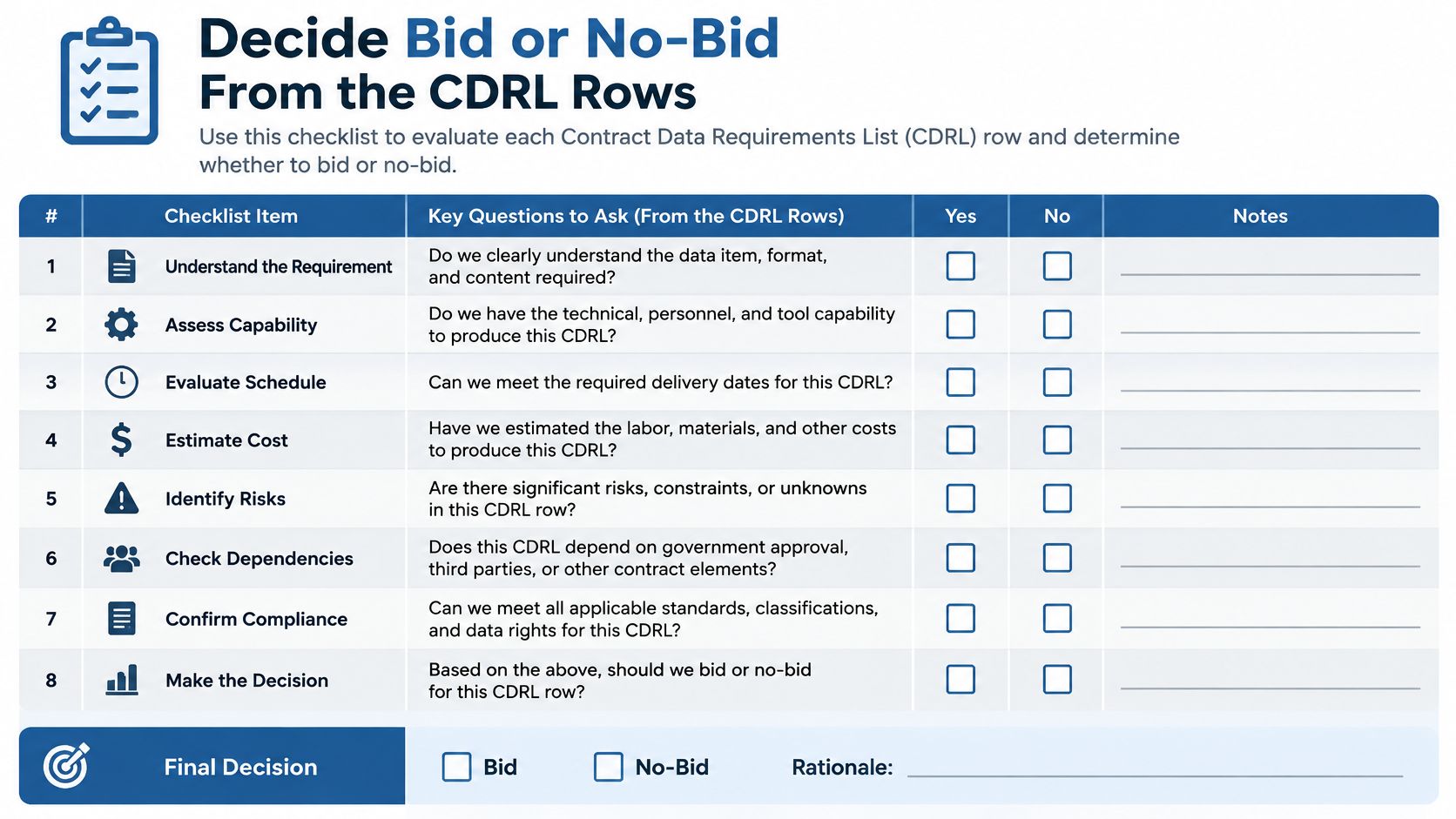
A failed row goes to one of three places, and choosing correctly is the whole discipline:
- The bid/no-bid decision, when the gap is unpriced recurring effort you cannot staff or fund.
- A written clarification question to the contracting officer, when the requirement is ambiguous rather than expensive. An ambiguous distribution list or an unclear approval cycle often resolves in a single answer before award, and almost never resolves in your favor after it.
- Subcontract terms, when a lower-tier supplier must produce quality records or technical publications and your flowdown has to say so. If the data item depends on someone else's document, the obligation belongs in their purchase order, priced, before you sign yours.
Set the threshold in advance, in writing. Something as simple as "no-bid if unpriced recurring data effort would exceed the margin on the base work" ends the argument at 11 p.m. on submission night. On fixed-price work the threshold bites harder, because recurring data labor you did not price comes straight out of margin with no adjustment mechanism. A monthly report with a five-day government review cycle is a permanent part-time position for the life of the contract, and the math either survives that or it does not.
Record the CDRL version, the clarification responses and the cost assumptions in the bid file. Contract administration will need that trail the first time someone asks why a report is due monthly and who agreed to it.
The CDRL review works best as one input inside a disciplined qualification pass, weighed with the same seriousness as deadlines, clearances and incumbents. FederalPipeline's capture briefs read every solicitation and show what is being bought, the clearance, set-aside and certifications required, the incumbent, the ceiling and every deadline, so the data-item review sits beside those checks instead of replacing them. Teams comparing platforms for that intake work can scan the GovCon Reviews software rankings alongside their own trial use. The rows are cheap to read now and expensive to discover later.
FederalPipeline is built on SAM.gov, FPDS, USAspending, DoD budget justification books, Congress.gov, DLA DIBBS and Navy NECO, updated daily, so you can pull the solicitation, its attachments and the buying office's history in one place before you price a single CDRL row. Parts RFQ records include quantities, buy history and approved sources, which is exactly what you need when a certificate requirement depends on an upstream manufacturer. Signing up takes only a work email and a magic link, with no password. Visit FederalPipeline, open a live opportunity you are qualifying this week, and run the four bid-ready tests on every data item before your pricing sheet closes.