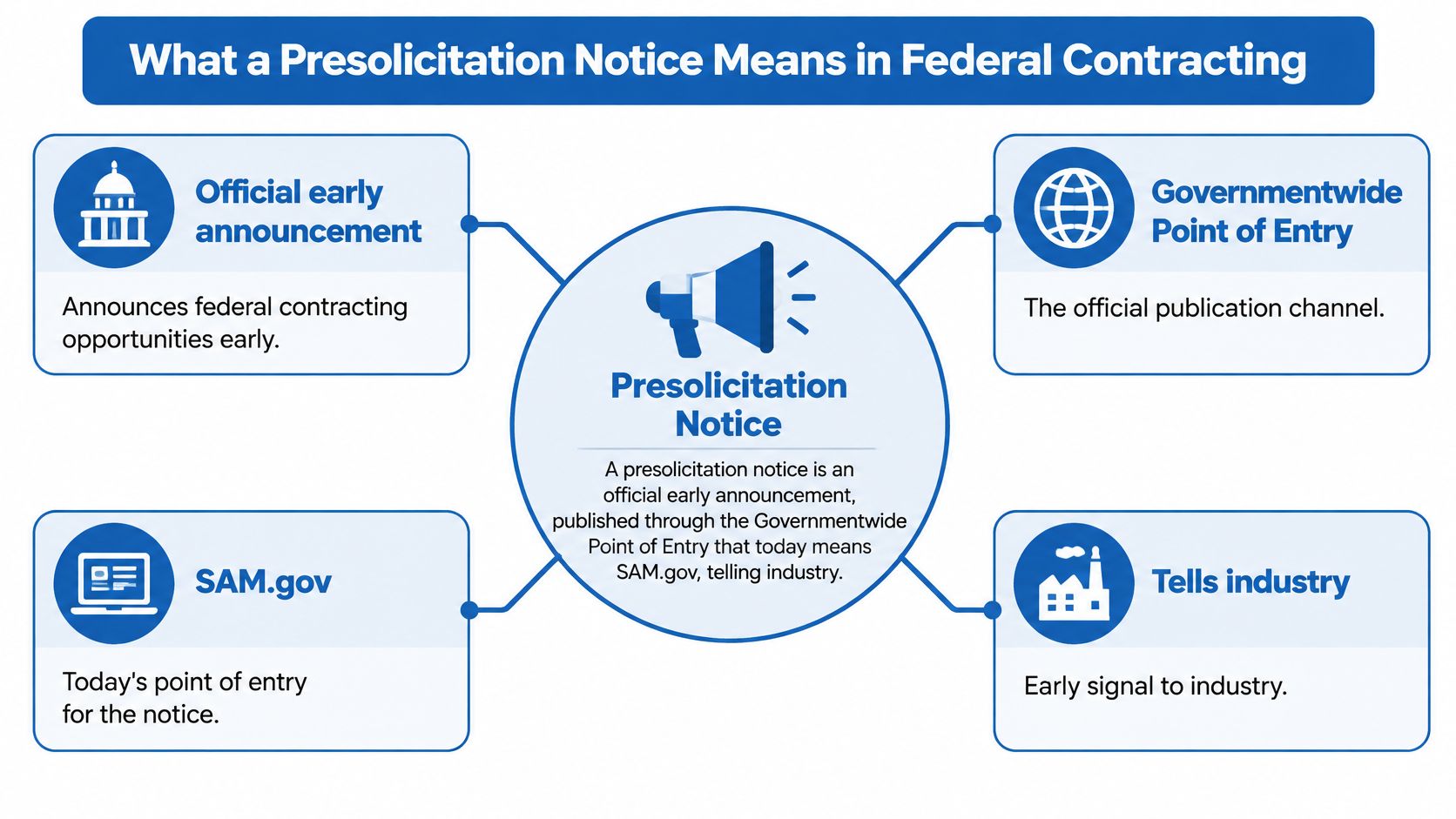
A presolicitation notice is an official early announcement published through the Governmentwide Point of Entry, which today means SAM.gov, telling industry that an agency intends to issue a solicitation. It is not itself a request for proposals or a promise of award.
So why do capture teams walk into a Monday stand-up and talk as if the agency has already committed the work, the set-aside, and the dollars? The posting gives you a description and a date. Leadership hears a pipeline number. Those are not the same thing, and the gap between them is where proposal hours get burned.
Read the notice as a signal you can extract, not as a forecast you can brief. The day it appears, pull the fields that drive a pursue-or-wait call, mark every blank as unknown, and refuse to fill those blanks with what the team hopes the agency meant.
What a Presolicitation Notice Means in Federal Contracting
A program office posts a notice for follow-on IT support. An analyst opens SAM.gov, sees an agency name, a short description, a NAICS code, and a response date, then forwards it with the subject line “we're bidding this.” That email overpromises. What is a presolicitation notice in that moment? It is an early public signal of a planned acquisition, not the document that lets anyone submit a priced offer.
FAR Subpart 5.2 puts the notice in public view. FAR 5.204 requires contracting officers to provide access to presolicitation notices through the Governmentwide Point of Entry (GPE), so the posting is governmentwide market communication, not a courtesy email from one office. FAR 15.201 lets the agency use that same notice to talk with industry before the formal solicitation, including a request that prospective offerors describe their capabilities so the office can judge whether those firms could be viable competitors.
A notice works like a film trailer. It shows the premise, the cast, and a release window. You still cannot review the film, because the full cut, the running time, and the ending are not in the trailer. A notice shows scope in general terms, a likely contract shape, set-aside indications, place of performance, anticipated timing, and whether the office wants industry input. The later solicitation writes the formal terms, evaluation factors, clauses, and submission deadline.
Three limits matter when you brief the team:
- Not a request for proposals. It does not normally constitute an offer request, and it does not let a company submit a binding bid.
- Not a binding offer from the agency. Nothing in the posting locks scope, quantity, or eligibility.
- Not a promise that an award will happen. The office can reshape the buy, delay it, or drop it after market research.
That line matters because the notice moves visibility ahead of proposal instructions. The lead time has one practical use: qualification work that cannot start the week an RFP drops. Check the facility clearance, the missing certification, the NAICS size problem, and the teaming gap before anyone talks about a bid. If the description points at a systems replacement, read how public bodies sequence large replacements, including ERP modernization for public bodies, before you tell leadership the requirement is “real.” A modernization narrative in a notice remains a planning signal. It is not a funded statement of work.
Practical rule: Brief leadership on what the notice lets you check this week, not on a win you have not been asked to price.
What Information a Presolicitation Notice Contains
Open the notice and build one record the same day. Do not wait for a cleaner version. Amendments overwrite fields, and a blank you "remember" from the summary is how bad briefs start.
Fields worth extracting
Nearly every usable notice carries the same core: who is buying, a general description, how the work is coded, where it happens, a contact, and a response date if the office wants one. Other fields show up only when the acquisition type calls for them. A set-aside, a price range, a clearance, or a contract-type hint can be present and still be provisional.
| Field | What it tells you | What to do with it |
|---|---|---|
| Notice ID and notice type | Unique identifier and whether this is a presolicitation, sources sought, or special notice | Save the ID and a date-stamped copy; search it again before every decision |
| Agency and contracting office | Who is buying and which office will run the award | Map the office to its forecast, budget lines, and recent awards |
| Requirement title and description | A general statement of what is being bought | Write a one-line capability fit statement and list the questions the description leaves open |
| NAICS code and size standard | How the agency classified the work and which size standard applies | Confirm you qualify under that NAICS before spending proposal hours |
| Product service code | The procurement category used in federal spending data | Pull past awards under the same code to see who wins this work |
| Set-aside or small business reservation | Whether the agency reserves the work for small businesses or a socioeconomic group | Check certification status and whether a teaming partner is needed |
| Place of performance | Where the work is performed or delivered | Flag travel, site visits, state licensing, or local hiring cost |
| Estimated magnitude or price range | A ballpark value, most often stated on construction notices | Size the opportunity; never treat it as a ceiling or a target price |
| Anticipated solicitation date and response date | When the solicitation is expected and when any notice response is due | Put both dates on the pursuit calendar with a reminder a week earlier |
| Stated purpose of response | Capability information, written questions, request for a bid set, or no response wanted | Decide whether engaging can influence the requirement |
| Clearance and qualification requirements | Security level, facility clearance, or a qualification standard | Start the clearance or qualification path now; it takes longest |
| Attachments and contracting officer contact | Draft documents, specifications, market research questions, or the point of contact | Read attachments before the description; email questions early and in writing |
| Contract type hints | Whether the agency signals firm-fixed-price, cost-reimbursement, or an IDIQ | Flag the pricing model and accounting requirements for the bid decision |
Why some cells are empty
An estimated value shows up often on construction notices and often nowhere on a services notice. A blank is an unknown, not a red flag and not a zero. Do not invent a range from last year's award and paste it into the record as if the contracting officer stated it.
Read the response line before you draft anything. It may ask for a capability statement, written questions, a request for the complete bid set, or nothing at all. Sending a ten-page capabilities deck when the notice asks for two questions wastes the only attention you will get from that office.
Attachments before conclusions
Draft specifications and market-research questions often sit in attachments, not in the two-paragraph description. If you brief from the summary alone, you will miss a qualification standard or a place-of-performance constraint that changes the fit call.
Mark every empty cell unknown. Assumption is how a set-aside that was never stated becomes "small business" in a pipeline report.
Where the Notice Sits in the Acquisition Timeline
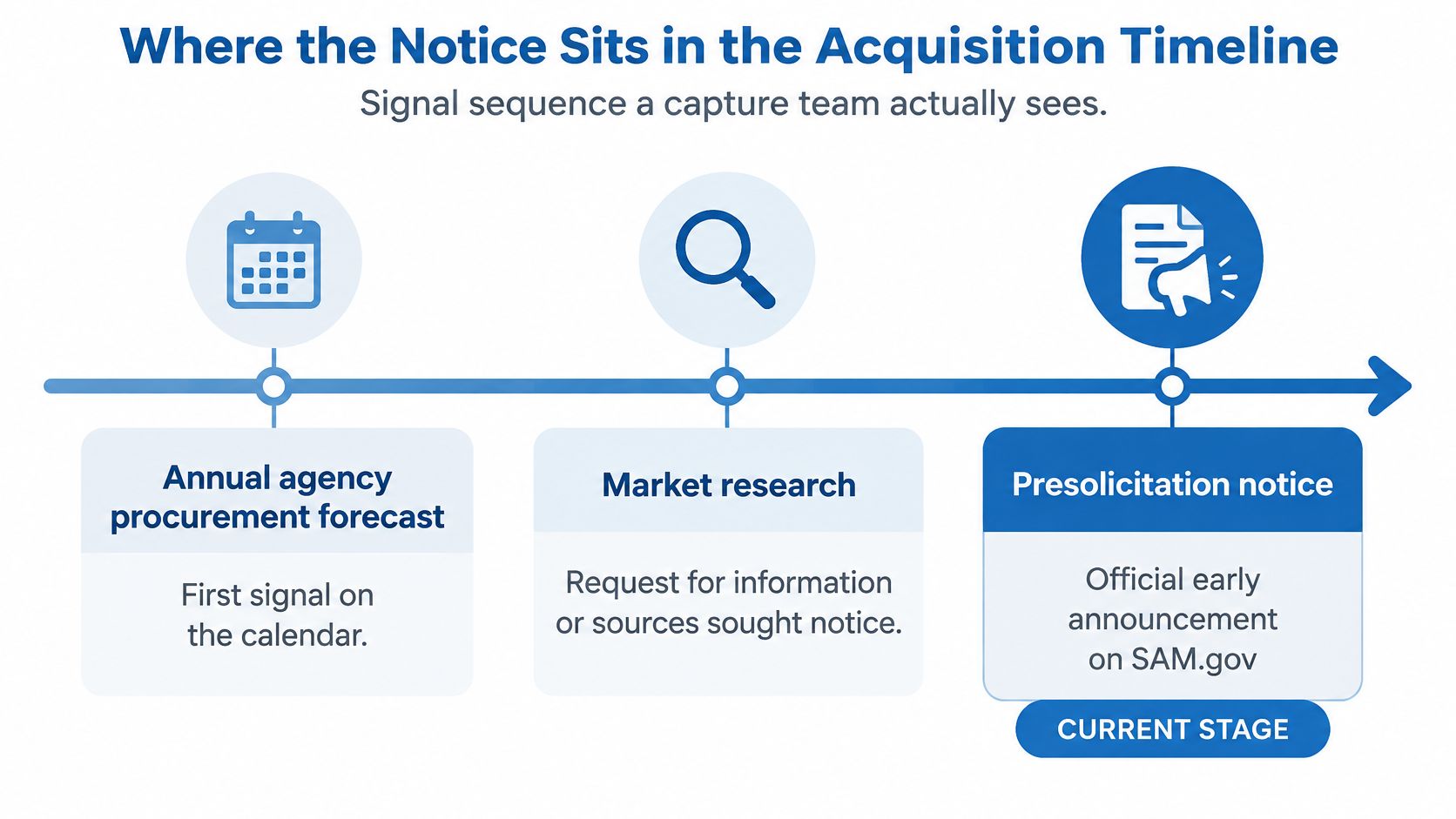
A capture team does not meet a requirement for the first time on SAM.gov. The sequence, when the agency is moving, looks like this: an annual procurement forecast, then market research such as a request for information or a sources sought notice, then the presolicitation notice, then sometimes a draft solicitation, then the solicitation, proposals, and award. The notice is one card in that row, not the row itself.
What the publicizing rules actually fix
FAR 5.203 requires agencies to transmit applicable proposed contract-action notices to the GPE. The response period depends on the acquisition and on the exceptions. FAR 5.202 identifies circumstances in which synopsis requirements do not apply at all. There is no universal lead time between the notice and the solicitation. Publication does not establish that the requirement will proceed unchanged, stay unrestricted, or keep the stated value and schedule.
What you buy is a preparation window, not a schedule you can put on a wall chart for leadership.
Spend the window on evidence, not on a draft proposal
Use the days you have for four checks, in this order:
- Expiring contract. Confirm the current vehicle's end date and ceiling so you know whether this is a recompete signal or a new start.
- Budget line. See whether the program shows up in the agency's budget justification, not only in the notice title.
- Recent winners. Look at who won the last two awards under the same product service code and office.
- Fields that move. Note scope, quantity, set-aside, place of performance, security, and both dates as items you will re-read, not as facts you will freeze.
A sources sought notice earlier in the chain is market research, not a duplicate of this posting. If you only have the presolicitation and none of the earlier signals, lower your confidence. The notice is most actionable when forecasts, budget evidence, prior awards, and contracting-office behavior point the same way. One posting with none of those connections is as likely to be exploratory, or later canceled, as it is to become an RFP.
Keep the notice, every amendment, and the eventual solicitation side by side. Record what changed in scope, quantity, set-aside decision, and deadline, and assign a confidence level to each field instead of carrying last month's extract forward.
What the Notice Tells You and What Only the Solicitation Decides
The question worth asking in the pursuit meeting is narrow. What can we safely conclude from this posting, and what are we guessing?
FAR 5.204 frames the notice as information to industry and the public that the Government intends to issue a solicitation in the near future. Contracting officers generally must publicize the proposed contract action before issuing that solicitation. The notice may show the agency, the requirement, an anticipated acquisition method, a set-aside direction, a response date, or a request for feedback. The solicitation can still change scope, schedule, contract type, evaluation factors, and eligibility. Under FAR Part 15, a response invited as market research can shape acquisition planning. It does not function as a bid or a proposal.
| Item | Presolicitation notice | Solicitation |
|---|---|---|
| Scope of work | General description of the requirement | Detailed statement of work, performance work statement, or specifications |
| Set-aside decision | Indicated or reserved | Final and stated in the set-aside notice |
| Contract type | Hinted at, if at all | Specified, with clauses attached |
| Estimated value | Sometimes stated, most often for construction | Stated ceiling, estimated quantity, or pricing schedule |
| Evaluation factors | Rarely disclosed | Stated with relative importance |
| Submission deadline | Date for any response to the notice | Firm proposal due date and time |
| Security and qualification requirements | Flagged in general terms | Specified as hard eligibility conditions |
| Quantities and period of performance | Approximate or absent | Fixed or estimated, usually with option years |
| Clauses and terms | Not applicable | Full terms and conditions |
| Award obligation | None | Offer, acceptance, and award process |
Three inferences that cost you
The requirement will proceed unchanged. Scope, quantity, the set-aside, place of performance, security, and deadlines can all move. Briefing a "locked" pursuit on Monday's extract means you staff a proposal against a buy that may not exist in that form. Small businesses feel that first, because the same two writers cannot be on a ghost requirement and a live one.
A stated range is a ceiling or a target price. A magnitude on the notice is a ballpark for sizing interest. Pricing a solution to the top of that range, or telling finance the contract is "worth" that figure, invents a number the solicitation has not set. The pricing schedule, ceiling, or estimated quantity arrives later.
Answering the capability request counts as bidding. A capability statement or a set of questions can influence how the office plans the acquisition. It does not put you in the competitive range, and it does not substitute for a proposal written to the instructions in the solicitation. Teams that stop after the capability email discover, on proposal day, that they never built a government proposal against stated factors.
Ignoring the notice has a cost too. You lose the time needed to close a clearance, a certification, or a past-performance gap that a solicitation response window will not cover.
Separate the work into three actions and do not blend them. Monitor only when the posting is thin or the fit is unclear. Submit capability information or questions when the notice asks for them and you can still qualify. Begin formal bid preparation only after the solicitation, or a draft that is stable enough to outline against, shows the factors and the eligibility rules. Check each unsafe inference against that later document before you commit writers.
How Notice Content Changes by Acquisition Type
A single definition of the notice misleads, because the regulation does not ask every acquisition to disclose the same things. Teams that apply one checklist to construction, sealed bids, and negotiated services will either over-read a thin notice or under-read a thick one.
FAR 36.213-2 draws the sharpest line. For construction expected to exceed the simplified acquisition threshold, a presolicitation notice is generally required unless properly waived. It must describe the work in enough detail to communicate its nature and volume, including estimated price information, and it must go out early enough to stimulate broad bidder interest. That is a disclosure duty. It is still not the bid set.
Qualification requirements are different again. The notice should identify the relevant specification and give prospective offerors time to show they can meet the standard. The qualification decision itself is not granted by the posting.
Sealed bidding often does less. The notice may mainly announce the requirement and the deadline for requesting a complete bid set, and it normally leaves out drawings, plans, and specifications. If your analyst is hunting for quantities in that PDF, they are looking in the wrong document.
Negotiated work under FAR Part 15 reads closest to market research. You may see a general description and an invitation to send capability information. You should not expect evaluation factors.
Some buys never produce a notice. Below the simplified acquisition threshold, or in a situation FAR 5.202 excepts from synopsis, the first public document can be the solicitation or a quote request, with little warning. Waiting for a presolicitation on those actions is how you miss them.
Does the notice tell you if you are eligible?
Often, no. Eligibility turns on the specification, the clearance level, the size standard as finally applied, and the evaluation criteria. Construction may give you nature, volume, and a price range. A qualification notice may name the specification. A sealed-bid notice may give you only a date to request the package. A negotiated notice may give you a paragraph. None of those is a pass-fail determination.
| Acquisition type | What the notice must include | What to expect later |
|---|---|---|
| Construction expected to exceed the simplified acquisition threshold | Description of the work in enough detail to communicate its nature and volume, including estimated price information, issued early enough to stimulate broad bidder interest | Full plans and specifications with the invitation for bids or request for proposals |
| Qualification requirement | Identification of the relevant specification and time for prospective offerors to demonstrate ability to meet it | Qualification determination applied at solicitation |
| Sealed bidding | Announcement of the requirement and the deadline for requesting the complete bid set | Bid set issued; drawings, plans, and specifications normally not part of the notice |
| Negotiated acquisition under FAR Part 15 | General description, sometimes a request for capability information as market research | Request for proposals with evaluation factors and proposal instructions |
| Below the simplified acquisition threshold or otherwise excepted under FAR 5.202 | May be no presolicitation notice at all | Solicitation or quote request appears with little warning |
Record the acquisition type and the stated purpose of the response on the pursuit card. Then write, in one line, which conclusions must wait: eligibility, price, evaluation weight, and clauses almost always wait. I would not let a team mark "qualified" on a negotiated services notice that never names the clearance or the size standard as a hard condition.
How to Work a Notice Step by Step and Decide Your Next Move
Run this the day the notice hits, before anyone builds slides. Each step below sorts every field into one of two bins: what the agency has stated, and what your team is tempted to assume.
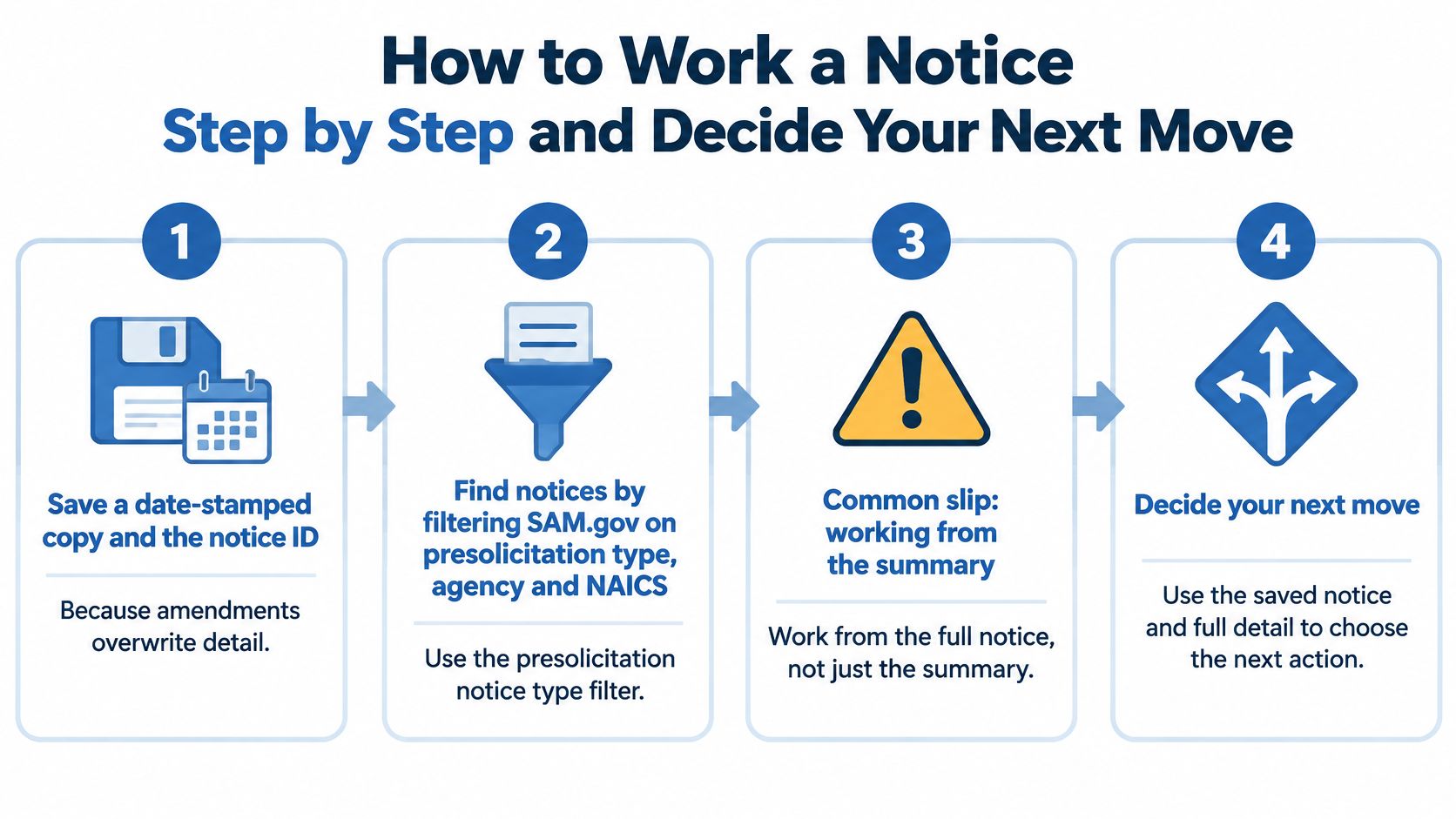
1. Save the notice ID and a date-stamped copy. Amendments replace text, and the version you priced against may not be the version the solicitation honors. Filter SAM.gov on presolicitation type, agency, and NAICS so you are not mixing this posting with a sources sought or a special notice. The expensive miss is working from the summary card and never opening the attachments, where the response instructions usually live.
2. Extract every field into one record. Agency, contracting office, NAICS and size standard, product service code, set-aside, place of performance, clearance, publication date and response date, and the purpose of the response. Write unknown in every empty cell. A blank set-aside line stays unknown until a later document fills it. The worst entries in a pipeline are the ones somebody guessed at because a prior buy from that office went a certain way.
3. Test what the notice states. A stated set-aside, size standard, clearance, or certification is a decided fact, and decided facts can rule you out today. What the notice cannot do is qualify you, because the eligibility conditions land with the solicitation. If you fall outside a stated reservation or cannot clear a stated requirement in time, the pursuit conversation is over. Record the no-bid reason in a short internal note with the date, so nobody reopens the same notice next month without new facts.
4. Pull the incumbent. Find the expiring contract, its ceiling, and its period of performance in prior award data under the same office and code. Keep the notice's stated range and the incumbent's contract value in separate fields. One is an estimate for a future award; the other is a signed number with a modification history behind it.
5. Cross-check budget and program evidence. A budget justification line that names the program raises confidence. No line at all should lower it. A notice title alone proves nothing about funding.
6. Set an alert on the notice ID and on the agency-plus-NAICS pair. You want the amendment and the solicitation delivered to you. Rediscovering the same posting six weeks later costs you the one thing a presolicitation gives you, which is lead time.
7. Choose one action.
- Monitor only when a stated set-aside, size standard, or clearance rules you out, or when budget and award history do not support the posting.
- Engage with written questions or a capability statement when the notice invites input and nothing stated blocks you. A capability statement runs about a page: what you sell, relevant past performance, your codes and size status, a named contact. The one-page structure in short sales proposal templates transfers directly to that layout.
- Start bid preparation when fit, incumbent knowledge, and budget evidence line up and you can name the instructions still missing. That preparation is capture management: positioning, teaming, and customer contact before the RFP exists. The evaluation factors have not been published, so there is nothing to write a proposal to yet.
8. Log the pursuit so it has an owner. Give the pursuit a name, assign one person, set the next action, and pick a revisit date ahead of the anticipated solicitation date. A notice nobody rechecks is a bookmarked file. In FederalPipeline, each pursuit added to the pipeline carries exactly those fields: a pursuit name, a next action, and a target date. When the solicitation does appear, capture briefs read it for what is being bought, the clearance, set-aside and certifications required, the incumbent, the ceiling, and every deadline. Until that document exists, searching SAM.gov solicitations alongside agency forecasts, grants, and innovation programs in one place is how you tell whether this notice stands alone or sits on a forecast the agency published months earlier.
Two notices, two records
A construction notice states a price range. Size it against prior awards under the same code, and treat that range as a magnitude for the pipeline. Keep the word ceiling out of the record.
A services notice carries no estimate at all. Log the value as unknown. Borrowing a number from a similar contract so the pipeline report looks complete puts a fabricated figure in front of leadership.
Both notices still read "unknown" on set-aside after the attachments are read. Neither is ready for a bid recommendation. Both are ready for a revisit date.
Common Questions About Presolicitation Notices
Where should a new analyst look first?
SAM.gov is the GPE for these postings. Filter on notice type, then agency and NAICS, and open the full record plus attachments. A forecast page or a prior award can tell you whether the office has been signaling this buy for months. The notice alone cannot.
What if the notice is amended or withdrawn?
Save the new copy under the same notice ID and rewrite only the fields that changed. Withdrawn or silent notices happen. Do not leave the old extract in the pipeline as if the response date were still live. If nothing has moved by your revisit date, the next action is a pass or a continued monitor, not a ghost proposal.
Can a small business treat a set-aside line as final?
No. An indicated reservation is a planning signal. Certifications, the size standard, and teaming still have to be checked against the solicitation's eligibility conditions. Spending proposal labor because the notice "looks small business" is how a two-person shop loses a week. If the line is blank, it is unknown, not unrestricted and not reserved.
Should we email the contracting officer?
Only for what the notice leaves open, and only in writing. Ask about the response they requested. Do not ask them to confirm award, ceiling, or that your team will be selected. Informal calls do not amend the posting.
What should we do about site work and labor before we engage?
If place of performance or a construction description implies job sites, subcontractors, or badging, get your labor and safety records in order before you offer a capability statement. A contractor management record that shows who is cleared to be on site saves you from promising a crew you cannot document. That preparation is qualification. It is not a bid.
When is it reasonable to tell leadership we are pursuing?
After the eligibility blockers are clear, the incumbent and budget checks are written down, and you have named an owner and a revisit date. "We saw a notice" is not a pursuit. "We can respond to the question they asked, and we will re-read the record before the anticipated solicitation date" is.
FederalPipeline connects SAM.gov notices with forecasts, budgets, buyers, and prior awards so a capture team can qualify a presolicitation without treating it as an award. Use it to watch the notice ID, compare the office's history, and keep each pursuit tied to a next action before the solicitation drops. Visit FederalPipeline to see the open opportunities and set the alerts your analyst will reopen.